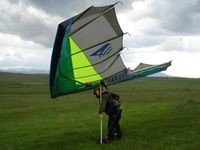
Kiceniuk Icarus

Icarus 2

The Icarus 1 was a 1971 hang glider.

The 1971 Icarus 2 was built in a powered version as the UFM Icarus II / Aeroplane ultralight.
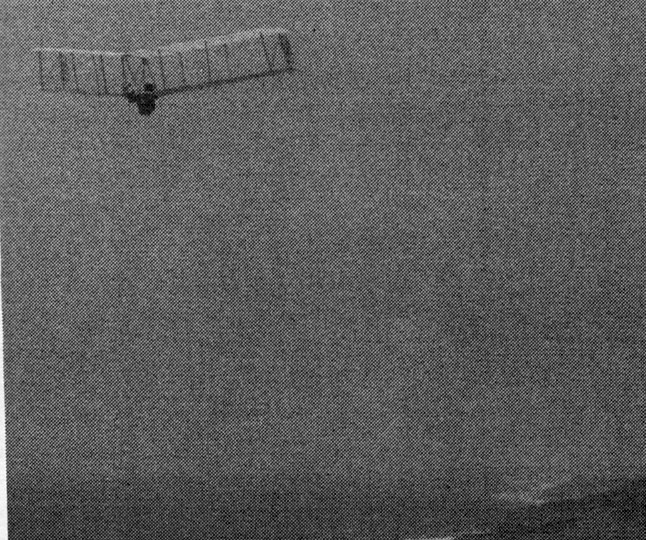
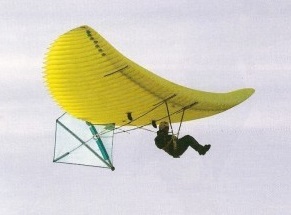
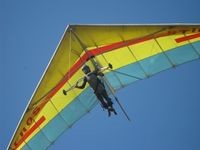
Taras Kiceniuk in Icarus II at Torrey Pines

Kiceniuk Icarus Article

The 1973 Icarus 5 is a rigid aircraft controlled by displacement of the center of gravity in pitch and by action of the control surfaces in roll / lace (a little like a fledge except that there the pilot is seated). It could be bought in the United States as a kit.

Icarus 5

Gallery

Icarus 1
Wing span: 9.17 m
Hang glider weight: 25 kg

Icarus II
Wing span (trailing edge): 30 ft
Wing area: 192 sq ft
Aspect ratio: 5.6
Wing loading: 0.88-1.28 lb/sq.ft
Chord: 41″
Airfoil: Eiffel.07
Sweep: 15 degrees
Washout: 4.5 degrees
Weight: 55 lb
Max Pilot weight: 200
Speed range: 18 – 45 mph
Take-off airspeed: 20 mph
Landing airspeed approach: 20-25 mph
Landing airspeed, flare: 4-6 mph
Stall speed: 18 mph
Best glide speed: 20 mph
Minimum sink speed: 19 mph
Sink rate minimum: 210 ft/min
Glide ratio maximum: 8.5
Glide ratio minimum: 1.0
Design “G” load: 4
Ultimate “G” load: 6
Folded size: 16″x41″x16′

Icarus 5
Wing area: 14.9 m²
Wing span: 9.75 m
Aspect ratio: 6.4
Hang glider weight: 36 kg
Minimum pilot weight: 60 kg
Maximum pilot weight: 110 kg
Minimum speed: 16 km/h
Maximum speed: 60 km/h
Max glide ratio speed: 12 km/h
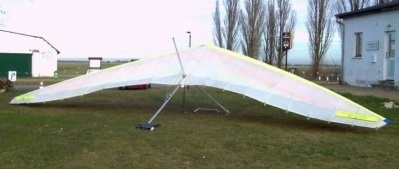
Kiceniuk Batso Rogallo

Barry Hill Palmer had a good paying aerospace job and was flying on a minimalist and inexpensive glider purely for curiosity and fun. He did not attempt to modernize or market the flexible wing hang glider; there was no attempt to publicize on the media, except for an ‘accidental’ report made by a small local newspaper. Palmer freely gave information about the wing to any person interested, including Francis Rogallo and Richard Miller, who develop the famous Bamboo Butterfly Rogallo wing hang glider, the plans of which circulated in some American magazines in the mid 1960s; Tara Kiceniuk’s followed with plans for the bamboo Batso Rogallo wing.

Kalbermatten Delka

The 1994 Delka glider apparently flew well enough on early test flights with weight shift for pitch control, and tip rudders for roll however weight shift for pitch must have been compromised with the pilot moved inside the wing (no pendular agumentation). The pitch control was some how assisted by control surfaces.

Apparently the test pilot Didier Favre was killed on testing due to structural failure. Laurent Kalbermatten dropped the concept however has proceeded with the Woopy Fly paraglider hang glider hybrid.

Wing area: 13.7 m²
Wing span: 10.5 m
Hang glider weight: 25 kg

Kalbermatten Woopy

The Kalbermatten Woopy is a Swiss high-wing, single-place, hang glider that was designed by Laurent de Kalbermatten of Villars-sur-Glâne, Switzerland. The price was about 15’000CHF and ready to fly about 10 minute.

The Woopy fuselage is made from aluminum tubing, with a conventional tail, a seated pilot position and weight shift controls. The wing is inflatable and based on the same concept as an air mattress, kept inflated by two small battery-powered fans. Launch and landing is carried out on foot.

Much of the development was undertaken using scale flying models to speed construction and reduce pilot risk.
Two models were developed, the Woopy Fly and the Woopy Jump, plus a powered version of the Woopy Fly.
The Woopy Fly aircraft was developed in Siberia and can be assembled in 15 minutes, the wing is inflated by two small electric fans underneath the wing, and it is powered by small 20 hp engine.

Variants:

Woopy Fly
Initial model
Wingspan: 9.7 m (31.8 ft)
Aspect ratio: 4.58:1
Wing area: 20.5 sq.m (221 sq ft)
Empty weight: 17 kg (37 lb)
Glide ratio: 9:1

Powered Woopy Fly
Engine: HE R120 120 cc two-stroke, 20 hp
Propeller: 70 cm (28 in)
Empty weight: 123 lbs (56 kg)
MTOW: 240 lbs (109 kg)
Cruise speed: 32 kts / 37 mph / 59 kph
Stall speed: 23 kts / 26 mph / 43 kph
VNE: 40 kts / 46 mph / 74 kph
Take-off distance: 197 ft (60 m)
Landing distance: 164 ft (50 m)
Fuel consumption: 1 GPH (3.8 LPH)

Woopy Jump
More portable development model
Empty weight: 7 kg (15 lb)
Folded length: 160 cm (63 in)

JAI Stealth

Stealth-13

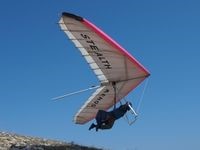
The JAI Stealth-13 is a sports and competition hang glider. Only one example was built, in 2005. The JAI Stealth-13 was built by the hang glider club “Ikar” of the Aviation Institute Kharkiv.

The Stealth-14 new deltaplane is a mast version of the Stealth KPL 2-14 model, built in series by Eros. The new model has a mast with longitudinal and transverse tensioners, but maintains the anti-dive equipment inside the wing.

2003 Stealth-14

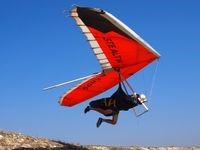
In January 2003 Eros successfully tested the experimental Stealth 14, designed and built by the Club of Deltaplanos “Ikar” of the Aviation Institute Kharkiv.

The performance of this model is between the Stealth 14 mast model and the original Stealth KPL 2-14, being lighter than its predecessor. The new model is more maneuverable due to its lower moment of inertia. By using a low trapeze your landing is smoother.

At least six copies of the Stealth-14 were built. Three of them for specific clients (one was kept in Ukraine and another two were sold to Russia, flying in Voronezh and Ufa).

The cost of a Stealth-JAI ranged between 1600 and 2000 euros, depending on the wing cover, the composition of the structure and the packaging conditions.

Gallery

JAI Studient

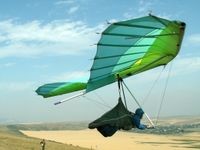
Studient-16 Zilioni (Green)

The JAI Studient-16 (Russian: ХАИ Студент-16) was developed in the Club of Deltaplanos “Ikar” of the Aviation Institute Kharkiv.

Designed by JAI graduate Sergei Serguyev in 1998, at least five copies have been manufactured, of which three were sold to private hands after several years of operation.

The model had its rebirth in 2013 when the example known as “Proto” was built, followed later by “Super-new”.

The first Studient 16 was built in 1998 and named Zilioni (Green). It was the main training apparatus between 1999 and 2010. The hang glider was modified in 2004. It was sold in Voronezh in 2010.

The second Studient 16, named Shtil (Calm), was built in 2005. It was sold in Azerbaijan in April 2013 to a private club run by Jafarov Ilgar.

Studient-16 Shtil (Calm)

The third Studient 16, Novi (New), was built in 2009. It was sold in Odessa in August 2013 to Sania Sirosh.

Studient-16 Novi (New)

The fourth Studient 16, Proto, was built in 2013. On this newly created deltaplane, multiple-time champion of Ukraine Dmitri Russov tried to win the Grinienko Cup in 2013.

Studient-16 Proto

The fifth Studient 16, Svierxnovi (Super-new), was built in 2014.

Studient-16 Svierxnovi (Super-new)

The JAI studient-19 (Russian: ХАИ Студент-19) – was a tandem experimental training deltaplane developed by the Club of Deltaplanos “Ikar” of the Aviation Institute Kharkivm and built in 1998 by the Ukrainian firm “Eros”. It was never mass-produced.

This device has proven to be an excellent starter trainer for people weighing more than 80 kg. In its original role as a tandem coach, it is rarely used.

Studient 19

First flying in 2009, two JAI studient-21 (Russian: ХАИ Студент-21) were built for training at Deltaplanos. The first, built in 2009, was sold in Azerbaijan in 2010 to the Delta Plane Club of the Federation of Extreme and Air Sports.

2009 Studient-21

The second Studient-21 was built in 2014.

2014 Studient-21

The first JAI studient-13 (Russian: ХАИ Студент-13) Malysh (Small) was built in 2003, for “people of short stature and low weight”.

2003 Studient-13

The second Studient-13 Zaporozhki Malysh (Little of Zaporozhia) was specially built in 2011 for the Zaporozhie Delta Plane Club led by Vladimir Yefimov.

2011 Studient-13

JAI / Deltaplanos Club Ikar / Ícaro

Delta Plane Club “Ikar” (Russian: Дельтапланерний клуб ХАИ Икар) – Delta flight club created in 1976 at the JAI as a section of the OSKB of Kharkov Aviation Institute.

The Ikar (Ícaro) deltaplane club was created in 1976 as a dependency of SKB JAI. Its objective was to interest students in the process of technical development of aviation in this new discipline that was only just gaining strength in those years. The decision to create the club as an independent unit within the OSKB was taken after the visit of the JHA team made up of Vladimir Selyukov and Igor Katckar at the Soviet Championship held in the USSR in 1976.

It was assigned to the new club and received a space in a workshop behind the Impulsos building, where it continues to operate. At that time students were not afraid to climb their deltaplanes to the second level via a narrow iron staircase with two landings. Nor is that a problem today, despite the fact that the new models have increased their dimensions and weights.

During the years of existence of the JAI Deltaplanes Club, more than 50 deltaplanes of all generations have been built. It is noteworthy that this club during the years of Soviet power was one of the leaders in the projection and construction of advanced deltaplanes. The club’s athletes frequently won awards and medals at Soviet and Republican events. More than 50 JAI students passed through the flight school.
After the fall of the USSR

During the process of the fall of the USSR the club did not cease its activities. Training flights were carried out every Sunday and lectures were given daily and the availability of flight material was maintained. All the weight of the training in the early 90’s fell on two copies of the Slabutich UT type, of which one had to be discharged in 1994, due to its physical condition. In 1998, the Oduvanchik sport deltaplane, designed and built by Sergei Agafonos, was also decommissioned. These deltaplanes in their time proved to be superior to most of the sports models of the time, which allowed JHA athletes to triumph in the USSR championships, Ukraine and those held in Crimea, Alma-Ata and the Caucasus. By the early 1990s, even the Sport-14 and Sport-15 models were already out of date and even with improvements, they were unable to compete with modern types. Maintained with scarce student resources, these devices managed to keep the club’s spirit alive and continue to develop the skills of the club’s new pilots.

It was clear to all that primary education could be achieved on any deltaplane, but once some experience was gained, obtaining a sports master’s degree was only possible using competitive models. With the support of the club members and with the help of several graduates of the institute, it was possible in 1998 to create the first Studient deltaplane , designed by JAI graduate Sergei Serguyev, but the enthusiasm does not generate funds, so the next The specimen could only be built after four years.
Actual state

In July 2002 another Studient was built and by August 2003 another training model could be built, this time with a smaller wing area and intended for light weight pilots.

A new sports model would only appear in October 2003 in the form of the excellent Stealth-JAI device, of which seven copies have been built.