La Mouette

Founded in 1974 by brothers Gérard Thevenot and Jean-Marc Thevenot, the company was formed to produce versions of the American Seagull hang glider. Their glider was named La Mouette, after which the company was named. In 1979 they produced the La Mouette Atlas which remained in production through 2012 and of which there are over 8000 examples flying.

In 1986 the company started building paramotors and in 1995 introduced the “topless” hang glider, deleting the kingpost and upper flying wires.

1998: 1 rue la Petite Fin, F-21121 Fontaine les Dijon, FRANCE

In 2010-11 the company developed an electric aircraft, the Samson.

The company also built a rigid wing hang glider, the Tsunami and a powered parachute, the Skydancer under the brand Helite. Helite went on to be a company that specializes in air bag designs.

Lambie Hang Loose

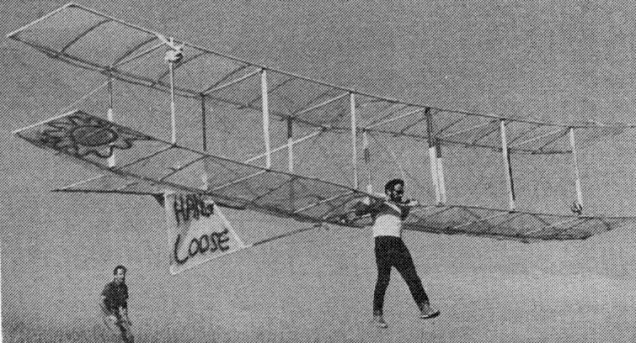
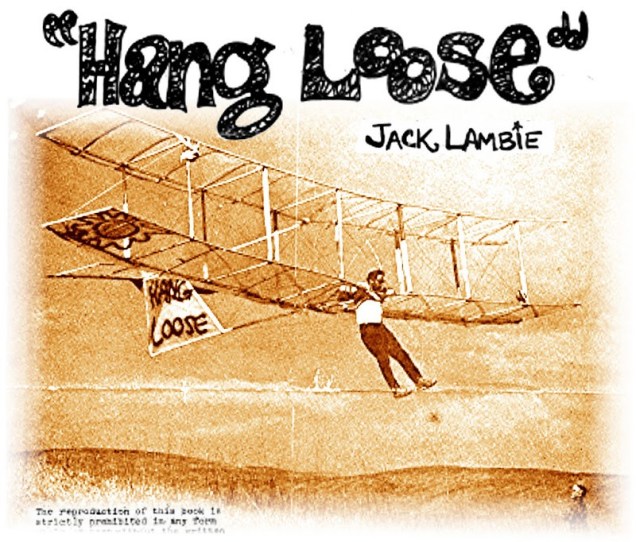
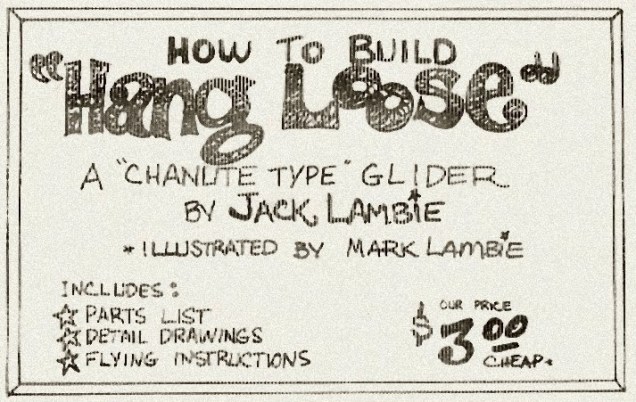
In 1972 a guy named Jack Lambie wrote an article for Soaring magazine and published a set of plans on “how to build your own Chanute-style hang glider”. He called his design “Hang Loose” (hey it was the 70’s 😉

Experience:
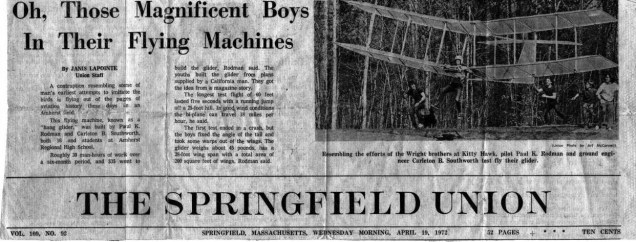
When I saw that article, I knew instantly I had to build one. I can remember sketching ideas for such craft since I was in 5th grade. So I ordered the plans Carleton and I built one. On one of the days of testing we happened to get photographed and interviewed by the local newspaper. (I think the reporter was just happening by at the time)

We had to make some changes to the design: for one thing we could not get bamboo to make the ribs. Instead I cut them out of 1/8″ plywood, about 1″ thick top to bottom and mounted the ends between two pine blocks. Heavier than the bamboo but a better fit to the shape for sure.

We also could not get the yellow pine that was suggested and used spruce I think, but it had some very small knots in it that did cause a problem at one point. (Spar failure in flight!)

At the time, I already had a sailplane pilot’s license (you can solo at 14 and it was cheaper than flying power planes) and of course I had flown a lot of model airplanes, so I was elected the test pilot. You can see me in that photo with my leg out to move the CG (centre of gravity) forward a bit.

The angle of the tail was not set properly so I could not get the angle of attack enough and basically just fell down with the thing. After fixing that back at Carleton’s house (right across from the field in the picture) it worked great. We both flew it many times down a little 20′ grassy drop-off.

The feeling of the glider lifting you up as it gained speed was AWESOME.

You could not really turn the thing at all…too much stability in roll. We talked about adding some tip-dragger rudders or ailerons but the flight times were short enough you didn’t really need any left – right steering.

We had a few snafus but by never flying higher than it was safe to fall we didn’t get hurt. Spectators would offer to hook us up to their cars with a rope and and tow us …but we were too smart for that 😉

Kratzner Plank

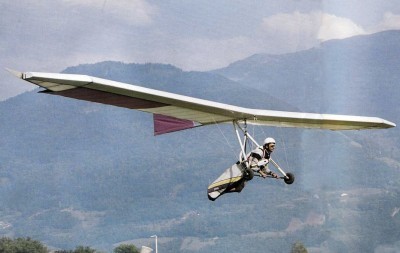
The construction was foam and glass D cell straight D cell wing. The nice feature is it allows the use of ailerons with differential throw as the lever arm from the ailerons to the CG is too short to give much pitch change – so no need for spadds, spoilerons, tip rudders or other complicated devices.

The 1982 Kratzner Plank was for advanced pilots.

proto unique
Wing area: 17 m²
Wing span: 12.78 m
Aspect ratio: 9.6
Hang glider weight: 59 kg
Minimum speed: 29 km/h
Maximum speed: 100 km/h
Max glide ratio (L/H): 16
Minimum sink rate: 0.78 m/s
Nose angle: 180°

Kondor Kite Pegasus

The Pegasus is a high performance Rogallo for experienced pilots. It features six roaches with pressurised battens, double outriggers, applied leading edge pockets, adjustable keel camber and a system for changing from seated to prone flying in one minute.

The airframe is made from 6061-T6 anodised aluminium tubing in 1.5in x .049 and 1 5/8in x .058. Rigging cable is 3/32in 7×7 vinyl coated stainless steel. All hardware is 304 stainless steel.

The Sail was 3.8oz or 4.5oz stabilised dacron available in 11 colours.

21 x 16
Leading edge: 21 ft
Keel length: 16 ft
Wing span: 32 ft
Wing area: 200 sq,ft
Aspect ratio: 5.25
Nose angle: 98˚
Sail billow: 4˚
Weight: 34 lb
Takeoff speed: 18 mph
Stall speed: 15 mph
Max speed: 45 mph
Best glide ratio (L/D): 7.1
Best L/D speed: 24 mph
Min sink: 210 fpm

22×16
Leading edge: 22 ft
Keel length: 16 ft
Wing span: 34 ft
Wing area: 230 sq,ft
Aspect ratio: 5.47
Nose angle: 98˚
Sail billow: 4˚
Weight: 38 lb
Takeoff speed: 18 mph
Stall speed: 15 mph
Max speed: 45 mph
Best glide ratio (L/D): 7.1
Best L/D speed: 24 mph
Min sink: 210 fpm

Kollman Raptor

A copy of the Fledge with a composite airframe the same platform as a Fledge. The airfoil was a 2412. It is nearly symetrical with a low pitching moment. The first step was to make the D-tube and load test it. The first D-tube weighed 25 lbs. Jim Marske gave the info and the D-tube was successfully loaded to +7 g’s -4g’s.

The original rigid wing design was scrapped. A new design was started named the Raptor. The Raptor would use the same pitch stable airfoil that’s on the Marske Monarch. A new set of D-tubes were completed. These were made of foam and fiberglass with a carbon fiber spar. They weighed 25 lbs each and were load tested to verify the strength.

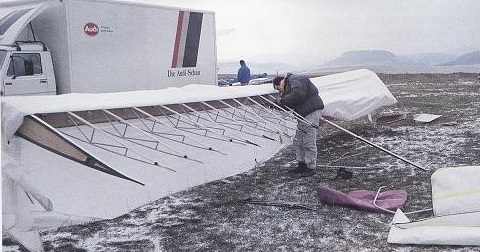
While waiting for the sail it was decided to build a hard wing version of the Raptor. Using Marske Monarch molds for the D-tubes, the D-tubes were made to Monarch specs with the addition of some twist. The D-tubes weighed 32 lbs apiece. Since they were built to Monarch strength they were stronger than necessary for a hang glider. The ribs were made of fiberglass and spruce. There was also a spruce trailing edge. The airframe was covered with heat shrinkable Mylar. The empty weight was 140 lbs.

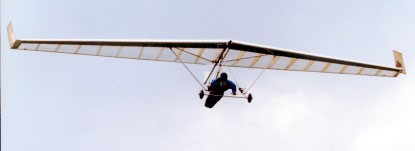
The wing was essentially a Monarch wing swept back with tip rudders. It has a standard control bar with struts and no top rigging. The pilot uses weight shift for pitch. For roll control sliders are used just like on the later Fledge hang gliders.

The plan was to aerotow the Raptor and make short hops and feel it out. The first flights were made in spring of 1994. Ten feet of altitude resulted in a long flat glide. The drag rudders were responsive and predictable. After many hops with the highest being 100′ it was decided to tow to 5000′ and feel it out. The climb up to 5000′ was uneventful. After release the first thing to find out pitch stability. Pulling on the bar, the bar pressure built up steadily. There was very little bar movement but substantial bar pressure. Below 15 mph indicated it felt mushy but wouldn’t break or fall off to one side. The glider never stalled and broke it just goes into a low speed mush with a high sink rate. Direction control is still there because the drag rudders are still working. The slider controls worked well but it was clear I didn’t have enough mechanical advantage on the rudders. When the glider was banked it would tend to tighten up and turn higher unless high side rudder was used. All in all it was a sucessful flight. The Raptor felt stable and controlable. The handling wasn’t great but it was acceptable for a first flight. The Raptor prototype weighed 140 lb.

After a couple months reworking the rudder cables and playing with different dihedral settings the handling got just right. The Raptor was now roll neutral. That means it stays banked at what ever angle it is set at. Deploying a rudder makes the glider roll in that direction. Once the desired bank angle is achieved the rudder is released. The Raptor will continue to turn at that bank angle. To return to level flight the opposite rudder is applied. This was just like weight shifting.

One of the first thing noticed was the Raptor’s ability to turn tight and climb in thermals.

It was decided to set up a production run of three gliders and 6 D-tubes and hardware needed wasn’t available off the shelf. Others wanted collapsible gliders and they wanted smaller gliders. The collapsible was a challenge. The first collapsible glider took almost an hour to put together and it wasn’t easy. It also weighed over 130lbs. To get the smaller size wing and still use the same molds the airfoil was modified. Truck tested the pitch curves were well in excess of what the H.G.M.A. required. By changing the size and modifying the aerfoil the dihedral setting was going to need change. This wing was a lot more sensitive to dihedral settings. The sink rate seemed similar but the glide was definitely better than other hang gliders. This wing isn’t able to generate lift as well at lower speeds.

Through repeated set ups and break downs and modifying the design, at 105 lbs. it set up faster and easier. The sail was made by Dick Cheney. Using the original airfoil with less area than the first prototype, this glider flew great from the first flight. The performance seemed even better than the first glider. The only negative to report is bar pressure. Flying above 45 mph is very difficult because of too much bar pressure.

There was a total of 2 hardwings and 5 collapsible gliders built to September 1999. All of the gliders were load tested and passed. The different D-tubes were all constructed using different techniques and the lightest one was 19 lbs.

The next redesigned was 15 lbs lighter and with the 20 lb D-tubes for a weight of 75lbs. The amount of twist was reduced by 2 degrees, and the also reflex reduced on the airfoil to lessen bar pressure.

The Raptor is now flown by weight shift. The wing is built to cantilever strength with a shifting control bar that is connect to the the rudders. When you shift your weight the control bar shifts deploying the rudders. This is the same system used on other rigid wings except thier cables are connected to spoilers. The beauty of this system is a hang glider pilot gets on it and it flies just like a weight shift glider.

The Raptor 2 appeared in 1994.

Raptor
Wing area: 15.04 m²
Wing span: 12.49 m
Aspect ratio: 10.5
Hang glider weight: 34 kg
Minimum pilot weight: 59 kg
Maximum pilot weight: 112 kg
Max glide ratio (L/H): 18
Max glide ratio speed: 56 km/h

Raptor 2
Max glide ratio (L/H): 18

Klingberg Klingberg

Rol Klingberg built the wing without plans (never drew them) and used only a few templates for making parts. There are no plans for the full size Klingberg Wing as a “one-off” design.

The right wing had slightly less twist due to a construction error and in a stall the wing would drop the right wing. Recovery could be made by simply returning the ailerons to a neutral setting. The test pilot made the error of flying too slow twice. Once at altitude with room to recover and once low without room to recover. At Torrey, the wind was too low for soaring flight and the test pilot attempted to stay aloft by flying slow. A beginner’s type error. As Klingberg watched at the edge of the Torrey cliffs he saw the wing flying near stall speed and was not surprised to see it drop the right wing. The test pilot did not perform the correct recovery process and crashed.

Klingberg still had three feet of the left wing tip (the one that impacted the cliffs) in 2006. The engineering facts surrounding the failure of the Wing is that he modified standard airfoils for the tips. The modification made combined with the low Reynold’s number caused the design to have tip stall problems. A technical report of the problem was published in Hang Glider magazine in the late 1980’s.

The test pilot (Daryl “Monty” Bell) stole the Wing after the crash at Torrey. The Wing was too damaged to provide sufficient information for a second Wing to anyone other than the designer. If anyone knows the locations of any remains, Rol Klingberg would like to have that information.

Klingberg attempted to recover the remains of the wing from the test pilot a few months after the crash but was unable to do so. In the process, Klingberg had extensive discussions with the local law enforcement officials and they pointed out that Monty Bell had a number of “encounters” with the local police and was considered to be an on-going problem for them.

Kilborne, Dave

Dave Kilborne was a California water skier who met Bill Bennett in 1969 and, with a little help from the Australian, began to build his own kites. These first Kilbo-kites were, like the ski kites they were patterened after, small with a 13 foot keel. After Kilborne had taught himself to fly over water, he began to consider the possibility of foot launching. After some low level practise and the construction of a larger, 16 foot kite, he was making self-launched flights over Mission Ridge near San Jose. On 6 September 1971, Dave Kilborne soared for an hour and four minutes.