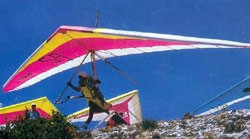
The Compact was a 1989 hang glider for Advanced pilots.
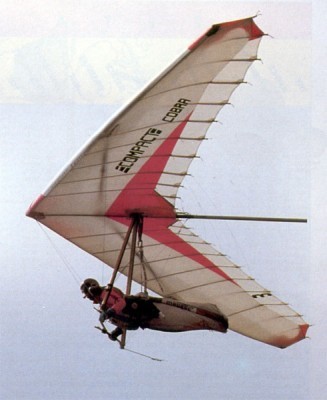
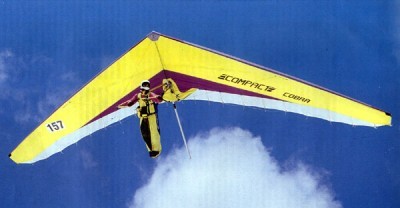
The 1992 Compact Cobra was for Advanced pilots.
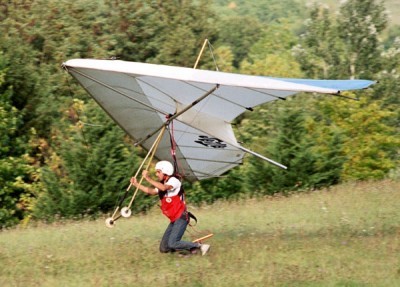
The Compact Cobra glider is one of the easiest controled gliders in its class. It can be your first glider after school. The very slack side wires were always a source of worries for spectators.
Compact 13 Wing area: 13.9 m² Wing span: 10.1 m Hang glider weight: 29 kg Minimum pilot weight: 50 kg Maximum pilot weight: 75 kg Packed length: 5.9 m Packed length short: 3.9 m Nose angle: 127°
Compact 14 Wing area: 14.1 m² Aspect ratio: 7.23 Hang glider weight: 31 kg Minimum pilot weight: 58 kg Maximum pilot weight: 80 kg Number of battens: 28 Nose angle: 132°
Compact 15 Wing area: 15.1 m² Aspect ratio: 7.72 Hang glider weight: 34 kg Minimum pilot weight: 75 kg Maximum pilot weight: 100 kg Nose angle: 130°
Compact Cobra 135 Wing area: 14.5 m² Wing span: 10.2 m Hang glider weight: 31 kg Minimum pilot weight: 65 kg Maximum pilot weight: 95 kg Packed length: 5.5 m Packed length short: 4.4 m Number of battens: 28 Nose angle: 127°
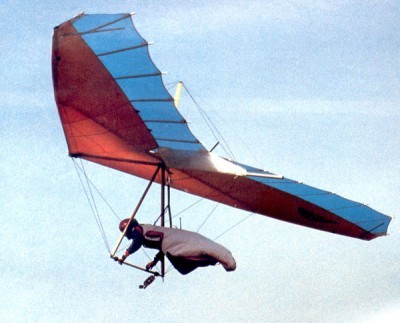
The 1982 Azur for Intermediate pilots is an interesting wing, sensitive in pitch throughout its range of speed. When tested, the Azur 15 sq.m had a disappointing drop rate.
1982 Azur
Unscaloped trailing edge fluttered at speed so they fitted ‘lolipop sticks’ as small battens but they didn’t work very well.
Azur 15 1982 Wing area: 15 m² Wing span: 10.10 m Aspect ratio: 6.8 Hang glider weight: 28 kg Minimum pilot weight: 55 kg Maximum pilot weight: 75 kg Minimum speed: 25 km/h Maximum speed: 80 km/h Max glide ratio (L/H): 10 Max glide ratio speed: 44 km/h Minimum sink rate: 0.96 m/s Packed length: 5.80 m Packed length short: 4 m Number of battens: 18 Nose angle: 119°
Azur 17 1982 Wing area: 16.5 m² Wing span: 10.6 m Aspect ratio: 6.8 Hang glider weight: 30 kg Minimum pilot weight: 65 kg Maximum pilot weight: 85 kg Minimum speed: 25 km/h Maximum speed: 80 km/h Packed length: 6.3 m Packed length short: 4.30 m Nose angle: 119°
Azur 19 1982 Wing area: 19 m² Minimum pilot weight: 75 kg Maximum pilot weight: 110 kg Minimum speed: 25 km/h Maximum speed: 80 km/h Packed length: 6.3 m
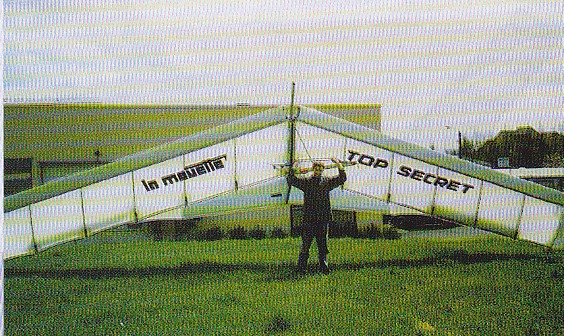
The Top Secret was foot launched hang glider for advanced pilots with a rigid composite “D-shaped” leading edge. It has carbon composite foldable ribs, which are attached to the rigid leading edge. The left and right wing are hinged together so that they can easily be folded for easy carriage. The sailcloth is fixed on the leading edge by Velcro straps. At the trailing edge, they are attached to the end of the ribs using straps. The sails came in 2 pieces for each wing. The top and bottom surface rest on the ribs solely by the tension between the attach points at the leading edge and trailing edge. For the first prototype, Mylar was used to make the sail. Dacron can also be used. The sail was stitched at La Mouette. Mylar was chosen for the first prototype because it is difficult to stretch and hence can be used as template for the subsequent Dacron sail.
Top Secret has an aspect ratio of 7.96 and a span of 11 meters. It also has a sweepback of 20˚ at the leading edge. The D-shaped leading edge is made of carbon composite material Dyneema. Layers of Dyneema were put into wooden molds and epoxy resin applied under vacuum without autoclave. The part was subcontracted to Dyn Aero, Dijon, France. The ribs are of rectangular cross section bars made of carbon fiber outer layer and foam core. These are also made at Dyn Aero.
The keel is made from Aluminium Alloy AU4G. It consists of tubes and sheet metals. All fabrications were done in house at La Mouette. Cables are standard stainless steel. The trapeze bar is also made of Aluminium Alloys. In house trapeze bar and cables common to other hang gliders manufactured at La Mouette are used throughout.
Roll control is by spoilers. The spoilers consist of a flat composite plate. An envelope shroud for the spoiler is stitched on the top surface of the sailcloth. The flat plate fits inside the pouch and is activated by a system of cables and pulleys linked to the control bar. Flat composite boards were fabricated at Dyn Aero using vacuum techniques. Flaps are also provided. It also consists of a flat composite plate enclosed in an envelope stitched to the sailcloth. It can be activated by a cable system linked to the control bar.
The control bar is of a standard triangular shape and the pilot is suspended from the keel in the classical prone position of normal hang gliders. Control is by weight shift and also spoilers. The flaps and spoilers have a system of springs to return them to their original position.
The Top Secret was named Tsunami after some minor changes. The Top Secret with the Tsunami twist has a carbon T tail, D sections and control frame. Turning is fast for spoilerons.
Weight: 37.5 kg Wing span: 14.0 m Wing area: 15.2 sq.m Vne: 115 km Stall: 28km Vzmin: 0.8 m/sec Price (1998) 56000 FF
Wing area: 14 m² Wing span: 13 m Aspect ratio: 11.66 Minimum pilot weight: 68 kg Maximum pilot weight: 108 kg Minimum sink rate: 0.7 m/s Packed length: 5.6 m Nose angle: 127°
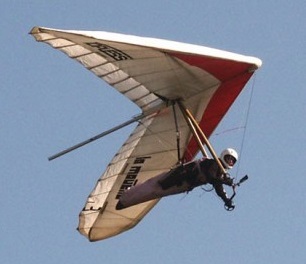
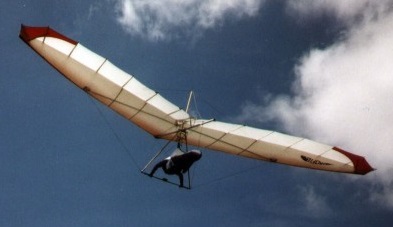
The 1995 Topless, for advanced pilots, is easy to fly and land with no surprises or bad habits. Some of the carbon fiber battens have broken but they’re easy to repair with kite tubing.
The alignment of the VG pulleys during setup can easily get twisted around – but it’s fairly simple to keep the assembly straight.
The 1998 Topless 2 was for advanced pilots.
Topless 2
The Topless 2 was very easy to fly. A bit tricky for landings, because not much flare authority. A few steps help. Latest versions of the topless are easier to land.
In the owner manual, there is nothing about the m² wing. Gerard Thevenot says he sold many of them in Japan. They fly well with 60 kg pilots.
Topless 3
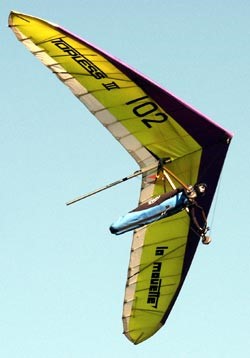
The Topless IV was made only in 2003 and stopped production the same year. The difference with the Topless III is only fixation washout tips on the leading edge.
Topless IV
Topless 11 Wing area: 11 m² Wing span: 9.84 m Aspect ratio: 8.8 Hang glider weight: 27 kg Minimum pilot weight: 40 kg Maximum pilot weight: 60 kg Maximum speed: 100 km/h Packed length: 3.9 m Number of battens: 20 Nose angle: 127°
Toplesss 12.8 Wing area: 12.8 sq.m Pilot weight: 55-75 kg Wing span: 10.12 m Nose Angle: 127° Aspect ratio: 8 Hang glider weight: 31 kg Minimum speed: 33 km/h Maximum speed: 100 km/h Packed length: 4.15 m Number of battens: 24 Price (1998) £ 3650
Toplesss 13.5 Wing area: 13.5 sq.m Certification: DHV 3 Pilot weight: 65-95 kg Wing span: 10.12 m Nose Angle: 127° Aspect ratio: 7.6 Hang glider weight: 32 kg Minimum speed: 33 km/h Maximum speed: 100 km/h Packed length: 4.15 m Number of battens: 24 Price (1998) £ 3650
Topless 2 11 Wing area: 11 m²
Topless 2 12.8 Wing area: 12.8 m² Wing span: 10.2 m Aspect ratio: 8 Hang glider weight: 32 kg Minimum pilot weight: 50 kg Maximum pilot weight: 75 kg Minimum speed: 27 km/h Maximum speed: 95 km/h Packed length: 5.05 m Packed length short: 4.15 m Nose angle: 127°
Topless 2 13.5 Wing area: 13.5 m² Wing span: 10.2 m Aspect ratio: 7.6 Hang glider weight: 33 kg Minimum pilot weight: 60 kg Maximum pilot weight: 95 kg Minimum speed: 27 km/h Maximum speed: 95 km/h Packed length: 5.05 m Packed length short: 4.15 m Nose angle: 127°
Topless 3 12.8 Wing area: 12.8 m² Wing span: 10.2 m Aspect ratio: 8 Hang glider weight: 32 kg Minimum pilot weight: 50 kg Maximum pilot weight: 75 kg Minimum speed: 27 km/h Maximum speed: 95 km/h Packed length: 5.05 m Packed length short: 4.15 m Nose angle: 127°
Topless 3 13.5 Wing area: 13.5 m² Wing span: 10.2 m Aspect ratio: 7.6 Hang glider weight: 33 kg Minimum pilot weight: 60 kg Maximum pilot weight: 95 kg Minimum speed: 27 km/h Maximum speed: 95 km/h Packed length: 5.05 m Packed length short: 4.15 m Nose angle: 127°
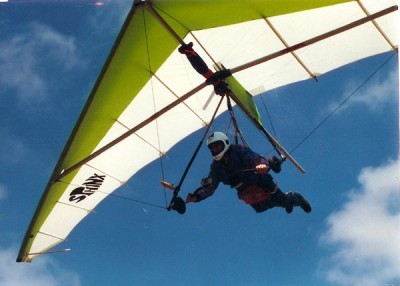
Designed by Gérard Thévenot, the 1987 Sphinx bi is a sturdy, but heavy wing. The wing is without surprises when flying.
However, on takeoff its weight gives it a strong inertia and it is necessary to pilot as in the books. It is a quality bi, built to last.
Sphinx D Wing area: 15.1 m² Wing span: 9.9 m Aspect ratio: 6.5 Hang glider weight: 27 kg Minimum pilot weight: 50 kg Maximum pilot weight: 85 kg Packed length: 6 m Packed length short: 4.1 m Number of battens: 13 Nose angle: 120°
Sphinx bi Wing area: 20 sq.m Pilot weight: 90-190 kg Wing span: 10.8 m Hang glider weight: 34 kg Nose angle: 120° Aspect ratio: 5.8 Packed length short: 4 m Number of battens: 15 Price (1998) £ 2200
Racer 13 Hang glider circa 1998. Wing area: 13 sq.m Pilot weight: 50-75 kg Wing span: 9.73 m Nose angle: 127° Aspect ratio: 7.3 Hang glider weight: 30 kg Packed length: 4.8 m Packed length short: 3 m Number of battens: 24 Price (1998) 7900 DM
Racer 14 Hang glider circa 1998. Wing area: 14 sq.m Certification: DHV 3 Pilot weight: 70-90 kg Wing span: 10.35 m Nose angle: 127° Aspect ratio: 7.65 Hang glider weight: 32 kg Packed length: 5.2 m Packed length short: 4.5 m Number of battens: 24
Racer 15 Wing area: 15 m² Wing span: 11 m Hang glider weight: 34 kg Minimum pilot weight: 90 kg Maximum pilot weight: 110 kg Packed length: 5.4 m Packed length short: 4.5 m Number of battens: 26 Nose angle: 127°
In the original 1984 Profil the two winghalves were joined by bungees, there was a large gap inbetween; it had a floating hangpoint.
The whole wing was designed for advanced pilots by Jean Louis Darlet when he was working for La Mouette. His concept with the separation of the wing halves was to overcome the roll limitations that persist to this day. While the billow shift mechanism does improve roll control, the inertia of the unloaded side delays upward billow.
Darlet sought to improve roll response by separating the wing halves and reconnecting with a rubber bunge to allow the loaded wing half to billow up independently to the unloaded side.
Darlet claimed the roll response was consideribly improved with this concept such that the wing could be safely towed free from fear of lateral lock outs. Pilots were apparently less enthusiastic (and possibly not prepared for such positive and light control inducing PIOs) and the wing was modified by La Mouette, firstly with the LE to kingpost junction reconnected so only the rear half of the wing was separted, then finally the entire wing was rejoined.
Follow-ups Profli Sport and Profil Competition had hardly anything in common with the original.
Profil Competition
The Profil Competition was wing without surprise, rather well made, with the qualities and faults of the time.
Profil Proto
The 1983 Profil Proto was for advanced pilots.
Profil 13 Hang glider circa 1998. Wing area: 12.9 sq.m Pilot weight: 45-60 kg Wing span: 9.58 m Nose Angle: 120 degs Hang glider weight: 23 kg Packed length: 3.7 m
Profil 15 Hang glider circa 1998. Wing area: 14.9 sq.m Pilot weight: 55-80 kg Wing span: 10 m Aspect ratio: 6.66 Nose Angle: 120 degs Hang glider weight: 27 kg Packed length: 4.1 m Price (1998) £ 2300
Profil 16 Hang glider circa 1998. Wing area: 16.3 sq.m Pilot weight: 70-95 kg Wing span: 10.5 m Aspect ratio: 6.76 Nose Angle: 120 degs Hang glider weight: 29 kg Packed length: 4.3 m Price (1998) £ 2300
Profil Competition 15 Wing area: 14.9 m² Wing span: 10 m Aspect ratio: 6.71 Hang glider weight: 29 kg Packed length: 4.1 m Nose angle: 120°
Profil Competition 16 Wing area: 16.9 m² Wing span: 10.5 m Aspect ratio: 6.52 Hang glider weight: 30 kg Minimum pilot weight: 70 kg Maximum pilot weight: 90 kg Packed length: 4.3 m Number of battens: 23 Nose angle: 120°
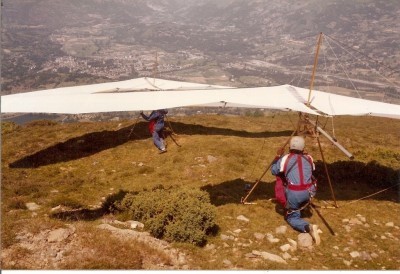
The Atlas first appeared in 1979 for novice pilots.
Primary Single Surface Glider. One of the first 30% double surface wings handling was a little heavy but the best of the 4th gen. It nly takes two quick pins to rig.
Atlas 14 A topless hang glider circa 1998. Wing area: 13.8 sq.m Hang glider weight: 24 kg Certification: DHV 2 Pilot weight: 50-75 kg Wing span: 9.3 m Nose Angle: 120 degs Aspect ratio: 6.25 Packed length: 4 m Packed length short: 2 m Price (1998) £ 1750
Atlas 16 A topless hang glider circa 1998. Wing area: 15.8 sq.m Hang glider weight: 25 kg Certification: DHV 2 Pilot weight: 65-95 kg Wing span: 9.9 m Nose Angle: 120 degs Aspect ratio: 6.2 Packed length: 4.2 m Packed length short: 2.2 m Number of battens: 12 Price (1998) £ 1750
Atlas 18 A topless hang glider circa 1998. Wing area: 18 sq.m Pilot weight: 90-140 kg Wing span: 10.5 m Nose Angle: 120 degs Aspect ratio: 6.1 Hang glider weight: 29 kg Packed length: 4.4 m Packed length short: 2.2 m Price (1998) £ 1800
 All Aero