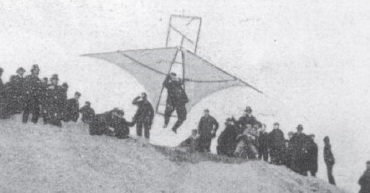
Lavezzari 1904 flexible wing hang glider
Lavezzari 1904 flexible wing hang glider
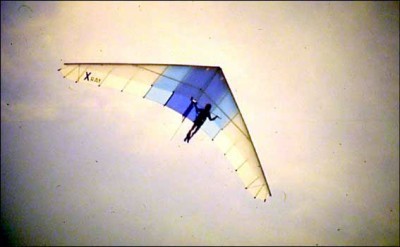
A 1981 hang glider.
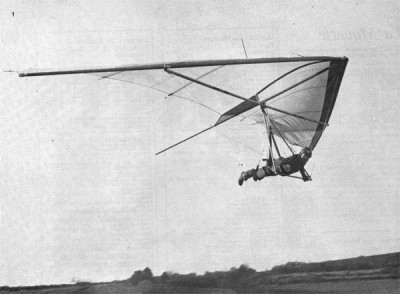
In early 1974, Gérard Thevenot still a student at the engineering school of Nancy ISIN acquires the plans of the Seagull (an American manufactured glider) and decided to build his own wing based on this model in order to fulfil his wishes to become airborne. He called the wing “Mouette” (Meaning Seagull in French). Like the Seagull, the Mouette had curved leading edges and was thus advertised as a conical-cylindrical wing. By mistake he built the leading edges stronger than required due to the materials he had at hand, thus improving the wing’s stability and performance. Enthusiasm about hang gliding and the new wing spread rapidly among his friends who begged him to build some for them.
Jean-Marc Thevenot, already employed at the time and very skilled with his hands, helped his younger brother construct these gliders and quickly realized how productive and promising this adventure could be. So he decided to start a company combining Gérard’s talent as a pilot and designer with his own intuitive skills for management. The company, La Mouette progressively grew and largely contributed to the performance and safety of the sport.
The “cylindro-conical” wings and this particularity gave them a good stability and a very low speed of flight, very appreciated by novice pilots, as well as a very low drop rate compared to the wings of that time. It was the wing of the first soarings.
The first hang glider built and sold by La Mouette, the 1974 Mouette 20 was for Novice pilots. Very popular in France around 1976.
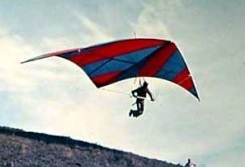
The 1976 Mouette 17 was for Novice pilots.
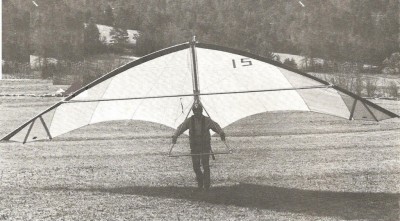
A Mouette F was a 1980 hang glider.
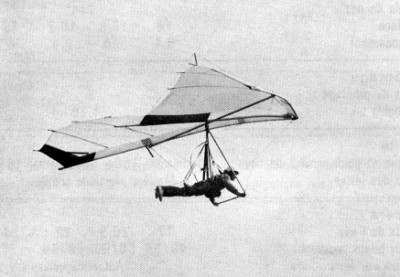
Mouette 20
Wing area: 20 m²
Wing span: 10.25 m
Aspect ratio: 5
Hang glider weight: 18 kg
Minimum pilot weight: 85 kg
Maximum pilot weight: 110 kg
Minimum speed: 22 km/h
Maximum speed: 50 km/h
Packed length: 5.7 m
Packed length short: 4 m
Number of battens: 4
Nose angle: 102°
Mouette 17
Wing area: 17 m²
Wing span: 8.50 m
Aspect ratio: 4,25
Hang glider weight: 17 kg
Minimum pilot weight: 55 kg
Maximum pilot weight: 65 kg
Packed length short: 5.21 m
Number of battens: 4
Nose angle: 102°
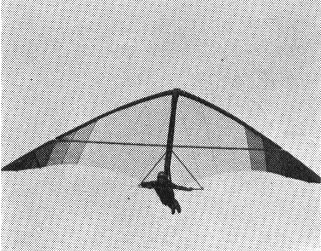
A 1977 hang glider.
MD 15
Wing area: 15 m²
Wing span: 8 m
Aspect ratio: 4.25
Hang glider weight: 15 kg
Maximum pilot weight: 55 kg
Packed length: 4.9 m
Number of battens: 4
Nose angle: 102°
MD 17
Wing area: 17 m²
Wing span: 8.5 m
Aspect ratio: 4.25
Hang glider weight: 17 kg
Minimum pilot weight: 55 kg
Maximum pilot weight: 65 kg
Packed length: 5.21 m
Number of battens: 4
Nose angle: 102°
MD 19
Wing area: 19 m²
Wing span: 9.97 m
Aspect ratio: 4.25
Hang glider weight: 18 kg
Minimum pilot weight: 65 kg
Maximum pilot weight: 90 kg
Packed length: 5.7 m
Number of battens: 4
Nose angle: 102°
MD 21
Wing area: 21 m²
Wing span: 10.25 m
Aspect ratio: 5
Hang glider weight: 25 kg
Minimum pilot weight: 85 kg
Maximum pilot weight: 110 kg
Packed length: 6.6 m
Number of battens: 6
Nose angle: 102°
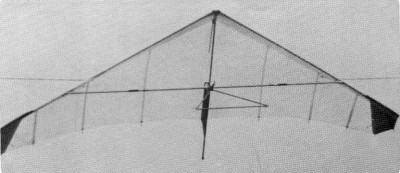
A 1979 hang glider.
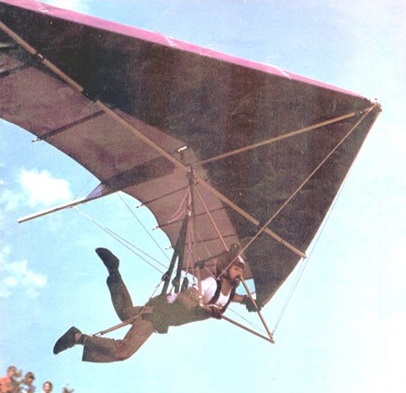
Forerunner of the Atlas, the 1978 Jet was not a double surface, because the transverse was not integrated. The Jet was quickly transformed into Atlas by reducing the double surface.
The Jet was a dangerous wing. In sliding or at high speed, the intrados swelled down and became an extrados. There was no batten. In a second the wing was tumbling and the shock of the pilot destroyed the wing.
Claudius Labuthe, an engineer at the ONERA (national aeronautical research and research office), discovered the taint of the JET. On an access road at the Vilacoublay aerodrome, the objective of the “manipulation” as Claudius said, photograph the intrados of the wing with different incidences. To do this, Labuthe and René Coulon glued fluorescent strips on the intrados and mounted the wing on a mini tray that Coulon had built on the roof of a Rancho matra. Claudius was driving and Coulon was on the roof. They made several trips without any loss of lift. In a final attempt, the rope holding at the end of the leading edge broke. Coulon clung to the trapeze as the wing swiveled on the yaw axis and then rocked forward on the pitch axis. The next day, the development of the photographs showed that in oblique attack the intrados swelled, passed in profile biconvex, source of instability in pitching. Laying a single intrados lath was the solution.
Wing area: 15.5 m²
Wing span: 9.8 m
Aspect ratio: 6.2
Hang glider weight: 22 kg
Minimum pilot weight: 50 kg
Maximum pilot weight: 70 kg
Packed length: 5.8 m
Number of battens: 12
Nose angle: 120°
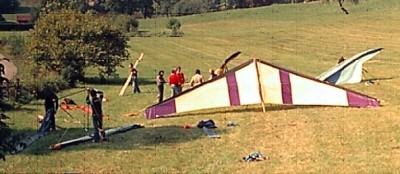
A 1976 hang glider for Intermediate pilots.
Wing area: 18.5 m²
Wing span: 9.5 m
Hang glider weight: 19 kg
Packed length: 4.2 m
Nose angle: 110°
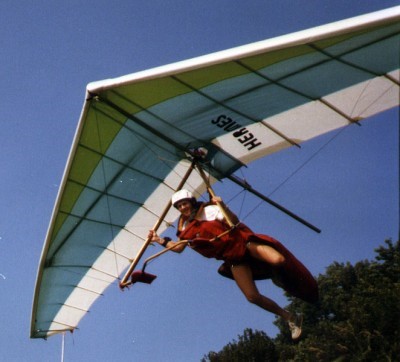
High aspect ratio and performance for that time. A time when manufacturers did not know how to pack performance and light handling in the same glider. A time when light handling meant instability. Therefore the 1985 Hermes is a high performance glider for advanced pilots, very stable…but very heavy to handle. Super wing in thermal stability.
Hermes 13
Wing area: 13.3 m²
Wing span: 10.6 m
Aspect ratio: 8.44
Hang glider weight: 29 kg
Minimum pilot weight: 55 kg
Maximum pilot weight: 65
Packed length short: 4.1 m
Nose angle: 127°
Hermes 14
Wing area: 13.8 m²
Wing span: 10.6 m
Aspect ratio: 8.14
Hang glider weight: 30 kg
Minimum pilot weight: 60 kg
Maximum pilot weight: 75
Packed length short: 4.1 m
Nose angle: 127°
Hermes 15
Wing area: 14.8 m²
Wing span: 10.6 m
Aspect ratio: 7.59
Hang glider weight: 31 kg
Minimum pilot weight: 65 kg
Maximum pilot weight: 85
Packed length short: 4.1 m
Nose angle: 127°
Hermes 16
Wing area: 15.8 m²
Wing span: 10.6 m
Aspect ratio: 7.11
Hang glider weight: 32 kg
Minimum pilot weight: 75 kg
Maximum pilot weight: 100
Packed length short: 4.1 m
Nose angle: 127°
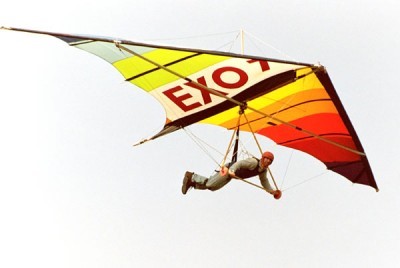
The 1977 La Mouette EXO7 is the Atlas’ ancestor.
The wing had little boost to neutral, and tends to slip if not piloted properly. Requires a correct, active steering, but light wing and very pleasant once understood.
A small modification removed the slip and made it a perfectly safe wing. Removal of the keel pocket on the front part of the mast. The return to the neutral becomes real, and the wing is more lively.
Wing area: 16.5 m²
Wing span: 9 m
Aspect ratio: 4.95
Hang glider weight: 22 kg
Minimum pilot weight: 60 kg
Maximum pilot weight: 80 kg
Packed length: 5.3 m
Number of battens: 8
Nose angle: 120°
Wing area: 17.75 m²
Wing span: 9.7 m
Aspect ratio: 4.95
Hang glider weight: 24 kg
Packed length: 5.65 m
Number of battens: 8
Nose angle: 120°
Wing area: 18.5 m²
Wing span: 9.6 m
Aspect ratio: 5
Hang glider weight: 26 kg
Minimum pilot weight: 80 kg
Maximum pilot weight: 110 kg
Packed length: 5.65 m
Number of battens: 8
Nose angle: 120°
Hang glider
Wing area: 14.8 m²
Wing span: 10.6 m
Hang glider weight: 30 kg
Minimum pilot weight: 60 kg
Maximum pilot weight: 80 kg
Packed length: 6 m
Packed length short: 3.7 m
Number of battens: 26
Nose angle: 120°
 All Aero