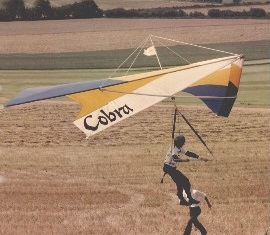
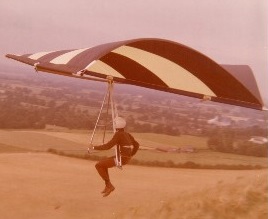
The 1975 Cobra is a second generation glider and although without deflexers the design incorporates truncated tips and battens. The Cobra is reported to be a pleasant and docile kite which has a considerably superior performance to a standard Rogallo. A further size was later offered. Produced in two sizes.
The Cobra was priced at £300.00 inc VAT and tuition. The 17 ft leading edge model for lighter pilots cost £290.00 inc VAT and tuition.
Sail area: 222 sq ft Pilot weight: 11 st and above Leading edges: 19 ft Keel: 17 ft
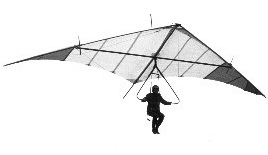
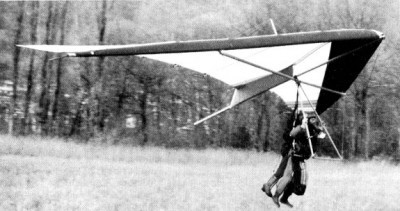
The 1974 Argus was a new design based on two years of experience with the Arion. It incorporated many changes, in particular to the sail which had a revised profile. The Argus was made in two sizes the 230 sq ft model was suitable for pilots of 10 stone.
During 1974 McBroom recommended that kingposts should be fitted to all Rogallos. Therefore the Argus would perhaps be the first British production glider to be kingposted.
The top rigged 1974 Argus was available in kit form for £140.00 plus VAT, it with drilled tubes for £155.00 plus VAT, and also supplied ready to fly.
In 1975 the Argus was offered with a new large A frame suitable for prone flying. Fittings being black anodised.
1975 Argus
A two-seater Rogallo balloon drop was made by Geoff McBroom and Norman Millhouse on a Twin Argus.
Prices for the 1975 Argus including VAT and tuition were: 17 ft (10 st. or less) £250.00. 18 ft (10-15 st) £262.50. 19ft (12 st. or more) £287.50. 20 ft 6 in (two seater) £325.00. Kits and plans were also available.
1974 Argus Sail area: 235 sq ft Leading edges: 18 ft
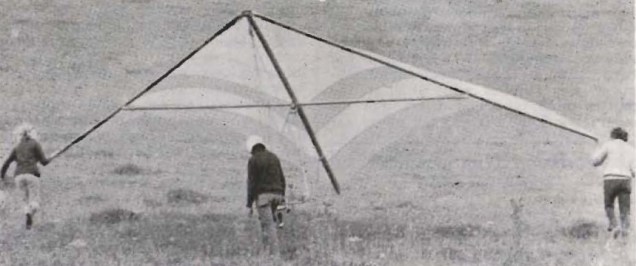
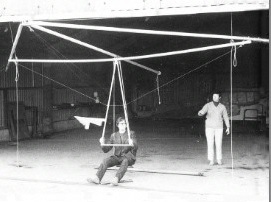
The first British hang glider of modern times was created by a group of six flying enthusiasts in mid 1971. They were; Geoff McBroom, Les Hockings, Steve Stanwick, Howard Holdie, Tony Gillette and Don Cameron.
The first flight was made by Les Hockings at Camlong Down near Dursley. The glide angle was about 3:1 rather than the expected 5:1, however the machine was reported to be easy to fly.
Wing span: 7.92 m / 26 ft Leading edge: 20 ft Sail area: 280 sq ft Max glide ratio (L/H): 3 Minimum sink rate: 1.8 m/s / 6 ft/sec at 20 mph Take off speed: 15 mph
During early 1973 McBroom revised the dimensions of his glider based on 17ft boom lengths. This became the Arion for which he produced two instruction manuals, one to build the machine and one on how to fly it.
Wing span: 6.7 m / 22 ft Wing boom length: 16ft 9in Max glide ratio (L/H): 5 Minimum sink rate: 2.3 mps / 7.5 fps at 25 mph Nose angle: 80° Take-off speed: 15 mph approx Recommended speed range: 15-35 mph Weight 18swg version: 37 lbs Weight 16swg version: 44 lbs
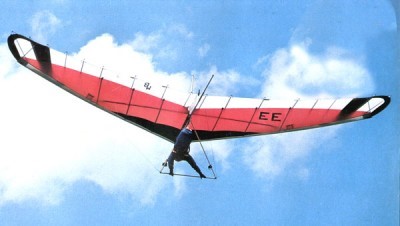
McBroom claims that the 1977 Lynx 18 is a delightfully pleasant glider to fly, with an incredibly low sink rate. Although a 7:1 glide angle is claimed the machine frequently outglides and outsoars kites claiming 8:1.
Amongst the early enthusiasts who were amongst the first to buy, build or fly a hang glider during early seventies who later went on to become manufacturers was Geoff McBroom who founded McBroom Sailwings.
 All Aero