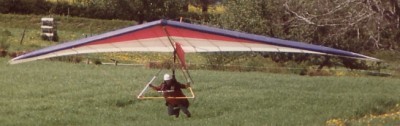
Rithner TGV
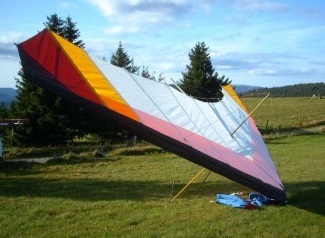
A carbon copy of the La Mouette Atlas, it was initially called “Atlas Rithner” but was eventually renamed “Swiss Atlanta” after a resounding (and justified) lawsuit brought to Etienne Rithner jointly by Marcel Lachat (the Swiss importer of La Mouette) and La Mouette itself.
A very pleasant wing with excellent finish, and tubes of 1.5in.
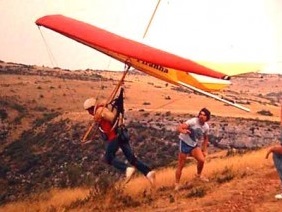
The Piranha is a copy of the Comet that is even better than the Comet itself. Handling is not great but can be improved with a home-made overdrive. Note: it’s Swiss made, therefore french pilots should have paid an import tax when buying it…and they usually didn’t!!!)
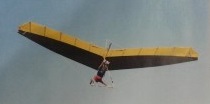
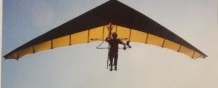
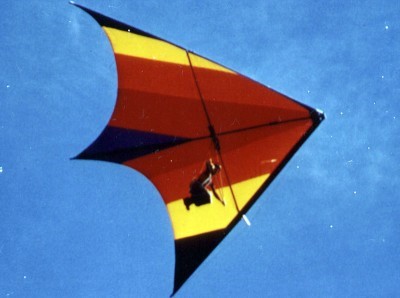
In the early 1970s, E. Rithner distributed the Bernard Danis (wing = Manta) and Electra Flyers (wing = Hirondelle) brands in Switzerland before being “inspired” to make them on his own account. Very quickly the Hirondelle Electra took over by proving to be more powerful and safer than the Manta which had the unfortunate propensity to put itself in the flag, often irreversible because the dive was stable (several accidents). Electra, which already had the “S” shaped keel (the front part was curved downwards by a cable between the upper anchorage of the trapezium and the nose, the rear part being curved upwards by the longitudinal upper cable Back), was fairly stable (slight neutral) and did not suffer from the (often fatal) phenomenon of feathering. Its fineness was of approx. 5.5, its drop rate of 2.5 – 3.0. For a weight of 18 kg.
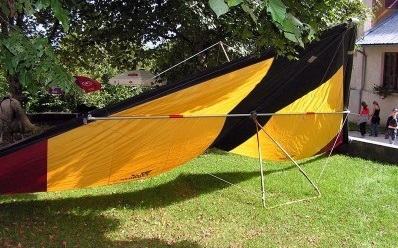
The Electra of the 1st generation had the corners of the trapezium always bent, American fashion. Undoubtedly, at this time, E. Rithner still imported a few pieces of hardware (stiffeners, screws, etc.) and US structural trapezium.
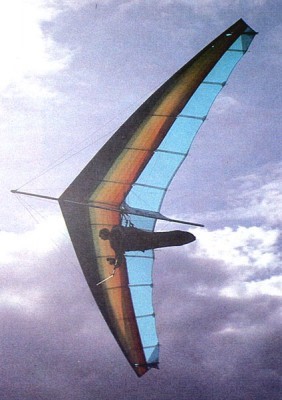
The 1984 Garuda (sometimes spelt Garouda) was a copy of the Sapphire of Bautek. Not a true copy but it was much cheaper which explains its popularity for advanced pilots.
Very good little wing, handy and light, with modest but respectable performances, wing made above all for a pleasure and pleasure of the maximum flight.
Wing area: 17 m²
Wing span: 10.8 m
Aspect ratio: 6.9
Hang glider weight: 32 kg
Minimum sink rate: 0.95 m/s
Packed length short: 3.2 m
Nose angle: 132°
Garuda 162
Wing area: 16.2 m²
Wing span: 10 m
Aspect ratio: 6.2
Hang glider weight: 26 kg
Packed length: 5.80 m
Packed length short: 2.50 m
Number of battens: 16
Nose angle: 130°
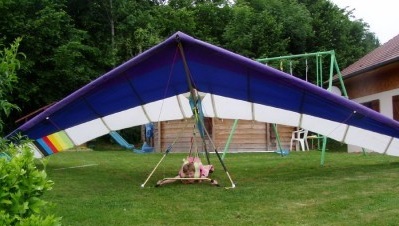
The Master and the 1984 France were absolutely identical, “inspired” of the Magic III, with 14 slats on the extrados and 4 laths of intrados. For reasons of pure marketing, E. Rithner sold this wing in France under the name of “France”.
Wing area: 15 m²
Wing span: 10 m
Aspect ratio: 6.65
Hang glider weight: 27 kg
Wing area: 16.37 m²
Wing span: 10.60 m
Aspect ratio: 6.80
Hang glider weight: 29 kg
In the early 1970s, E. Rithner distributed the Bernard Danis (wing = Manta) and Electra Flyers (wing = Hirondelle) brands in Switzerland before being “inspired” to make them on his own account. Very quickly the Hirondelle Electra took over by proving to be more powerful and safer than the Manta
Hang glider builder
Hang glider
Wing area: 13 m²
Wing span: 11 m
Aspect ratio: 9.3
Hang glider weight: 33 kg
Minimum speed: 29 km/h
Max glide ratio (L/H): 17.5
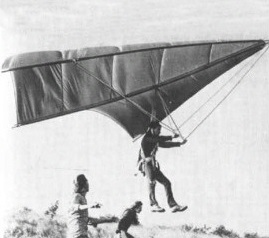
This glider was designed by Regan and friend during the summer of 1972 and constructed in October of that year. First flights were undertaken in early November in Farnham Park.
 All Aero