1998:
Wilhelmster, 14
D-80801 München
Germany
Hang glider and trike builder
1998:
Wilhelmster, 14
D-80801 München
Germany
Hang glider and trike builder
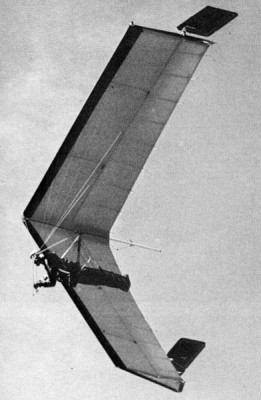
A 1981 hang glider for advanced pilots. The ASW Flash is made by Scherer who began copying the Fledge II in 1980.
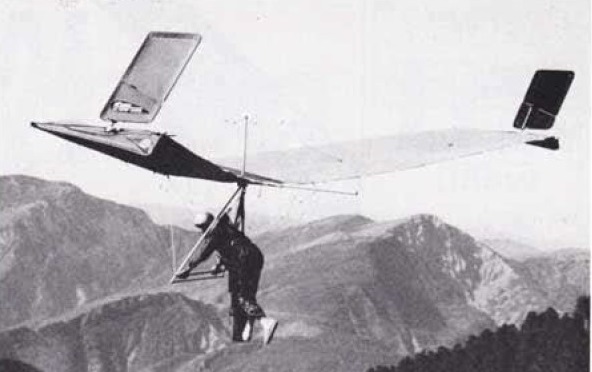
The ASW Flash was sold in Switzerland for £1400 in 1982.
ASW Flash
Wing area: 168 sq.ft
Double surface: 100%
Nose angle: 144°
Weight: 64 lb / 29 kg
Wing area: 15.6 m²
Wing span: 10 m
Aspect ratio: 6.2
Hang glider weight: 29 kg
Nose angle: 127°
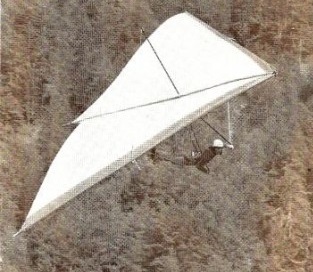
The Diamond was a 1976 development of the Swallow by Savoie Delta.
Wing area: 17.5 m²
Wing span: 9.2 m
Aspect ratio: 4.8
Hang glider weight: 20 kg
Nose angle: 102°

The Sundog is a rigid wing that was designed by Californian Mike Sandlin. The Sundog is an evolution of the Skypuppy,
Sundog was a rigid wing built to test the usefulness of flaps on a hang glider. This version has full span flaps which fold under the wing for transport. There are spoilerons on the top surface of the wing for turning, actuated by side motion of the hang loop. The flaps were pulled down by a rope. The tail surfaces are just fixed stabilizers.
It was too heavy, at 90 lb and the static balance was non-existent (special launch procedures required), but it was fun to fly once you got it in the air. Full span flaps allow simple, easy landings, very similar to a drogue chute.
They were up-only ailerons, actuated from the hang loop, then returned to neutral by a bungee cord (like the spoilerons, which came later). A good system, but Sandlin wanted bigger flaps.
Low performance landings were the easiest and safest.
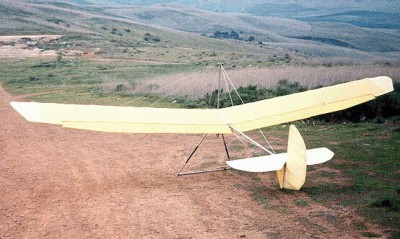
The Sandlin Skypuppy had only about 100 square feet of wing, and rudder steering. It was too fast at Sandlin’s weight for good soaring. Flown around 1986, the big flaps worked well.
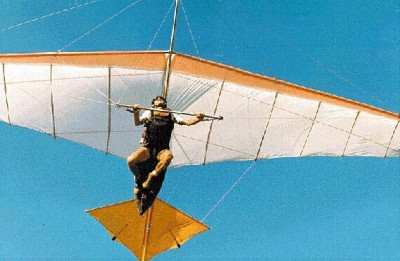
The Litewing series attempted to turn back the clock to the era of 35 lb. hang gliders. This is a bit of crude sail making, but it was fun and adventurous.
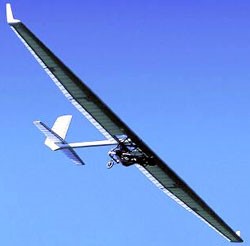
Designed by Roger Ruppert, the 1998 Archaeopteryx was conceived as a conventional glider configuration for foot launch. Primary targets were set to minimize the mass, allowing slowest possible flight speeds and providing good manoeuvrability based on a friendly stall behaviour as well as outstanding high-speed flight performances with full fairing on the cockpit. The concept permits a safe foot launch also in nil wind conditions. Excellent climb rates and an efficient riding out of extremely weak and slim thermals (microlift) are possible.
No. Built: 1
Wing span: 13.6 m / 44.6 ft
Wing area: 12.8 sq.m / 138 sq.ft
Gross Weight: 160 kg / 353 lb
Aspect ratio: 12.07
L/D Max: 24
MinSink: 0.44 m/s | 87 fpm
Hang glider weight: 40 kg
Minimum pilot weight: 70 kg
Maximum pilot weight: 110 kg
Minimum speed: 29 km/h
Maximum speed: 140 km/h
Packed length: 6 m
Seats: 1
Ruppert Composite GmbH, Etzelstrasse 34 Wald 8636, Switzerland
Archaeopteryx
Zürcher Hochschule Winterthur
Roger Ruppert
PO Box 805
8401 Winterthur
Switzerland
Glider / hang-glider builder
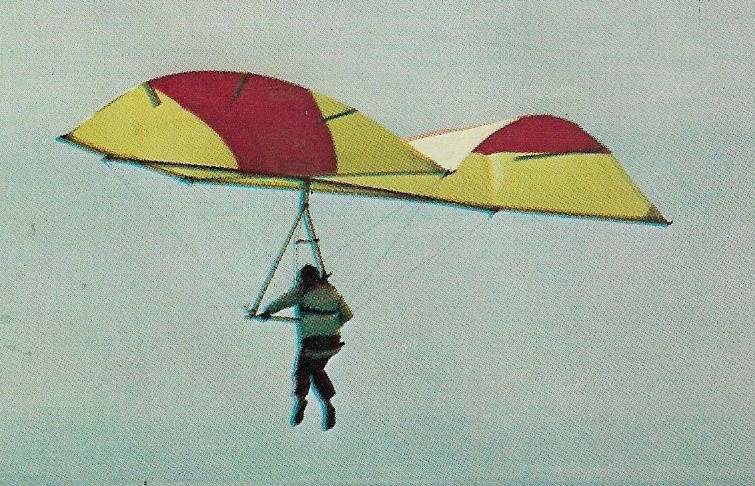
In 1948, Francis Rogallo, a NASA engineer, and his wife Gertrude Rogallo, invented a self-inflating flexible wing they called the Parawing, also known after them as the “Rogallo Wing” and flexible wing.
The term “Rogallo wing” is synonymous with one composed of two partial conic surfaces with both cones pointing forward. Slow Rogallo wings have wide, shallow cones. Fast subsonic and supersonic Rogallo wings have long, narrow cones. The Rogallo wing is a simple and inexpensive flying wing with remarkable properties.
The wing itself is not a kite, nor can it be characterized as glider or powered aircraft, until the wing is tethered or arranged in a configuration that glides or is powered. In other words, how it is attached and manipulated determines what type of aircraft it becomes. The Rogallo wing is most often seen in toy kites, but has been used to construct spacecraft parachutes, sport parachutes, ultralight powered aircraft like the trike and hang gliders. Rogallo had more than one patent concerning his finding; the due-diligence expansion of his invention involved cylindrical formats, multiple lobes, various stiffenings, various nose angles, etc. The Charles Richards design and use of the Rogallo wing in the NASA Paresev project resulted in an assemblage that became the stark template for the standard Rogallo hang-glider wing that would blanket the world of the sport in the early 1970s.
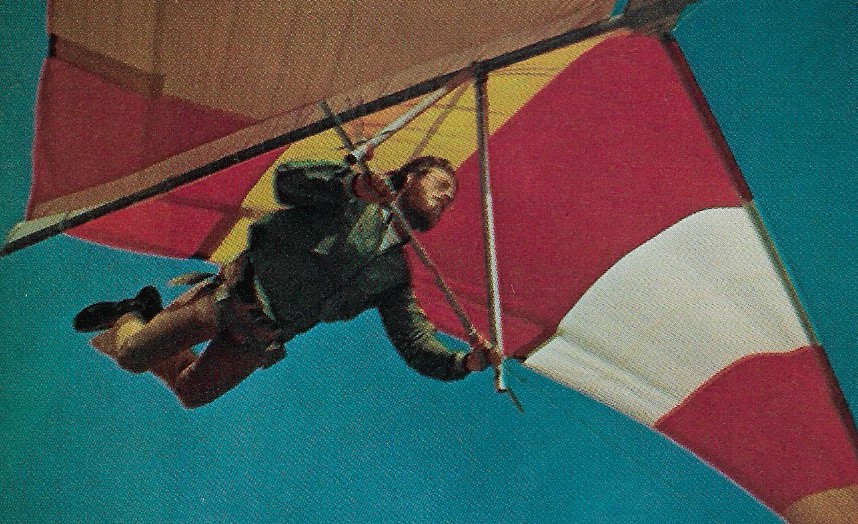
Beyond that, the wing is designed to bend and flex in the wind, and so provides favorable dynamics analogous to a spring suspension. Flexibility allows the wing to be less susceptible to turbulence and provides a gentler flying experience than a similarly sized rigid-winged aircraft. The trailing edge of the wing – which is not stiffened – allows the wing to twist, and provides aerodynamic stability without the need for a tail (empennage).
In 1961–1962, aeronautical engineer Barry Palmer foot-launched several versions of a framed Rogallo wing hang glider to continue the recreational and sporting spirit of hang gliding. Another player in the continuing evolution of the Rogallo wing hang glider was James Hobson whose “Rogallo Hang Glider” was published in 1962 in the Experimental Aircraft Association’s magazine Sport Aviation, as well as shown on national USA television in the Lawrence Welk Show.
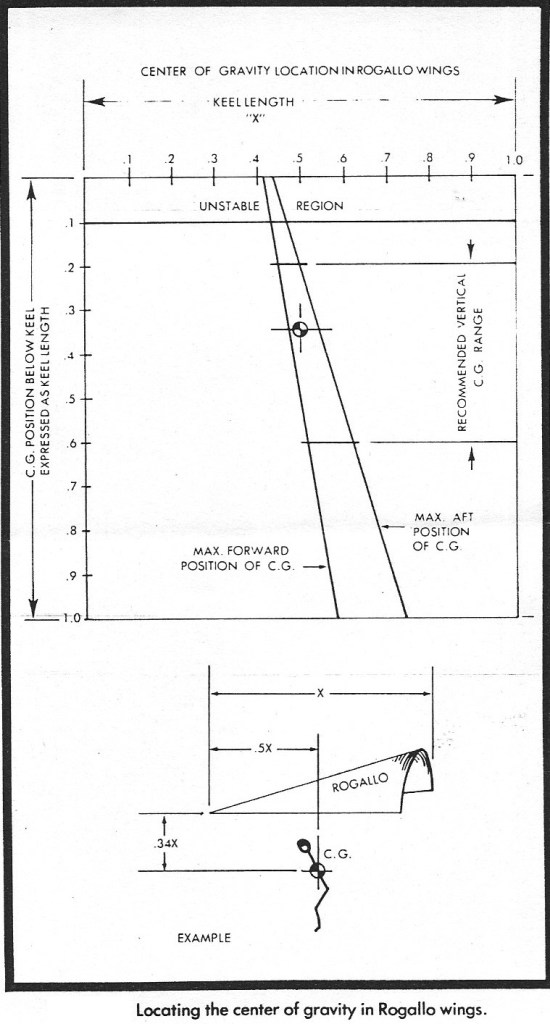
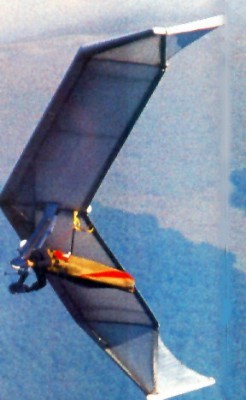
The Flair was a design developed by Günter Rochelt in 1987. Featured on the cover of ‘Drachenflieger’ magazine in November 1987. It was first conceived in 1984, but took some time to develop, with work on the fiberglass – Carbon – Kevlar airframe begun in Spring 1987. After a few test flights, in which the performance was confirmed but the rudders were found to be somewhat ineffectual, Günter decided not to put the Flair into production, concluding that he could improve performance further with some changes to the design (which led to the Flair 30, whose design goal was to reach a 30:1 glide ratio in a foot-launched aircraft.)
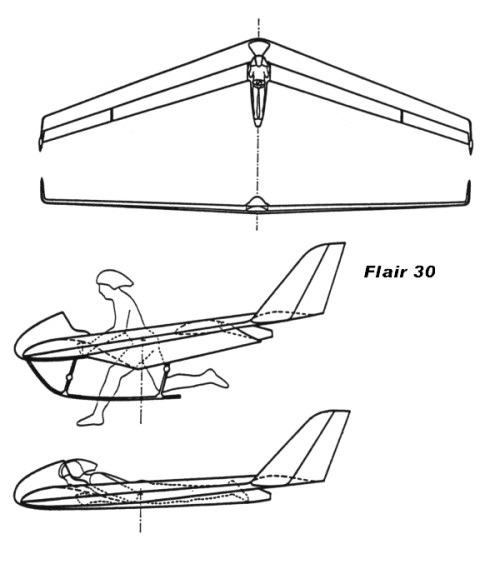
The Flair 30 was a follow-up to the Flair design and first flew in 1990. The pilot could launch by foot, then lay prone in a special harness, and finally land on a skid. After extensive test flights, including more than 50 hours logged by test pilot Knut Von Hentig, the prototype was destroyed in a crash at a sailplane club, when the sailplane pilot flying it dove into the ground at high speed from less than 100 m. Control reversal was suspected but unproved.
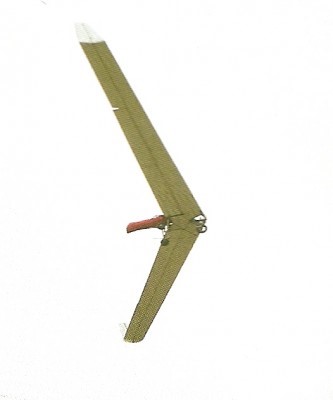
The test pilot felt the glide ratio and sink rate was quite poor, worse actually than modern flex wings
Flair
Wing area: 14.5 m²
Wing span: 11.47 m
Aspect ratio: 9
Maximum pilot weight: 165 kg
Max glide ratio (L/H): 17
Max glide ratio speed: 45 km/h
Minimum sink rate: 0.65 m/s
Nose angle: 147°
Flair 30
Wing area: 11 m²
Wing span: 12 m
Aspect ratio: 14
Profile: CM-140-K47
Hang glider weight: 33 kg
Maximum pilot weight: 90 kg
Minimum speed: 30 km/h
Maximum speed: 150 km/h
Max glide ratio (L/H): 30
Max glide ratio speed: 65 km/h
Minimum sink rate: 0.72 m/s
Packed length: 6.6 m
Nose angle: 160°
 All Aero