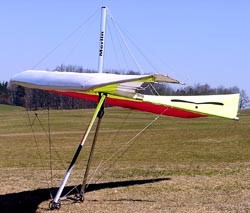
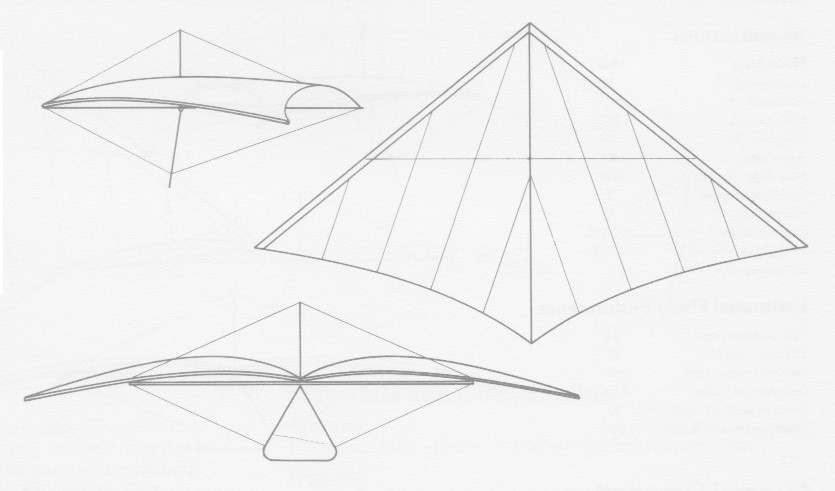
Merlin 133 Wing area: 12.4 sq.m Wing span: 9.9 m Pilot weight: 60-80 kg Nose Angle: 132 deg Aspect ratio: 8 Certification: DHV 3 Price (1998) 64000 ÖS
Merlin 133 Wing area: 12.4 m² Wing span: 9.95 m Aspect ratio: 8 Hang glider weight: 28 kg Minimum pilot weight: 50 kg Maximum pilot weight: 75 kg Nose angle: 127°
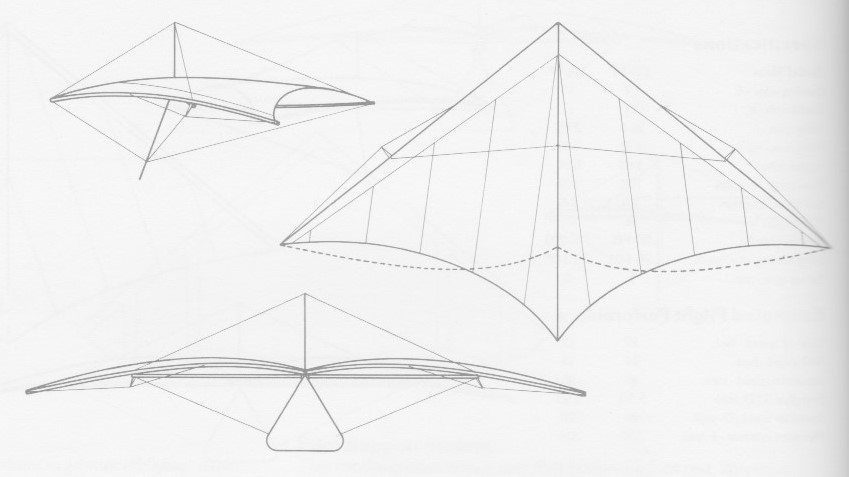
Merlin 148 Wing area: 13.8 sq.m Certification: DHV 2-3 Pilot weight: 70-90 kg Wing span: 10.25 m Nose Angle: 133 deg Aspect ratio: 7.6 Price (1998) 65800 ÖS
Merlin 148 Wing area: 13.8 m² Wing span: 10.25 m Aspect ratio: 7.6 Hang glider weight: 30 kg Minimum pilot weight: 70 kg Maximum pilot weight: 90 kg Nose angle: 127°
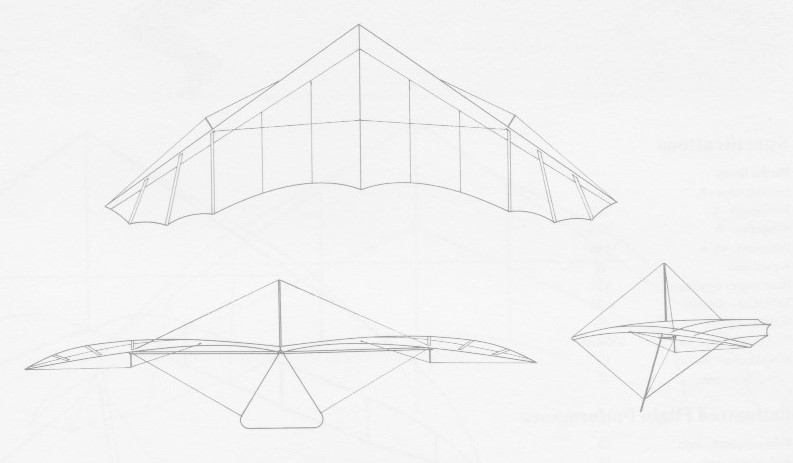
Merlin 158 Wing area: 13.8 sq.m Certification: DHV 2-3 Pilot weight: 80-110 kg Wing span: 10.4 m Nose Angle: 133 deg Aspect ratio: 7.4 Price (1998) 66000 ÖS
Merlin 158 Wing area: 14.6 m² Wing span: 10.4 m Aspect ratio: 7.4 Hang glider weight: 33 kg Minimum pilot weight: 80 kg Maximum pilot weight: 105 kg Nose angle: 127°
1998: Schlichterstrasse 63, A-6262 Schlichter, AUSTRIA
Seedwing Europe was authorized to produce the model Sensor 510E160 and 610-144 by Seedwings Inc (USA) until July 1993. At the end of the contract, Andreas and Manfred Bangheri continued to produce the “Sensor” under the name of “Seedwings Europe” without the agreement of Bob Trampenau.
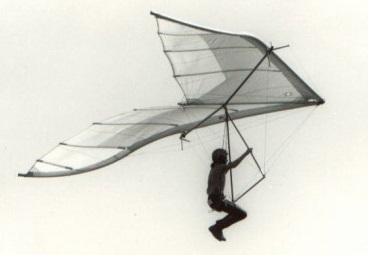
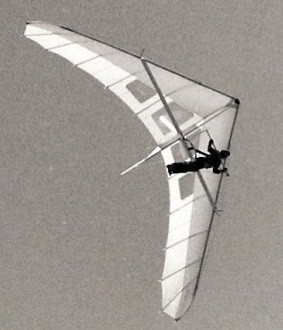
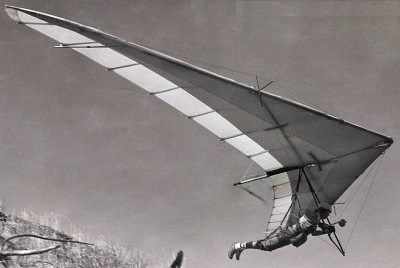
The Sensor 1 was a 1975 hang glider which featured a double surface sail and swept truncated tips. It was very stable in comparison to most high performance gliders, faster than most standards, and with good penetration. It has positive dive recovery with full sail deflation because of rigid truncated washout. This glider has been the test bed for diffusor tip theory in flex membrane wings.
Sensor I
The Sensor I airframe is made from 6061-T6 1.75in x .049 anodised aluminium tubing and all rigging cable is 3/32in 7 x 7 vinyl coated stainless steel aircraft quality. All hardware is aircraft quality, and the sail is made from 4.25oz and 3.0oz stabilised dacron, then available in white only.
There was the option of seated or prone harness.
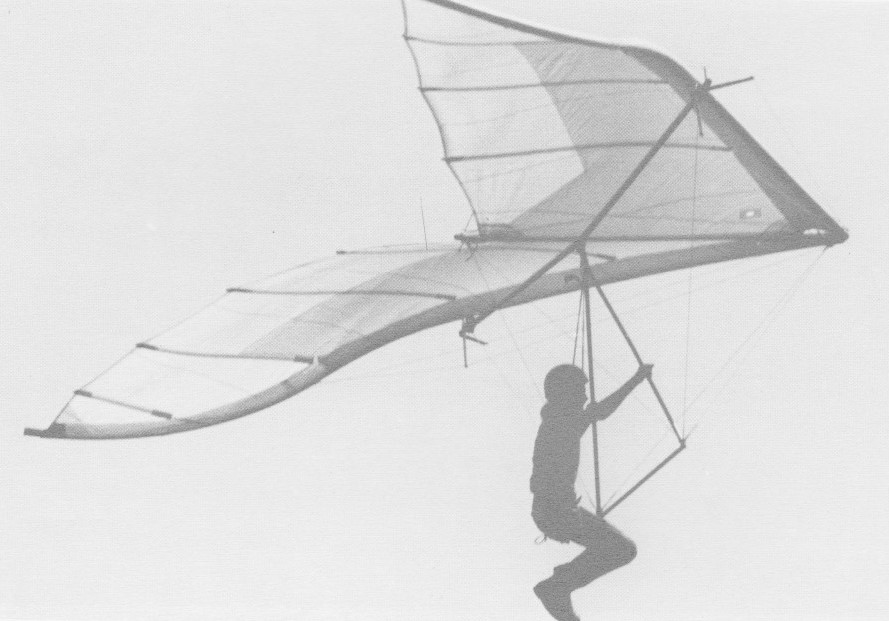
The Sensor 2 was from 1976 featured Flare Tips advanced tip design. This eliminates tip stall during steep banked turns and parachuting. The wingtips are extended with a Flare Tip Batten which allows the tip to flex in the angle of attack. The airfoil is a semi-double surface inflated type.
Sensor II
The Sensor II’s Flare Tips gives it a tip inertia that is lower than most. This is very light and flexible concept allows for rapid turn response, light tip gust effects, lower induced drag and improved washout distribution. The airfoil gives high L/D and low moment. The keel is reflexed and cambered for positive pitch moment.
The airframe is made from 6061-T6 and 2024-T3 aluminium tubing that is doweled and bushed. All rigging cable is 3/32in 7 x 7 vinyl coated stainless steel aircraft quality. All hardware is aircraft quality.
The sail is made from 3.8oz Howe & Bainbridge stabilised dacron with reinforcement in stress areas and double zig-zag stitched. The sail is fully battened. Seated or prone harness support sysems were options.
Sensor 2
The Sensor 210B is from 1976.
Sensor 210B
The Sensor 210C is from 1977.
Sensor 210C
The Sensor 210E is from 1979.
Sensor 210E
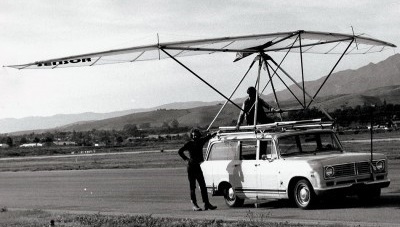
Construction plans were available for the Sensor 210E, all in inches and AN standards, and available in two sizes. The Sensor at that time was “the ultimate flying machine”. Bob Trampenau has been the inventor of curved flexible wingtips. Despite the fixed crossbars (floating crossbars) and big span it was easy to roll. Now, it handles like an ocean vessel.
Both the Sensor 310A and Sensor 310B were 1977 models.
Sensor 310A
The Sensor 411A was also a 1977 hang glider, followed by the Sensor 411B in 1978.
Sensor 411A
Sensor 411B
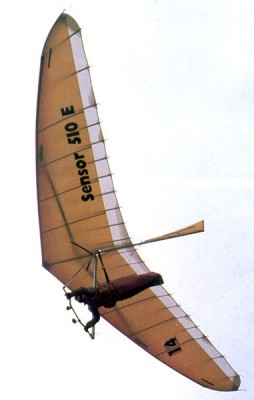
The 1985 Sensor 510 was for advanced pilots.
Sensor 510
The Sensor 610 came in 1992.
Sensor 610
Seedwing Europe was authorized to produce the model “Sensor 610-144” until 1993. At the end of the contract, they continued to produce the “Sensor” under the name of “Seedwings Europe” without the agreement of Bob Trampenau.
The Sensor 610 CF3 was a 2000 version for advanced pilots.
Sensor 610 CF3
The 2005 Sensor 610 CF4 was for advanced pilots.
Sensor 610 CF4
The 2007 Sensor 610 CF5 was for advanced pilots.
Sensor 610 CF5
The 2008 Sensor 610 F5 was for advanced pilots.
Sensor 610 F5
Seedwings produced the Sensor 610 and, in 1993, the Sensor 611.
Sensor 611
The 1986 Sensor 710 was for advanced pilots.
Sensor 710
Sensor I Keel length: 7.5 ft Wing span: 29.5 ft Wing area: 145 sq,ft Aspect ratio: 6 Nose angle: 110˚ Sail billow: .025˚ Weight: 45 lb Pilot weight: 130-160 lb Takeoff speed: 15 mph Stall speed: 16 mph Max speed: 45 mph Best glide ratio (L/D): 8-1 Best L/D speed: 25 mph Min sink: 275 fpm
Sensor II Keel length: 9.2 ft Wing span: 32.8 ft Wing area: 165 sq,ft Aspect ratio: 6.5 Nose angle: 110˚ Sail billow: 0.5˚ Weight: 36 lb Pilot weight: 140-180 lb Takeoff speed: 12 mph Stall speed: 14 mph Max speed: 45 mph Best glide ratio (L/D): 9-1 Best L/D speed: 25 mph Min sink: 225 fpm
Sensor 210E 183 Wing area: 17m² Wingspan: 10,5m
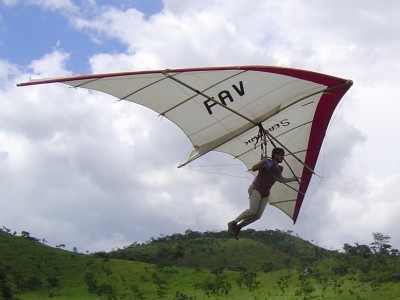
Sensor 510 Wing area: 14.96 m² Wing span: 10.6 m Aspect ratio: 7.5 Hang glider weight: 30 kg Number of battens: 20
Sensor 610 Wing area: 13.5 m² Wing span: 10.4 m Aspect ratio: 8 Minimum pilot weight: 60 kg Maximum pilot weight: 85 kg Nose angle: 127°
Sensor 610 CF3 135 Wing area: 12.63 m² Wing span: 10 m Aspect ratio: 8 Hang glider weight: 30 kg Minimum speed: 32 km/h Maximum speed: 104 km/h Max glide ratio (L/H): 15 Minimum sink rate: 0.76 m/s Packed length: 5.2 m
Sensor 610 CF3 142 Wing area: 13.19 m² Wing span: 10.4 m Aspect ratio: 8.1 Hang glider weight: 32 kg Minimum speed: 32 km/h Maximum speed: 104 km/h Max glide ratio (L/H): 15 Minimum sink rate: 0.76 m/s Packed length: 5.3 m
Sensor 610 CF3 150 Wing area: 13.93 m² Wing span: 10.7 m Aspect ratio: 8.2 Hang glider weight: 33 kg Minimum speed: 32 km/h Maximum speed: 104 km/h Max glide ratio (L/H): 15 Minimum sink rate: 0.76 m/s Packed length: 5.5 m
Sensor 611 Wing area: 14.4 m² Wing span: 10.85 m Aspect ratio: 8.2 Minimum pilot weight: 75 kg Maximum pilot weight: 105 kg Nose angle: 127°
Sensor 710 145 Wing area: 10.12 m² Wing span: 13.47 m Aspect ratio: 7.6 Hang glider weight: 29 kg Minimum pilot weight: 70 kg Maximum pilot weight: 85 kg Packed length: 5 m Number of battens: 14 Nose angle: 132°
Sensor 710 152 Wing area: 10.43 m² Wing span: 14.12 m Aspect ratio: 7.7 Hang glider weight: 30 kg Minimum pilot weight: 77 kg Maximum pilot weight: 102 kg Packed length: 5.2 m Number of battens: 14 Nose angle: 132°
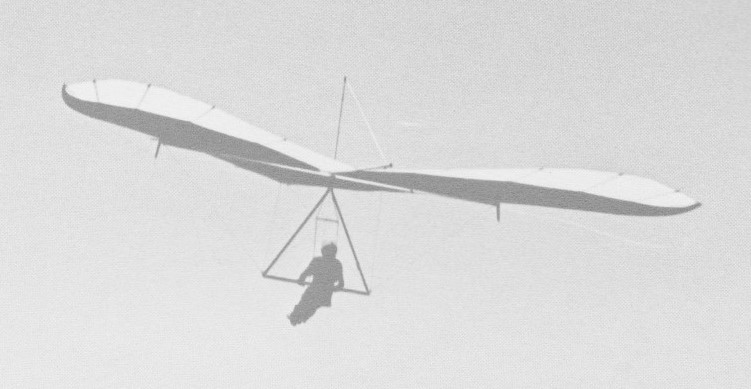
The 1975 Sunseed is a double surface, diffuser tip flying wing. It has outboard control surfaces. Canted tip wings provide self righting characteristic. It has a fibreglass leading edge with an aluminium trailing edge wedge. Draggons on the wing tips can be operated as glide path control devices to reduce glide angle from 12-1 to 5-1. The wing tip design provides induced drag and tip vortex reduction. The lower wing surface is ribless.
The airframe is made from 2024-T3 anodised aluminium. Rigging cable is 3/32in 7 x 7 stainless steel aircraft qualiy, vinyl coated. Hardware is all aircraft quality parts. The sail is 1.8oz stabilised dacron and is fitted with zippers and Velcro tapes. There was the option of seated or prone harnesses.
The Sunseed dissembles to a bundle 10 ft long and 1 ft in diameter.
The Sunseed has a stable stance even in steep turns with no tendency to dive or stall.
The run out distance before touchdown is about four times that of a Rogallo. It has a 13.7% airfoil and a load factor of 6G.
Wing span: 32.8 ft Wing area: 128.5 sq,ft Aspect ratio: 8.36 Wing sweep: 15˚ Weight: 50 lb Pilot weight: 125-180 lb Takeoff speed: 15 mph Stall speed: 16 mph Max speed: 40 mph Best glide ratio (L/D): 12-1 Best L/D speed: 25 mph Min sink: 275 fpm
Do not confuse with “Seedwing Europe” who was authorized to produce the model Sensor 510E160 and 610-144 until July 1993. At the end of the contract, Andreas and Manfred Bangheri continued to produce the “Sensor” under the name of “Seedwings Europe” without the agreement of Bob Trampenau.
A 1976 hang glider for advanced pilots. The duck design was supposed to prevent luffing dives, but according to Vol Libre, the wing was not flyable at speed.
Hang glider weight: 25 kg Packed length short: 5.30 m
In 1972, Mike Riggs, president of Seagull Aircraft Inc of Santa Monica in California, commenced a 14 month study which resulted in the semi-cylindrical Seagull III. Riggs, a graduate of the Northrop Institute of Aeronautics, saw the merits and demerits of both conical and cylindrical and set out to develop a Rogallo wing which, if possible, would combine the virtues of both and none of the vices. The patented “Camber Control” system which he developed more than fulfilled his aims. The leading edge spars have a vertical curve running out from the nose for about one-third of their length which in flight impart a cylindrical form to the inboard wing sections. The outboard two-thirds of the leading edges are straight, although not in the same plane as the keel, and thus the outboard wing sections adopt a conical form in flight. This configuration allows for a higher aspect ratio than is possible with the conical type. It has a 25 per cent improvement in L/D ratio, allowing it to fly much more slowly than a conical but retaining the ability to fly as fast at similar wing loadings. This makes it not only much easier to learn to fly on but also greatly extends the scope of the skilled soaring pilot. The angle of incidence, which caries along the length of the leading edge, is greater through the curved nose section than out at the wing tips. Thus in a nose up attitude the nose will reach a stall mode but lift is still being generated further outboard and aft towards its wing tips. Thus the centre of pressure moves aft inducing stall recovery. Under these conditions stall recovery can be made immediately without any height loss simply by pulling back on the control bar i.e. pulling the pilot’s weight forward. Under similar conditions, the conical will drop its nose sharply and loose about 80 ft of altitude before recovering, and is susceptible to dropping one wing and spinning at such a time. The semi-cylindrical in a dive mode also provides full recoverability. When a point is reached where there is zero angle of attack through the outboard sections of the leading edges there is still a sufficient angle of attack through the inboard curved sections to generate lift thus moving the centre of pressure forward allowing the nose to rise. Even in a vertical dive the curved leading edges and the multi-plane nature of the airframe ensure that the wing sail does not collapse and thus it remains controllable.
Seagull 3
Captain Chuck Stahl, a United Airlines 707 pilot, who test flies commercially produced hang gliders in the United States, was unable to make the Seagull III fall out of the sky. In his test report he credited it with full recoverability from the following: high speed stall, low speed stall, vertical dive, chandelle and tail slide, and like all Rogallo wings it can be used as a parachute when the pilot runs out of room or wants to descend vertically.
The semi-cylindrical Seagull III represents the state of the art in Rogallo wing flying. Whereas conicals, with their narrow airspeed range and consequently critical wing loadings, need to be sized according to pilot weight, the Seagull Ill allows for as wide a range of pilot weights as is likely to be encountered.
A Seagull III has been recorded as having gained 2,000 ft of altitude from a foot launch in California’s Santa Ana Valley using the combined effects of thermal and ridge lift. It has the ability to remain aloft on ridge lift all day long and can safely be put through a great variety of manoeuvres, although no hang glider yet could be described as fully aerobatic.
Seagull 3
The Seagull IIIZ has adjustable trim to adjust the control bar pressure in varying positions. It is fitted with split crossbars and padded control bar. The airframe is made from 6061-T6 1.75in x .058 anodised aluminium tubing. Rigging cable is 7 x 19 stainless seel with white vinyl coating, and all hardware is aircraft quality stainless steel.
Seagull IIIZ
The sail is made from 3.8oz stabilised dacron and was available in 12 colour combinations. The options for pilot support were seated, supine or prone harness.
The Seagull 4 was almost identical to the Seagull 3. The most conspicuous difference was a cambered, S-shaped keel instead of a straight tube. It also had a two-piece swept-back cross-brace rather than a single tube. The difficulty in DIY for Seagull III was the shaping of the leading edge tube; such was a doorway for buying full ship or parts from Seagull Aircraft.
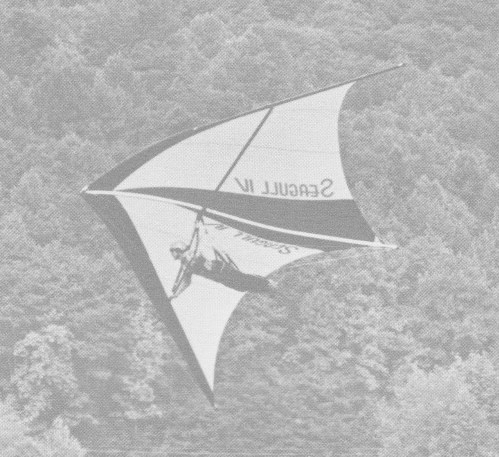
The Seagull IV is a high performance glider designed for Hang Three pilots and for open competition. It is a direct descendant of the Seagull III, using the same truncated conical shape, but with much higher performance characteristics. The Seagull IV has the same nose angle and curved leading edges, but a much shorted, curved keel. The sail is very flat and its trailing edge is roached outward, instead of the normal hollow cut. This was the first glider designed with a shaped, cambered keel and a roached, battened sail.
Seagull IV
The Seagull IV has adjustable trim allowing pilots to adjust the control bar pressure for ideal comfort in varying conditions. Split cross bars for convienence, and padded control bar. The airframe is made from 6061-T6 1.75in x .058 anodised aluminium tubuing. Rigging cable is 7 x 19 stainless steel with white vinyl coating. All hardware is aircraft quality stainless steel.
The Seagull IV sail is made from 3.8oz stabilised dacron, in a choice of 12 colours. The Seagull IV was supplied with options of seated, supine or prone harness.
The Seagull VII has adjustable trim allowing pilots to adjust the control bar pressure for ideal comfort in varying conditions. Split cross bars for convienence, and padded control bar. The airframe is made from 6061-T6 1.75in x .058 anodised aluminium tubuing. Rigging cable is 7 x 19 stainless steel with white vinyl coating. All hardware is aircraft quality stainless steel.
The Seagull VII sail is sewn with no billow, the stability being derived from the curved tubing and diffused wingtips. The low sail billow cuts resists prolonged sail inversions in thermal turbulence. The anhedral tips combined with the radial, tapered, foam sandwich battens provide for the lowest tip vortex possible. The Hang Four rated Seagull VII exhibits a smooth, positive pitching moment at any angle of attack.
Seagull 5 – Pilot Jack Schroeder
The cambered keel was not on the Seagull III but on the Seahawk and the Seagull V (Verticle Stabilizer) model.
Seagull 7
Seagull VII
The Seagull VII has adjustable trim alloing pilots to adjust the control bar pressure for ideal comfort in varying conditions. Split cross bars for convienence, and padded control bar. The airframe is made from 6061-T6 1.75in x .058 anodised aluminium tubuing. Rigging cable is 7 x 19 stainless steel with white vinyl coating. All hardware is aircraft quality stainless steel.
I knew Jack. I was one of the factory pilots from Telluride in those days. Part of the TAF (Telluride Air Force). It was tragic when Jack became a paraplegic from a mishap trying to land on the shore. He was one of the best. Don Dusatko
Seagull 3 Wing area: 240 sq. ft Single surface Nose angle: 90 deg Glide ratio: 23 – 24:1
Seagull IIIZ Leading edge: 17 ft Keel length: 15 ft Wing span: 26.6 ft Wing area: 178 sq,ft Aspect ratio: 3.98 Nose angle: 102˚ Sail billow: 2.5˚ Weight: 36 lb Pilot weight: 80-145 lb Takeoff speed: 12 mph Stall speed: 14 mph Max speed: 35 mph Best glide ratio (L/D): 5.5-1 Best L/D speed: 20 mph Min sink: 320 fpm
Seagull IIIZ Leading edge: 19 ft Keel length: 17 ft Wing span: 29.5 ft Wing area: 223 sq,ft Aspect ratio: 3.89 Nose angle: 102˚ Sail billow: 2.5˚ Weight: 40 lb Pilot weight: 135-200 lb Takeoff speed: 12 mph Stall speed: 14 mph Max speed: 35 mph Best glide ratio (L/D): 5.5-1 Best L/D speed: 20 mph Min sink: 320 fpm
Seagull IV 19×17 Leading edge: 19 ft Keel length: 17 ft Wing span: 29.5 ft Wing area: 174 sq,ft Aspect ratio: 5.0 Nose angle: 102˚ Sail billow: 2˚ Weight: 42 lb Pilot weight: 130-175 lb Takeoff speed: 14 mph Stall speed: 17 mph Max speed: 45 mph Best glide ratio (L/D): 6.5-1 Best L/D speed: 22 mph Min sink: 270 fpm
Seagull VII Leading edge: 19 ft Keel length: 11 ft Wing span: 31.4 ft Wing area: 161.1 sq,ft Aspect ratio: 6.13 Nose angle: 110˚ Sail billow: 0˚ Weight: 46 lb Pilot weight: 130-165 lb Takeoff speed: 12 mph Stall speed: 16 mph Max speed: 50 mph Best glide ratio (L/D): 8.5-1 Best L/D speed: 24 mph Min sink: 237 fpm
Seagull VII Leading edge: 20 ft Keel length: 12 ft Wing span: 33 ft Wing area: 184.9 sq,ft Aspect ratio: 5.89 Nose angle: 110˚ Sail billow: 0˚ Weight: 48 lb Pilot weight: 155-220 lb Takeoff speed: 12 mph Stall speed: 16 mph Max speed: 50 mph Best glide ratio (L/D): 8.5-1 Best L/D speed: 24 mph Min sink: 234 fpm
A 1979 hang glider, the Seagull Aircraft 10 meter was light, responsive, had a good clean sail for its day, and was reasonably competitive. You could really stand that glider up on its wing tip and feel every nuance of the thermal. A great, strong, stable, yet fast-rolling for low G aerobatics from Mike Riggs and Bob Keeler. The deflexer system on the leading edge worked great for performance tuning. The trapezium was not foldable.
For the late 70’s era the Seahawk was a marvelous intermediate-level glider. Fast, responsive, stable, well constructred, and had the Seagull classic dropped nose. The cambered keel was on the Seahawk. It came w/negative G cables down the wing (it could be ordered with these) for extra safety.





 All Aero