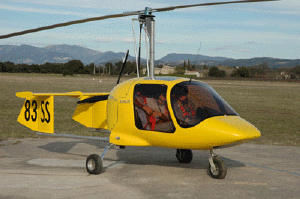
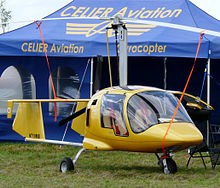
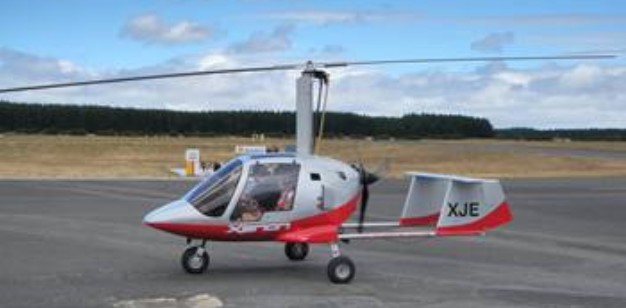
Xenon was designed by French aircraft designer Raphael Celier and was manufactured in Poland to the French Ultralight category standards. Celier Aviation established its reputation with the two-seat side-by-side configuration Celier Xenon 2 series of autogyros. By 2011 over 100 of these were flying.
This high performance ultralight autogyro was available as a kit or ready to fly. Registered as an LSA.
Delivered fully factory built starting at $61,000 in 2009.
The composite structure is the airframe, providing lightness and incorporating a full roll cage to protect the occupants. The cabin is 10″ wider than a Cessna 172 and the two pilots are separated by a 10″ console and arm rest. Behind the seats is a very large luggage compartment. The Aircopter rotor blades are aluminum yet use titanium for strength and tip weighting for higher inertia. The DUC R propeller features a spoon blade with a wider tip and built in feathering. It is carbon forged under high pressure and a carbon fiber spinner is fitted.
The box tail section is directly in the propeller slipstream and is on a long lever arm for effectiveness with or without engine power. The 28″ high cabin is soundproofed, with interior carpeting and heated leather bucket seats, and the Xenon meets European noise standards.
The Xenon is available with a choice of 3 different engines. The standard model comes with a Rotax 912S Engine that delivers 100 horsepower. The 914 Model features a Rotax turbo that delivers 115 horsepower for up to 5 minutes after which the engine delivers a continuous 100 horsepower. The high altitude or extra climb ability model is the 912 RST version which has a Rotax 912 sporting a custom designed Mitsubishi turbo delivering 122 horsepower for take-off followed by a continuous 110 horsepower with full time turbo boost.
The doors are removable for flight, leaving a full wrap around optical windshield with overhead windows and foot well windows, allowing near unobstructed viewing. The instrument panel is shock mounted to be vibration free and includes full instrumentation for flight performance and engine monitoring. Flight instruments include: altimeter, airspeed indicator and vertical speed indicator. Rotor tach and fuel are separate gauges while graphic digital engine monitor uses colored LEDs to keep track of engine tach, CHT and EGT gauges, volt/amp meter, oil pressure and temperature, fuel flow, turbine temperature and manifold pressure. There is a 12 volt power plug for the portable GPS or MP3 player. Options include intercoms, VHF radio and transponder with altitude encoder.
The console arm rest puts the throttle and 280 rpm pre-rotator under one hand. Circuit breakers control the panel and landing lights and overhead heat vents are fitted.
Options vary depending on the model but your Xenon is available with propeller spinner, special metallic paint, cabin and blade covers, larger rotors, removable joystick, adjustable pedals, heated leather seats or a ballistic parachute.
Engine: Rotax 912S, 100 hp
Propeller: 3 Blade DUC Windspoon 68.5 in
Max TO weight: 1,155 lbs.
Empty Weight: 583 lbs
Payload: 462 lbs
Rotor blades: Type 8H12 Aircopter Extruded Aluminum
Rotor Diameter: 27.55 ft
Dics Area: 596.1 sq. ft
Total Width: 86.6 in
Total Length: 192.9 in
Total Height: 110.23 in
Cabin Width: 49.2 in
Pre-rotator: Mechanical 280 RRPM
Wheel Diameter: 400×4
Vne: 108 kt / 124 mph / 200 kph
Minimum Speed: 19 mph
Cruise 75%: 75 mph
Max speed: 105 mph
Climb Rate: 600-1200 fpm
Glide Ratio: 3:1
Service Ceiling: 15,000 ft
Endurance: 4 hr + res
Take off Dist: 100-300 ft
Landing Dist: 15 ft
Fuel Capacity: 22 USG
Fuel Burn @ 65% pwr: 4.8 USGPH
Endurance: 4 hrs + res
Engine: Rotax 914, 115 hp
Empty Weight: 616 lbs
Propeller: 3 Blade DUC Windspoon 68.5 in
Max TO weight: 1,155 lbs.
Rotor blades: Type 8H12 Aircopter Extruded Aluminum
Payload: 484 lbs
Rotor Diameter: 27.55 ft
Dics Area: 596.1 sq. ft
Total Width: 86.6 in
Total Length: 192.9 in
Total Height: 110.23 in
Cabin Width: 49.2 in
Pre-rotator: Mechanical 280
Wheel Diameter: 400×4
Vne: 108 kt / 124 mph / 200 kph
Minimum Speed: 19 mph
Cruise 75%: 87 mph
Max speed: 115 mph
Climb Rate: 600-1200 fpm
Glide Ratio: 3:1
Service Ceiling: 15,000 ft
Endurance: 4 hr + res
Take off Dist: 100-300 ft
Landing Dist: 15 ft
Fuel Capacity: 22 USG
Fuel Burn @ 65% pwr: 4.8 USGPH
Endurance: 4 hrs + res
Engine: Rotax 912 RST, 122 hp
Empty Weight: 605 lbs
Propeller: 3 Blade DUC Windspoon 68.5 in
Max TO weight: 1,155 lbs.
Rotor blades: Type 8H12 Aircopter Extruded Aluminum
Payload: 550 lbs
Rotor Diameter: 27.55 ft
Dics Area: 596.1 sq. ft
Total Width: 86.6 in
Total Length: 192.9 in
Total Height: 110.23 in
Cabin Width: 49.2 in
Pre-rotator: Mechanical 280 RRPM
Wheel Diameter: 400×4
Vne: 108 kt / 124 mph / 200 kph
Minimum Speed: 19 mph
Cruise 75%: 99 mph
Max speed: 121 mph
Climb Rate: 600-1200 fpm
Glide Ratio: 3:1
Service Ceiling: 15,000 ft
Endurance: 4 hr + res
Take off Dist: 100-300 ft
Landing Dist: 15 ft
Fuel Capacity: 22 USG
Fuel Burn @ 65% pwr: 4.8 USGPH
Endurance: 4 hrs + res
 All Aero