1995-7: 5 Utrecht Court, Donvale, Australia 3111.
Autogyro builder
1995-7: 5 Utrecht Court, Donvale, Australia 3111.
Autogyro builder
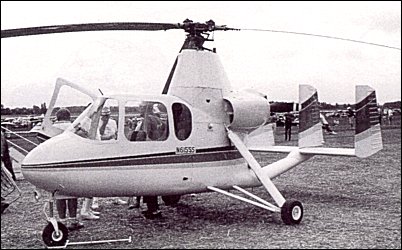
The U-17 gyrocopter was designed by Raymond E. Umbaugh with a 4130 welded tube centre section, aluminium forward fuselage and tail. His U-17 design was a tandem two-seat machine with a slim low-set tailboom and a single fin and T-tailplane. The prototype, N43U, was built for Umbaugh by the Fairchild Engine & Airplane Corporation at Hagerstown, Maryland. It made its first flight in mid-1959 and was powered by a 195kW Lycoming engine.
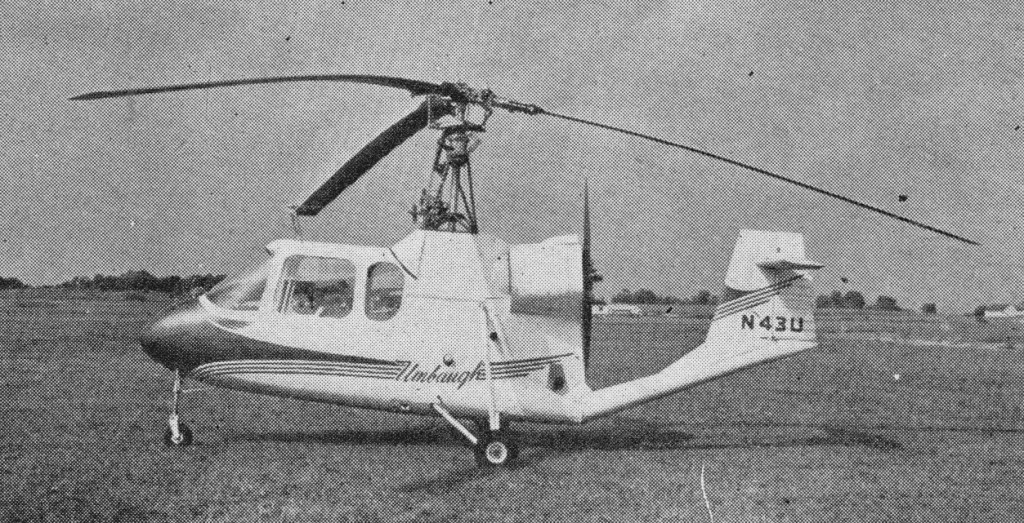
The second prototype, designated U-18, was redesigned to eliminate the stability problems of the first prototype. This aircraft was fitted with a 135kW Lycoming 0-360 and, initially, with a V-tail. The stability problems were still not resolved and a new triple tail was installed with a low-set tailplane bearing two fixed fins and a third movable one in the centre. This improved the Umbaugh to the point where it was awarded its Type Certificate (1H 17) on 12 September 1961, and certification of the production version, the Model 18-A, was granted early in 1965.
Ray Umbaugh embarked on an ambitious plan to market the U-18, placing an order for 10000 units with Fairchild as the Flymobil. A large network of dealers and distributors was set up in the United States but Umbaugh started to run into trouble because the manufacturing output of the U-18 was too slow to meet the demands of dealers for demonstration aircraft.
Basic price of the Umbaugh 18 was quoted as $9,995 (£3,498), or $11,695 (£4,093) for the deluxe model 18A, in July 1962.
The dealers, who had paid large franchise fees took over Umbaugh, the agreement with Fairchild was terminated and manufacturing moved to Florida. Fairchild built only five development aircraft during 1960, all being tandem 2-seaters with 180hp Lycoming O-360-A1D engines. The company finally collapsed with just four aircraft completed and flown.
The design was then acquired by Air & Space Manufacturing of Muncie, Indiana in 1965, which made some modifications to the tail unit and commenced manufacture of the Air & Space 18A. Again, Air & Space was faced with dealer pressure for aircraft and set out to raise capital for expansion. This funds-raising exercise resulted in accusations from the Securities & Exchange Commission of irregularities in the commercial claims made to new investors and, though the company’s management was eventually cleared of wrongdoing, the costs and delay resulted in the company’s collapse. A total of 99 production aircraft had been registered though only 67 of these appear to have been actually completed by the end of 1965.
The assets of Air & Space then went into storage but were eventually reinstated by one of the dealers, Don Farrington of Paducah, Kentucky.
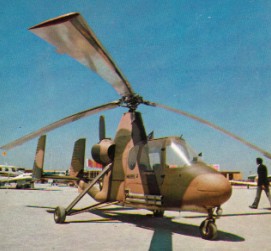
The autogyro has an all-metal fuselage skin, and wooden rotor blades reinforced with glassfibre. The engine drive can be connected to the rotor for jump starts, after which it is disengaged and clutched to the pusher propeller for forward movement.
In 1972 Farrington Aircraft Corporation proposed a Forward Air Control version, with provision for air-to-ground rockets for target marking. Lacking the rights to the type certificate, Farrington Aircraft set up a programme to remanufacture existing aircraft with a modified collective pitch system, fibreglass engine cowlings and new composite blades.
Farrington Aircraft produced the tandem two-seat Model 20A Heliplane cabin autogyro as a modern development of the Air & Space Model 18-A.
Farrington has also developed an amateur-built kit gyrocopter with some features of the Umbaugh U-18 known as the Farrington “Twinstar”.
Air & Space 18A / Umbaugh A18A Flymobil
Engine: 180 hp Lycoming O-360-A1D, 180 hp / 135kW
Prop: Hartzell HC-C2YK-1BLF/FL7666A constant speed
Rotor blades: 3 blade composite
Rotor dia: 35 ft 0 in / 10.67 m
Width: 9 ft
Length: 19 ft 10 in / 6.04 m
Height: 9 ft 3 in / 2.82 m
Min speed: 25 mph
Cruise: 90 mph
Top speed: 112 mph / 177km/h
Empty wt: 1315 lb
Useful load: 485 lb
Max TO wt: 1800 lb / 816 kg
Ceiling: 3658m
Range: 483km
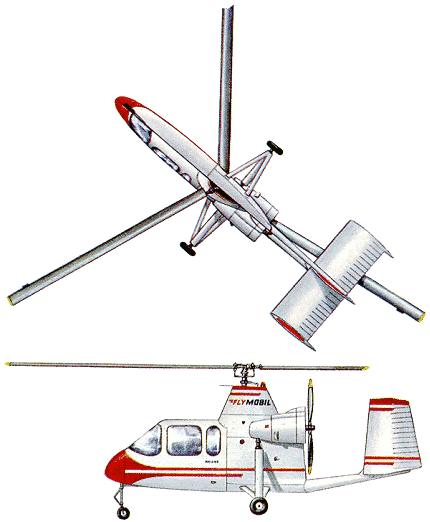
Produced 68 examples of the Model 18-A autogyro at Muncie, Indiana during 1960s, as slightly modified version of Umbaugh light two-seat autogyro (developed 1957-1962).
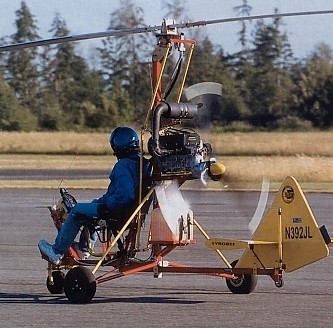
It was decided to build and aircraft that was very much like the Bumblebee, but constructed using as much in the way of standard ultralight parts and over-the-counter gyroplane components as possible. The result was the Gyrobee, which first took to the air in June of 1990 and debuted in the pages of Rotorcraft magazine in the October-November 1990 issue.
The Gyrobee had a low-rotor disc loading as its core concept, which allows it more decent performance on 40 hp, and the designer planned for a 215-pound pilot. A single seat open frame autogyro with the frame bolted together, the engine used is the 40 hp Rotax 447, Prop: 60” x 38” 2 blade laminated maple (LEAF), and Rotordyne 25’ x 7 3/8” bonded aluminium rotor blades.
The Gyrobee is a non-commercial model whose plans were available for free download on the Internet at http://taggart.glg.msu.edu/gyro/gbplans.php, consisting of 126 pages of text and drawings.
Aerotec, Inc. is a separate company that sets airframe kits and engines based on the Gyrobee plans.
Engine: Rotax 447, 40 hp
Prop: 60” x 38” 2 blade laminated maple (LEAF)
Rotor blades: Rotordyne 25’ x 7 3/8” bonded aluminium
Width: 7’8”
Height: 8’
Length: 12’
Empty wt: 246 lb
Useful load: 250 lb
Gross wt: 496 lb
Take-off Run: 600-800 ft
Minimum Level Flying Speed: 8-9 mph
Best Climb Airspeed: 35 mph
Cruise Airspeed: 45-50 mph
Maximum Level Flight Airspeed: 60 mph
Maximum Rate-of-climb: 750 fpm
Endurance: 60 min (10 min. reserve)
Flight Range: 45-50 miles (no wind, 10 min. reserve)
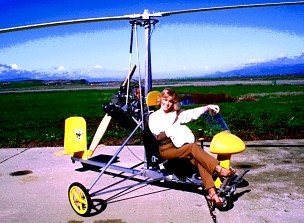
In 1984 the world’s first ultralight gyroplane made its debut in the pages of Ultralight Aircraft magazine. This was Martin Hollmann’s Bumblebee. Hollman had originally planned to market Bumblebee kits, but only a small run had been produced.
A single seat open frame autogyro with an airframe of bolted 2×2 aluminium tubing and a simplified rotor head. Big enough for a large pilot, the plans sold for US$200 in 2001 and US$250 in 2009.
Able to take either a 40-hp Rotax 447 or a 38.5-hp Kawasaki engine, the take-off distance is 230 ft on a calm day and useful load is 270 pounds.
Engine: Rotax 447, 40 hp
Prop: 66” x 68” wood
Rotor blades: 23’ x 7” aluminium/composite
Disk area: 415 sq.ft
Width 7’4″
Height 7’8″
Length 12′
Empty Weight 230 lbs
Useful Load 300 lbs
Gross Weight 500 lbs
Fuel cap: 5 USG
Min Speed 10 mph
Cruise 40 mph
Top Speed 70 mph
Range: 65 sm
Service ceiling: 16,000 ft
Seats: 1
Landing gear: nose wheel
Engine: Rotax 503, 52 hp
Rotor span: 7 m
MAUW: 230 kg
Empty weight: 115 kg
Fuel capacity: 20 lt
Max speed: 150 kph
Cruise speed: 90 kph
Minimum speed: 25 kph
Climb rate: 5 m/s
Seats: 1
Fuel consumption: 15 lt/hr
1998: 3 Harris Ct., Bldg. S., Monterey, CA 93940, USA.
Gyrocopter builder
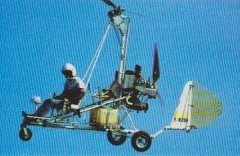
Air-Copter designed the blade from extruded dural, with a biconvex NACA 23112 profile.
Engine: Hirth F30 , 80 hp
Rotor span: 7 m
Blade area: 0.215 sq.m
MAUW: 350 kg
Empty weight: 145 kg
Fuel capacity: 35 lt
Max speed: 170 kph
Cruise speed: 120 kph
Minimum speed: 15 kph
Climb rate: 10 m/s
Seats: 2
Fuel consumption: 17 lt/hr
Plan price (1998): 500 Fttc
1998:
Aerodrome de Muret-Lherm
F-31600 Lherm
France
Gyrocopter manufacturer
Kit, Tandem seat, High wing, Composite & fabric, Trigear gyrocopter
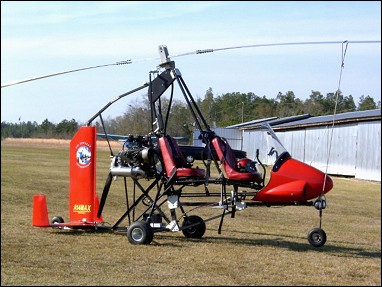
The Air Command Commander Elite is a two-seat kitbuilt autogyro. Construction of the tandem-seat F-30 began in late 1999 with the first flight was made on 1 March 2000, and a public debut at Sun ‘n’ Fun, April 2000. A side-by-side version of the F-30 has been introduced.
The Commander Elite features an open cockpit with a range of options and many subassemblies preconstructed by the factory. Quoted build time was 100 hours.
With pre-drilled and anodised 6061-T6 tubular airframe, with a 5 x 5cm tubing used for mast. With an optional glass fibre enclosure, the F-30 has aluminium rudder and composites horizontal stabiliser and tailfins. The optional enclosure givies 10-15 mph higher cruise speed.
The landing gear is of fixed tricycle type with glass fibre speed fairings, aluminium suspension system with Hager wheels and brakes on all wheels, the mainwheel with hydraulic brakes. The nose wheel is fully castoring with a leg of 4130 steel tube and 6.00×6 Azusa tyres: 7.6cm tailwheel.
The pilot and passenger sit in tandem on Elite F-30 and side by side on Elile F-30ES.
Basic engine instrumentation is provided with each kit, and options include hydraulic pre-rorator and clutch reduction drive on F-30; and pre-rotator, C Box upgrade and electric start on F-30ES. Optional is a New Horizons Components gyro recovery system rocket-powered ballistic parachute. Fuel capacity is 37.9 litres in two seat tanks; and an optional 68.1 litre seat tank.
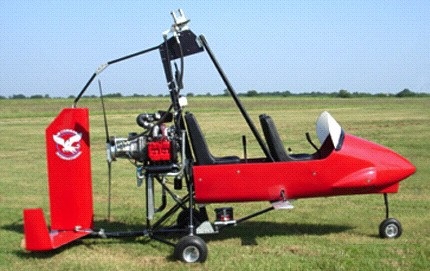
Versions were:
Elite F-30: Basic version, with Hirth F-30 engine.
Elite F-30ES: As F-30, but side-by-side seating.
Elite Mazda: As F-30, but with more powerful engine; withdrawn 2002.
Over 200 kits had been sold by the end of 2002.
The kit pricee in 2001 were:
Tandem light weight without engine: $12,570
Tandem heavy weight without engine: $14,235
F-30 Tandem, basic kit: $19,975
F-30 Tandem, all options: $24,975
Mazda Tandem, basic kit: $22,975
Mazda Tandem, all options: $28,450
The 2003 kit prices were: F-30 US$22,475; F-30ES USS21,792, both including engine.
Engine options include the 67 hp Rotax 582, 100-120 hp Arrow or the original 82.0kW Hirth F-30 driving a 68”four-blade Warp Drive propeller and 27’ x 8” Sky Wheels composite rotor blades. Tandems reach speeds up to 120 mph with a 160-hp engine or 110 mph with a 110-hp Hirth F-30, while the side-by-side can get up to only 85 mph with the F-30. A Patrol version came fully equipped with options.
Tandem
Engine: Rotax 582
Width: 5’7”
Height: 8’10”
Length: 13’5”
Empty wt: 450 lb
Useful load: 685 lb
Gross wt: 1135 lb
Min speed: 20 mph
Cruise: 75 mph
Top speed: 105 mph
Tandem 1000
Engine: Arrow 1000, 100 hp
Speed max: 105 mph
Cruise: 75 mph
ROC: 1000 fpm
Take-off dist: 300 ft
Landing dist: 0-5 ft
Service ceiling: 10,000 ft
Fuel cap: 12 USG
Weight empty: 380 lb
Gross: 1000 lb
Height: 8.9 ft
Length: 13.4 ft
Disk span: 27 ft
Seats: 2
Landing gear: nose or tail wheel
Tandem Subaru
Engine: Subaru EJ22, 135 hp
Propellor: 3 blade 68″
Rotorblades: 28-29′ Dragon Wings, Sky Wheels
Take off roll: 350′-750′
Cruise: 65-95 mph
Fuel Consumption: 3-5 gph
Tandem Mazda
Engine: Mazda 13B Rotary, 170 hp
Height: 8.9 ft
Length: 14 ft
Disk span: 29 ft
Empty weight: 700 lb
Gross weight: 1500 lb
Fuel capacity: 14 USG
Max speed: 120 mph
Cruise: 75 mph
Rate of climb: 1000 fpm
Takeoff dist: 350-700 ft
Landing dist: 0-20 ft
Service ceiling: 10,000 ft
Seats: 2
Tandem Hirth F-30
Engines: Hirth F-30, 110 hp
Propeller: Warp Drive 68″
Rotor Blades: 28-29′ / 8.53m Dragon Wings, Sky Wheels
Width: 6’2″ / 1.88m
Height: 9′ / 2.74m
Length: 13’5″ / 4.09m
Empty Weight: 490 lbs / 222kg
Useful Load: 420 lbs
Gross Weight: 910 lbs / 578kg
Max. operating speed: 177km/h
Min Speed: 20 mph / 33km/h
Cruising speed: 121-129km/h
Top Speed: 75-80 mph
Max rate of climb at sea level: 366m/min
Service ceiling: 3050m
Take-off run: 31-76m
Landing run: 0-6m
Tandem Hirth F-30ES
Rotor diameter: 8.84m
Fuselage length: 3.25m
Height to top of rotor head: 2.13m
Width: 1.70m
Max. take-off weight: 412kg
Empty weight: 141kg
Max. operating speed: 135km/h
Cruising speed: 105km/h
Min flying speed: 36km/h
Service ceiling: 3050m
take-off run: 31-76m
Landing run: 0-6m
 All Aero