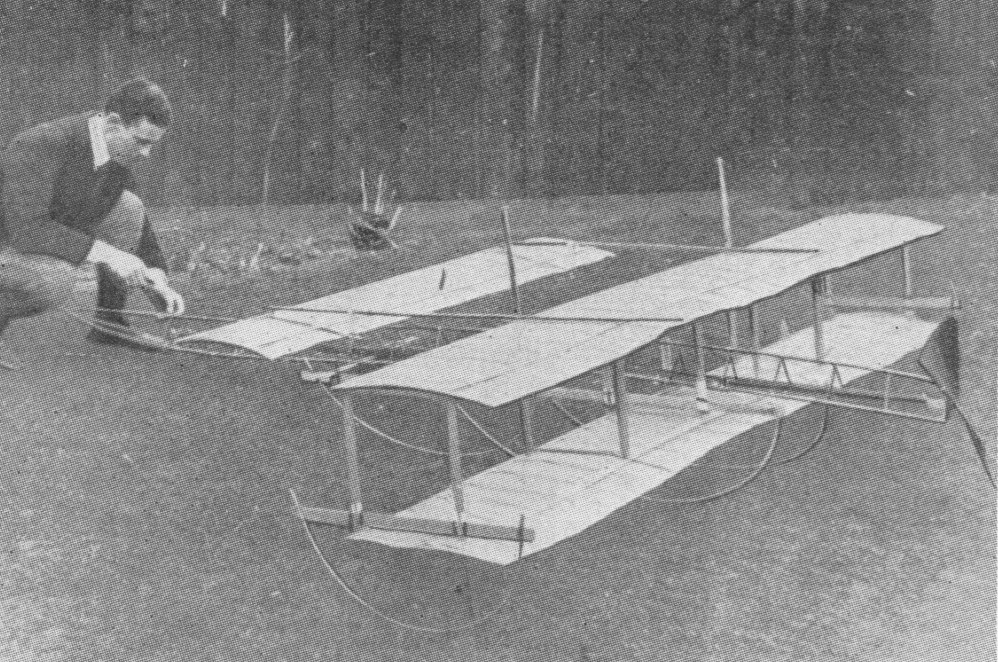
When the Daily Mail organised a model-flying contest at Alexander Palace, London, in March 1907, young A.V. Roe won first prize. His 8 ft tail first model flew more than 100 feet.
Avro Article
Alliott Verdon Roe, after a varied career in surveying, tree-planting, fishing, post-office management and marine engineering began aircraft design in 1906. Spurred by winning £75 in a model aircraft contest held in London in 1907. Roe built a full-size biplane, which made some tentative hops from the motor racing circuit at Brooklands in 1908.
Moving to an abandoned railway arch on Lea Marshes in Essex, he built the Roe I Triplane which weighed less than 91 kg (200 lb) and was covered in brown wrapping paper. He called it the Bull’s-Eye Avroplane after the brand-name of men’s trouser braces whose manufacturer had supported him. In July 1909 the Roe I Triplane made the first official powered flights in Britain by an all-British aircraft.
Alliott Roe subsequently developed three other triplane designs, one of which he flew (and crashed three times) at the great Boston-Harvard Aviation Meeting of 1910.
A.V. Roe and Company was established at Brownsfield Mill, Great Ancoats Street, Manchester, by Alliott Verdon Roe and his brother Humphrey Verdon Roe on 1 January 1910. Humphrey’s contribution was chiefly financial and organizational; funding it from the earnings of the family webbing business and acting as Managing Director until he joined the RFC in 1917.
In the summer of 1910 A. V. Roe and Company declared its willingness to build aeroplanes to other people’s designs and the first such aircraft was a Farman-type biplane for a Bolton business man. The Farman-type evidently did not meet with much success as 18 months later, at the end of 1912, the engine and airframe were advertised for sale in new condition for £45 and £60 respectively. Bolts, fittings and bracing wires were also supplied to Miss Lilian Bland who built and flew the Mayfly biplane of her own design at Carnamony, Belfast. Each of these aircraft was fitted with one of the few examples of the 20 h.p. two cylinder, horizontally opposed, air cooled Avro engines. These were never given an Avro designation.
A.V.Roe carried out numerous experiments with all kinds of plane sections with varying cambers, etc. These were sold off in November 1911 at peppercorn prices for gliders.
The first Avro aircraft to be produced in any quantity was the Avro E or Avro 500, first flown in March 1912, of which 18 were manufactured, most for the newly-formed RFC. The company also built the world’s first aircraft with enclosed crew accommodation in 1912, the monoplane Type F and the biplane Avro Type G in 1912, neither progressing beyond the prototype stage. The Type 500 was developed into the Avro 504, first flown in September 1913. A small number were bought by the War Office before the outbreak of the First World War and the type saw some front line service in the early months of the war, but is best known as a training aircraft, serving in this role until 1933. Production lasted 20 years and totalled 8,340 at several factories: Hamble, Failsworth, Miles Platting and Newton Heath.
By 1913 the company had become registered as A.V.Roe & Co. Ltd.
After the boom in orders during the First World War, the lack of new work in peacetime caused severe financial problems and in August 1920, 68.5% of the company’s shares were acquired by nearby Crossley Motors who had an urgent need for more factory space for automotive vehicle body building.
In 1924, the Company left Alexandra Park Aerodrome in south Manchester where test flying had taken place during the period since 1918 and the site was taken over by a mixture of recreation and housing development. A rural site to the south of the growing city was found at New Hall Farm, Woodford in Cheshire, which continued to serve aviation builders BAE Systems until March 2011.
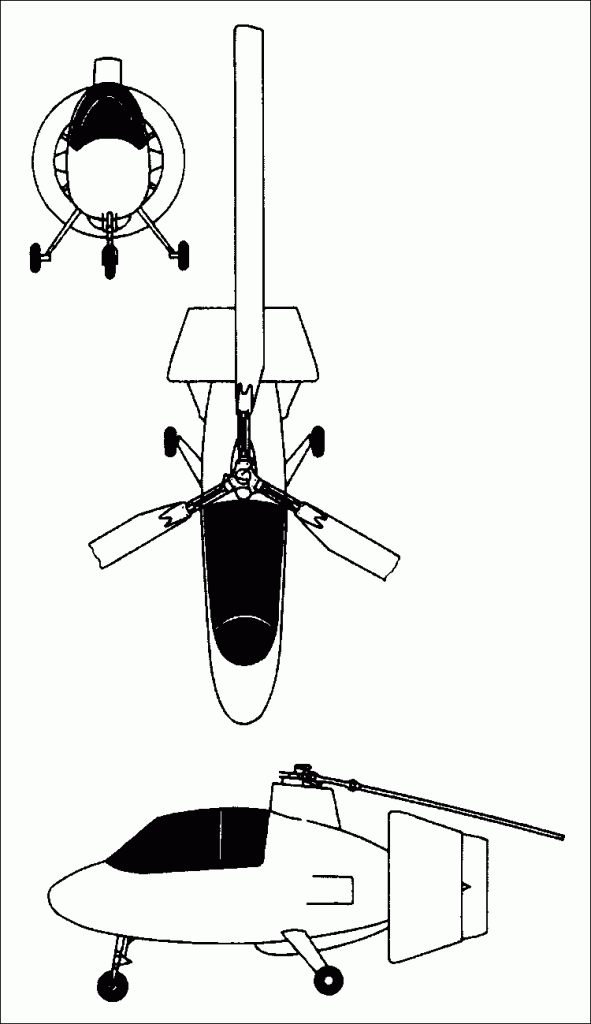
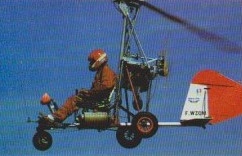
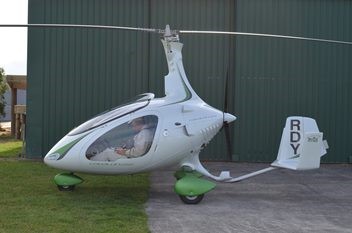
Cierva Autogiro production started in Britain at A. V. Roe’s Hamble factory in 1926.
In 1928 Crossley Motors sold AVRO to Armstrong Siddeley Holdings Ltd. In 1928, A.V.Roe resigned from the company he had founded and formed the Saunders-Roe company that after World War II developed several radical designs for combat jets, and, eventually, a range of powerful hovercraft.
In 1928 Avro acquired a license to build the Fokker F.VIIB/3M as the Avro 618 Ten: it carried eight passengers and two crew, and orders included five for Australian National Airways. Rivaling the success of the 504 was the twin-engined Anson trainer and coastal patrol monoplane, flown as the Avro 652 civil transport for Imperial Airways in 1935.
In 1935, Avro became a subsidiary of Hawker Siddeley.
More than 10,000 Ansons were built in Britain and Canada between 1935 and 1952. The twin-engined Manchester bomber of 1939, with the unproven Rolls-Royce Vulture engines, was not a success, but led to the superb four-engined Lancaster, of which 7,374 were built during Second World War. The York transport derivative mated the same wings and tail, plus a central fin, with an entirely new fuselage seating 12 passengers. The Lincoln bomber was built as a replacement for the Lancaster, entering RAF service soon after VJ-day.
Over 7,000 Lancasters were built and of the total, nearly half were built at Avro’s Woodford and Chadderton (Manchester) sites, with some 700 Lancasters built at the Avro “shadow” factory next to Leeds Bradford Airport (formerly Yeadon Aerodrome), northwest Leeds. This factory employed 17,500 workers at a time when the population of Yeadon was just 10,000. The old taxiway from the factory to the runway is still evident.
Although only ⅓ of Lancasters hit their target, the Lancasters were at the time Britain’s best bombers.
The civilian Lancastrian and maritime reconnaissance Shackleton were derived from the Lancaster design. Avro’s postwar Tudor transport was not a success. With the same wings and engines as the Lincoln, it achieved only a short (34 completed) production run following a first flight in June 1945 and the cancellation of an order from BOAC.
The company’s last piston-engined aircraft was the Shackleton four-engined maritime reconnaissance aircraft. Following production of four Avro 707 delta research aircraft, the company produced the four-jet delta-wing Vulcan bomber, which began to enter RAF service in 1956. The Vulcan saw service as a conventional bomber during the British campaign to recapture the Falkland Islands in 1982. Vulcan XH558 flew again after several years of refurbishment, and several are prized as museum exhibits. Avro’s last design before being restyled the Avro Whitworth Division of Hawker Siddeley Aviation, in 1963, was the Avro 748 twin-turboprop transport (first flown in 1960). The Royal Flight bought a few and a variant with a rear-loading ramp and a “kneeling” main undercarriage was sold to the RAF and several members of the Commonwealth as the Andover.
When the company was absorbed into Hawker Siddeley Aviation with Folland, Gloster, Armstrong Whitworth, and de Havilland in July 1963, the Avro name ceased to be used. The brand still had a strong heritage appeal, and the marketing name “Avro RJ” (regional jet) was used by British Aerospace for production of the RJ-85 and RJ-100 models of the BAe 146 from 1994 to 2001. This aircraft type is sometimes also loosely called the “Avro 146”.
The BAe ATP (Advanced Turbo Prop) design evolved from the Avro 748. At 39 years, the Shackleton held the distinction of being the aircraft with the longest period of active RAF service, until overtaken by the English Electric Canberra in 1998.
 All Aero