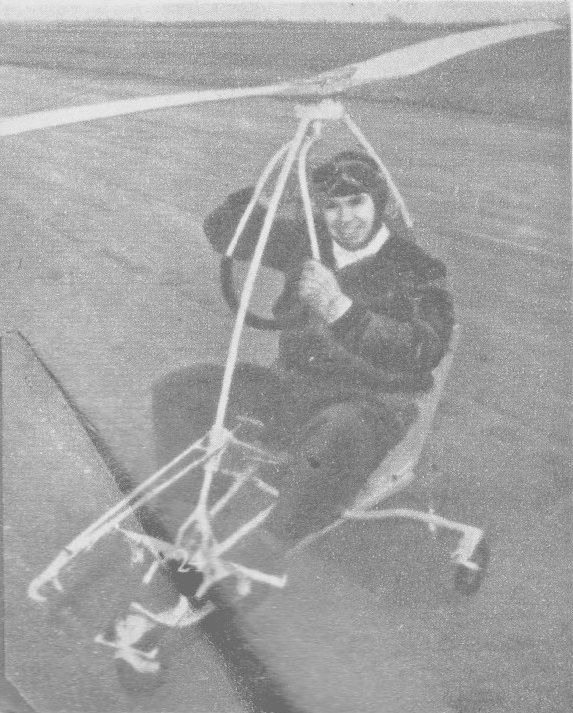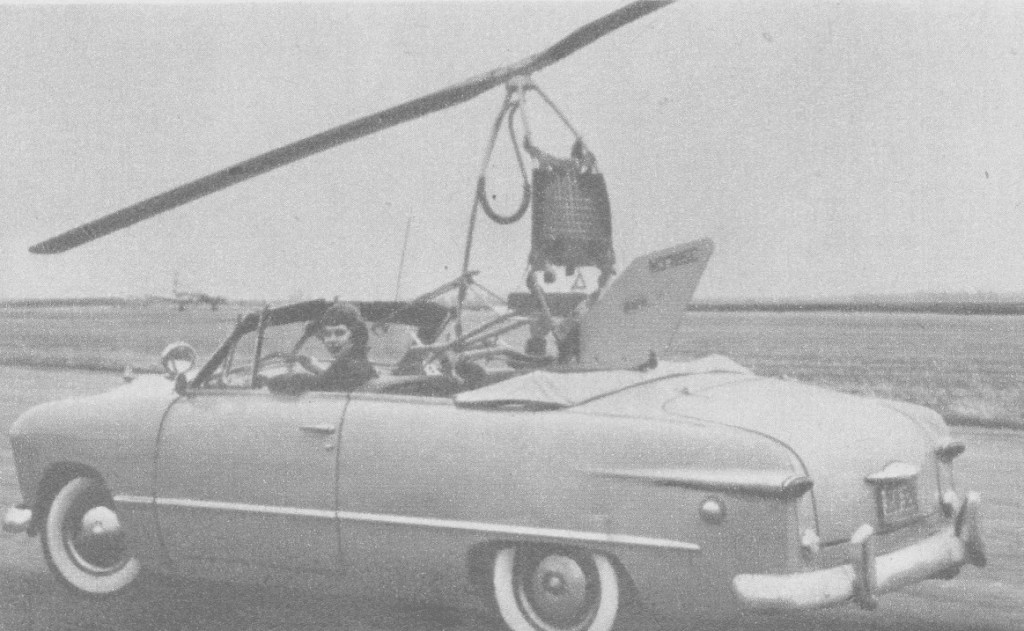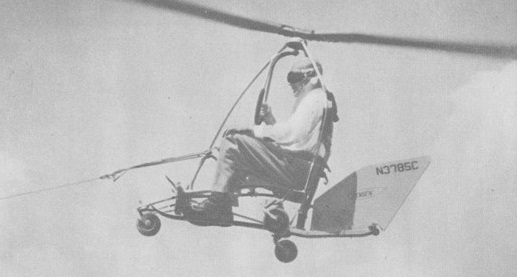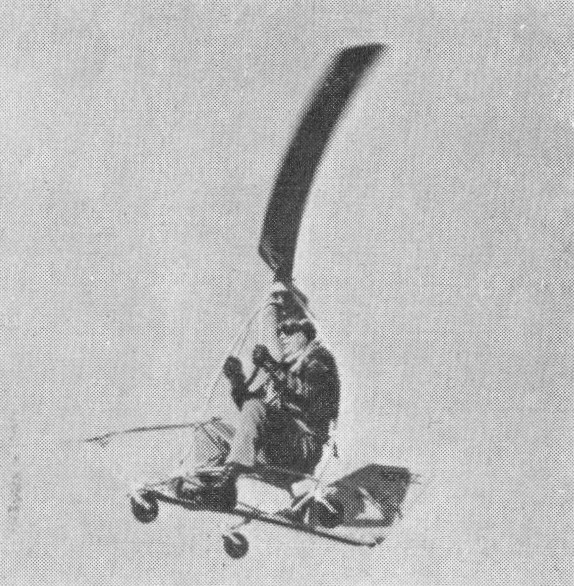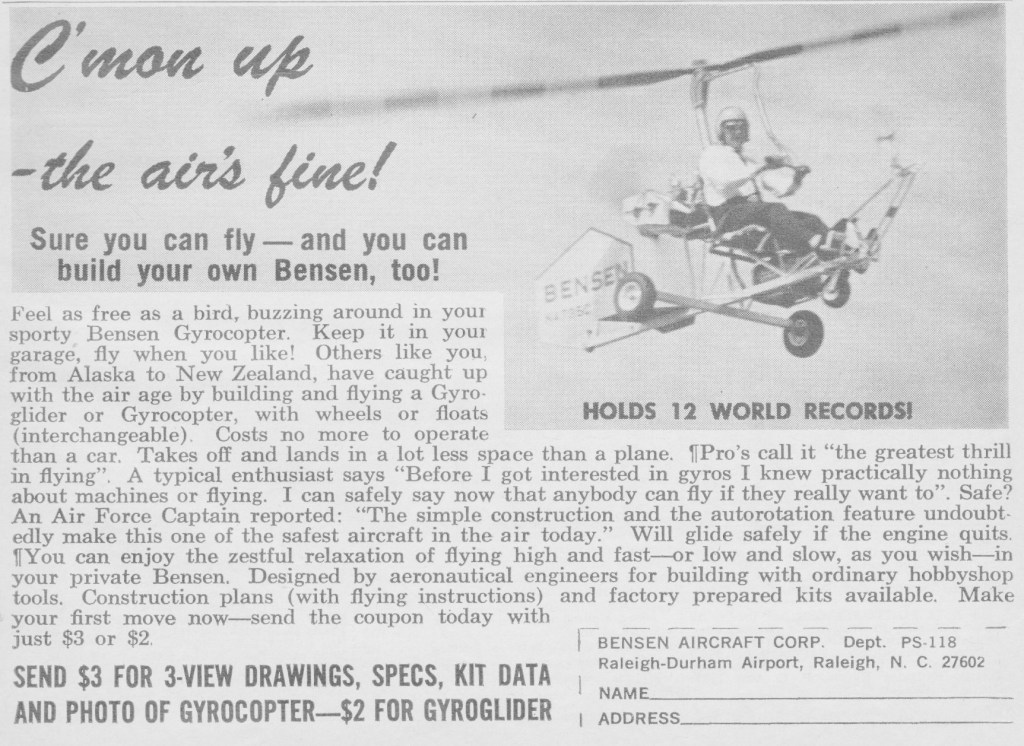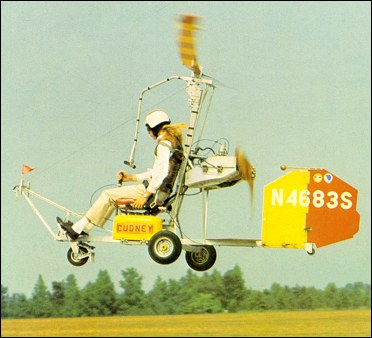
Bensen B-8

B-8M

From the B-5 Gyro-Glider factory-built prototype of 1954, Bensen evolved the B-6 and B-7, and from these has come the standard production model the B-8.
This has a more sturdy construction and was available as a factory-built machine or in kit form for amateur construction. Two water-borne versions of the B-8 were also available: the B-8B Gyro-Boat which has a boat-type hull and twin outrigged stabilising floats, and the B-8W Hydro-Glider mounted on twin floats.
From the reworked B-7M came the B-8M variant, first flying on 8 July 1957 and by the first production B-8M on 9 October 1957.
The B-8M is normally powered by a 72hp McCulloch piston engine. Optional features include a 90hp McCulloch engine and a mechanical rotor drive enabling the autogyro to make jump starts.

A float version of the B-8M is known as the Hydro-Copter.
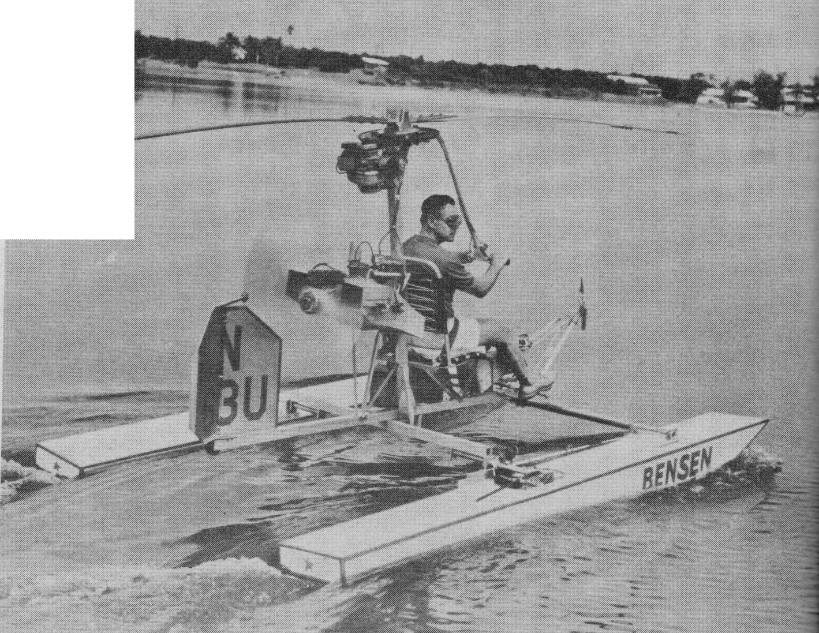
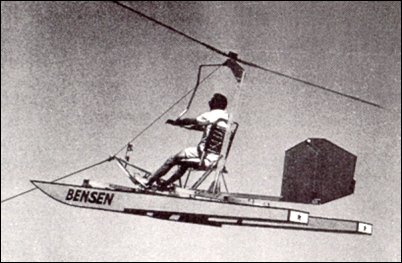
The Gyro-Boat is a variant of the Gyro-Glider, in which the basic free-turning rotor system, known as the Roto-sail, is mounted on any standard small dinghy. The result is literally a flying boat, intended to be towed above water by a motor boat.
The two-blade steel and plywood rotor has a diameter of 6.10m and disc area of 29.2sq.m. Each blade has an area of 1.0sq.m. When fitted to a 3.66m aluminium dinghy weighing 45kg, the complete Gyro-boat has an empty weight of 68kg and a loaded weight of 147kg carrying one person or 227kg carrying two people.
It takes off when towed at a forward speed of 37km/h, cruises at 55-110km/h and lands at 11km/h.
The prototype Gyro-Boat flew for the first time on April 25, 1956, and the first production model on July 8, 1956. The 1959 version can be fitted with stabilizing pontoons on outriggers for rough water operation.

B-8B Gyro-Boat

Designed for home construction from kits or plans, captured a series of international records in 1967, including an altitude of 7,275 ft (2,717 m) and a speed of 79 mph (127.15 kph) over a 15 km course.
In early 1968 the USAF ordered three as X-25 to test methods of improving the odds of a downed flyers escape. The X-25A had a more robust structure and a small engine. The two-seat X-25B was originally used un-powered but was later fitted with an engine.

By 1984 there were more than 10,000 active rotorcraft fans in the United States.
With purchase of their plans and component kits, it is possible to build a machine in a few weeks of spare time, with only a drill press and a few wrenches. Bensen Gyrocopters can be towed behind a car or boat or flown under their own power. The simple glider models are available as one or two seaters. The powered gyrocopters are available only as single seaters. The Gyrocopter is capable of climbing to 12,500 feet. The powerplant is a 72- to 90-hp McCulloch.
Price in 1982: $4,850 (Excludes engine). Units delivered to June 1982: 4,000.

The B-8 Gyro-Glider is a simple unpowered rotor-kite which can be towed behind even a small motor car. It is available as either a completed aircraft or kit of parts for amateur construction. Alternatively, would-be constructors can purchase a set of plans, with building and flying instructions. No pilot’s licence is required to fly it in the United States and many hundreds of kits and plans have been sold. Application was been made for an Approved Type Certificate.
The original Model B-7 Gyro-Glider was followed by the Model B-8, which is offered as either a single-seater or two-seater, the latter version being suitable for use as a pilot trainer.
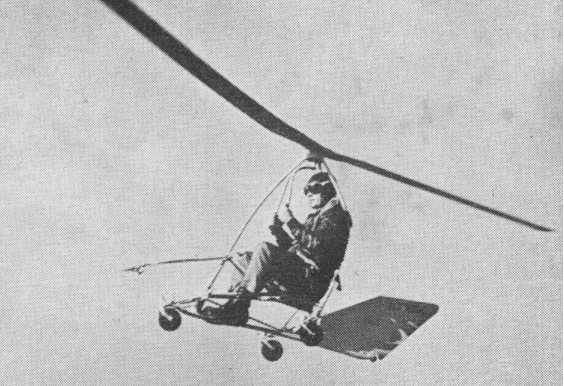
The Model B-8 consists basically of an inverted square-section tubular aluminium T-frame structure, of which the forward arm supports the lightweight seat, towing arm, rudder bar and landing gear nose-wheel. The rear arm supports a large stabilising fin and rudder, with the main landing gear wheels carried on a tubular axle near the junction of the T-frame. The free-turning two-bladed rotor is universally-mounted at the top of the T-frame and is operated directly by a hanging-stick control. It is claimed that the entire aircraft can be made from commercial tubing, wood and locally-available materials.
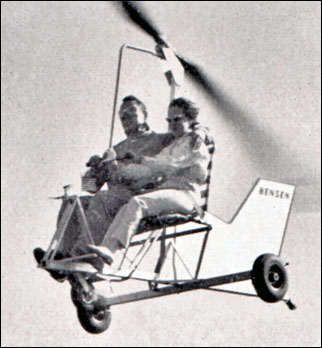
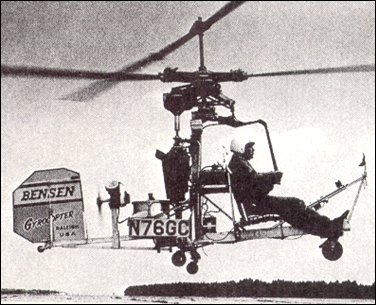
B-8 Gyro-Glider
B-8MH Hover-Gyro

Demonstrated in public for the first time in 1976, the B-8MH Hover-Gyro is described as a ‘Hovering Gyro-Copter’. It was powered by a 70-110hp modified water-cooled outboard engine driving the lower of the two rotors; the upper rotor autorotates. One 14 hp modified air-cooled go-kart engine drives the pusher propeller mounted at rear.
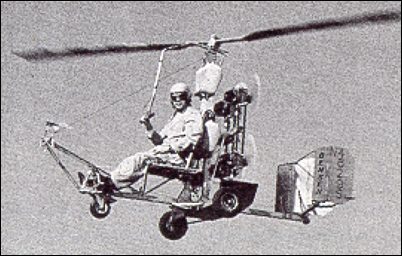
B-8 Super Bug

The B-8 Super Bug was a B-8M modification with two engines installed to spin up the rotor prior to take-off.
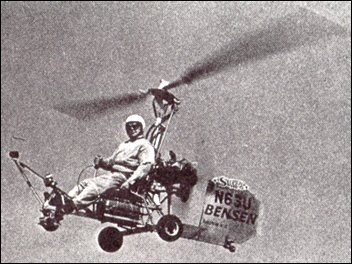
B-8HD

The B-8HD was a 1979 Gyro-Copter was based on the Super Bug design. It uses hydraulic drive to feed about 4hp from the engine to the rotor, instead of having a separate engine for pre-rotation. This is reported to give the aircraft a take-off run of less than 61m.

In August/September 1964 the B-8M three-view drawings, photos and specification were available for $2, or the complete construction plans for $30.
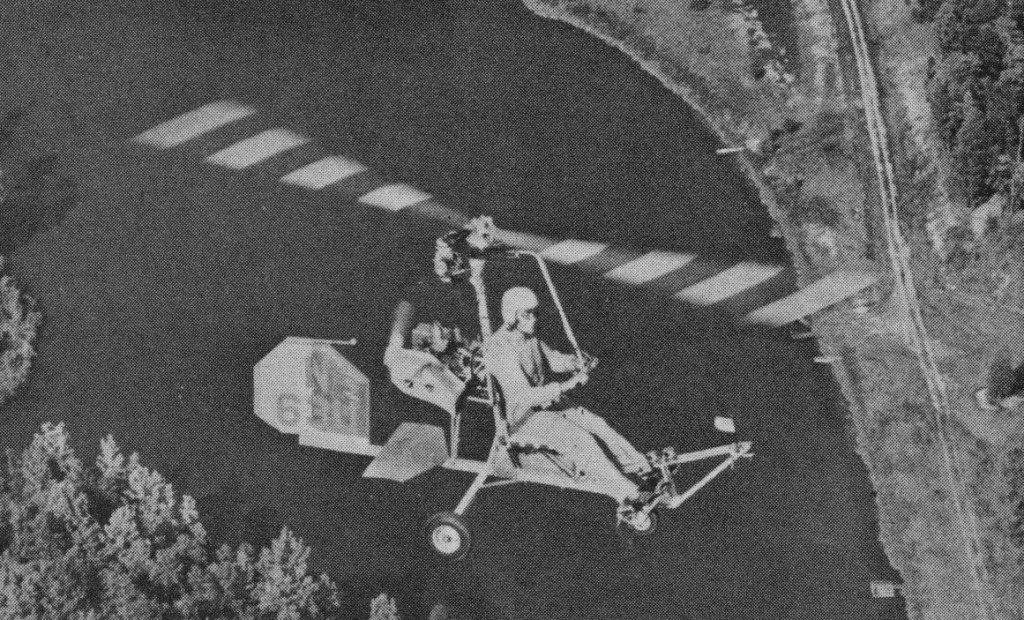
B-8M

Gallery

B-8 Gyro-Glider
Main rotor diameter: 6.1m
Fuselage length: 3.45m
Height: 1.90m

B 8M
Engine: McCulloch 4318E 4 cylinder, 72 hp
Rotor dia: 20 ft 0 in (6.1 m)
Fuselage length: 11 ft 4 in (3.45 m)
Height: 6 ft 3 in (1.9 m)
Max TO wt: 500 lb (227 kg)
Empty Wt. 247 lbs / 112kg
Fuel capaci¬ty 6 USG
Max level speed: 85 mph (137 kph)
Cruising speed: 72km/h
Ceiling: 12,000 ft / 3810m
Range: 161km
Bensen B-7

From the B-5 Gyro-Glider factory-built prototype of 1954, Bensen evolved the B-6 and B-7, and from these has come the standard production model the B-8. This has a somewhat more sturdy construction and is available as a factory-built machine or in kit form for amateur construction. Two water-borne versions of the B-8 are also available: the B-8B Gyro-Boat which has a boat-type hull and twin outrigged stabilising floats, and the B-8W Hydro-Glider mounted on twin floats.
In 1955 Bensen placed an engine in the B-7 and renamed it the B-7M (“m” for motorised). The B-7M flew for the first time on 6 December 1955. Two years later, in 1957, the B-7M was upgraded to include, among other refinements, a McCulloch 72-hp pusher engine.

Bensen B-6 Gyroglider

Bensen’s range of do-it-yourself helicopters and autogyros stem from the B-5 Gyro-Glider of 1954, which was a single-seat rotor-kite towed into the air at around 30km/h and obtained its lift by the flow of air over its autorotating rotor.

The 86 lb Bensen “Gyro-glider” which, towed behind a car, takes off at about 20 m.p.h. The B-6 Gyro-Glider could be built at home from household pipe, plywood and steel strip for about £30 in 1955.
In still air, it lands in 10-15 ft. at 7 m.p.h.

From the B-5 factory-built prototype, Bensen evolved the B-6 and B-7.
B-6
Engine: none
Main rotor diameter: 6.0m
Length: 3.45m
Height: 1.91m
Empty weight: 58kg

Bensen

Founded by Dr. Igor B. Bensen, formerly chief research engineer of the Kaman Corporation, to develop a series of lightweight autogyros. Examples built and supplied to USAF for research purposes, but marketed primarily in kit form for amateur construction. Also attempted to develop Cargolifter as multi-helicopter lifting platform, with eight-rotor sub-scale prototype flown in early 1980s.

November 1969

Baumgartl PB-60

Paul Baumgarti was an Austrian who had worked on three helicopter designs during the war years before emigrating to Brazil. He experimented with a number of light helicopters in the 1950s and 1960s including the single-seat PB-60 unpowered ground-towed rotor kite, and the PB-64 which was an ultra-light single-seater with a minimal tubular fuselage structure. No production of any of these designs was undertaken.

Barnett BRC540

Side seating, dual controls, 3 throttles – left, center, right – in front of seat cushion. 44″ wide inside.
Luggage space under and behind the bench seat. Price includes engine. Info pack, Barnett video and Subaru video – all for $47.50 Kit Price: $32,766 Plans: $185 in 2009.
BRC Coupe540 plans 2001: $225.
BRC540 Coupe
With a maximum airspeed of 138 mph faster than some basic helicopters the sporty “coupe” suffix is fitting. Cruising speed ranges from 85 to 105 mph, depending on altitude and load. The fully enclosed side-by-side two-seater also has dual controls, three throttles and two spaces for luggage.

Two-seat, side-by-side, fully-enclosed autogyro
Engines: Lycoming O-360, Continental, Subaru EJ22/EJ25
Propeller: 7′ prop capability
Rotor Blades: 32′ X 8″
Cruise 110 mph
Top Speed 138 mph
Empty Weight 625 lbs
Gross Weight 1,248 lbs
Height 8’1″
Length 14’5″
Fuel Capacity 17.5 gal
Disc Span 29.4′

Barnett J3 / J4 / J4B-2

The Barnett Gyroplane is a single-place craft constructed of tubular 4130 steel, fiberglass and aluminum. Its pusher prop is powered by a 65-hp Continental engine (originally a VW engine). The pilot sits inside an enclosed cabin shell. The J3-M differs from the J-4B by replacing the molded fiberglass cockpit nacelle with a flat-sided fabric-covered structure. Both models are fitted with tricycle gear and disc brakes.
Welded 4130 tubing airframe and tail. Fiberglass body shell polycarbonate covered canopy. Powder coated
assemblies. All four wheels sprung. Info pack, Barnett video and Subaru video – all for $47.50
Kit: $7,000 plus engine and instruments Plans: $135; 2009
Flying solo, you’ll get up to 125 mph in the single-seat J4B, but cruise is 110 mph in the tandem J4B2. J4B is available enclosed or partially enclosed, while the two-seater J4B2 is an enclosed model. The J4B plans 2001: $155

Barnett J4B2

The Barnett J4B2 is a two seat, tandem, enclosed autogyro. Welded 4130 tubing airframe and tail. Fiberglass body shell. Side pivot on canopy. All four wheels sprung. Prerotator optional. Cruising speed is 110 mph in the tandem J4B2. The J4B is available enclosed or partially enclosed, while the two-seater J4B2 is an enclosed model. J4B2 plans 2001: $185
Welded 130 tubing airframe and tail. Fiberglass body shell. Side pivot on canopy. All four wheels sprung.
Prerotator optional. Info pack, Barnett video and Subaru video – all for $47.50
Kit: $7,500 plus engine and instruments. Plans $185 in 2009.

J-4
Engine: VW, 34 hp
Gross Wt: 750 lb
Empty Wt: 441 lb.
Fuel capa¬city: 15 USG.
Main rotor length: 24’.
Length: 12’2”.
Top speed: 115 mph.
Cruise speed: 90 mph.
Climb rate: 700 fpm.
Ceiling: 14,000 ft.
Takeoff run: 200 ft.
Landing roll: 0-20 ft.
Range: 250 sm.

J-4B
Engine: 100 hp Continental O-200
Engine range: 65-100 hp
Prop: Barnett 57.5” Precision 3 blade wood laminate.
Rotor blades: Bonded and rivited aluminium 10’ x 7 3/8”.
Disk span: 23 ft.
Disk area: 415 sq.ft.
Min speed: 30 mph.
Cruise: 97 mph.
Top speed: 120 mph.
ROC: 1500 fpm.
Fuel cap: 15 USG.
Empty wt: 530 lbs.
Useful load: 350 lbs.
Gross wt: 850 lbs.
Width: 6’8”.
Height: 7’8”.
Length: 12’4”.

J-4B
Engine: Subaru, 100 hp.
Max speed: 120 mph.
Cruise speed: 97 mph.
Range: 270 sm.
ROC: 1500 fpm.
TO dist: 150 ft.
Ldg dist: 0-20 ft.
Service ceiling: 15,000 ft.
Fuel cap: 15 USG.
Empty wt: 441 lb.
Gross wt: 850 lb.
Height: 7.8 ft.
Length: 12.1 ft.
Disk span: 23 ft.
Disk area: 415 sq.ft.
Seats: 1.

J4B2
Engine: Continental O-200, 100 hp.
HP range: 100-150.
Speed max: 112 mph.
Cruise: 93 mph.
Range: 199 sm.
ROC: 500 fpm.
Take-off dist: 300 ft.
Landing dist: 0-20 ft.
Service ceiling: 8,000 ft.
Fuel cap: 17 USG.
Weight empty: 512 lbs.
Gross: 1085 lbs.
Height: 8.1 ft.
Length: 13.67 ft.
Disk span: 25.4 ft.
Disk area: 505 sq.ft.
Seats: 2.
Landing gear: nose wheel.
Prop: Barnett 57.5” Precision 3 blade wood laminate.
Rotor blades: Bonded and rivited aluminium 12’ x 7.75”.