Cierva

Juan de la Cierva was born in Murcia, Spain on September 21, 1895, and by 1908-9, had decided to make aviation his career. In 1911 he enrolled at the Civil Engineering College of Madrid (Caminos, Canales y Puertos) and in 1912 with his friends “Pepe” Barcala and Pablo Diaz constructed the first Spanish airplane, the BCD-I, known as “EI Cangrejo” – the “Red Crab”, becoming the “Father of Spanish Aviation.”

By the mid 1920s Cierva’s success became known worldwide, and he was invited to Britain to demonstrate his machines to the Air Ministry.

Transferring operations to England in 1925 and forming Cierva Autogiro Ltd. on March 24,1926 with prominent Scottish industrialist James G. Weir, his brother Viscount William Weir of Eastwood and Sir Robert M. Kindersley, Cierva continued to improve the Autogiro and in early 1929 licensed the technology and rights to his patents to Harold Frederick Pitcairn of Bryn Athyn, P A. Early models of which were based on surplus Avro 504Ks. British, French, German, American, Japanese and Russian companies built Cierva type autogiros.

Two best known craft were C.8L, first rotorcraft to fly the English Channel, and C.30A, built by A. V. Roe as Rota for RAF. Production of other Autogiros licensed by Cierva to Airwork (C.30, C. 30P); Avro (C.6, C.8, C.9, C.12, C.17, C.19, C.30A, C.30P); British Aircraft Manufacturing Co (C.40); Comper (C.25); de Havilland (C.24, C.26); George Parnall & Co. (C.10, C.11); and Westland (CL.20).

Weir formed a separate company (G. & J. Weir Ltd.) in 1933, and reestablished Cierva Company in 1944.

In 1936, Cierva was killed in the Croydon KLM airliner accident when the aircraft in which he was a passenger crashed after taking off in fog. From 1936 to 1939 James Allan Jamieson Bennett was Chief Technical Officer of the company. Dr. Bennett carried through with Cierva’s intention to offer the Royal Navy a gyrodyne, which Cierva had argued would be simpler, more reliable and efficient than the proposed helicopter. Bennett’s design, the C.41, was tendered to the Air Ministry (Specification S.22/38) but preliminary work was abandoned with the outbreak of World War II. Bennett joined Fairey Aviation in 1945, where he led the development of the Fairey FB-1 Gyrodyne.

After Second World War evolved (jointly with above company), the W.9, a two-seat helicopter using jet thrust to counteract torque. The W.11 Air Horse three-rotor design was built for Cierva by Cunliffe-Owen; designed specifically for crop-spraying, it was first flown December 8,1948. The first prototype of the Air Horse crashed killing Alan Marsh, Cierva’s manager and Chief Test Pilot John “Jeep” Cable, Ministry of Supply Chief Helicopter Test Pilot, and J. K. Unsworth the Flight Engineer. This led Weir to cease further investment in the company and its development contracts were transferred to Saunders-Roe.

The W.14 Skeeter, small two-seat helicopter, first flown October 8,1948. Both designs taken over in 1951 by Saunders-Roe, together with other Cierva projects. Company then concentrated on research; eventually reemerged as Cierva Rotorcraft Ltd, and bought up Rotorcraft Ltd. in April 1966 and Servotec Ltd. in 1968.The prototype CR.LTH-1 flew October 18,1969, but was not produced due to lack of funds.

J.Weir maintained a working association with J.S.Shapiro, and in 1961 63 Servotec built a man carrying helicopter model to embody Weir’s ideas of a non stalling rotor, which emerged from many years of model tests. In the course of this collaboration, Weir became aware of the CR Twin development and in 1965 decided to give this development financial support. This combination of interests was cemented in a take over of Rotorcraft Ltd by the Cierva Autogiro Co, which was thereupon renamed the Cierva Rotorcraft Co. The largest shareholders were Weir and Shapiro.
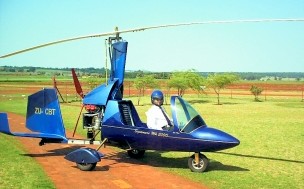
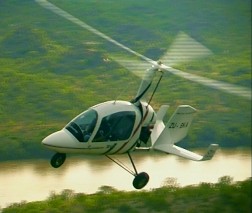
Chayair Sycamore Mk.2000

At 17 ft., 9 in., the tandem Sycamore is one of the longer gyroplanes, using a 115-hp engines and reaching speeds up to 106 mph. The Mk2000 is partially enclosed.
Square and round-tube aluminum airframe with composite semi-enclosure. Instrument panel.
Available: Production built, licensed in the LSI amateur-built class.

Two-seat tandem, semi-enclosed gyroplane
Engine: 115 hp Rotax 914, turbo charged four-stroke
Propeller: 68″ ARPLAST 3-blade
Rotor Blades: Chayair composite
Specifications:
Min Speed 35 mph
Cruise 80 mph
Top Speed 110 mph
Empty Weight 365 kg
Useful Load 225 kg
Gross Weight 590 kg
Width 5’11”
Height 8’6″
Length 17’9″

Chayair Sycamore Mk.I

At 17 ft., 9 in., the tandem Sycamore is one of the longer gyroplanes, using a 115-hp engines and reaching speeds up to 106 mph. The Mk1 is fully enclosed.
Square and round-tube aluminum airframe with composite enclosure, removable doors. Instrument panel.
Available: Production-built, licensed in the LS1 amateur-built class.

Two-seat tandem fully enclosed gyroplane
Engine: 115 hp Rotax 914 turbocharged four-stroke
Propeller: 68″ ARPLAST 3-blade
Rotor Blades: Chayair composite
Min Speed 35mph
Cruise 80 mph
Top Speed 110 mph
Empty Weight 380 kg
Useful Load 210 kg
Gross Weight 590 kg
Width 5 ft 11 in
Height 8 ft 6 in
Length 17 ft 9 in

Chauviere Gyroptere

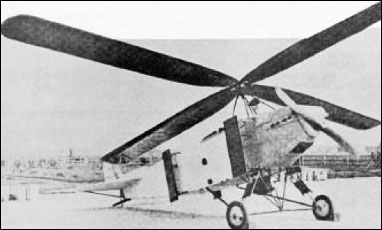
Lucien Chauviere, a propeller designer, built a machine dubbed the Gyroptere in 1927, based on the principles of a patent he had filed ten years earlier. It used a 170kW Renault engine to drive a four-blade rotor with flapping hinges and clutched to power a tractor propeller at the nose. To counter torque while the rotor was powered, control flaps mounted vertically on the fuselage sides vectored the slipstream. Testing of the 1,372kg aircraft did not progress very far before his available finances were expended.

Celier Aviation Kiss

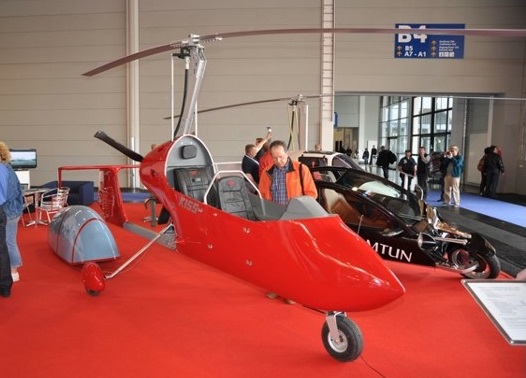
The Celier Kiss is a series of Polish autogyros that was designed by Frenchman Raphael Celier and produced by his company, Celier Aviation of Jaktorów-Kolonia, Poland. When it was available the aircraft was supplied as a kit for amateur construction or as a complete ready-to-fly-aircraft.

The tandem seat Kiss series was designed as a complement to the side-by-side configuration Celier Xenon 2 series of autogyros. The Kiss series all feature a single main rotor, tricycle landing gear, a low-set T-tail and a choice of engines, all mounted in pusher configuration.

In 2011 the Kiss 912, assembled, cost €29,900.

Variants:

Kiss 912
Base model, with two seats in tandem, powered by a 80 hp (60 kW) Rotax 912UL engine in pusher configuration. The cockpit has a semi-enclosed fairing with a windshield.
Main rotor diameter: 8.4 m (27 ft 7 in)
Main rotor area: 55.4 m2 (596 sq ft)
Empty weight: 200 kg (441 lb)
Gross weight: 450 kg (992 lb)
Fuel capacity: 50 litres (11 imp gal; 13 US gal)
Maximum speed: 140 km/h (87 mph, 76 kn)
Endurance: 3 hours
Rate of climb: 3 m/s (590 ft/min)
Disk loading: 8.1 kg/m2 (1.7 lb/sq ft)
Crew: one
Capacity: one passenger

Kiss 912S
Upgraded model, with two seats in tandem, powered by a 100 hp (75 kW) Rotax 912ULS engine in pusher configuration. The cockpit has a fully enclosed fairing.

Kiss 914
Turbocharged model, with two seats in tandem, powered by a 115 hp (86 kW) Rotax 914 engine in pusher configuration. The cockpit has a fully enclosed fairing.

Celier Aviation

Celier Aviation is an aircraft manufacturer, founded by Raphael Celier in France in 1993. The company was moved to Piotrków Trybunalski, Poland in 2006 and Safi, Malta in 2017. The company specializes in the design and manufacture of autogyros available in kit form and also as fully assembled aircraft.

The company established its reputation with the two-seat side-by-side configuration Celier Xenon 2 series of autogyros. By 2011 over 100 of these were flying. Celier subsequently developed a tandem-seat design, the Kiss, but it was not produced in large numbers. By 2014 the company was offering only the Xenon 4, a development of the Xenon 2.

The company also developed the XeWing, a fixed wing light aircraft using the fuselage and engine of the Xenon 2, but mounting a folding strut-braced parasol wing in place of the autogyro’s main rotor. The design was shown at AERO Friedrichshafen in 2009, but was never offered for sale and it is unlikely it was ever developed beyond a single prototype.

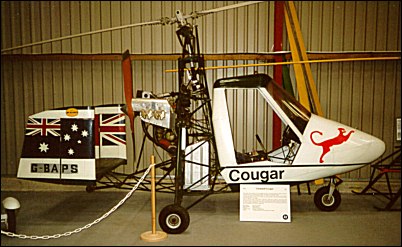
Campbell Cougar

The Campbell Aircraft Company was founded in the late 1950’s to develop and build autogyros and in 1969 began production of the single seat Cricket autogyro. This was later followed by a two-seat project and the construction of a single seat prototype was carried out by Western Airways at Weston-super-Mare Airport in early 1973. Powered by a single Rolls Royce Continental O-240-A 4-cylinder ‘flat-four’ piston engine it first flew in April 1973.

Cricket autogyros were still being manufactured in 2007, and Peter Lovegrove who was the original designer of the Cougar and Cricket was still involved.