Focke-Achgelis Fa-225

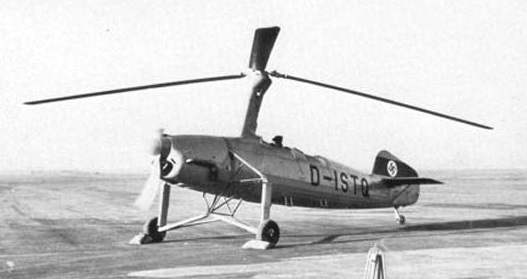
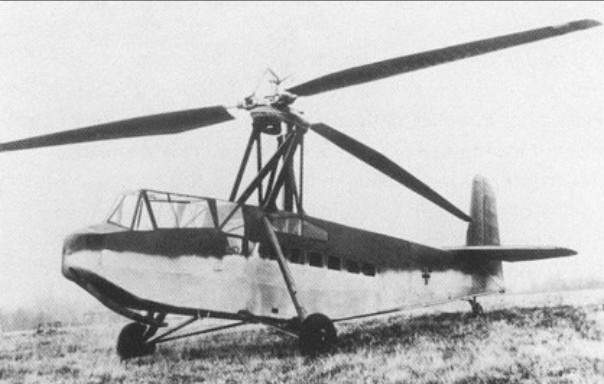
During the first half of the Second World War, the use of assault gliders was dependent on the availability of sufficient landing area. The idea arose of exploiting the almost vertical or very steep descent to be obtained from rotary wings in autorotation, and in 1942 the fuselage of a DFS 230 glider had its fixed wings replaced by an Fa 223 three-blade rotor mounted on a structural pylon. To take the increased landing load, a braced undercarriage replaced the normal skid. This hybrid rotaglider, designated Focke Achgelis Fa 225, was towed behind a Junkers-Ju 52/3m in tests, during 1943, and could land within a distance of 18 m (59 ft). It was not put to operational use.

Fa 225
Rotor diameter: 12m
Loaded weight: 4400 lb
Useful load: 2200 lb
Max towed speed: 190km/h

Focke-Achgelis Fa 186

German helicopter development began with Focke Wulf’s acquisition of the rights to manufacture Cierva autogyros during the 1920’s. Over 30 Cierva C.19 and C.30 autogyros were built during the late twenties and early thirties, and from this experience, Heinrich Focke, the engineering half of the Focke Wulf organization, decided to develop an original autogyro design to compete in the Luftwaffe’s contest to provide a utility-liaison aircraft. The Fa 186 was a one-man autogyro built by Focke-Wulf in 1937 with backing from the RLM (ReichsLuftfahrtMinisterium – Reich Aviation Ministry).

The Fa-186 was essentially a FW-56 “Stosser” parasol wing advanced trainer, with the wings removed, tail unit and landing gear redesigned and configured for two seats in tandem. The engine remained unchanged, with a clutch arrangement installed to start the blades rotating for takeoff. An autogyro uses the main powerplant for forward thrust while the rotors freewheel in flight. The aircraft could take off and land in very short distances, but it could not hover or take off and land vertically. Although the Fa-186 was successfully flown it was beaten out by the Fieseler Fi-156 Storch for the Luftwaffe contract. Only one prototype of the aircraft was constructed, and the project was abandoned when the RLM preferred the Fieseler Fi 156 Storch over the Fw 186.

The ilmavoimat / Maavoimat team did evaluate the Fa-186 very early in 1938, and while it was considered not suitable for the intended role and was removed from consideration, one of the Maavoimat Officers on the evaluation team (who was also familiar with the Glider Program underway) considered the gyrocopter interesting enough to recommend further discussions with the FockeWulf company to his own immediate Command.

Engine: Argus As 10C, 240 hp
Maximum speed: 112 mph

Focke-Achgelis

Formed in 1933 by Heinrich Focke, formerly of Focke-Wulf, and aerobatic pilot Gerd Achgelis. Developed world’s first completely successful helicopter, Fw 61, flown as a prototype on June 26,1936. Also designed Fw 186 Argus As 10C-engined autogyro to similar requirement that had produced the Fieseler Storch. Twin-rotor Fa 223 Drache, first flown August 1940, ordered into production 1942 at Hoyenkamp factory, later at Laupheim; in 1945 a captured Drache became first helicopter to cross English Channel. Fa 330 Bachstelze rotor kite deployed operationally aboard U-boats from 1942.

Flettner Fl 185

The development contract for the Fl 185 was issued by the RLM in February 1937; two SV-Types were planned. It was given the designation “Helicopter Conversion 184” in the Aircraft Development Program, because the planned Fl 184 V3 was used in the construction of the Fl 185 V1. The Fl 185 project was financed with the insurance sum received from the destroyed Fl 184 V1 and a grant of approximately RM 50,000 from the RLM. Mockup inspection took place in April 1937.

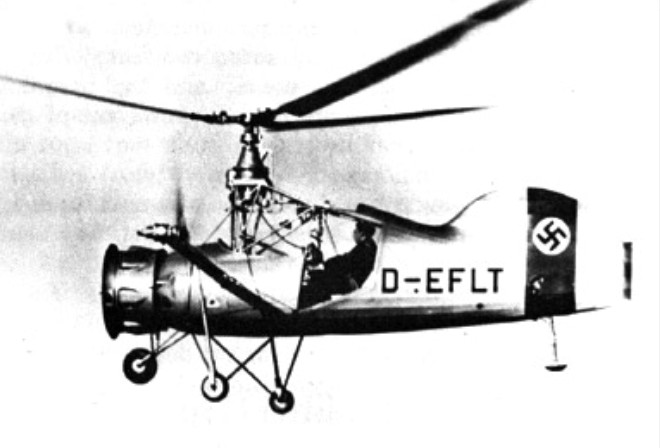
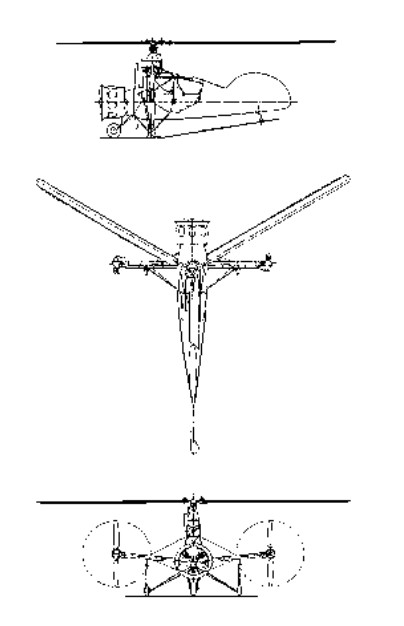
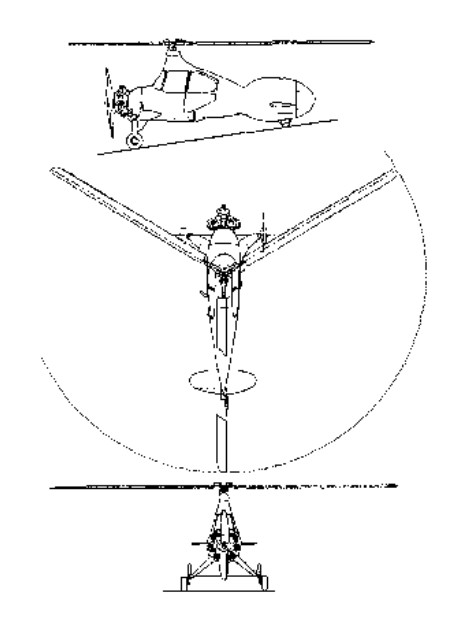
The Fl 185 was a gyroplane equipped with a three-blade rotor. Torque balance was achieved by means of variable-pitch pusher propellers driven by extension shafts located at the ends of outriggers mounted on each side of the fuselage. The starboard propeller produced backward thrust, the port forward, so that the total moment exerted on the fuselage balanced that of the main rotor. The centrally-mounted Sh.14A engine drove, in addition to the rotor and anti-torque propellers, a large cooling fan in the nose consuming about 14hp. The main gearbox was in the front part of the cockpit.

The sole prototype built was the Fl 184 V1 D-ELFT, which carried out a number of flights m 1938. The Fl.185, which had a three-wheeled undercarriage, was given only a few tests near the ground, and then abandoned in favour of the Fl.265, which embodied the intermeshing rotor system on which Flettner had now begun to work.

Fl 185
Engine: 1 x Siemens-Halske SH 14A, 140hp
Rotor diameter: 12m
Weight fully loaded: 898kg
Empty weight: 771kg
Seats: 1

Flettner Fl 184

In December 1934 talks were held by the development group of the RLM (LC II) in the presence of State Secretary Milch which were to lead to important decisions concerning future air armaments.

The following is noted in the minutes under Section 4 “Rotary Wing Aircraft”: “The development of rotary wing aircraft is to receive preferential treatment. Consequently all work now under way is to be accelerated, as these aircraft will presumably be of significance for land and sea use in the future.”

In the LC II.1’s general working plan (Dec. 1935) “rotary wing aircraft” appeared under the heading: “Sport, basic training, advanced training and special aircraft” (Report II/1a). The following types are listed: Fi 184, Fw 61, Focke Wulf project (the later Fw 186) and LC 30 Focke-Wulf license.

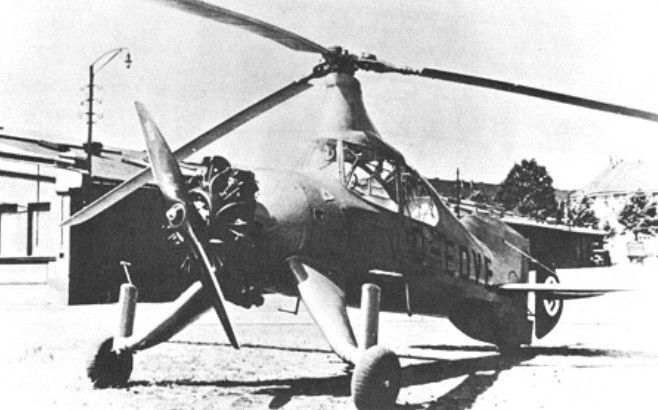
In January 1935 Flettner received a development contract from the RLM for an “experimental autogiro” (autogiro with three-blade rotor). Three so-called “SV-Types” were planned. Inspection of the mockup took place in June 1935. Only one prototype, the Fl 184 V1 D-EDVE was built. The aircraft was destroyed as a result of pilot error in the course of its maiden flight in December 1936. The Fl 184’s external shape still exhibited a certain similarity to the C 30 autogiro being built under license by Focke-Wulf at that time. Power was provided by an Sh 14 engine driving a conventional propeller.

The Fl 185 project was financed with the insurance sum received from the destroyed Fl 184 V1 and a grant of approximately RM 50,000 from the RLM.

Fl 184
Engine: 1 x Siemens-Halske 14, 140hp
Rotor diameter: 12m
Seats: 1

Flettner GmbH

Anton Flettner G.m.b.H
Anton Flettner (1885-1961) was born in Germany and attended the Fulda State Teachers College in Germany. On finishing his studies, he was employed by Zeppelin on development work into remote-control systems for lighter-than-air craft. When he was teaching mathematics and physics in a high school in Frankfurt, he began to develop ideas leading to his work for Germany in World War I.

After the war, he was named managing director of the Institute for Aero and Hydro Dynamics, Amsterdam, The Netherlands. He held that post until 1931.

From 1926 to 1945, Mr. Flettner was president of the Anton Flettner Aircraft Corporation in Berlin.

The “Anton Flettner G.m.b.H.” was a small engineering company dedicated to helicopters. It is believed that the firm was founded in Berlin in 1935. The earliest document the author has been able to find is a letter from the Military Economics inspectorate (W.I.) III, Berlin to the RLM concerning firms involved in production for the Luftwaffe and dated October 2, 1936. The letter states that the W.I. III first became aware that the firm had been given important work by the RLM (LC II) as the result of a formal application for an exemption from military service for one of Flettner’s skilled workers.

The same inspectorate sent the secrecy agreements to the Flettner Company, Berlin-Johannisthal, Segelfliegerdamm 27, for signature on January 22, 1937.

Due to the growing number of air raids on Berlin, in August 1943 the company began transferring its operations to Schweidnitz in Silesia (approx. 50 km SW of Breslau); due to the deterioration of the transportation system the operation took several months. The Fl 282s on hand with the company were also flown to Schweidnitz to continue the test program. In February 1944 the workforce reached approximately 120 men, its highest level ever.

With the Red Army approaching Silesia, in January/February 1945 the company moved back to Berlin-Tempelhof. Any systematic work or further production was of course out of the question under these circumstances. To make matters worse, two days after its arrival the rest of the company’s equipment was destroyed in a night raid on Tempelhof. What was left of Flettner was subsequently evacuated to Bad Tolz (Upper Bavaria); two Fl 282s were also flown there. The history of the Anton Flettner G.m.b.H. ended there with the arrival of American troops.

Firestone / Pitcairn Autogiro Co / Pitcairn-Larsen Autogiro Co Inc / Pitcairn-Cierva Autogiro Company (PCA) / AGA Aviation Corp / G&A Aircraft Inc

The youngest son of John Pitcairn, co-founder of Pittsburgh Plate Glass Company, Harold was born in 1897 and took an early interest in aviation. Inspired by the first flight of the Wright brothers in 1903, he began flight training as an air cadet in the last days of WWI, and would eventually earn a pilot’s license signed by Orville Wright.

1924: (Harold F) Pitcairn Air Service
air field, flight school, FBO
Bryn Athyn PA.
USA

Pitcairn was established in the mid-1920s in Philadelphia, Pennsylvania. Pitcairn and Agnew Larsen, who he had met in pilot training, produced the Mailwing airmail series biplanes including PA- 5 Mailwing high-performance single-seat mailplane used on U.S. Air Mail routes.

1925: Pitcairn Air Lines
sold to Eastern Air Transport in 1929 as origin of Eastern Air Lines
1925: Pitcairn Aircraft Inc
Pitcairn Air Field #2
Willow Grove PA.
USA

In 1928 Harold Pitcairn ordered a Cierva C.8W (the W was for the American Wright Whirlwind engine), which arrived at Pitcairn Field, Willow Grove, Philadelphia, PA and on December 18, 1928. It made the first rotary-wing flight in America, piloted by Cierva pilot H. C. A. “Dizzy” Rawson, followed the next day by Pitcairn.

In early 1929, Cierva and Pitcairn negotiators agreed that the Pitcairn-Cierva Autogiro Company (PCA) would be formed in America with the rights to license Cierva’s patents. Pitcairn threw himself into the development and promotion of the Autogiro – and the results of the next 16 months would earn him and his associates the Collier Trophy for the greatest aviation achievement for 1930.

1929: Autogyro operations as Pitcairn-(Juan de la) Cierva Autogiro Co.

c.1930: Autogiro Co of America (aka AGA) as patent licensee (to Buhl, Kellett, Sikorsky, etc).

Pitcairn Aviation Inc turned to autogiro construction with PAA-1 of 1931 and the name changed to Pitcairn Autogiro Company in the early 1930s. They sold a number of PA-18 and -19 autogiros, including a military version of the PA-34 two-seater to the USAAC. Plant and contracts were taken over in 1940 by Pitcairn-Larsen Autogiro Company, in turn succeeded very shortly afterwards by Aga Aviation Corporation.

Feb 1941: Pitcairn-(Agnew E) Larsen Autogiro Co Inc.

Dec 1941: Renamed AGA Aviation Corp (pres: Virgil H Frazier).

In 1943 G and A was acquired by the Firestone Aircraft Company of Akron, Ohio, together with almost 200 patents concerned with rotary-wing aircraft. G and A built gliders and experimental autogiros in the Second World War, and carried out subcontract manufacture.

1946: Acquired by G&A (Gliders & Aircraft) Div, Firestone Rubber Co.

After the company became the G & A Aircraft Division of Firestone, the emergence of Bell and Sikorsky in a depleted post-war market discouraged continuing the helicopter development in the early 1940s.

Firestone was formed in 1946 by name change from G&A Aircraft Inc., a subsidiary of Firestone Tire and Rubber Company.

1947: Firestone Aircraft Co.
Farrington Twinstar

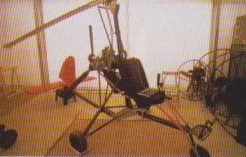
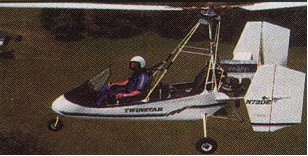
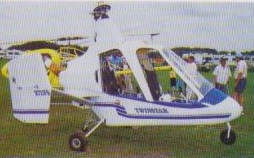
Farrington has developed an amateur-built kit gyrocopter with some features of the Umbaugh U-18 known as the Farrington “Twinstar”. This has an open fibreglass cockpit shell, a large twin-fin tail unit and a main rotor mounted on a tubular steel pylon. It is powered by a 110kW Lycoming 0-320 and the first prototype first flew in 1991.

A two seat tandem, enclosed autogyro with a pre-welded (tig) tube structure and full dual controls.

Engine: Lycoming O-320, 150 hp.
HP range: 135-200.
Height: 8 ft.
Length: 12 ft.
Disk span: 28 ft.
Fuel cap: 19 USG.
Weight empty: 700 lbs.
Gross: 1200 lbs.
Speed max: 90 mph.
Cruise: 65 mph.
Range: 90 sm.
ROC: 900 fpm.
Take-off dist: 200 ft.
Landing dist: 0-50 ft.
Service ceiling: 10,000 ft.
Seats: 2.
Landing gear: nose wheel.

Engine: Lycoming O-320, 150 hp
Rotor span: 9.14 m
MAUW: 560 kg
Empty weight: 340 kg
Max speed: 145 kph
Cruise speed: 110 kph
Minimum speed: 32 kph
Seats: 2
Fuel consumption: 25 lt/hr
Kit price (1998): US$9995