A pilot of up to 250 pounds can comfortably jump aboard the Super Bandit. The single-seat, opened-frame can be equipped with a 94-hp EA-81 Subaru engine or it can morph into an ultralight with a 55-hp 503 Rotax engine. With the Subaru, it can reach 85 mph and with the Rotax, 63 mph. Useful load is 313 pounds with the Subaru or 348 pounds with the Rotax.
Kit prices in 2001 were:
Basic kit (without engine, instruments and propeller): $7500
Deluxe kit: $11,000
Gyrocopter
JAI JAI-31
The JAI-31 (Russian: ХАИ-31) gyroplane was developed at the JAI in 1977. This original single-seat apparatus was designed for the development of scientific experiments and sport flights. The design and construction was directed Gennadi Grigorievich Jmyz.
The JAI-31 gyroplane was built on a platform composed of two floats made of wood, joined together with metal stringers on which the pilot’s seat, the rotor base and the vertical plane were mounted.
The control of the gyroplane was through the combination of the 6.2 meter diameter rotor and the rudder.
To take off, the rotor began to rotate manually and then towed by a speedboat.
The JAI-31 was continued in the second, improved, JAI-31A of 1978, which was mainly characterized by the absence of the vertical plane.
JAI-31
Rotor diameter: 6.2 m
Empty weight: 60 kg
Maximum takeoff weight. 135 kg
Maximum speed: 50 km / h
Take-off speed: 25 km / h
Landing speed: 5 km / h
Seats: 1
JAI-31A
Rotor diameter: 6.2 m
Empty weight: 65 kg
Maximum takeoff weight. 130 kg
Maximum speed: 55 km / h
Landing speed: 5 km / h
Seats: 1
Irkut A-002
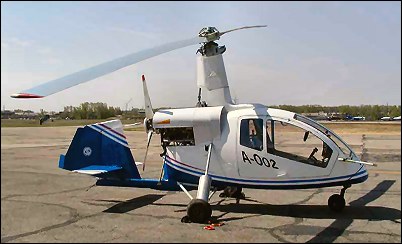
In October 2000, IAPO announced branching out into design and manufacture of its own products in the form of the prototype A-002 autogyro. A three-seat autogyro, an experimental version had been tested in 1998. The almost complete prototype was shown at Moscow in August 2001. First flight 21 April 2002.
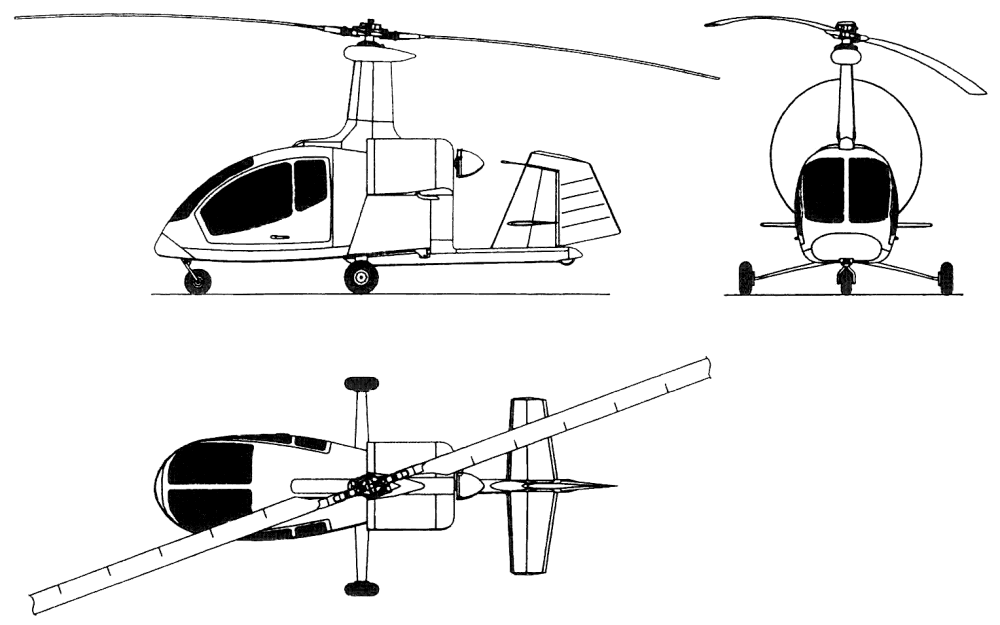
The A-003 conforms to FAR Pt 27 and Russian AP-27. A streamlined, cabin autogyro, with pusher propeller, single, sweptback fin with large rudder, and broad track landing gear. It is equipped for engine-driven pre-rotation of rotor.
All flying controls are manual, an all-moving tailplane mounted at one-third of fin height, with a horn- and mass-balanced rudder. Generally built of metal, the rudder and elevator of composites. The landing gear is a tricycle type; fixed. Cantilever-spring mainwheels; rubber-in-compression shock-absorber on nosewheel. Mainwheel tyres 400×150; nose 100×125. Hydraulic disc brakes on mainwheels. Safety tail skid on prototype; auxiliary tailwheel on production version.
The prototype has one 157kW Teledyne Continental IO-320 flat-six driving a fixed-pitch, two-blade propeller. Alternative engines of 134 to 157kW and three-blade propeller can be installed. Subaru conversions were under consideration in April 2003.
The A-002 has two front seats, side by side, with dual controls, and a single rear seat. Upward-hinged doors are on each side. Heating and ventilation are provided.
A-002
Rotor diameter: 9.80m
Length of fuselage: 4.98m
Height, rotor removed: 3.17m
Propeller diameter: 1.90m
Max take-off weight: 800kg
Overload take-off weight: 850kg
Empty weight: 500kg
Max level speed: 210km/h
Min flying speed: 40km/h
Max rate of climb at sea level: 150m/min
Service ceiling: 3000m
Take-off run (jump start): 0m
Take-off run (normal start): 40m
Range with 200kg payload 500km
Endurance 6h
Irkut
Founded on 28 March 1932 and commissioned on 24 August 1934, as GAZ 125 (becoming GAZ 39 in 1941), Irkut has built some 6,500 aircraft of 16 types from Antonov, Ilyushin, MiG, Petlyakov, Sukhoi, Tupolev and Yakovlev bureaux and supplied them to 21 countries. In recent years, it has manufactured MiG-23UB trainers (1970-85); 165 kits for Indian-assembled MiG-27MLs; Su-27UB trainers (from 1986); and was responsible for producing the Su-30 fighter (since 1991) and Beriev Be-200 amphibian. Su-30 customers include China and India; offers Su-27UBM and Su-30KN upgrades to older aircraft. Series manufacture of the Yak-112 lightplane has been abandoned, although company has been allocated prospective manufacture of the Ilyushin/HAL IL-214 twin-jet transport. Also undertakes Su-30 upgrades.
Irkut is a member of AVPK Sukhoi. Known from April 1989 until 2002 as IAPO (Irkutsk Aviation Industrial Association), having become a joint stock company in October 1992, but on 19 December 2002: shareholders approved a company change of name to Irkut NPK, IAPO becoming a subsidiary.
Hollman HA-2M Sportster
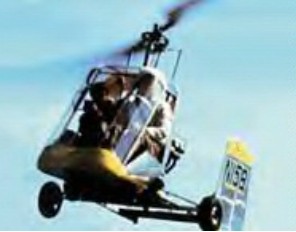
As part of his Aeronautical Engineering thesis research Martin Hollman designed a set of aluminum rotor blades for a two-place gyroplane. Having designed a practical rotor system for a two-place gyro, he moved on to the design of a gyroplane to go with the new blades. The result was the Hollmann Sportster, a two-place home-built gyroplane. Plans for the Sportster were made available, powered by a certified Lycoming engine.
The Sportster is designed for the homebuilder who has limited access to power tools. Ninety percent of the structure is bolted or riveted together, 2x2in aluminum tubing, and a minimum of machined parts are used. For convenience, the Sportster is designed to be towed behind a car.
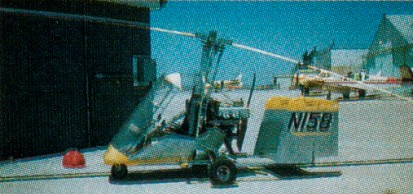
Two average people, 350 pounds combined, can fly comfortably inside its nearly enclosed cockpit for up to 90 miles on a cross-country trip. A 130-hp Franklin, 135-hp Lycoming, or 150-hp Lycoming engine can be used. With the engine cut, the Sportster has a 1,000-fpm sink rate. The Sportster is now marketed by Aircraft Designs, Inc.
The Sportster has been in the air since 1974. Its side-by-side dual controls are ideal for flight training. It’s partially enclosed and uses a 160-hp Lycoming engine to reach top speeds of up to 100 mph. Well-detailed plans for the Sportster 2001: $535
HA-2M
Engine: 160 hp Lycoming O-320.
Prop; 67”x 38” wood.
Rotor blades: Hollmann 28’x9”.
Min speed: 15 mph.
Cruise: 85 mph.
Top speed: 120 mph.
Empty wt: 700 lbs.
Useful load: 500 lbs.
Gross wt: 1200 lbs.
Width: 7’8”.
Length: 14’.
Engine 150-hp Lycoming
Rotor diameter 30ft
Gross Wt. 1100 lb
Empty Wt. 600 lb.
Fuel capacity 17 USG.
Length 13 ft
Top speed 90 mph.
Cruise 75 mph.
Minimum speed 28 mph.
Climb rate 500 fpm.
Ceiling 7,000 ft
Takeoff run 350 ft.
Landing roll 0 ft.
Range 120 sm.
Engine: Lycoming O-320, 150 hp.
Disk span: 28 ft.
Disk area: 616 sq.ft.
Speed max: 90 mph.
Cruise: 75 mph.
Range: 150 sm.
ROC: 1000 fpm.
Take off dist: 700 ft.
Service ceiling: 12,000 ft.
HP range: 130-150.
Fuel cap: 17 USG.
Weight empty: 650 lbs.
Gross: 1100 lbs.
Height: 8 ft.
Length: 12 ft.
Seats: 2.
Landing gear: nose wheel.
Engine: 160 hp Lycoming, O-320.
Propeller: 67″ X 38″ wood
Rotor Blades: Hollmann 28′ X 9′
Min Speed 15 mph
Cruise 85 mph
Top Speed 120 mph
Empty Weight 700 lbs
Useful Load 500 lbs
Gross Weight 1,200 lbs
Width 7 ft 8 in
Length 14 ft
Hollman Aircraft
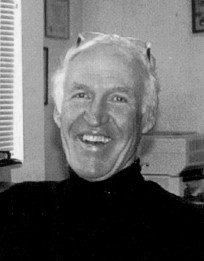
As part of his Aeronautical Engineering thesis research he designed a set of aluminum rotor blades for a two-place gyroplane. Having designed a practical rotor system for a two-place gyro, he moved on to the design of a gyroplane to go with the new blades. The result was the Hollmann Sportster.
1980: 11082 Bel Aire Ct. Cupertino, CA 95014, USA.
1995-7: 3 Harris Ct., Bldg. S., Monterey, CA 93940, USA.
2009: 5 Harris Court, Bldg. S, Monterey, CA 93940, USA.
Hinchman H-1 Racer
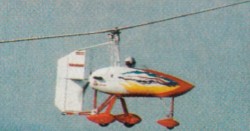
The original version of the H-1 Racer single-seat autogyro was first flown in 1987. Plans and kits available for the Racer in latest form.
Winner’s Circle Engineering kit for the H-1 Racer (including frame, tail, steering, landing gear, seat tank, brakes, front suspension and rotor head) in 2001: US$6000
Engine: Rotax 503DC
HP range: 40-64
Weight empty: 310 lb
Gross: 550 lb
Height: 7.9 ft
Fuel cap: 5 USG
Length: 10.75 ft
Disk span: 25 ft
Disk area: 490 sq.ft
Speed max: 85 mph
Cruise: 65 mph
Range: 65 sm
ROC: 1200 fpm
Take-off dist: 500 ft
Landing dist: 10 ft
Service ceiling: 10,000 ft
Seats: 1
Landing gear: nose wheel
Engine: Rotax 503, 52 hp
Rotor span: 7.60 m
Blade area: 0.21 sq.m
MAUW: 285 kg
Empty weight: 172 kg
Fuel capacity: 37 lt
Max speed: 160 kph
Cruise speed: 105 kph
Minimum speed: 48 kph
Climb rate: 4 m/s
Seats: 1
Fuel consumption: 19 lt/hr
Hinchman Aircraft Co
1995-8: PO Box 56, Monrovia, IN 46157, USA.
Autogyro builder
Helmy MT-7 / VPM S-2
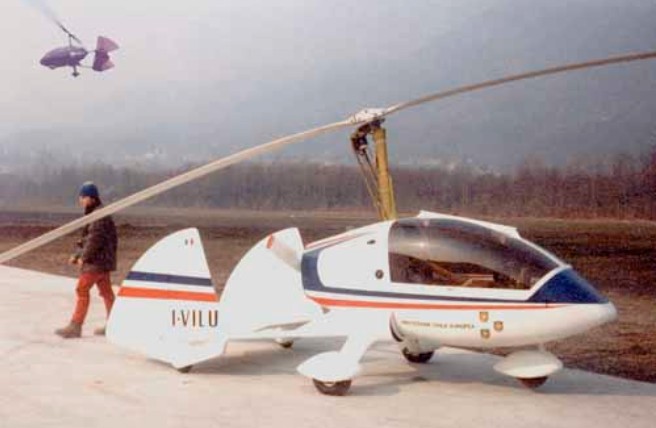
In 1980 Vittorio Magni of Italy had designed a new, two-seat autogyro with a 150 hp Lycoming engine. The machine got the project name MT-7 (Magni-Tervamaki). Vittorio later redesignated the machine as VPM S-2.
The calculations and general design blueprints were delivered to Vittorio, who was responsible for all the detail design. He also built the machine together with his son. The machine was completed in 1985, and it also flew well.
Some years later the machine was lost in an accident in France. The control rods had been bent in road transport by a truck.
Magni continued the development of autogyros and has designed a series of gyros which all seem to have the rotor head and blade design of JT-5 and MT-7.

Helicop-Air L.50 Girhel / L.51 Girhel
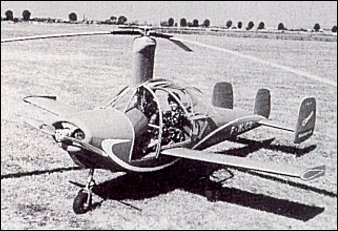
In France, Helicop-Air, produced the prototype of a two-seat light autogyro-type aircraft known as the Girhel.
The Girhel is a side-by-side two-seat light aircraft to which an autogyro rotor has been fitted. It was designed with the assistance of Ing. Georges Lepere.
For take-off the rotor can be set turning by engaging a clutch in a drive-shaft from the engine. In flight the rotor autorotates and the engine drives a tractor airscrew in the conventional manner. Most of the “lift” is contributed by the fixed wings in cruising flight, so that the rotor is heavily loaded only during take-off and landing. The three-blade rotor is of wood construction, with variable pitch. Starting is by a clutch and drive-shaft from engine. The wings are mid-wing cantilever monoplane with a single metal spar, wood covering, large ailerons, and end-plates at the tips.

The all-metal fuselage structure has a cantilever monoplane type tail unit, with conventional elevators, two fins and central rudder. All-wood structure. The landing gear is a non-retractable tricycle type. The nose-wheel is steerable and brakes are on the main wheels.
The two seats are side-by-side in the enclosed cabin. Dual controls are optional. Space for baggage is aft of the seats. There is provision for carrying a litter or agricultural spray-gear.
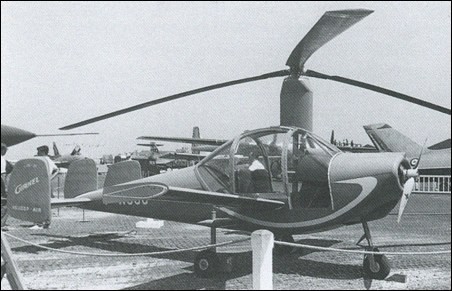
This was exhibited for the first time at the 1959 Paris Salon de l’Aeronautique.
It is not clear whether the prototype actually flew.
Two versions of the Girhel were offered:
Girhel L.50. 90hp Continental C90 engine with Ratier two-blade fixed-pitch airscrew.
Girhel L.51. With 150hp Lycoming O-320 engine with a variable-pitch airscrew.
Helicop-Air L.50 Girhel
Engine: Continental C.90, 65kW
Prop: Ratier two-blade fixed-pitch
Rotor diameter: 10.0m
Wngspan: 6.0m
Length: 6.10m
Height: 2.70m
Helicop-Air L51 Girhel
Engine: Lycoming O-320, 150hp
Prop: variable-pitch
Rotor diameter: 10.0m
Wngspan: 6.0m
Length: 6.10m
Height: 2.70m
Weight empty: 416kg
Weight loaded: 750kg
Max speed (est.): 215km/h
Cruising speed (est.): 180km/h
Min flying speed (est.): 22km/h
Range with pilot and 234kg payload (est.): 100km
Range with two persons and baggage (est.): 1000km
 All Aero