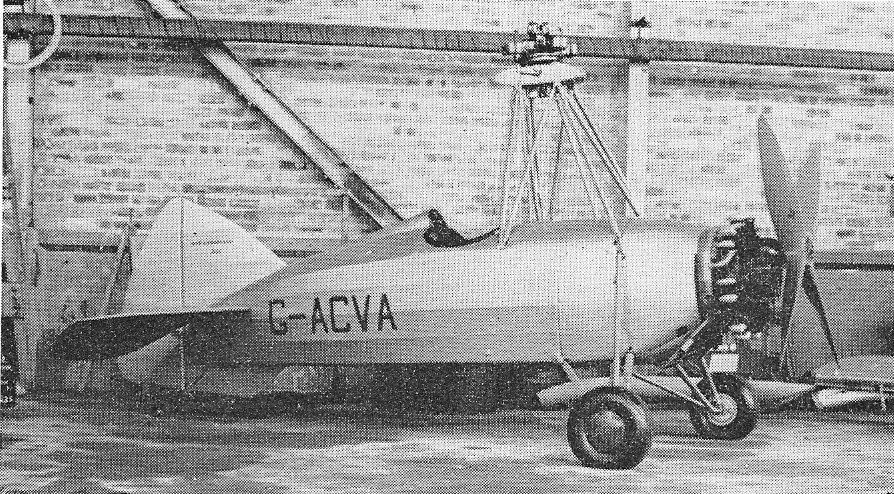
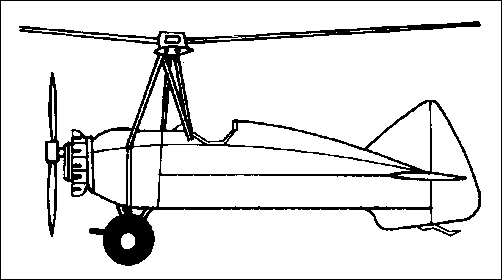
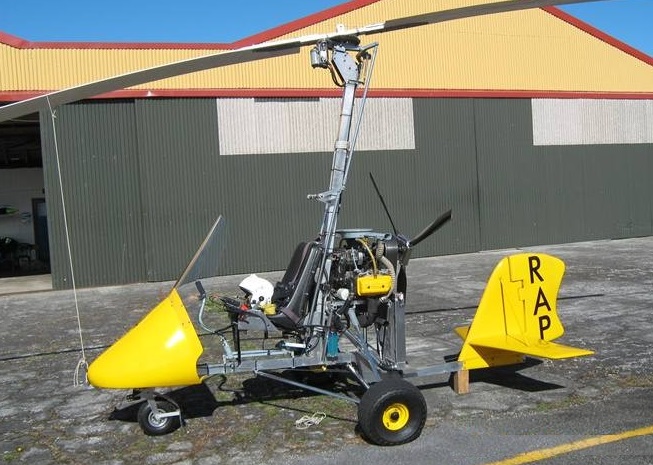
Power was a 75 hp Pobjoy, and chief feature of the machine was the positive control of lift by variable incidence of the rotor blades while in flight. Lateral control could be obtained by rocking the rotor spindle, while fore and aft control was by a hinged tailplane and normal elevators.
Engine: 75hp Pobjoy Rotor diameter: 22 ft Overall length: 17 ft 11 in Height: 7 ft 8 in
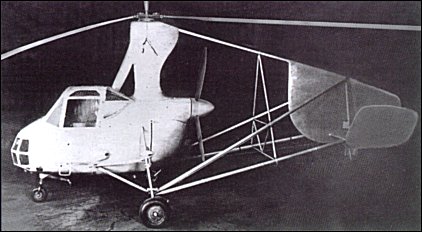
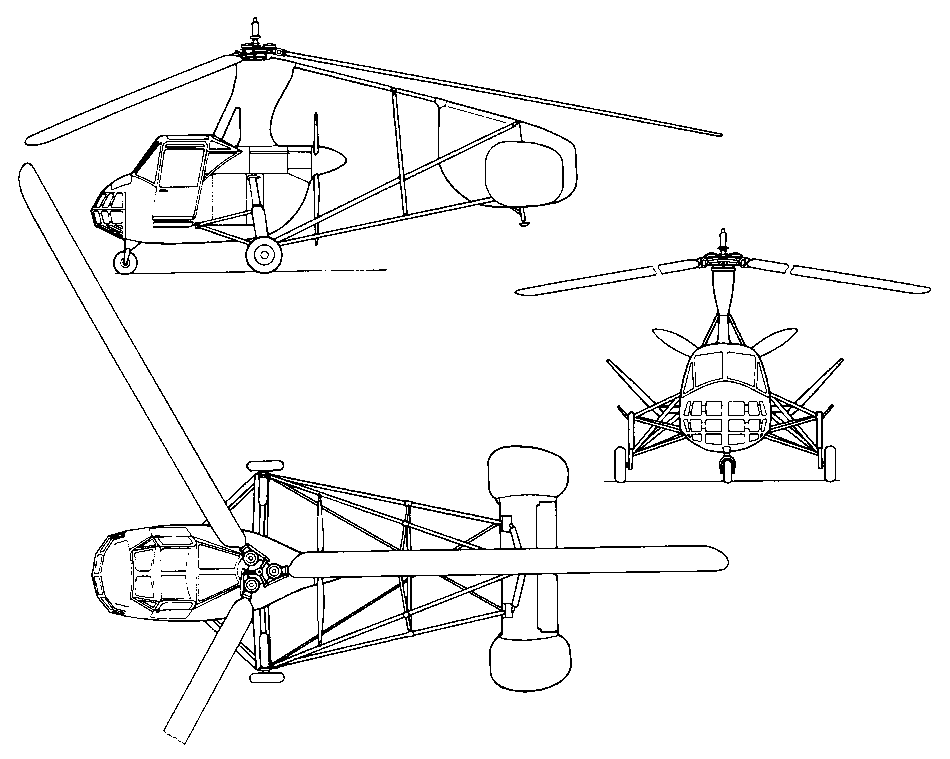
Kamov took job of chief designer in factory at Smolensk opened 1939 to make production autogyros (beginning with A-7-Za). Kamov obtained permission to build a side-by-side observation machine with side doors. The AK was fitted with tricycle gear, a single fin rudder on struts from rotor head and main gears, and no wings. Work was delayed by evacuation in July 1941 but work restarted at a new facility in Lake Baikal region in 1942. The project was abandoned 1943 because of termination of interest by VVS.
AK Engine: 1 x MV-6 Rotor diameter: 13.5m Loaded weight: 1317kg Empty weight: 1026kg Max speed: 176km/h Ceiling: 4,700m
This autogyro designed by Kamov was considerably more stream-lined than its predecessors. The rotor had three blades, the fuselage was completely covered by a light alloy skin and the landing gear was streamlined. A later version, the A-7-3, which had two small fins below the stabilizer, was used during the last war for some observation missions. Kamov created the only (in the World) armed autogyro (A-7-3) that saw (limited) combat action.
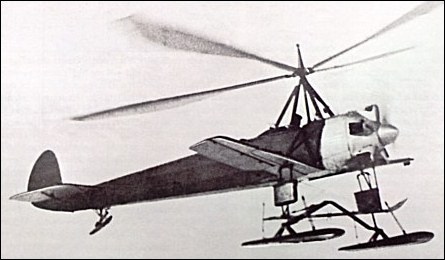
A major reconstruction of the KaSkr-1 with much more powerful cowled engine resulted in the KaSkr -2. Other minor changes included a rudder of better shape. First flown in 1930, it was operated on skis in the winter of 1930-31. Pilot D.A.Koshits had flown the KaSkr-2 on 90 occasions by late 1931. The KaSkr-2 led to the 2-EA and A-4 at CAHI.
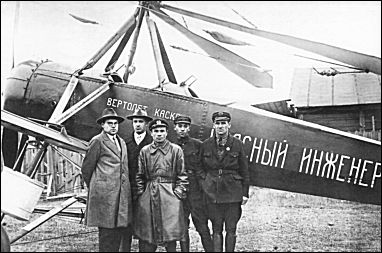
Designated from Kamov and N.K.Skrzhinskii, autogyro Krasnyi Inzhyener (Red Engineeer) was based on the Cierva C.8 using an Avro 504 (U-1) fuselage, landing gear and most of flight controls. The original rotor had four braced blades, and small wings were fitted. The first ground running test was 1 Sept 29. The rotor began to spin, but the control system proved ineffective and was subjected to major changes. The U-1 rudder was changed for a larger surface, then the torque of the engine/propeller almost overturned machine. This was rectified by hanging an 8kg weight under the right wingtip. Test pilot I.V.Mikheyev was unable to fly aircraft because of a lack of power. The KaSkr-1 was rebuilt as the KaSkr-2.
KASKR-1 Engine: 1 x M-2, 90kW / 100 hp Rotor diameter: 12m Fuselage length: 8.8m Max take-off weight: 950kg Empty weight: 750kg Max speed: 90km/h Operating ceiling: 15-25m Endurance: 1.5hr Crew: 1
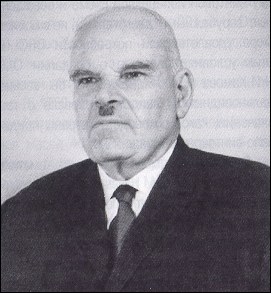
Nikolai Il’yich Kamov was born in 1902. In 1923 he graduated from the Tomsk Technological Institute. From 1923 to 1931 he worked at a number of the USSR’s aircraft factories having various posts, including those of brigade chief and leading designer in the design bureau of D.P.Grigorovich. From 1931 to 1948 (with short pauses) he headed separate brigades and an experimental design group in TsAGI. Between 1928 and 1943 he was engaged in the design and construction of autogyros. Nicolai Kamov started building his first rotor-winged aircraft in 1929, together with N.K.Skrzhinskij. The first Soviet Autogiro was designed by Kamov and Skrzhinskii based on Cierva models. In 1945 he started the design work on a co-axial helicopter. Kamov gained distinction for lightweight single-seat helicopters after Second World War, including Ka-8 of 1947. On October 7, 1948 the Minister of Aviation Industry M.V.Khrunichev issued Directive No.772 ordering the establishment of the Experimental Design Bureau No.2 (OKB No.2) headed by N.I.Kamov. The OKB was to be hosted by the State All-union Experimental Factory No.3 in Sokol’niki, a district of Moscow. In accordance with this directive all the specialists of the group which had been developing the Ka-8 on a voluntary basis were transferred to Kamov’s OKB-2. The aircraft factory No.3 of the Ministry of Aviation Industry was considered to be, for all practical purposes, the base enterprise of the OKB headed by chief designer I.P.Bratukhin. It comprised several production shops and divisions, including the flight test facility at the Izmaylovo airfield (then a suburb of Moscow). The OKB-2 occupied the rooms allocated to it at the premises of this enterprise. Its staff rendered considerable assistance to the speedily growing brigades of the OKB-2 in establishing themselves and gaining the necessary practical experience in design and calculation work. This was followed by the single-seat Ka-10 of 1950 appearance as a piston-engined helicopter for shipbome observation duties, with two contrarotating rotors and no anti-torque tail rotor; these rotor design features were to be found in most subsequent Kamov helicopters. The Ka-15 two-seater of the 1950s used for agricultual work in addition to naval anti-submarine and other roles, and the Ka-18 four-seat development was flown in 1957 and widely operated on varied civil tasks. The Ka- 22 Vintokryl was a very large twin-turboprop convertiplane, first seen in 1961, and established many world records. The twin-turboshaft powered Ka-25 was first flown in April 1961 and deployed by the Soviet Navy as a shipborne anti-submarine warfare helicopter, and also for target acquisition, joining the Navy from 1972 and manufactured up to 1977. The more capable Ka-27 was first flown in August 1973 and joined Soviet Navy from 1981, with the Ka-28 as an export version. The related Ka-29 first flown in July 1976 as a shipborne assault and transport variant plus the Ka-33 export model without weapons. The Ka-31 was flown in October 1987 as a shipborne AEW&C variant, and Ka-32 first flown October 1980 as civil model for transport, flying-crane, rescue, offshore support, patrol, firefighting and other uses, with the Ka-327 as a maritime patrol version of the Ka-32. The piston-engined civil Ka-26 first flew in 1965 (some military use), with the modern Ka-126 (first flown in October 1987) and the Ka-128 turboshaft developments. All having pod-and-boom fuselages to allow attachment of modules aft of cockpit for various cargoes (from passenger carrying to agricultural equipment) or left open for flying-crane duties. A new twin-turbine development is the Ka-226 (first flown September 1997). The Ka-50, was first flown in June 1982 as a single-seat combat helicopter, with the Ka-50N Black Shark night-attack version flying March 1997, while side-by-side two-seat derivative became the Ka-50 Alligator (first flown in June 1997). 1995: 8a March 8th St., Lubertsky, Moscow Region 140007, Russia. In 1996, Kamov became a member of MIG MAPO-M. A military multipurpose twin-turboshaft helicopter is the Ka-60 for 10 equipped troops (rolled out July 1998), with a 16-passenger civil version as the Ka-62. A light single-turboshaft Ka-115 was to fly in 1999, carrying pilot and up to four passengers.
The Helicopter Engineering Research Corp was formed in 1947 by D.K. Jovanovich and F.J. Kozloski who were former employees of the Piasecki Helicopter Corp. Their first design, the two-seat tandem rotor Jov-3, flew in 1947. The company was renamed J.O.V. Helicopters in 1948. The design rights were sold to McCulloch Motors in the same year for their new Helicopter Division, with Jovanovich as Chief Engineer.
The Aircraft Division of McCulloch Motors Corporation developed a slightly larger model, the MC-4C. Jovair Corporation was formed some years later and took the design a stage further, resulting in the Sedan 4E (certificated 1963), of which limited production began in 1965. In June 1962 Jovair flew the prototype J-2 two-seat light autogyro; both programs were taken over 1969-1970 by McCulloch Aircraft Corporation.
Jovanovich and Kozloski left McCulloch when the Airplane Division was closed, and formed Jovair Corp in 1957 to continue their work on helicopters.

 All Aero