A single-seat gyroplane built in 1962.
Gyrocopter
McCandless M-1
There were two prototypes, one M1 and one M4 at the Ulster Folk and Transport Museum
McCandless (Aviation) Ltd
UK
Founded by Rex McCandless at Newtownards, County Down, to develop single-seat gyroplane built originally as M-2 in 1962. Developed later as M-4 with original Triumph motorcycle engine replaced by 1500cc Volkswagen engine. Production M-4 built by W. H. Ekin (Engineering) Ltd.
Marchetti Avenger
A two seat side by side, open frame gyrocopter.
Engine: 150-160 hp Lycoming.
Rotor blades: Rotordyne.
Min speed: 18 mph.
Cruise: 85 mph.
Top speed: 110 mph.
Empty wt: 625 lbs.
Useful load: 525 lbs.
Gross wt: 1150 lbs.
Width: 6’8”.
Length: 11’2”.
Magni M22 Voyager Tandem
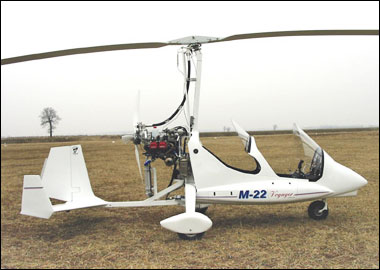
Magni Gyro has announced the June, 2005 availability of the M-22 Voyager. Based on the M-16 Trainer model, it sports large baggage strakes on each side of the tandem enclosure. Baggage space includes available space under both seats. The M-22 Voyager eliminates the rear seat flight and engine controls to allow full utilization of available spaces for baggage. (rear controls cannot be added to the M-22. The M-16 is not adaptable to M-22 modifications.)
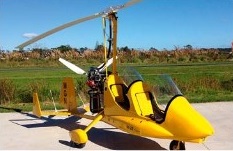
The M-22 Voyager is the same performance and price as the dual control 914, M-16 Trainer. The M-22 is available only with the Rotax 914UL engine. All appropriate M-16 options are available on the M-22, such as the rear seat windscreen.
The M22 provides approximately 150 liters of available storage space. External compartment doors provide easy access. Sold as kit or fully assembled, the M22 can be fitted as an ag sprayer. The M22 features a 4130 steel tube frame, streamlined composite, wheel pants, leaf-spring and tail planes.
2009 Price: 48280 EURO
M22
Engine: 115 hp Rotax 914UL
Propeller: 67″ composite 3-blade ground adjustable
Rotor Blades: 27′ composite (fiberglass and carbon fiber)
Specifications: 914
Min Speed 20 mph
Cruise: 78 kt / 90 mph / 145 kmh
VNE: 100 kt / 115 mph / 185 kmh
Empty Weight 595 lbs
Useful Load 617 lbs
Gross Weight 1,212 lbs
Width 5’11”
Height 8’6″
Length 15’3″
Climb Rate 950 ft/min / 5 m/s
Glide Ratio: 1:4
Take-off distance (50ft obstacle): 230 ft / 70 m
Landing distance (50ft obstacle): 100 ft / 30 m
Magni M 22 Voyager
Rotor diameter: 8.54m
Overall length: 4.65m
Overall width: 1.80m
Overall height: 2.60m
Propeller diameter: 1.70m
Weight empty: 272kg
Max take-off weight: 550kg
Max level speed: 185km/h
Cruising speed: 145km/h
Rate of climb at sea level: 5m/s
Service ceiling: 4000m
Range, no reserves: 481km
Endurance: 3.4 hr
Magni M21
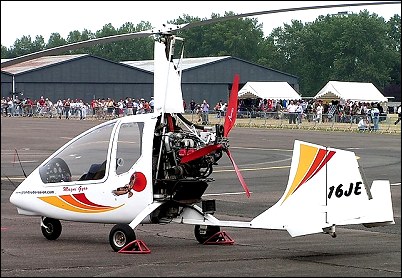
The Magni factory was working on the two-seat, tandem, fully-enclosed M-21. The prototype of this model was flying, but production availability and pricing was not available.
The M-21 replaces the M-19 development. The M-21 has larger cabin room and uses the Rotax 914.
Magni M20 Talon
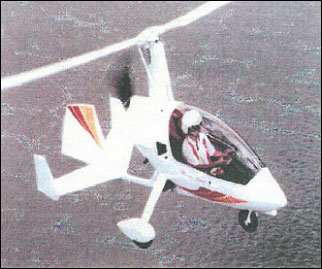
A single-seat autogyro ultralight, prototypes were flying but production had not begun by mid-2003, although promotion was continuing.
Featuring a pod and boom fuselage with sweptback tailplane and triple fins, the rudder is on the central fin only. The M 18 Spartan can he upgraded to M 20 standard.
A welded 4130 chromoly main structure with glass fibre fuselage and wheel fairings, and two-blade main rotor of composites construction with mechanical prerotator. The landing gear is a fixed tricycle type.
Power is from one 59.6kW Rotax 912 UL flat-four driving a ground-adjustable pitch, three-blade, carbon fibre pusher propeller. Fuel in integral cockpit seat/tank of epoxy/glass fibre, capacity 45 litres.
Magni M 20 Talon
Engine: 59.6kW Rotax 912 UL
Rotor diameter: 7.62m
Overall length: 3.92m
Overall width: 1.73m
Overall height: 2.37m
Propeller diameter: 1.62m
Weight empty: 205kg
Max take-off weight: 300kg
Max level speed: 177km/h
Cruising speed: 145km/h
Rate of climb at sea level: 300m/min
Service ceiling: 3500m
Take-off run: 45m
Landing run: up to 30m
Range, no reserves: 289km
Endurance: 3 hr
Magni M19 Shark
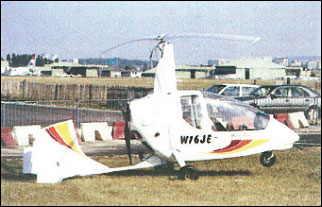
Three M-19 Shark two-seat ultralight autogyro were built for trials by 2002. However, not placed in production and development and marketing effort switched to M 21.
The M-16 can be upgraded to M 19 standard. A pod and boom fuselage with sweptback tailplane and triple fins, with a rudder on the central fin only. The M-19 has a welded 4130 chromoly main structure with glass fibre fuselage and wheel fairings. Two-blade main rotor of composites construction with mechanical prerotator. The landing gear is a fixed tricycle type.
Power is from one turbocharged 84.6kW Rotax 914 UL flat-four with electric starter, driving a ground-adjustable pitch, three-blade, carbon fibre pusher propeller. Fuel in integral cockpit seat/tank of epoxy/glass fibre, capacity 74 litres.
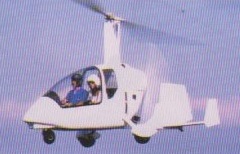
Magni M 19 Shark
Rotor diameter: 8.23m
Overall length: 4.80m
Overall width: 1.85m
Overall height: 2.60m
Propeller diameter: 1.70m
Weight empty: 280kg
Max take-off weight: 550kg
Max level speed: 185km/h
Cruising speed: 145km/h
Rate of climb at sea level: 300m/min
Service ceiling: 3500m
Take-off run: 90m
Landing run: up to 30m
Range, no reserves: 481km
Endurance: 4h 30min
Engine: Rotax 914, 115 hp
Rotor span: 8.20 m
Blade area: 0.22 sq.m
MAUW: 450 kg
Empty weight: 290 kg
Fuel capacity: 35 lt
Max speed: 180 kph
Cruise speed: 130 kph
Minimum speed: 30 kph
Climb rate: 5 m/s
Seats: 2
Fuel consumption: 18 lt/hr
Price (1998): 77 800 000 Lire
Magni M18 Spartan / VPM M-18 Spartan
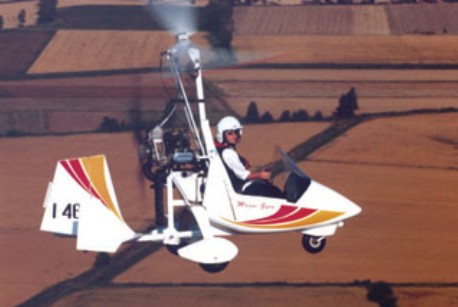
The 1998 version of the M-18 Spartan had an airframe of welded square-section 4130 steel tube. The fairing was optional.
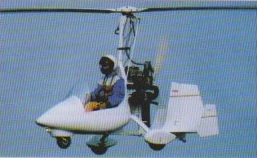
Simpler to build than the other models, the M-18 is a single-seat autogyro made of the same steel airframe from the other models. Its smaller, 65-hp Rotax 582 engine delivers only a slightly reduced top speed of 105 mph. Available open or partially enclosed.
The millennium model M-18 is provided with the Rotax 582 engine (65hp) with standard dual carburetors, “E” gearbox electric start and exhaust silencer. Other standard equipment includes altimeter, airspeed indicator, rotor tachometer, engine tachometer, hobbs hour meter, water temperature gauge, prerotator, rotor brake, wheel brakes, landing light, wheel pants, manual cockpit trim control and 30 litres fuel capacity. Sold as Kit or Fully-Assembled.
M-18 Spartan
Engine: 65hp Arrow 500cc.
Prop: 65” VPM composite, 3 blade ground adjustable.
Rotor blades: 24’ x 8.7” VPM composite.
Min speed: 20 mph.
Cruise: 80 mph.
Top speed: 95 mph.
Empty wt: 353 lbs.
Useful load: 308 lb
Gross wt: 661 lb
Width: 5’3”
Height: 6’5”
Length: 11’6”
M-18 Spartan 2000
Engine: 65 hp Rotax 582, “C” gearbox with Electric Start
Propeller: 63″ 3-blade, ground adjustable
Rotor Blades: 24′ x 8.7″ composite (fiberglass & carbon fiber)
Overall length: 2.98m / 9’9″
Overall width: 1.78m / 5’10”
Overall height: 2.34m / 7’8″
Weight empty: 167kg / 368 lb
Max take-off weight: 350kg / 771 lb
Useful Load 403 lb
Max speed: 170km/h / 105 mph
Min Speed 20 mph
Cruising speed: 110km/h / 70 mph
Service ceiling: 3500m
Rate of climb: 3.5m/s
Range, no reserves: 170km
Endurance: 1.5 hr
Magni M16 / VPM M-16 Tandem Trainer
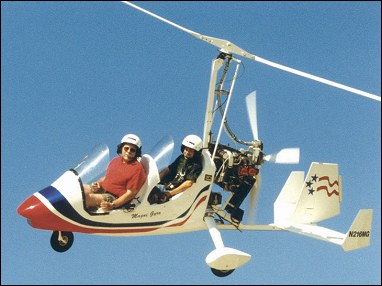
Designed by Gil Cazumba Cardoso, the M-16 is the Big Mercedes of Magni’s models with a wider cabin and more knee room in the front seat, the partially enclosed, the M-16 includes dual controls, a large instrument panel and standard electric trim. Both the M-16 and M-14 have engine options of a 115-hp Rotax 914 or a 100-hp Rotax 912 ULS. The top speed for both is 115 mph. Crop dusting is also possible in the M-16 with an optional 150 litre agricultural spray gear.
The Magni is constructed from chrome alloy steel with fibreglass panels, wheel spats and instrument panel and powered by a water cooled Rotax 914 Turbo 4 engine delivering 115 hp and driving a ground-adjustable 1.7-m, three bladed carbon Arplast pusher propeller. The 8.5-m two bladed rotor manufactured by Magni, is composite and has a mechanical pre-rotator and rotor brake. Maximum cruise is 115 mph, while normal cruise is 90 mph and the aircraft’s service ceiling is 3,500 m. Fuel in integral cockpit seat/tank of epoxy/glass fibre, capacity 50 litres.
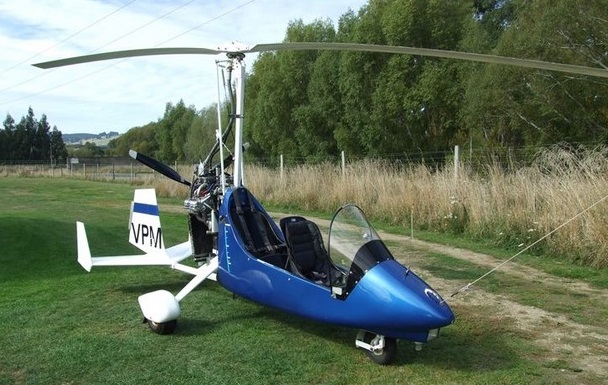
The Magni Gyro M16-2000T is of Italian origin, coming from just outside of Milan, and is a tandem-seat and dual-control aircraft with a semi-enclosed streamlined composite cockpit built around a chrome-alloy 4130 steel tube welded airframe. This gyro comes almost fully equipped, requiring only a compass, radio and intercom to be complete. A tandem two-seat design with full dual controls, wheel pants, leaf-spring and tail planes, an optional rear windscreen was available.
The M 16-2000T was one aircraft (c/n 022074) supplied by manufacturer in September 2003 and modified to United Kingdom BCAR Section T standards for ‘Golden Eagle’ world circumnavigation expedition, then due to begin in February 2004.
M-16 Tandem Trainer
Engine: 120 hp Arrow 1000cc.
Prop: 67” VPM composite, 3 blade ground adjustable.
Rotor blades: 28’ x 8.7” VPM composite.
Min speed: 20 mph.
Cruise: 80 mph.
Top speed: 115 mph.
Gross wt: 1432 lbs.
Width: 5’11”.
Height: 8’6”.
Length: 15’3”.
Magni M 16 Tandem Trainer
Rotor diameter: 8.23m
Overall length: 4.65m
Overall width: 1.80m
Overall height: 2.60m
Propeller diameter: 1.70m
Weight empty: 270kg
Max take-off weight: 450kg
Max level speed: 185km/h
Cruising speed: 145km/h
Rate of climb at sea level: 300m/min
Service ceiling: 3500m
Take-off run: 50m
Landing run: up to 30m
Range, no reserves: 481km
Endurance: 3 hr
M16-2000T
Engine: Rotax 914.
Prop: ground-adjustable 1.7-m, three-blade Airplast pusher.
Rotor dia: 8.5-m
Cruise: 90 mph
Max speed: 125 mph
Seats: 2.
Magni M-16 Tandem Trainer 2000
Engines: 115 hp Rotax 914UL, 100 hp Rotax 912 ULS
Propeller: 67″ composite 3-blade ground adjustable
Rotor Blades: 27′ composite (fiberglass and carbon fiber)
Specifications: 914 or 912UL
Min Speed 20 mph
Cruise 90 mph
Top Speed 115 mph
Empty Weight 595 lbs / 585 lbs
Useful Load 617 lbs / 627 lbs
Gross Weight 1,212 lbs
Width 5’11”
Height 8’6″
Length 15’3″
 All Aero