PAL-V One

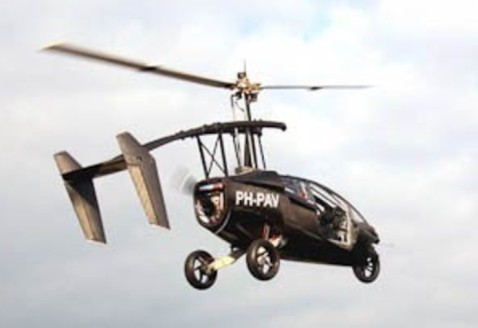
The PAL-V (Personal Air and Land Vehicle) in flight is an autogyro or gyrocopter designed by C. Klok (exterior design), with a pusher propeller at the rear of the fuselage providing forward thrust and a free-spinning rotor providing lift. Directional stability is provided by twin boom-mounted tailfins. It has a tricycle undercarriage with relatively large wheels.

On the ground, the propeller and rotor are stopped and power is diverted to the wheels, allowing it to travel as a three-wheeled car. Unusually, it leans into turns like a motorcycle, a solution pioneered by the Carver vehicle, also produced by a Dutch company. However, the PAL-V does not tilt as a Carver but like the BMW “Simple Concept” from 2009. The PAL-V ONE transforms into a gyrocopter within minutes as its rotor unfolds and its tail extends. Converting the PAL-V ONE from airplane to automobile takes about 10 minutes. The propeller folds itself automatically into the driving position. Pushing a button then lowers the rotor mast into the horizontal position. The same motion lowers the tail. The outer blades are folded over the inner blades via hinge mechanisms. And then driver/pilot has to push the tail into its driving position and secure the rotor blades.

The PAL-V One has two seats and a 160 kW flight certified gasoline engine, giving it a top speed of 180 km/h (112 mph) on land and in air, and a Maximum Takeoff Weight of 910 kg.

A prototype model was first test flown in March 2012 and the company was seeking funds to develop the type for production. Estimated unit price is around $300,000 in 2014.

Engine: 160 kW
Dimensions Road (LxWxH): 4.0 x 1.6 x 1.6 m
Empty weight: 1,499 lb (680 kg)
Gross weight: 2,006 lb (910 kg)
Maximum speed: 97 kn (112 mph; 180 km/h)
Minimum control speed: 27 kn (31 mph; 50 km/h)
Range inflight: 220-315 mile
Range on land: 750 mile
Takeoff dist: 165m (540 ft)
Landing roll: 30 m (100 ft)
Capacity: 2
PAL-V Europe NV

PAL-V Europe NV started in 2001 to design a roadable aircraft. It evaluated many potential technologies and created numerous concepts in cooperation with research institutes and universities. The most important breakthrough was the maturing of the DVC tilting technology in 2005. This brought into reach the design of a real flying car instead of a roadable aircraft. This technology allowed for safe driving without compromises while having a high centre of gravity and a narrow aerodynamic shape necessary for flying. A “flying car” concept.

Having designed and patented their findings and concepts, PAL-V Europe NV hired a team of engineers with automotive, aviation and motorcycle backgrounds and started the engineering of its proof-of-concept prototypes. Partners were selected and contracted for several system elements. This led to the first flight of PAL-V’s proof-of-concept prototype in 2012.

Since then the company entered the next phase of development, engineering the first commercial version, optimizing the design, and starting up production. This was to result in the market launch of the first model: the PAL-V ONE.

Oslist Microgiro

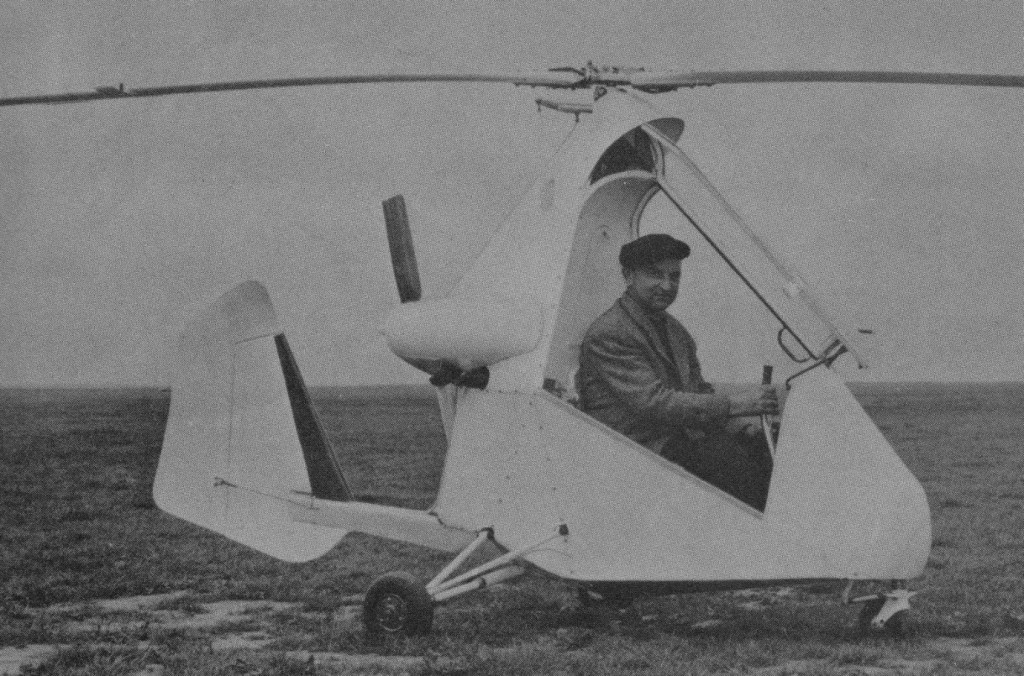
Francois Oslist designed and built a small autogiro, he called Microgiro, in 1964.

Rotor blades are formed from solid spruce, with an aluminium hub. The fuselage is steel tube with an aluminium skin. The tail is also tubular steel but with fabric cover.

Gallery

Engine: McCulloch, 72 hp
Rotor diameter: 20.6 ft
Rotor chord: 7.8 in
Fuselage length: 10.66 ft
Hieght: 6.3 ft
Landing gear tread: 54 in
Landing gear track: 65 in
Main wheel diameter: 9.5 in
Nosewheel diameter: 6 in
Empty weight: 330 lb
MTOW: 550 lb

Odier & Bessiere Clino-giro

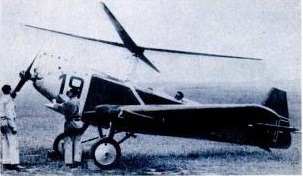
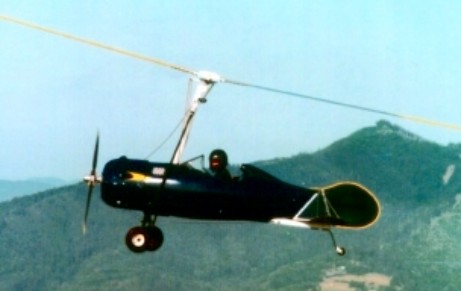
French engineers Odier and Bessiere flew their combination airplane and autogyro, dubbed the “Clino-giro”, in 1931, at Guyancourt. The foundation of the craft is a revamped Caudron C-193 with a rotor smaller and stiffer than normal for an autogyro attached. Th engineers claimed that the craft had a climb angle three times that of an ordinary airplane and a radius of action much better than that of a conventional autogyro.

North American Rotorwerks Pitbull SS

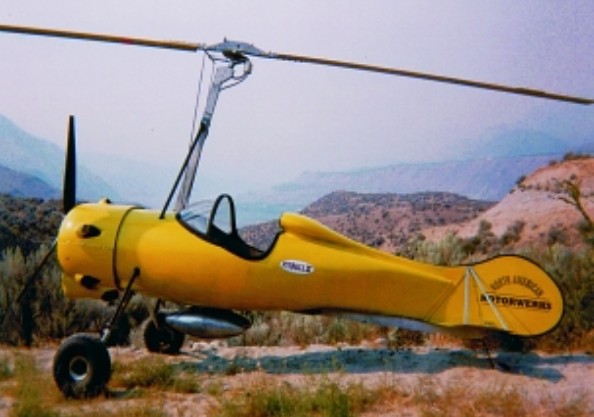
Single-seat enclosed tractor autogyro. Standard equipment includes hydraulic prerotator, disk brakes, instruments. Optional are a long range belly tanks, enclosed canopy and floats. Complete with engine, the kit sold for $13,900 in 2009.

Engine: Rotax 582 or Subaru EA 81
Rotor Blades: Dragon Wings or Sport Copter
Specifications:
Min Speed 18-22 mph
Cruise 70 mph
Top Speed 85 mph
Empty Weight 290 lbs
Useful Load 320 lbs
Gross Weight 610 lbs
Width 5’10”
Height 8′
Length 13’6″

North American Rotorwerks Pitbull II

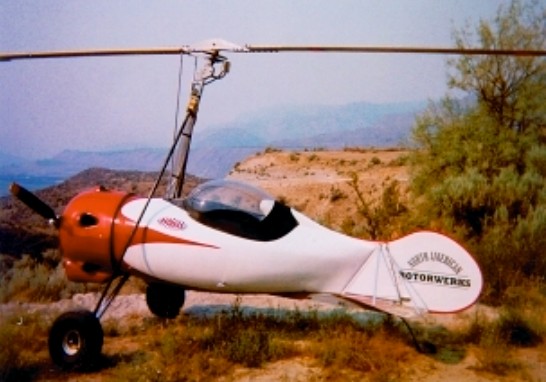
A two-seat partially-enclosed tractor autogyro, developed from the original Pitbull. Equipped with hydraulic brakes and hydraulic prerotator, the complete kit, less engine, sold for $14,900 in 2009.

Engines: Subaru EA 81 – EA 82
Rotor Blades: Sport Copter or Dragon Wings
Prop: 80″
Width 7’2″
Height 8’6″
Length 15’6′
Empty Weight 440 lbs
Useful Load 585 lbs
Gross Weight 1,025 lbs
Min Speed 25-30 mph
Cruise 70 mph
Top Speed 88 mph
Baggage capacity: 20 lbs, 2 cu.ft

North American Rotorwerks Pitbull

First flown in 1993, a front-engine design, the Pitbull, has modern, unique options like float capability. The predrilled, bolt-together frame cuts down construction time for the single-seat gyro that accepts a Subaru EA-81, a 48-hp Rotax 503 or a water-cooled 582.

The Pitbull can be partially or fully enclosed and its useful load ranges from 240 to 290 pounds. All models have double bearing rotorhead with one inch main shaft. 4130 chromoly gear and stainless steel rudder control rods. Rotor blades can be 23’6”-25’6” length, and 6.25”-8” chord.

Kit price list for the Pitbull:
Complete without engine, propeller or instruments 2001-9: $7900
Complete without engine 2001: $9900
Complete with engine in 2009- $11,900.

Engine: Rotax 447, 40 hp
Rotor Blades: Dragon Wings or Sport Copter
Height: 8 ft
Length: 13.5 ft
Width 5’10”
Empty weight: 253 lb
Gross weight: 523 lb
Fuel capacity: 5 USG
Max speed: 63 mph
Cruise: 58 mph
Min Speed 18-22 mph
Rate of climb: 900 fpm
Takeoff dist: 100 ft
Landing dist: 0-5 ft
Service ceiling: 10,000 ft
Seats: 1

Engine: Rotax 503 DCDI, 52 hp
Rotor span: 7 m
Blade area: 0.18 sq.m
MAUW: 250 kg
Empty weight: 130 kg
Fuel capacity: 25 lt
Seats: 1
Fuel consumption: 15 lt/hr

Newman Australia II

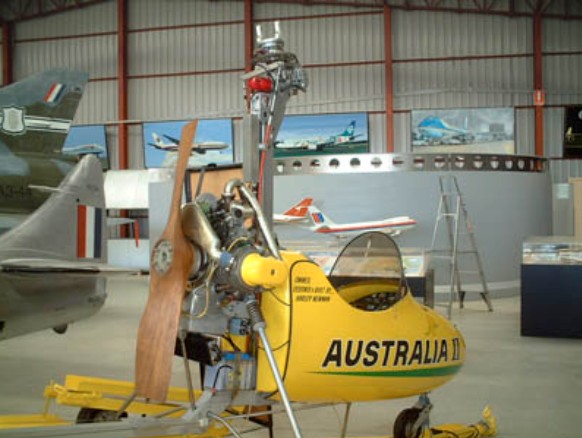
The Australia II was owned, designed and built by Sydney Engineer Mr. Harley Newman. The advantages of Australia II over the original gyrocopter, named Australia, include a more streamlined overall design, lighter weight and a single rudder to reduce the air drag created by the twin rudders on the original machine.

The engine is a turbo charged 900cc BMW motor bike engine. Features of the aircraft include a Streamlined Cabin, Hydraulic Pre-Spin Wind Up for the Rotor Blades, Full Instrumentation, Hydraulic Disc Brakes, Self Starter, Radio Communication, Cabin Controlled Adjustments for Advance and Retarding the engine, altering the Fuel Mixture of the Carburettor and directing the Oil Flow from the Hydraulic Pump to the Hydraulic Motor in the Rotary Head.

The fuel tank has been designed to be an integral part of the cabin area. Also of note was the design of the Tail Plane and Rudder.

Australia II was never flown. However, a considerable amount of Ground Testing and Development on the Engine, particularly the Turbo Charger had been carried out. At the time of Mr. Newman’s death this machine was producing high Horsepower and Static Thrust. At the time of it’s construction, Australia II was by far the most technically advanced Gyrocopter in Australia.

Australia II was donated to the Australian Aviation Museum by Harley Newman’s son Gordon, as this was his father’s wish.