Rotary Air Force RAF 1000

Bernard Haseloh holds the first Gyro Pilot’s License issued in Canada and is widely recognized as a
pioneer in the gyroplane industry. Mr. Haseloh is highly regarded by Federal Aviation Regulators
having for many years served as the designated gyroplane instructor for Alberta, Canada.
Bernard Haseloh served as a key technical advisor to the development, testing & design of the
RAF 2000

1987 the Group forms Rotary Air Force Marketing Inc, First aircraft to go into production is the RAF 1000,
recognizing the need for proper flight instruction and to meet the demand for a two place gyroplane the
Rotary Air Force team introduces the Two place Gyroplane in 1989.

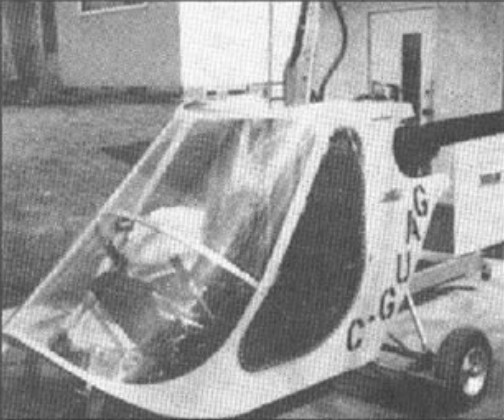
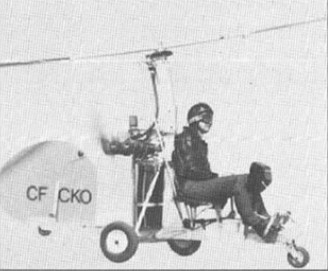
A single seat enclosed gyrocopter. Engine: 130 hp EA82 or EJ22 Subaru. Pre-rotator spins up to 350 rpm. Airframe is bolted square and round tube aluminium. Shock mounted landing gear.

Engine: Subaru EA-82
HP range: 100-130
Prop: 60” x 13o Warp Drive 3 blade composite
Rotor blades: 28’ RAF composite.
Height: 8 ft
Length: 12.16 ft
Disk span: 25 ft
Disk area: 555.7 sq.ft
Fuel cap: 12 USG
Weight empty: 460 lb
Gross: 1125 lb
Speed max: 115 mph
Cruise: 80 mph
ROC: 1000 fpm
Take-off dist: 150 ft
Landing dist: 1-10 ft
Seats: 1
Landing gear: nose wheel
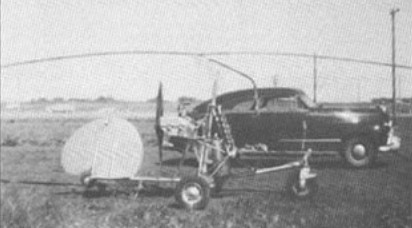
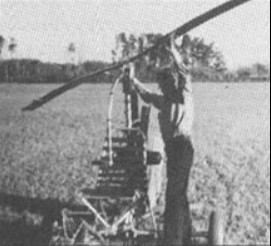
Haseloh Gyroplane

Late 1950s

Mr. Haseloh has logged more than 2000 hours of flying time on his experimental “HASELOH” designed machines and has spent over 10,000 hours in the development of prototype gyroplanes of “ THE TYPE “ manufactured and sold by Rotary Air Force South Africa.

First Haseloh built gyroplane, 1954
Two place development, late 1970s.

1970 protptype with two part mast, and CW mounted shock mounted cheek plates.

Rotary Air Force / Haseloh

The origins of Rotary Air Force South Africa date back to 1943 when Bernard J. Haseloh hovered his first experimental helicopter at his shop in Ponoka, Alberta, Canada.

Mr. Haseloh was discouraged from building and testing amateur/experimental built helicopters, by the Government who felt that the technology for the power driven rotor system was too complex for the private individual.

To further complicate matters, at that time the Government had no regulations in place for amateur/experimental built helicopters. Therefore, his keen interest in Rotary Winged Aircraft turned toward the development of gyroplanes, the first of which was successfully completed in 1954

Over 30 years, Bernard Haseloh has developed and implemented numerous design and structural innovations for gyroplanes.

Mr. Haseloh has logged more than 2000 hours of flying time on his experimental “HASELOH” designed machines and has spent over 10,000 hours in the development of prototype gyroplanes of “ THE TYPE “ manufactured and sold by Rotary Air Force South Africa.

Bernard Haseloh holds the first Gyro Pilot’s License issued in Canada and is widely recognized as a pioneer in the gyroplane industry. Mr. Haseloh is highly regarded by Federal Aviation Regulators having for many years served as the designated gyroplane instructor for Alberta, Canada.
Bernard Haseloh served as a key technical advisor to the development, testing & design of the
RAF 2000

1987 the Group forms Rotary Air Force Marketing Inc, First aircraft to go into production is the RAF 1000,
recognizing the need for proper flight instruction and to meet the demand for a two place gyroplane the
Rotary Air Force team introduces the Two place Gyroplane in 1989.

Incorporated in 1987, Rotary Air Force employed 16 people in 2001.

1995-7: Box 1236, Kindersley, Saskatchewan S0L 1S0 Canada.

In May 2001, RAF announced that it would be expanding its activities into commercial applications, including agricultural spraying and paramilitary functions.

As of April 2, 2007, Rotary Air Force Marketing Inc. closes doors.

Raven Lite

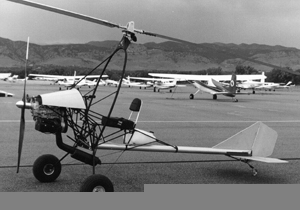
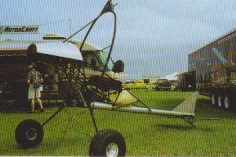
First flown in 1996, development/testing continued into 2008. With ongoing changes in the Ultralight/Light Sport arena, development of both the FAR Part 103 legal Ultralight gyro and the 2-3 seat cargo twin-engine gyro were put on hold.

Taildragger landing gear with large “tundra tires”, cable braced tempered aluminum main gear, and steerable tailwheel for superior handling off runway on rough terrain.

Conventional elevator control in the pitch axis are to minimize “porpoising” and “bunt-over”. A chrome-moly roll cage construction with pilot enclosure and lexan windshield are provided.

An optional pre-rotator assembly is available for reduced take off distance.

Engine: Geo Metro 4-stroke, 993cc, 60 hp
Propeller: 72″ two blade Ivoprop
Rotorblades: 23′ bonded aluminum skin
Min. speed: 22-25 mph
Cruise: 55-65 mph
Range: 150 miles
Empty Weight: 254 lbs.
Useful Load: 310 lbs.
Gross Weight: 564 lbs.
Width: 6 feet 6 inches
Height: 8 feet 2 inches
Length: 15 feet

Engine: AMW Cuyuna 460F, 45 hp
hp range: 45-55
Height: 8.2 ft
Length: 15 ft
Disk span: 23 ft
Fuel capacity: 5 USG
Empty weight: 254 lb
Gross weight: 489 lb
Max speed: 65 mph
Cruise: 60 mph
Range: 100 sm
Takeoff dist: 150 ft
Landing dist: 0-20 ft
Seats: 1

Engine: 2si, 50 hp
Rotor dia: 7.02 m
Max weight: 306 kg
Empty weight: 113 kg
Max speed: 105 kph
Cruise: 85 kph
Min speed: 24 kph
Seats: 1

Pitcairn-Cierva PAA-1

The 1931 PAA-1 (ATC 433) was priced at $6,750. Twenty-five were built.

Any PA-20 or PAA-1 autogyro could be changed to a PA-24 by installing a Kinner B-5 engine.

Year: 1931
Engine: Kinner B-5, 125 hp
Rotor dia: 37 ft
No of blades: 4
Span: 22’9″
Length: 18’7″
Gross wt: 1750 lb
Empty wt: 1178 lb
Max speed: 90 mph
Cruise: 75 mph
Range: 250 mi
Ceiling: 10.000′
Seats: 2