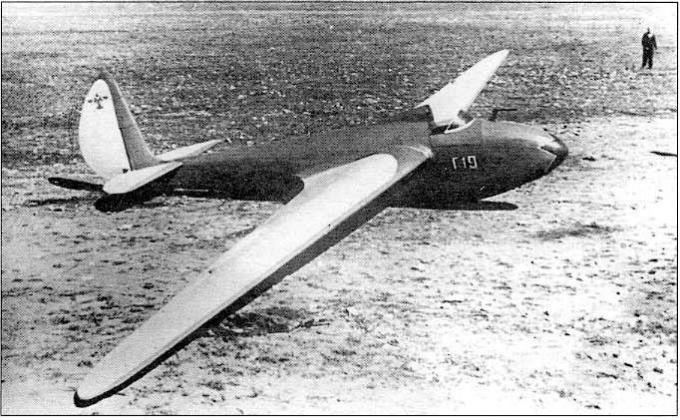
The G-19 (Russian: Грибовский Г-19) glider was designed as a development of the record – breaking G-17 single – seater and was generally similar to it. It would be the last glider designed by Gribovski, who would from there on design and construct light aircraft.
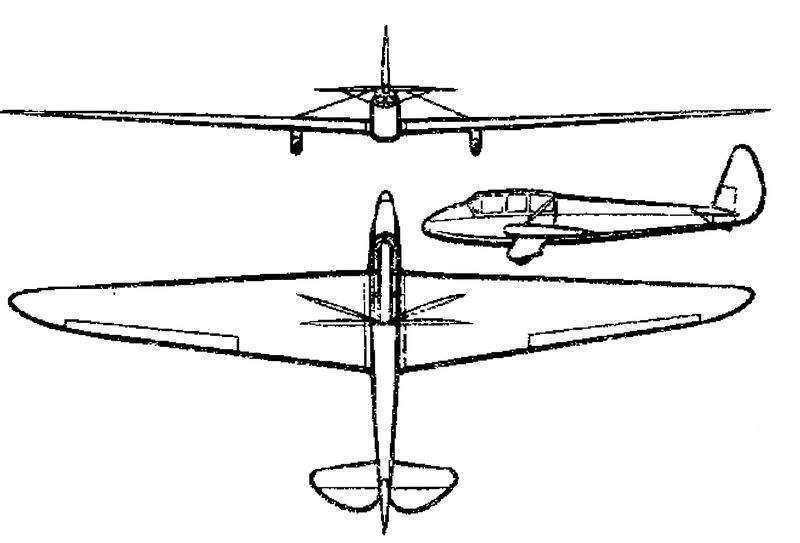
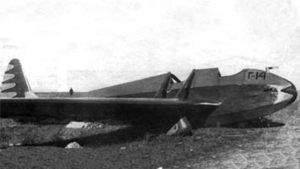
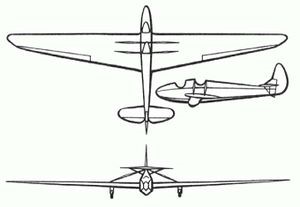
The Gribovski G-19 was designed as a single-seat cantilever mid-wing glider, specially prepared for aero-tow.
The double spar wing, presented in the front part of the wing was covered with 1 mm plywood sheets, up to the position of the second spar. The rest of the wing and ailerons were covered with fabric. The wing design used the TsAGI R-II profile proposed by the engineer PP Krasilschikov. Unlike the previous G-17, in addition to the louvered ailerons, it featured flaps to improve operations during landing. As with the G-18, great attention was paid to improving the attachment of the wings to the fuselage.
The trimmed tail unit featured cantilever planes and monoplane configuration. The leading edge of the empennage and horizontal planes also featured plywood overlay. The rudders were covered in fabric.
The fuselage featured a monocoque structure with a plywood coating. At its bottom there was a landing gear in the form of a ski with suspension.
The pilot was located in an open cockpit located in front of the wing leading edge, protected by a windshield. At the rear of the cockpit, the fuselage deepened to form a headrest.
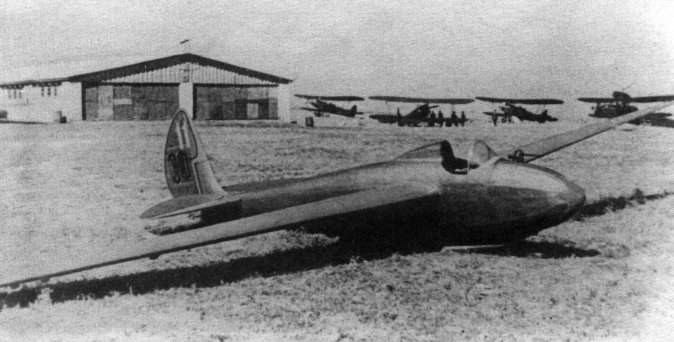
The G-19 glider was designed and built by the Moscow Building Bureau (MKB) of OSOVIAJIM in 1935. This glider entered the XI National Gliding Competitions.
G-19 Wingspan: 16.00 m Wing area: 14.40 m² Length: 6.15 m Height: 1.70 m Empty weight: 142 kg Wing loading: 15.4 kg / m² Surface of the horizontal planes: 1.60 m² Empennage surface: 0.85 m² Ailerons surface: 1.50 m² Glide ratio: 24.3 Accommodation: 1
In parallel with the G-17 single – seater glider, Gribovski would develop a tandem two-seater version designed as a development of the G-14. This model was projected in the Moscow Construction Bureau (MKB) of OSOVIAJIM in 1935, receiving the name G-18 (Russian: Грибовский Г-18).
The Gribovski G-18 repeats the structure of the G-14, appearing as a low-wing monoplane braced to the sides of the fuselage by struts. The large wing had a straight leading edge and an inverted trailing edge and was designed with an R-II wing profile. In order to improve aerodynamics, the joint with the fuselage was modified. The trailing edge of the wing featured large louvered ailerons measuring 2 square meters in area.
The landing gear maintained the composition of the previous G-14 with two simple wheels in pants and fixed to the wing soffit. The wide span between the two wheels allowed the necessary stability during aero-tow training.
The wide fuselage, covered with plywood, could be used to transport loads and luggage in the towed mode, so the structure was reinforced.
The cockpits, located in tandem, had a dual control system and were covered by transparent windows.
The G-18 glider was built in OSOVIAJIM’s own MKB workshops. By 1935 Gribovski managed to organize a small productive workshop in a neighbouring basement to the one occupied by the MKB. The entire staff of this workshop consisted of eight men. They practically did not have machine tools, so most of the metal parts had to be hired from other workshops. Another major problem arose when removing the finished parts from the basement. It was necessary to increase the size of a window.
Despite these conditions during 1935 this workshop would build the G-18, G-19 gliders and the G-20 light sport aircraft.
The G-18 glider was sent to participate in the XI National Gliding Competitions, being destroyed during its first flight in September 1935. The pilot IL Kartashiev managed to get out of the accident alive.
G-18 Wingspan: 15.60 m Wing area: 19.00 m² Length: 7.1 m Height: 1.50 m Ailerons surface: 2.00 m² Empty weight: 210 kg Wing loading: 19.5 kg / m² Glide ratio: 19 Accommodation: 2
With a view to participating in the XI National Sailing Competitions, Gribovski decided to build a single-seater glider capable of flying long distances taking advantage of thermal currents.
The Gribovski G-17 (Russian: Грибовский Г-17) was designed as a single-seat cantilever mid-wing glider, specially prepared for aero-tow.
The double spar wing, presented in its front part of the wing was covered with 1 mm plywood sheets, up to the position of the second spar. The rest of the wing and ailerons were covered with fabric. The wing design used the TsAGI R-II profile proposed by the engineer PP Krasilschikov. The slotted ailerons occupied 46% of the wingspan.
The tail unit featured cantilever planes and monoplane configuration. The leading edge of the empennage and horizontal planes also featured plywood overlay. The rudders were covered in fabric.
The fuselage featured a monocoque structure with plywood coating. At its bottom there was a landing gear in the form of a ski with amortization.
The pilot was located in an open cockpit located in front of the wing leading edge, protected by a windshield. At the rear of the cockpit, the fuselage deepened to form a headrest.
The G-17 glider was projected at the Moscow Construction Bureau (MKB) of the Union of Defense and Aviation Assistance Societies-Chemical Construction of the USSR, but at that time it still lacked productive capacity, so the construction of the only example built was made at the Frunze factory (ZIF) in 1934 – 1935. This was the reason for the three interlocking ZIF letters that were painted on the rudder. Completed in 1935 it was ready in time to participate in the XI National Sailing Competitions, in the fall of that year, where it would compete with the number 11 in its empennage.
G-17 Wingspan: 15.60 m Wing area: 13.60 m² Length: 6.15 m Height: 1.30 m Surface of the horizontal planes: 1.60 m² Empennage surface: 0.85 m² Aileron surface: 1.50 m² Empty weight: 126 kg Wing loading: 15.2 kg / m² Glide ratio: 23 Accommodation: 1
After the failure of the G-12 in its water operations, Gribovski opted to develop a lighter and smaller version that received the name G-16 (Russian: Грибовский Г-16).
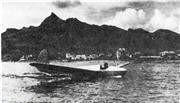
The G-16 glider was designed as a hydrofoil with a single deck hull and high cantilever wing, which had stabilization floats fixed to a support on its intrados and braced by means of uprights on its outer side. The wing structure comprised two box-like spars, joined together by light ribs. The wing was covered with 1 – 1.5 mm thick plywood, creating a flexible but strong structure. On the extrados, the wing had a fabric covering. The wing design used the TsAGI R-II profile proposed by the engineer PP Krasilschikov.
The hull had straight sides with a curved top and a 19-frame structure, a tail spar and five stringers. The entire hull was covered with 1.5 – 3 mm thick plywood nailed to the structure with galvanized laces and covered with glued and enameled canvas. Oil paint was used internally.
For operations on water, it had an ash skid at the bottom of the hull designed for landing on land.
The tail area made transition towards the empennage and the thin stabilizer braced in its lower part by two short uprights.
The pilot was located in an open cockpit forward, in front of the wing leading edge.
Built at the OSOVIAJIM Glider Factory, the G-16 participated in the X National Sailing Competitions held in Koktebel. On 25 September 1934 this glider, piloted by Gribovski, performed for the first time in the USSR, a takeoff from the water in a glider towed by an amphibious Shavrov SH-2 piloted by LG Minov.
A little later pilot N. Baruzdin made a takeoff from the sea towed by a Shavrov Sh-21Sh-2. This flight would cover the Koktebel – Gurzuf in Yalta.
G-16 Wingspan: 14.20 m Wing area: 14.90 m² Length: 5.57 m Height: 1.42 m Surface of the horizontal planes: 1.70 m² Empennage surface: 1.2 m² Ailerons surface: 1.36 m² Empty weight: 139 kg Wing loading: 14.7 kg / m² Glide ratio: 20.1 Optimal flight speed: 56 km / h Minimum descent speed: 0.72 m / s Accommodation: 1
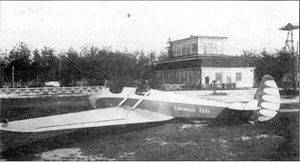
The Gribovski G-14 (Russian: Грибовский Г-14) glider was designed as a two-seater training glider for performing stunts and towed flight. The main objective of its builder when designing this glider was focused on obtaining a simple and cheap model in its production and operation, capable of meeting all the demands of piloting training.
The Gribovski G-14 was designed as a low-wing braced monoplane with wheeled undercarriage. The large wing had a straight leading edge and an inverted trailing edge and was designed with an R-II wing profile. Two parallel struts attached the two-spar wing structure to the top of the fuselage. The wing trailing edge featured large ailerons measuring 1.74 square meters in area.
The landing gear had a conventional composition with two simple 400×150 mm wheels carefully fitted with “pants” and fixed to the wing intrados. The wide span between the two wheels allowed the necessary stability during drag training flights over the ground.
The wide fuselage, covered with plywood, could be used to transport loads and equipment in drag mode, so the structure was reinforced. The cockpits, located in tandem, had a double control system. The Gribovski G-14 was designed for training in night flights, for which it was equipped with the necessary equipment and navigation lights.
The first G-14, built in the workshops of the Zhukovski Military Aeronautical Academy and nicknamed “Komsomol of the VVA”.
The G-14 prototype was built in parallel by two institutions. A first copy was built in the workshops of the Zhukovski Military Aeronautical Academy and another in Factory No.1 “Aviajim”.
The later fate of the G-14 built at the Academy and nicknamed “Komsomol of the VVA” is unknown. The prototype manufactured in the “Aviajim” factory was towed by air in order to participate in the X National Sailing Competitions held in Koktebel in 1934.
The pilots did not value the G-14 positively. The increased weight of the construction and problems in fixing the wing to the fuselage were highlighted as deficient. The positive aspects were the ample capacity of the fuselage, the good structural resistance and the wide span between the main landers.
The positive qualities of the G-14 glider made it an ideal candidate for conducting a series of experiments, so several specimens were built and configured under the purpose of the tests.
The prototype was specially modified at the “Aviajim” Glider Factory in May 1935 to carry out long-distance flight tests based on the refueling of the tug aircraft from the glider itself.
The first fuel transfer test from the glider to the tow plane was carried out on May 24, 1935 while flying at an altitude of 1,200 meters. From the G-14 piloted by Kuzmín 150 kg of fuel were transferred to the Polikarpov R-5 tug piloted by IS Baranov.
On the basis of these tests it was decided to build a specialized variant of the “flying tanker” known as the G-14 TsL-2A. The need to install fuel tanks in the structure increased the flying weight of this version to 780 kg, forcing measures to ensure the necessary structural strength.
The fuel was placed in five aluminum tanks, four in the wing roots (two on each side) and another in the fuselage, located in the position of the rear cockpit, near the center of gravity of the glider. In total the “flying tanker” could carry 500 liters of fuel. A system of pipes and valves ensured the connection of the fuel system with the connecting hook of the tow rope. The cable in this case was in the form of a hose through which the fuel was transferred and in its center was located a cable intended to withstand the drag loads.
In the autumn of 1935 a Polikarpov P-5L piloted by IS Baranov, towing a G-14 TsL-2A glider piloted by KM Vienslav, made a non-stop flight between Moscow and Koktebel, with refuelling in the air. This flight covered a distance of 1524 km, which was also a glider tow record.
As a continuation of the high-altitude trawl experiments, originally tested on the Gribovski G-9, engineer A. Ya. Scherbakov proposed to use a tandem drag method, of which each glider would fly higher than the previous one. To test this system, two more examples of the G-14 were built on the “Aviajim”.
During testing A. Ya. Scherbakov used two gliders, a G-9 and a G-14. As a tug aircraft, a Túpolev TB-1 was used, to which the G-14 was attached and, in turn, the Gribovski G-9.
The Gribovski G-14 was suitably modified for this flight. The forward cabin was closed and covered, opening to the rear. A reel with a 2 mm cable was located in the rear cabin. In order to guarantee the safe extension of this cable, a pipe was fixed to the right side of the fuselage, which ended on the empennage.
Several flights were executed with this chain. At the beginning of April 1936, the results obtained were established: with the Túpolev TB-1 flying at an altitude of 5000 meters, the G-14 had managed to reach 6000 meters and the G-9 7000 meters.
Subsequent flights were cancelled because flights at this point without sealed cabins were quite uncomfortable for the glider pilots.
From a suggestion by A. Ya. Scherbakov fitted one of the G-14s with a sealed cockpit that made it possible to lighten the pilot’s work in the cold, rarefied atmosphere. This cockpit was designed in the form of a kind of stretch calico cocoon preserving the shape of the seated pilot and covered at the top by a metal dome with transparent windows. The instrument panel was located outside the cockpit.
The G-14 thus became the first Soviet fixed-wing aircraft to use a sealed cabin.
Versions: G-14 – Two-seater training glider from 1934. Two copies built. G-14 TsL-2A or G-14 “tanker” – Tanker version built and tested in 1935. G-14 Ts “Tsepochni” – Experimental version built with the aim of testing Scherbakov’s idea of flying a “chain” of towed gliders, each one flying at a higher level than its predecessor. It was tested in flight 1936 – 1937, using a Tupolev TB-1 for towing a G-14 and G-9 . G-14 GK – 1936 experimental version conceived for high altitude operations with pressurized cabin designed by Scherbakov . G-14 MP – Single-seater motor glider project from 1936 . G-14 RP – Single-seater glider project with Dushkin RDA-1-150 reactive power plant .
G-14 Wingspan: 15.00 m Wing area: 18.00 m² Length: 7.80 m Height: 1.35 m Empty weight: 261 kg Wing loading: 23.4 kg / m² Surface of the horizontal planes: 3.0 m² Empennage surface: 1.38 m² Spoiler area: 1.74 m² Glide ratio: 15 Optimal speed: 63 km / h Minimum descent speed: 1.06 m / s Accommodation: 2
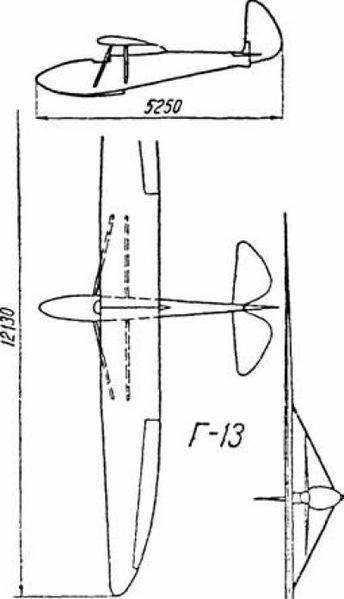
The Gribovski G-13 (Russian: Грибовский Г-13) was a 1933 lightened version of the successful G-9 competition glider. Gribovski achieved a reduction of 64 kg in relation to the previous glider.
The G-13 glider essentially repeated the G-9. It was a monoplane with a high-wing, braced to the fuselage by struts.
The wing had a double box-shaped internal structure that ran parallel throughout the entire span. At the rear of the wing there was an auxiliary stringer to which the ailerons were attached. The wing composition featured removable rectangular shaped consoles in the central section and elliptical ends. The centroplane was fixed to a central pile of the fuselage structure using screws and was braced by means of a pair of uprights located on each side and fixed to the fuselage structure in the lower section of the gunwales. These uprights were constructed of wood, and they were quite light.
Unlike the G-9, the entire wing was covered with fabric, without the characteristic Gribovski plywood sheets. In this way, a much lighter and simpler wing was achieved. The total weight of the wing was only 45 kg and with the upright structure it reached 51 kg (the relative weight per square meter did not exceed 3.5). This lightness brought about a deficiency: the wing was not very resistant to torsion, which would be solved in the improved version G-13bis, which reinstated the use of plywood covering up to the position of the second spar.
The entire leading edge was covered with 1mm plywood sheets, up to the second spar. The rest of the wing and ailerons were covered with fabric. The wing design used the TsAGI R-II profile proposed by PP Krasilschikov.
The fuselage had a semi-monocoque structure with 12 frames and plywood covering between 1.5 and 2 mm thick. The lower part of the fuselage featured a ski-shaped landing gear. This ski did not belong to the fuselage structure, but was fixed externally and had air suspension using a bicycle tube.
The tail unit featured a medium-sized empennage forming an integral structure with the fuselage. The horizontal planes were linked by a tube-shaped axis that allowed them to rotate together. The leading edge of the empennage and the horizontal planes were also covered with plywood. The rudders were covered with fabric.
The pilot was located in an open cockpit located in front of the wing leading edge, protected by a celluloid windshield. It sat on a board attached directly to the forward frames of the fuselage. The flight control was carried out by means of two pedals and the control stick. The elevator rudders were regulated by an independent tensioner.
The G-13 prototype finished being built in 1933, first flying in the September. In that same year it would participate successfully in the IX edition of the National Gliding Competitions.
In the G-13 glider, the pilot BI Kimmelman made a long-distance flight back to the starting point where he managed to reach 46 km and another open 71 km.
In 1934 the G-13bis version appeared, characterized by an increase in the wingspan and a reinforced structure. The weight of this version grew from 86 to 112 kg. The OSOVIAJIM OSOVIAJIM Glider Factory produced at least two copies of this version, which took part in the X National Gliding Competitions held in Koktebel. Although the G-13 was considered was an excellent glider for primary training, its construction was not continued, since the decision to mass produce the “Upar” glider of OK Antonov had already made.
G-13 Wingspan: 12.1 m Wing area: 12.8 m² Length: 5.37 m Height: 1.42 m Empty weight: 86 kg Elevator area: 1.50 m² Rudder surface area: 0.8 Ailerons area: 1.72 Wing loading: 12.9 kg / m² Glide ratio: 17 Accommodation: 1
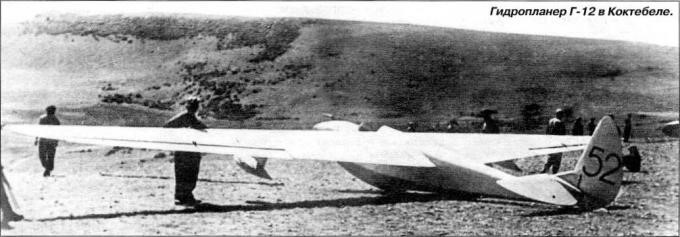
Gribovski G-12 glider during competitions at Koktebel.
With the objective of studying the potential of take-off and landing on the water, Gribovski decided in 1933 to build an experimental hydrofoil that received the name G-12 (Russian: Грибовский Г-12).
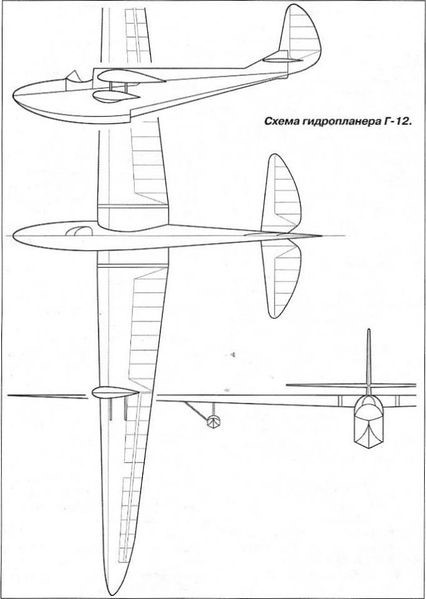
The G-12 glider was designed as a single-seater hydrofoil with a single-beam hull and high cantilever wing that had stabilization floats fixed to a support and braced by means of uprights on its external side. The wing structure comprised two box-like spars, joined together by light ribs. The wing was covered with 1 – 1.5 mm thick plywood, creating a flexible but strong structure. The wing had a fabric covering.
The hull had straight sides with a curved top and a 19-frame structure, a tail spar and five stringers. The entire hull was covered with 1.5 – 3 mm thick plywood nailed to the structure with zinc-plated lace and covered with glued canvas and enamelled in silver. Oil paint was used internally.
The G-12 glider was designed to operate in the water and on land, so the entire outer skin up to the tail post featured an ash skid designed for land landing at the bottom.
The tail area made transition towards the empennage and the thin stabilizer braced in its lower part by two short uprights.
The pilot was located in an open cockpit forward, in front of the wing leading edge.
The entire glider was painted silver.
The Gribovski G-12 glider was designed and built at the Moscow Construction Bureau (MKB) in 1933.
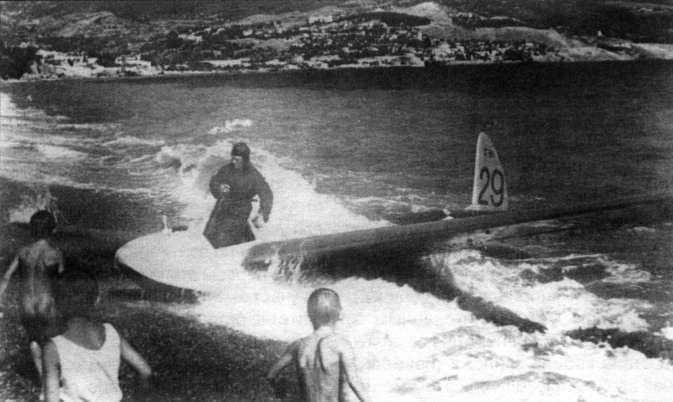
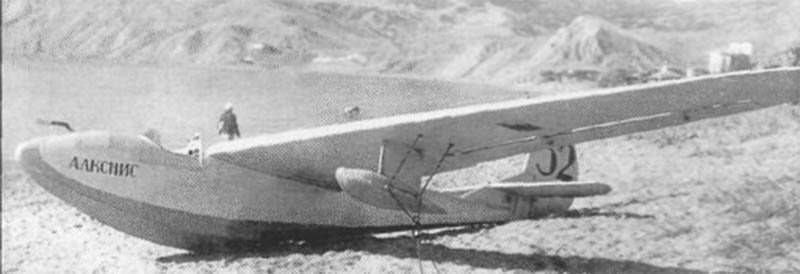
With the number “52” painted in black on its empennage and the name of the VVS chief “Alksnis” on the sides of the bow, it participated in the IX National Sailing Competitions. After the development of the normal flight tests, the G-12, piloted by AK Ioost, took off from the Uzun-Cyrt mountain, landing in the waters of the bay at Koktebel. It is noteworthy that landing proved to be considerably smoother than landing.
G-12 “Alksnis” hydrofoil on the Crimean beach during testing.
Later, in this same bay, an attempt would be made to carry out take-off tests from the water. Towing attempts from a motorboat and then from a Shavrov Sh-2 amphibious hydrofoil were unsuccessful. During the drag, when one of the side floats touched the water, they sank and slowed the glider. As a result of this the tests of aquatic operations were cancelled and from that moment the G-12 was only used on land.
G-12 Wingspan: 15.20 m Wing area: 15.40 m² Length: 6.50 m Height: 1.45 m Empty weight: 157 kg Wing loading: 15.4 kg / m² Stabilizers surface: 0.22 m² Elevator area: 1.77 m² Empennage surface: 0.9 m² Rudder surface area: 0.9 m² Aileron surface: 1.3 m² Accommodation: 1
From the end of 1931 and in parallel with the development of the G-9 glider, Gribovski began the development of a new model designed to carry six people. In many characteristics the new G-11 (Russian: Грибовский Г-11) repeated the double fuselage scheme of the unsuccessful G-3. The main difference between these two models was in the spacious cabins with capacity for three crew members, located in each of the fuselage structures and with side access doors.
Designed in 1931 – 1932, construction began at the OSOVIAJIM factory in 1932. The prototype was 80% complete by mid- 1933, when OSOVIAJIM decided to cancel it. Gribovski at this time was transferred to the post of substitute for the head of the Osoaviajim Construction Bureau (MKB), created in 1932 as an adjunct to the Glider Factory.
In the fall of 1931 Gribovski began towing experiments with the G-2bis glider, using as a tug a U-1 school biplane (a copy of the Avro 504K built in the USSR).
The experience gained during these flights allowed Gribovski to develop glider versions conceived from the outset to be aero-towed. Up to this time in the USSR the gliders only took off from heights with the help of some elastic tensioners that, when released, generated the necessary force to launch the glider.
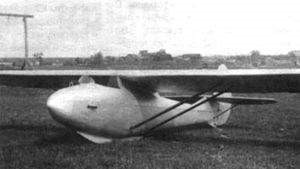
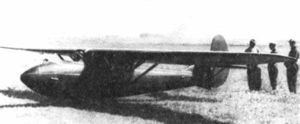
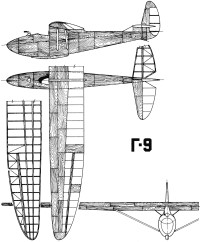
The Gribovski G-9 (Russian: Грибовский Г-9) was designed as a single-seater glider with a braced high wing, specially prepared for aero-tow.
The wing, with a double spar, featured removable rectangular consoles in the central section and elliptical ends. This plane was braced by means of a pair of uprights located on each side and fixed to the fuselage structure in the lower section of the gunwales. The entire front of the wing was covered with 1mm plywood sheets, up to the position of the second spar. The rest of the wing and ailerons were covered with fabric. The wing design used the TsAGI R-II profile proposed by PP Krasilschikov.
The tail unit had planes braced also by simple uprights and located directly at the bottom of the empennage. The leading edge of the empennage and horizontal planes also featured plywood overlay. The rudders were covered with fabric.
The fuselage had a semi-monocoque structure with 12 frames and plywood covering between 1.5 and 2 mm thick. At its bottom was a ski-shaped landing gear with air suspension using a bicycle inner tube. The pilot was located in an open cockpit located in front of the wing leading edge.
Built by Gribovski in 1932, the first of these gliders appeared in the winter of 1931 – 1932.
In parallel with the construction of the G-9 Gribovski began the organization of a long-range towed flight on this glider. To develop this flight Gribovski invited the experienced glider pilot VA Stepanchonok. The flight was planned for the Moscow – Koktebel route in order to arrive in time to participate in the VIII National Sailing Competitions.
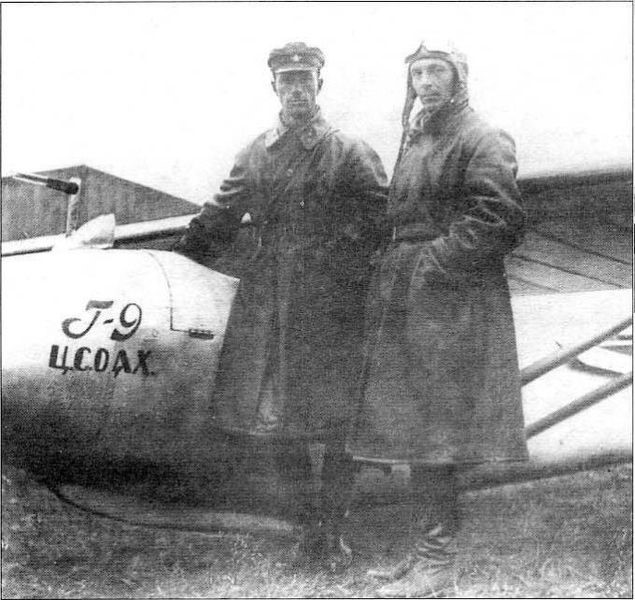
On the 29 of September of 1932 the G-9 flown by VA Stepanchonok, towed by a Polikarpov U-2 piloted by Gribovski, it took-off from Tushino airfield for the flight. The arrival in Koktebel was on October 6 at 6:00 p.m. The selected route covered: Moscow – Ryazan – Tambov – Zadonsk – Voronezh – Evdókovo – Kantemirovka – Lugansk – Yeisk – Chernoerkovski – Kerch – Koktebel, covering a total distance of 1700 km in 19 hours of flight. This long-range flight demonstrated the potential of using towed gliders to transport cargo and people.
Gribovski and Stepanchonok
During the competitions in Koktebel the flight tests were carried out with excellent results. On September 5, during competitions in Koktebel, Stepanchonok set a new record for high school aerobatics flights. During 2 hours and 6 minutes, the G-9 would execute 115 loops, 13 spin turns and inverted flight for 1 minute and 8 seconds.
The first prototype G-9 would be destroyed in an accident the 31 of October of 1932, when piloted by the collaborator of the TsAGI LV Kozlov, collided with another competitor, the SH-3. As a result, it lost part of the wing and ended up hitting the side of a rise backwards. The pilot died instantly. The plane, with its bow destroyed, slid down about 10 meters, losing its wings.
Despite the unfortunate accident, for which only the pilot was blamed, the G-9 had shown its excellent flying qualities. In the No.1 of the Magazine “Samoliot” of 1933 it was written: “The G-9 built by Gribovski is an excellent glider. The large reserve of structural strength, necessary for drag and flight figures, did not greatly increase its weight or limit its flight capabilities. Its excellent stability and ease of handling make it an excellent flight planner. “
The excellent results obtained in the competition played an important role in the fate of the glider, which was built in series at the OSOVIAJIM Glider Factory until 1939, being considered one of the main Soviet gliders for trailing and flight training.
There are documented data on production in the Glider Factory until 1937 with the following distribution: 1933: 4, 1934: 43, 1935: 75, 1936: 110, 1937: 50. In total, 282 copies were built in these years. Production data for 1938 are not known.
In 1936 the Gribovski G-9 glider began to be built in Turkey, where Soviet specialists helped to develop sport gliding.
By the end of the Great Patriotic War the VVS had understood the importance of massive air landings using gliders. At that time it was necessary to have a robust and simple apparatus to train pilots of heavy landing gliders. At this point the G-9 was again remembered. On the basis of the few existing examples, the plans were reconstructed, from which a small series of gliders was built.
The Gribovski G-9 established several records were and it was used in the development of a series of experiments.
In 1933 the pilot Yudin made a towed flight of 3550 km. The pilot SN Anojin (later a test pilot and Hero of the Soviet Union), together with the pilot Gavrish, carried out inverted towing maneuvers on the G-9.
In 1934 Simonov set a world record for flight duration, covering 35 hours and 11 minutes of continuous flight.
Continuing the school figure execution records, the 200 figures executed by VA Stepanchonok would soon be surpassed by the results achieved by VG Borodin. Later Simonov would set another record by running acrobatic figures on the G-9 glider for 5 continuous hours, including 300 loops and 10 reversals.
The 5 of May of 1935 in Samara catching a G-9 was carried out by a Polikarpov U-2 flying at a speed of 120 km / h. The glider this time was piloted by Yudin and the tug plane by Borovkov. Later in Túshino, experiments were carried out to capture the glider in flight, being carried out by the pilots Vasyani and Boordin.
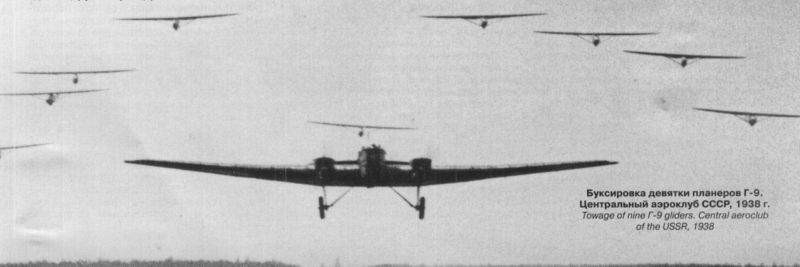
In 1938, a glider train made up of nine G-9 gliders towed from a Túpolev TB-1 bomber was presented during the air festival over Túshino A year later this story would repeat itself, but in this case with nine gliders.
Nine G-9 gliders are towed in flight over the Central Aeroclub by a TB-1 bomber.
In order to test the possibility of using gliders as an escape pod from stratostats in emergencies, a Gribovski G-9 was specially modified. The first test of this type was developed in 1936, when the glider, piloted Borodin, rose to the height of 2500 meters.
A second test took place on July 4, 1938, when the pilot V. Ílchenko was towed by the “CCCP VP-61” stratostat up to a height of 5100 meters and released, making a successful landing.
In 1936 the pilot PM Stefanovski reached the record height of 10360 meters in the G-9, towed by a Polikarpov I-15. A year later Flerov would surpass this mark when reaching 12,105 meters. On this flight the G-9 was towed by a Polikarpov RZ to a height of 8500 meters and then the glider ascended another 3605 meters while being towed. This was done with the help of a special tow cable designed by A. Ya. Scherbakov. At the time of takeoff, the glider was dragged by a normal 100-meter cable. Once a certain height was reached, when the wind turbulence disappeared, the new 0.2 mm steel cable was unwound, allowing the glider to increase the distance from the tugboat by 7000 meters.
G-9 Wingspan: 12.10 m Wing area: 13.00 m² Length: 5.77 m Height: 1.45 m Empty weight: 152 kg Maximum takeoff weight: 230 kg Wing loading: 17.7 kg / m² Glide ratio: 17.50 Accommodation: 1 Stabilizers surface: 2.1 m² Elevator area: 0.84 m² Spoiler area: 1.72 m²
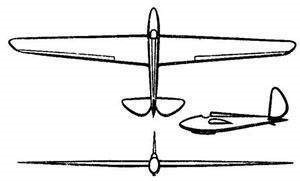
The G-7 (Russian: Грибовский Г-7) was a successful development of the previous types. As the tests of the high wing model G-6 did not bring the expected results, Gribovski decided to return to the configuration with mid wings, successfully tested on the G-2.
The G-7 glider was designed as a cantilever high-wing aircraft with medium deployment and E-385 profile. The wing had two wooden spars with a box-like structure and a sparse distribution of the wing rib. This characteristic caused the wing covering to form kind of waves on the wing surface.
The fuselage had a monocoque structure with plywood covering and its lower part ended in a ski, which guaranteed landing.
The tail was of the conventional monoplane type, with a very tall tail.
The pilot sat in an open cockpit just ahead of the wing’s leading edge.
The glider was designed and built at the Orenburg Flight School in 1929, during Gribovski’s years as an instructor. Due to the lack of space for construction, the group of enthusiastic builders relied on an abandoned church, working in the area of its bell tower. The different finished parts were lowered to the ground using ropes and then assembled.
In the VI National Competitions of 1929 Gribovski presented with the G-2 and G-6 models, participants in previous years and with the new G-7. Characteristic of Gribovski , the three designs stood out for their small dimensions, light weight and constructive simplicity.
The G-7 was one of the best gliders among the participants in the VI National Sailing Competitions, both for its stability in flight and for ease of control.
On October 16 1928, the pilot VA Stepanchonok tried to set a new flight record in this model. It originally took off from the north slope at 4:00 am, but the absence of wind caused the glider to soon descend. At 6:17 am he made the attempt again and this time with success. The glider stayed aloft throughout the day setting a Soviet record for flight duration of 10 hours 22 minutes. Throughout the day the average flight height did not exceed 150 meters. Only in late afternoon and with the appearance of some cloudiness, Stepanchonok managed to ascend to about 500 meters.
A year later the G-7 would participate again in the competitions. On this occasion it would once again be a reference by achieving a continuous flight of 23 hours and 40 minutes.
G-7 Wingspan: 14.50 m Wing area: 15.00 m² Length: 5.45 m Surface of the horizontal plane: 2.16 m² Vertical plane surface: 1.08 m² Spoiler area: 2.2 m² Aspect ratio: 14 Empty weight: 143 kg Wing loading: 14.9 kg / m² Glide ratio: 25.4 Accommodation: 1
 All Aero