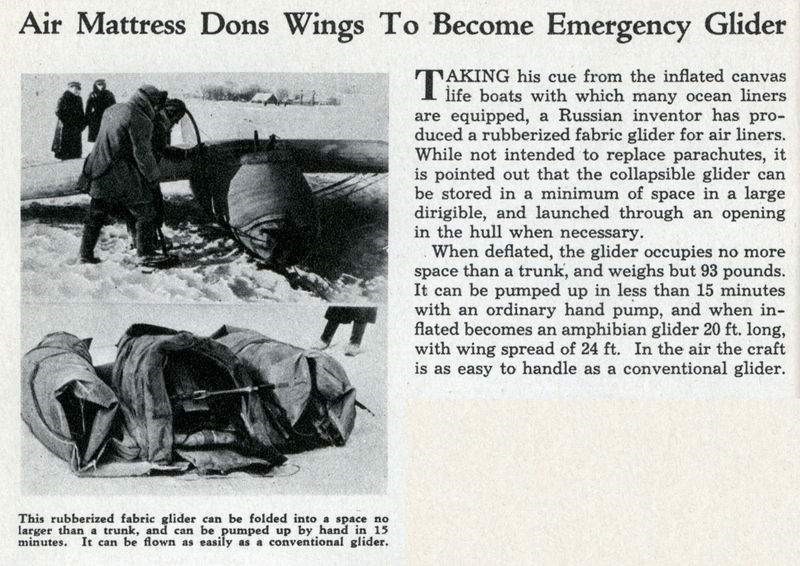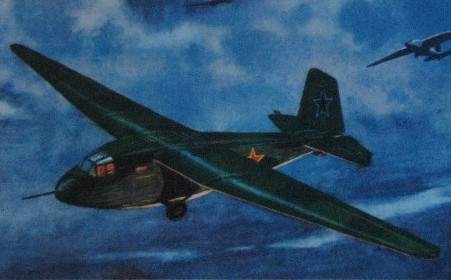
Grokhovsky G-31 / G-63

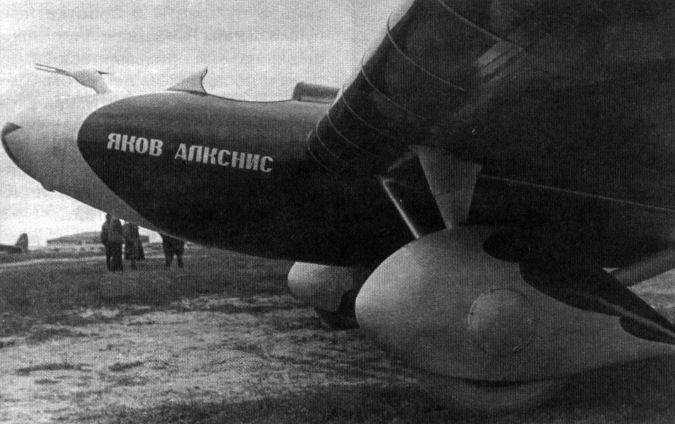
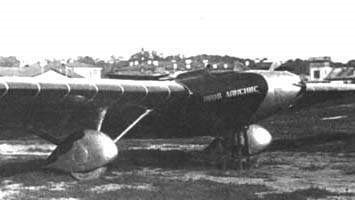
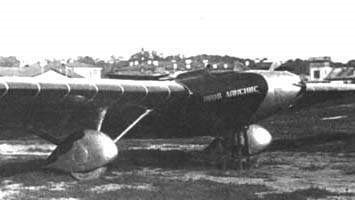
G-31 “Yakov Alsknis” glider, second copy produced

Since 1931 pilot and aeronautical constructor Pavel Grokhovsky began the development of means for landing troops. This new task received special support from the substitute of the People’s Commissar for Naval and Military Affairs and the chief of armaments of the RKKA, Mikhail Tukhachevsky.

After unsafe attempts to transport the paratroopers in underwing containers, Grokhovsky decided to try under his direction, Boris D. Urlapov designing a landing glider with a capacity for 16 paratroopers.

Urlapov had some experience working with gliders, for in 1925, in Saratov, he helped OK Antonov build the OKA-2 glider and later built a training model of his own design.

The task assigned by Grokhovsky envisioned the creation of a towed glider capable of carrying 1,700 kg of cargo or 17 paratroopers.

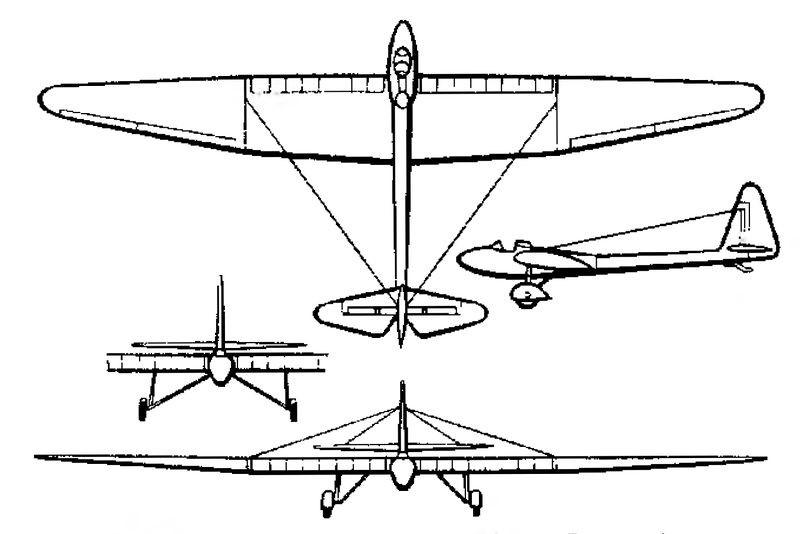
The glider was given the internal designation G-63 and was characterized by its unusual distribution of soldiers lying within the thick wing centerplane.

The G-63 glider was designed as a mid-cantilever wing monoplane with a wingspan of 28 metres. The front of the glider was designed as a projecting cockpit for the pilot.

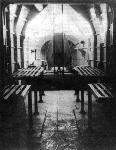
The thick wing featured a thick rectangular midplane with a large chord and trapezoidal wing consoles with rounded ends. This wing was built using profiles TsAGI-677, 678 and 679. The 16 soldiers were located prone in the midplane, in cells measuring 2100 x 660 x 550 mm separated by frames, which at the same time served as wing ribs. The leading edge of this centerplane was made up of a transparent cover that could be opened, pivoting upwards, for the loading and unloading operation of the soldiers.

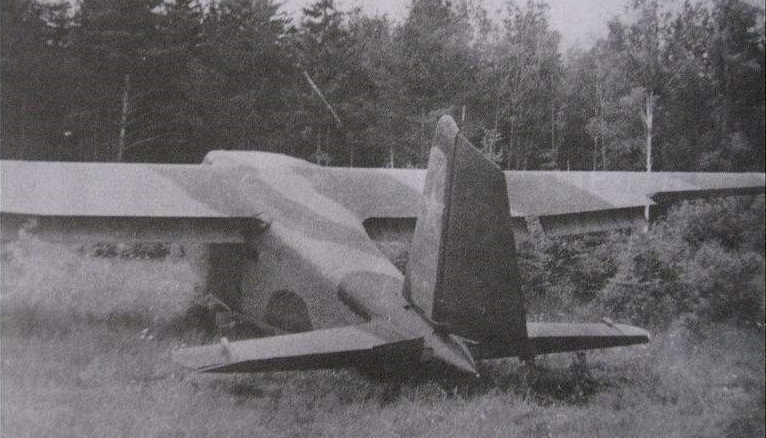
All construction was made of wood. The fuselage had a monocoque structure with a plywood covering. Following the wing, the fuselage tapered to become a slim oval section tail bar, to which the tail unit was attached. Bracing cables to the wing were used to secure the tail cone.

The tail unit, of the monoplane type, featured stabilizers braced to the keel.

The original landing gear was designed with a conventional structure with a tail skid and was of the fixed type. The main landers, with large simple wheels, were fixed to the centerplane structure in the wing and by means of long studs to the fuselage frames in their lower region. In the G-31 version, the landing gears were reinforced and drop-shaped aerodynamic fairings were placed on the wheels.

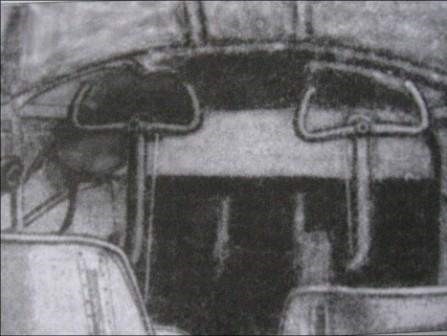
The original version placed the pilot in an open cockpit with a windshield, located forward of the wing leading edge. The improved version G-31 included a double cabin with double control.

The G-63 (Russian: Гроховский Г-31 (Г-63)) glider was built in Leningrad Factory No.47. In October 1932 construction was finished and testing began. The first flights were made by Grokhovsky himself. Later the tests were continued with the participation of test pilot VA Stepanchonok. The towing was done with the help of a Polikarpov R-5.

In 1932, during one of the test flights, the G-63 crashed, receiving serious damage.

The glider repairs took until August 1933. During this time, construction changes were made, which included increasing the surface of the rudders, modifying the operating angles of the rudders and ailerons, adding a position for a second pilot, among others. The rebuilt glider received the new designation G-31.

A year later the construction of a second prototype was finished, which was named “Yakov Alksnis” after the head of the VVS. This example featured cut-out landing gear and reinforced landing gear. The rudder control cables were concealed within the tail cone structure.
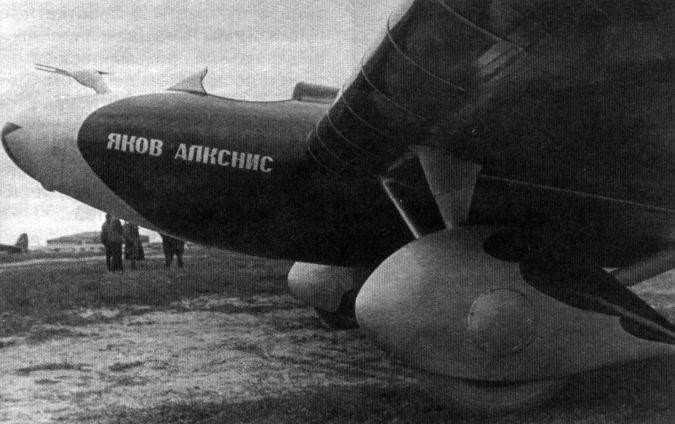
second example G-31A, named “Yakov Alksnis”

It was thought of giving the glider some capacity for autonomy. With this objective in 1935, the first G-31 prototype was equipped with a 100 hp M-11 engine, turning it into an experimental motorized glider or “planerlet” as it was called in the USSR at that time. The fuel capacity allowed the “planerlet” to stay in the air for about 20 hours.

During the tests, this example with a maximum load of 1,400 kg achieved a speed of 120 km/h with a cruise of 101 km/h and a ceiling of 5,000 m. Flights were made with a range of 2,000 km, but staying for 20 hours in a cramped compartment with hardly any movement capacity was extremely uncomfortable, especially considering that after landing the soldiers would have to go into combat.

With the aim of increasing speed, the installation of a more powerful engine was planned, which transformed the G-31 from a motor glider into a transport aircraft. This is how the G-31 version with the 700 hp Shvetsov M-25 engine would appear.

The little practical application of the idea and the lack of definition by the VVS of the technical specifications for a landing glider, resulted in its abandonment.

Despite the fact that in the early 1930s the USSR was at the forefront of landing glider development with the construction of the Grokhovsky G-31 and the Groshiev GNo.4, work in this direction did not receive enough attention and ended up being abandoned.

The Grokhovsky G-31 landing glider was unveiled to the public over Moscow Central Airfield in 1934 and according to historians was the origin in the development of the German DFS-230 landing glider.

Versions:
G-63 – Original version of the 1932 glider. It was damaged during testing.

G-31 – Improved 1933 model obtained as a result of the modifications introduced to the G-63 prototype after its accident.

G-31 “Yakov Alksnis” – Second example built in 1934 and named after the head of the VVS. It featured minor design improvements.

G-31A or MP – Modification of the first prototype with a 100 hp M-11 engine.

G-31/M-25 – Repowered version of the G-31MP with a 700 hp Shvetsov M-25 engine made in 1935 with the aim of improving performance.

G-63
Wingspan: 28 m
Wing area: 67.6 sq.m
Length: 12.37 m
Height: 3.3 m
Horizontal plane surface: 9.3 sq.m
Vertical plane surface: 3.6 sq.m
Aileron area: 8.1 sq.m
Wing aspect ratio: 11.6
Empty weight: 1290 kg
Wing loading: 44.4 kg/sq.m
Best glide ratio: 28.6
Crew: 1

G-31A
Powerplant: 1 × 700 hp M-25
Wingspan: 28.00 m
Wing area: 70.00 m²
Length: 18.60m
Empty equipped weight: 1400 kg
Maximum takeoff weight: 3200 kg
Wing loading: 46 kg/m²
Power load: 4.6 kg/hp
Payload: 16 equipped soldiers
Top speed: 135km/h
Crew: 2
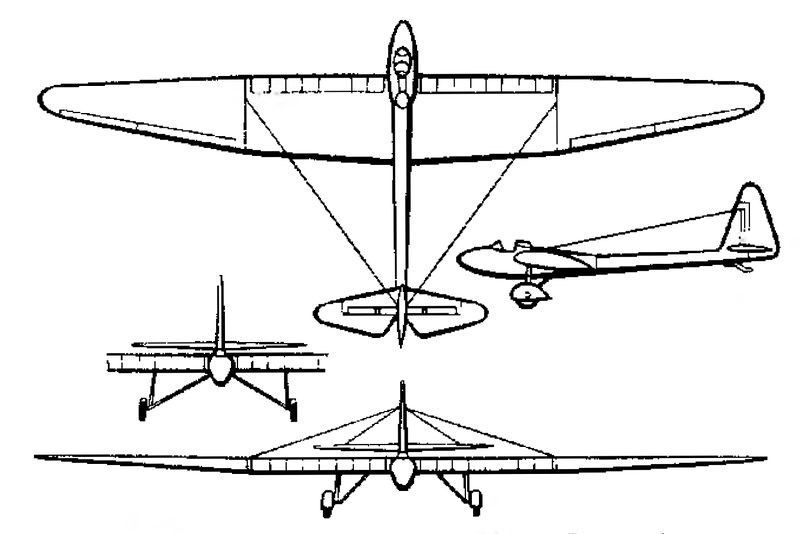
G-31 glider

Grokhovsky Inflatable Gliders

As part of the landing systems studies, the Bureau of Experimental Constructions headed by Grokhovsky proposed various configurations of inflatable gliders.

Systems on board aircraft and gliders were tested. Soon this working group would propose a highly original solution: the use of inflatable gliders, Grokhovsky inflatable gliders (Гроховский надувные планеры). Work in this direction was started by Grokhovsky in 1934. According to their design, these rubber gliders could be used by mountaineers and for disembarkation in places of difficult access. After landing, the plane could be collected and stored in a bag, and could easily be returned to be used again.

Experiments in the development of the inflatable model began with the creation of an inflatable wing. The works were carried out at the Leningrad factory “Krasni Triugolnik” (Red Triangle), one of the oldest industries in Saint Petersburg, specialized in the production of rubber products. The wing built, officially called the “Pneumatic Wing”, had the structural elements and spars also made of rubber and was tested by the glider pilot V. Petushkov, who was tied to it by means of belts.

Petushkov stood on the bed of a truck firmly tied to the wing. The truck picked up speed and soon the wing took off, taking its “pilot” into the air. After flying a certain distance, he was able to land gently on his legs.

This first flight was followed by others from the bed of the truck. Later it was decided to try tying the pilot to the car using a long rope. As the truck began to move, the pilot with wings was towed through the air. This flight could go on for several minutes, until the truck stopped. Initially the flights were not very “elegant”, but little by little Petushkov was learning to master the wing. During one of the flights, when landing the “pilot” did not touch the ground correctly and the glider landed on the wing. In other circumstances, the pilot would have been injured, but the inflated wing totally cushioned the blow.

As a second step, a simple inflatable glider was created with minimal control elements. According to Grojovski : – “this inflatable glider in a mountainous region will be able to absorb impacts of considerable force and its low weight will allow it to rise above the air flows”.

The glider was designed in a short time and its construction was commissioned to the Leningrad factory “Promtexnika”. The new glider was notable for its simplicity. It lacked ailerons and rudders as the control would be done by twisting.

In a straight line the glider flew smoothly and could be easily towed by a U-1 or U-2 biplane. This glider was tested in flight by Grokhovsky himself and several members of his collective. A film is preserved in the Krasnogorski archives where it is shown how the inflation and the towed unloading of this glider was carried out.

The problems arose in the turns. The lateral twists deformed the glider and the forces applied to the controls as well. The elastic fuselage absorbed all the pressures applied on the controls, making the flight uncontrollable. It was clear that the fuselage structure had to be combined in order to guarantee the necessary structural strength.

In 1935 the glider was shown to the country during the flypast in Tushino. Soviet newspapers promoted success and soon references to the Russian inflatable glider were found in the Western press.

The Western press echoed the Soviet achievement.

Given the lack of financing to continue the project, the glider was transferred to the Moscow Aviation Institute (MAI) as a possible way for its development. Grokhovsky was hopeful that the young engineers would be interested in the development of this technology. Once in the MAI, the glider was deposited in a warehouse and remained there until it was decommissioned.

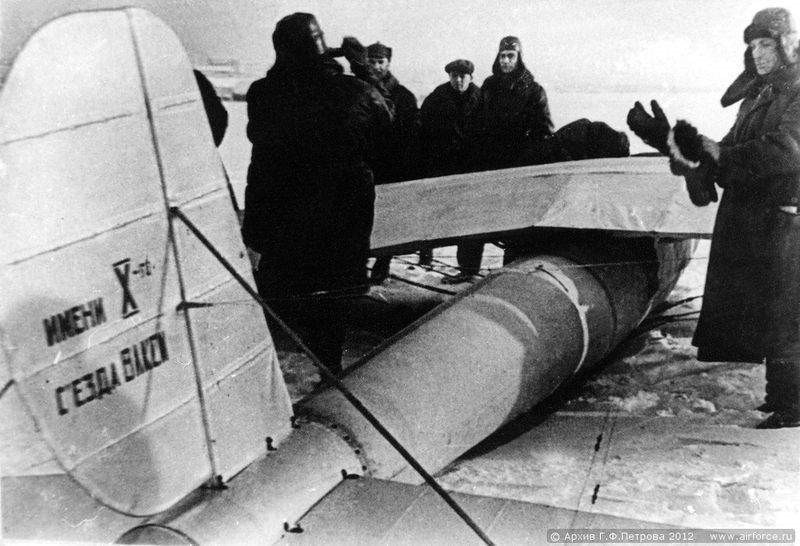
At the Grokhovsky Institute these works were continued. Under the direction of Ivan Titov, Grokhovsky’s replacement, the most developed of these gliders was created, the amphibious “X Congress of the VLKSM”.

It was a single-seater glider with a high-wing monoplane configuration. The fuselage at its rear was made up of a rigid tube to which the tail and landing pad were attached. Wooden controls were located in the cockpit.

The pilot sat on an inflated “pillow”. This version incorporated not only rubber, but wood and metal to the construction. Despite this, a high level of portability was achieved. The glider weighed only 77 kg and could be stored in a 1 x 1 x 0.5 meter bag

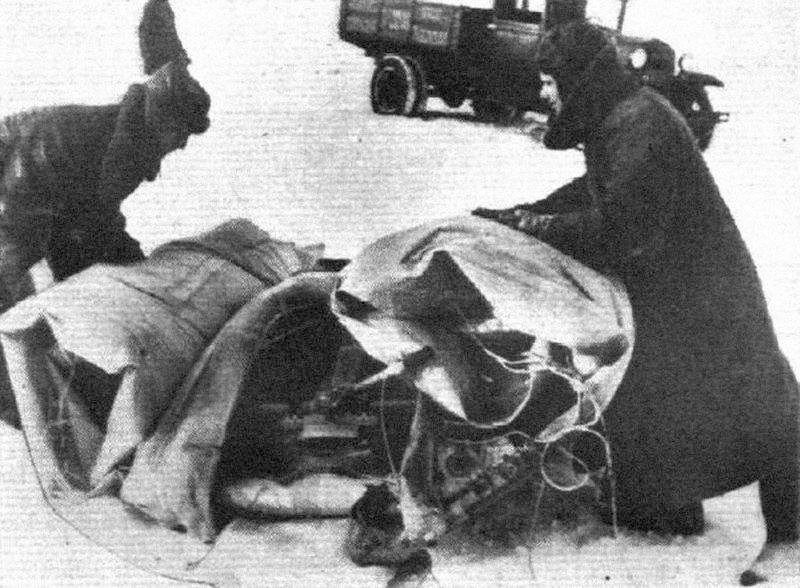
Unpacking the inflatable glider at a demonstration.

Preparation for the flight took about 20 minutes using a manually operated filling pump.

The construction was carried out in the factory “Krasni Triugolnik”, being ready for 1935. The “fuselage” was prepared to allow the glider to land both on land and on the water.

Inflatable amphibious glider named in honor of the X Congress of the VKLSM.

The first flight on this glider Grokhovsky wanted to carry out personally. The Leningradenses were able to observe how on a summer afternoon a motor boat advanced over the waters of the Neva River towing a glider that floated touching the water with its wings. As speed increased the wings began to rise and soon the glider rose slightly above the water. Bridges over the river prevented the flight from being long, but the objective had been achieved.

The tests were continued by Factory No.47 pilot Georgi Shmith. During the tests, carried out at the Leningrad Flying Club, the glider was towed by a Polikarpov U-2 aircraft at a height of 60 – 100 meters. After being released, it remained in flight, traveling about 1 kilometer before landing. Other successful tests were carried out.

With these results Grojovsky began to think about the possibility of making an inflatable plane.

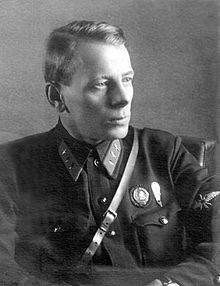
Grokhovsky, Pavel Ignatievich

Pavel Ignatievich Grokhovski (in Russian: Павел Игнатьевич Гроховский) was born in March 6, 1899 in Viasma, Smolensk.

His childhood was spent in Tver, where he completed the first four grades of primary education, later entering the Royal College of this city. At the age of 15 Grokhovsky left his studies and his home, traveling to Moscow, where he worked as a messenger for a pharmacy. In those years he frequently visited the Jodynka airfield where Russian aviation pioneers Dokuchayev, Gaber-Vlynski, Lerche held exhibitions, falling in love with aviation.

In 1917 he voluntarily joined a group of revolutionary sailors in Revel (Tallinn), participating in the October uprising. He participated in the Civil War as a sailor on the battle ship “Petropavlovsk”, in the Baltic Fleet. He participated in ground operations under the leadership of IKKoshinov and PEDybenko. Later he fought against the Germans in Ukraine; against Kolchak, Denikin and the White Forces and against the English intervening forces.

In 1919 he joined the Communist Party of the USSR and two years later he was appointed Commissioner of the Black and Azov Seas.

In 1922 he entered flight courses. He studied initially at the Yegorevsk Theoretical School and then at the Borisoglevsk Flight School. In 1925 he finished the Kacha Military Aviation School, becoming a pilot.
His first inventions related to aviation were developed by Grokhovsky in 1927, when he served as a military pilot in the 44th squadron at Novocherkass. In those years bomber training was done with concrete bombs.

Grokhovsky proposed to replace them with clay bombs filled with chalk of different colors. This not only made the teaching process cheaper, but it was very easy to analyze the results of the training since each crew was assigned a color that was scattered at the site of the fall of the artifact.

From 1929 he began to work as a test pilot at the VVS Scientific-Research Institute (NII VVS). In those years, the idea of parachute landing was beginning to develop.

In 1929 Grokhovsky made his first parachute jump.

Pavel Grokhovski after a parachute jump.

The first Soviet parachutists used the American Irvin system. Each parachute cost about 1,000 gold rubles. Grokhovsky proposed to sew the domes using cheap calico. To demonstrate the possibility of use, Grokhovsky himself and his collaborators performed demonstration jumps.

To study the possibilities of the new idea, the Oskonbyuró (Special Construction Bureau) of the VVS RKKA was created in 1932, dedicated to the development of skydiving and air landing techniques. Grokhovsky was appointed chief and chief builder.

Grokhovsky dreamed of a plane specialized in the transport of paratroopers. His conception would be embodied in the G-37, an aircraft built in the form of a structure with a high fixed landing gear to which a ventral container with landing troops could be attached. This cockpit could be released in flight and fell to the ground with a large parachute 40 meters in diameter.

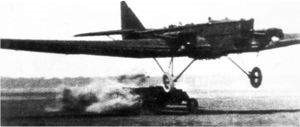
Launch of an Aviabus from the Túpolev TB-1 bomber in low altitude flight.

One of Grokhovsky’s novel inventions was his “Aviabus”, a system for launching charges and people from the air without using a parachute. The “Aviabus” was in the form of a flat container in the shape of a short, thick wing, which featured a two-wheel train with rubber cushioning on its bow and a skid on the tail. After launching from a height of 12 – 15 meters above the ground, the “Aviabus” performed a slight glide and when it touched the ground it kept rolling until it lost inertia. With this invention, Grokhovsky was able to considerably reduce the length of stay of the transporter aircraft in the landing area and the problems associated with take-off.

“Aviabus” projects were designed with different capacities and with wheel or ski landing gear. “Aviabus” were developed for land and water landings and even more innovative projects such as a motorized sled, which once launched from the mother plane could start its engine and fulfill its military task as an artillery troop transport. One of the variants was also the “avio-tanqueta”, an armored “Aviabus” with a train of mats and its own engine.

In 1932 the G-63 glider made its appearance. For the first time a glider of such dimensions was built, capable of lifting and transporting 16 soldiers, who travelled lying inside the thick wing. There was also a capacity to transport 500 kg of cargo.

When his organization became an Institute, Grokhovsky had the opportunity to expand his work to the design and construction of airplanes. Between 1934 and 1936, the institute designed and built 5 experimental aircraft models. Grokhovsky generally designed the schematic of the new plane and its development was entrusted to one of his subordinates.

PI Grokhovsky was transferred to a bureaucratic assignment at the Central Council of the Union of Defense Assistance Societies and Aviation-Chemical Construction of the USSR (OSOVIAJIM). The 5 of November 1942 was finally arrested by infundades accusations and ended up dying in prison. The “official” records this death on 2 October 1946 due to tuberculosis.

In 1957, Grokhovsky’s case was presented to the court of the Moscow military region, which completely cleared him due to the lack of evidence that showed involvement in the accusations.

Pavel Ignatievich Grokhovsky was responsible for more than 100 innovations and experimental creations, generally very advanced for his time. He proposed dive bombing long before they began to be used in a massive way, refuelling in the air, the use of the swept wing, the ekranoplanes. Many of these ideas were widely disseminated in later years. Grokhovsky was an exceptional man. His meager education was supplemented by a rare innate instuction. His acquaintances valued him as reckless and audacious, and at times he was irresponsible. Piloting a plane, he performed the acrobatic figures almost at ground level, he always drove the vehicles at high speed, personally tested his most dangerous creations.

Order of Lenin (1933)
Master of the Sport of Skydiving (1934)

Productions related to aeronautics

G-26
Experimental interceptor fighter developed between 1935 and 1936. It was unleashed by the use of a bicycle-type undercarriage with skids under the wings. The prototype was destroyed before its completion.

G-31
Glider from 1933 with capacity for 16 equipped soldiers obtained as an improvement of the previous G-63. Two were produced which were also tested in a motorized version with different powerplants.

G-37
Troop transport plane conceived in 1934 and characterized by its double fuselage and a large light from the ground to be able to transport a launchable container with landing troops under the belly. The container was launched from the air, descending with the help of a parachute.

G-38
Multifunctional combat aircraft known as “Light Cruiser” or LK-2. Developed in parallel with the G-26, the prototype would also be destroyed, when its construction had not yet been completed.

G-39 “Cucaracha”
1939 experimental fighter with arrow wings and tailless configuration.

G-52
“Flying battery” conceived on the basis of a heavily armed Túpolev TB-3 bomber with 76 mm field guns.

G-61
Modification of a Polikarpov R-5 reconnaissance aircraft with cassettes for landing troops located under the wings. Several prototypes were developed, which were successfully tested in 1936. In 1937 two of the civilian version Polikarpov P-5 would be used in an attempt to save Levanevski’s crew

G-63
Initial prototype of the G-31 landing glider. It was destroyed during testing.

Inflatable gliders
The Grokhovsky Institute developed three models of inflatable gliders that were successfully tested between 1934 and 1935.

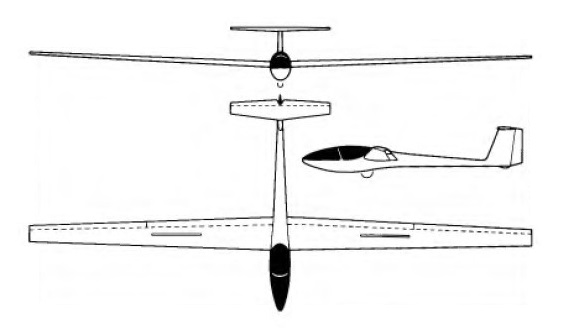
Grob G-109 / Vigilant

G109B

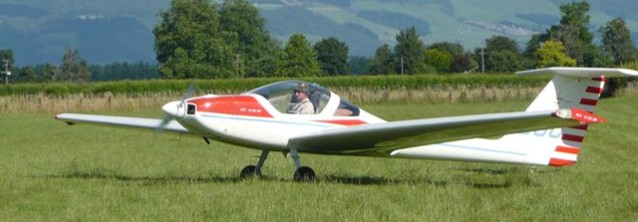
Designed by Burkhart Grob GmbH, the two seat Grob 109 motor glider features side by side seating and fixed tail dragger undercarriage with a steerable tail wheel. The fuselage and wings are made of industrial carbon fibre and glass fibre composites with air brakes. Glass Reinforced Plastic (GRP) is the main structural material with Carbon Fibre for the T-tailplane and rudder. Hard foam sandwiched between fibreglass cloth is used for stringers and formers in the fuselage as well as many other applications.

Grob’s G 109 has the ability to shed its wings, tailplane and elevators to enable it to be neatly packaged for transportation in a suitable road-borne trailer. Each wing has a tapered tongue that extends through the centre section to lock into the opposite wing root rib. The ailerons and air brakes are operated through push-pull control rods. The horizontal tailplane is fitted atop the fin and the quick connect fittings for the elevator and trim tab are fitted.
The Limbach L 2000 EB lA engine is rated at 59kw/80hp at 3,400 rpm. The engine has a single Slick magneto, twin Stromberg carbs with “pancake” sport air filters, Motorola alternator and a Hoffman feathering propeller with START (take-off and climb) and CRUISE pitch settings.

The 17.5 Imp gallon fuel tank is behind the cockpit and filled from above the left wing trailing edge. There are GRP skids/tie down points under each wing tip and the engine cooling air exits from fixed louvers in the bottom cowl.

The glassfibre monocoque fuselage has frames and longerons, while the low wing has a glassfibre roving main spar and a glassfibre/epoxy resin sandwich skin; there are aluminium air brakes in the upper wing surfaces. The fixed undercarriage has Scheibe hydraulic brakes on the spatted main wheels, and the tailwheel is steerable. The pilots sit under a one-piece forward-opening canopy and, after some flight testing, this was fitted with a central frame, while changes made to the undercarriage included moving the main wheels further back so as to unload the tailwheel, the main wheel struts being of steel. Wing span was increased from the original 15m (49ft 2.5in) to 54ft, the empty weight was increased and the motor cowling and wing roots were aerodynamically refined.

The prototype, D-KBGF, made its first flight on 14 March 1980, and the Grob G 109 was certified to JAR 22 in March 1980.

The prototype of the G.109B two-seat, side-by-side motorglider first flew in March 1983 as a version of the original G. 109, with increased span. The GROB G109B is a two-seat motor glider with T-type stabilizer, fixed landing gear and airbrakes. It is classified as a TMG (Touring Motor Glider). It was designed by Burkhart Grob GmbH and features side by side seating as well as a classical tail-dragger undercarriage with a steerable tail wheel. The fuselage and wings are made of industrial carbon-fibre and glass-fibre composites. The G109B’s engine was made by Grob (GR 2500) and is an aircooled 4-stroke flat engine.
In 1983 a Grob G109B motorglider extended the gliding world altitude record to 6,406m (21,018ft) and the gliding world altitude gain record to 5,042m (16,544ft).
Powered by a 75 hp (56 kW) Limbach engine, the G 109B in RAF service is known as the Vigilant T Mk 1 with the self-launching Volunteer Gliding Schools of the ATC and CCF. The Royal Air Force ordered the last 54.
Although production of this motorglider ceased in 1986, during 1990, Burkhart Grob Luft-und Raumfahrt was building between 70 and 100 more G.109Bs to meet a number of orders – including from the RAF.
A total of 322 of the G109 and 322 of the G109B aircraft were built from 1983 through to 1990.

In 1983 a Grob 109B extended the gliding world altitude record to 6406m / 21,018 ft and the gliding world altitude gain record to 5042 m / 16,544 ft.

G 109 / G 109B
Engine: 71 kW/ 95 bhp. Grob 2500
Wing span: 17.4m / 57.1ft
Wing area: 19sq.m / 204.5sq.ft
Empty Weight: 580kg / 1280lb
Payload: 245kg / 540lb
Gross Weight: 825kg / 1820lb
Wing Load: 40.44kg/sq.m / 8.28lb/sq.ft
Water Ballast: 0
L/DMax: 25 104 kph / 56 kt / 64 mph
MinSink: 1.10 m/s / 3.16 fps / 2.15 kt
Aspect ratio: 15.9
Airfoil: Eppler E580
Seats: 2
No. Built: 322

Engine: Limbach L 2000 EB 1A, 80hp @ 3,400 rpm.
Propeller: Hoffman HO-V62R/L 160T.
Span: 16.6m (54.45 ft).
Length: 7.9m (25.85 ft).
Height: 1.7m (5.51 ft).
Empty Wt: 606 kg (1336 lbs).
Useful load: 219 kg (484 lbs).
MTOW: 825 kg (1820 lbs).
Cruise @ 5,000 ft: 105 kts, 3,000 rpm, 16 litres/3/2 gals per hour.
Range (45 min res): 430 nm.
ROC: 530 fpm.
Best glide ratio: 1:30. Stall: 47 kts.
Min sink rate: 230 fpm at 51 kts.
Vne: 130 kts.
Load factor: Va (100 kts) +5.31-2.65,
Vne (130 kts) +4/-15.
Fuel cap: 80 lt.
Baggage cap: 20 kg (44lb).
Ldg dist: 223m (730 ft).
TO dist: 205m (673 feet).
Max X-wind: 11 kt.

Grob G-104 Speed Astir II

This single-seater Unrestricted 15m Class version of the Astir is generally similar to the Astir CS 77 except for wings of reduced area and different section, which have carbon-fibre spars and are fitted with so called ‘elastic flaps’ in which the gaps between the flap and the wing trailing edge are elastically sealed; these flaps can be deflected upwards to act as air brakes as well as downwards, and the ailerons can be drooped with the flaps.

The Speed Astir has the same cantilever mid-wing and T-tail as the Astir, but with a shorter fin and rudder and constructionally it is the same as its predecessor. The water ballast capacity has been increased to 330 lb.

After 25 of the original Speed Astirs had been built, production switched to the Speed Astir II which first flew on 11 November 1978.

This had a new and slimmer laminar flow fuselage, with carbon-fibre reinforcements in high stress areas, and a two-piece canopy, the rear section of which hinges to open aft. The tail unit is similar to that of the Astir CS but with shorter fin and rudder, and the new tailplane has a sealed elevator hinge line.

The slotless flaps extend half-way along the trailing edges, and the ailerons, which can be deflected in the same way, continue to the wingtips. Mounted on tracks and rollers, the ailerons and flaps articulate with the lower wing surface and can slightly increase the wing area. The wing upper surface features ‘elastic’ strips which form a permanent seal between flap and wing.

Grob G-104 Speed Astir II

In October 1979 the cockpit was lengthened by nearly 8in to accommodate taller pilots, and the Speed Astir IIB has carbon-fibre spars. From the same date the Speed Astir II 17.5, a version with a longer span of 17.5m, was due to become available. Altogether 98 Speed Astir IIs had been built by December 1979 and the type is out of production.

Speed Astir II

G 104 Speed Astir II & IIb
Wing span: 15m / 49 ft 2.5 in
Wing area: 11.46 sq.m / 123.4 sq.ft
Length: 21 ft 11.25 in
Height: 4 ft 2 in
Empty Weight: 265 kg / 584 lb
Payload: 250 kg / 551 lb
Gross Weight: 515 kg / 1135 lb
Wing Load: 44.94 kg/sq.m / 9.19 lb/sq.ft
Water Ballast: 140 kg / 308 lb
Max speed:168 mph (smooth air)
MinSink: 0.70 m/s / 2.3 fps / 1.36 kt at 47mph
L/DMax: 40 95 kph / 52 kt / 60 mph
Best glide ratio: 41.5:1 at 74.5 mph
Aspect ratio: 19.6
Airfoil: Eppler E 662
Seats: 1
No. Built: 107

Speed Astir II
Wing span: 15.0 m / 49 ft 2.5 in
Length: 6.60 m / 21 ft 8 in
Height: 1.27 m / 4 ft 2 in
Wing area: 11.5 sq.m / 124.8 sq ft
Wing section: Eppler E660
Aspect ratio: 19.6
Empty weight: 250 kg / 551 lb
Max weight: 515 kg / 1,134 lb
Water ballast: 180 kg / 397 lb
Max wing loading: 45 kg/sq.m / 9.2 lb/sq ft
Max speed: 146 kt / 270 km/h
Stalling speed: 35 kt / 64 km/h
Min sinking speed: 0.57m/sec / 1.87 ft/sec at 40 kt / 75 km/h
Best glide ratio: 41.5 at 65 kt / 120 km/h

Speed Astir II

Grob G-103 Twin Astir / Viking T. MK.1 / G-118

G-103 Twin Astir Acro

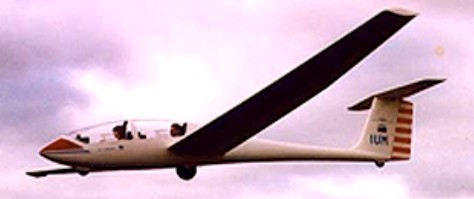
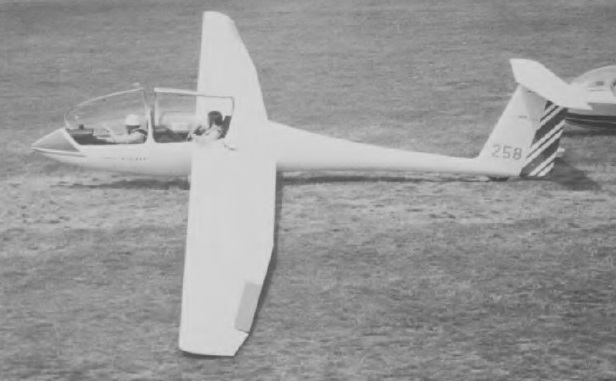
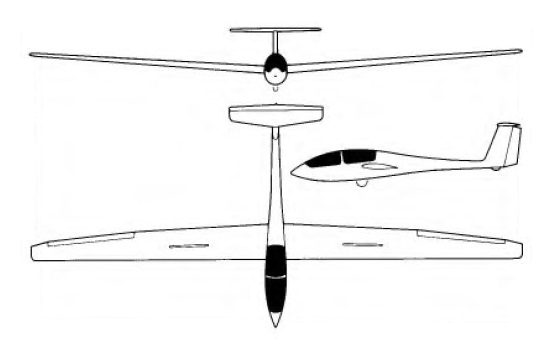
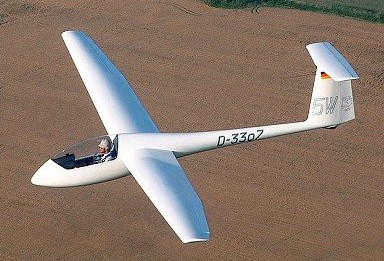
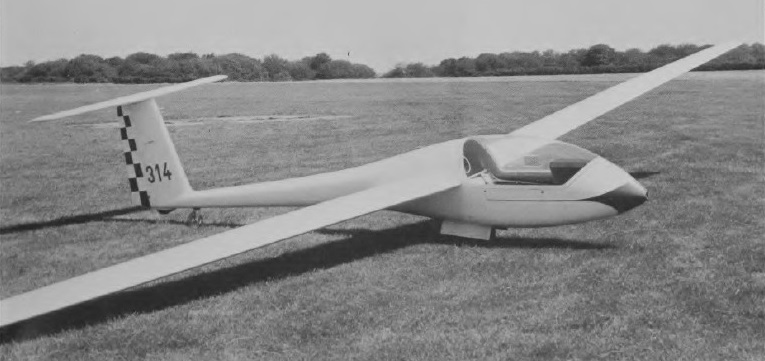
The Twin Astir was a two-seat 1970s development of the Standard Class Astir CS, differing from it principally in having a fuselage lengthened by 9.75 in to accommodate the second seat, and also reduced in depth by 1.5 in; wing span has been increased to 17.5m (57 ft 5 in) and the wings are now swept forward 3° 18′. The gear retracts by folding up to the left and lying horizontally under the rear seat. The 3.3 degree forward wing sweep was replaced by a straight wing with leading edges at right angles to the fuselage centerline early in the production run. Dual controls are provided under the two individual canopies, and the Twin Astir is offered to customers both with and without the basic instruments in the front cockpit and with or without water ballast, of which up to 198 lb can be carried.

The Twin Astir has the same mid wing position and T-tail as its single-seat counterpart, and is of the same glassfibre construction. In contrast to later G 103 models, the Twin Astir has the main wheel ahead of the center of gravity, and does not have a nose wheel. It was offered with a tailskid or an optional tail wheel. The G 103T Twin Astir had a fixed main wheel.

Design of the Twin Astir began in September 1974 and construction of the prototype was commenced in March 1976; this made its first flight on 31 December 1976. By the end of 1978 over 225 Twin Astirs had been delivered; production has now ended. The type is also known as the Twin Astir Trainer when used for this task.

Twin Astir G 103

Formerly the G118, the Twin II is a new tandem two-seater for training and club use to succeed the Twin Astir, from which it differs in having a narrower and more streamlined fuselage, improved cockpit layout and larger canopies, lower-set wings, a fixed monowheel plus a small wheel (likewise semirecessed) under the forward cockpit and a tailwheel, downturned wing tips and reduced empty weight. The same type of elasticated flaps as featured on the Speed Astir are fitted, and the T-tail is similar to the Twin Astir’s. Unlike the latter, no water ballast is carried. The Twin II first flew late in 1979.

The G-103 A Twin II was the successor of the Twin Astir with a nose wheel and a fixed six-inch main gear fitted behind the center of gravity in a fairing. The main wheel is equipped with a hydraulic brake. Modified ailerons produce a substantially improved roll response. Approach control is by top surface Schemmpp-Hith type airbrakes.

The Twin II won the world Out & Return record for two-seat sailplanes (1000.88 km/ 621.92 miles) flown by Tom Knauff of the U.S. The Twin II Acro is similar to the earlier model, but with strengthened mainspar caps and steel control pushrods which permit greater aerobatic performance. The Royal Air Force acquired 100 Acros (known as the Viking T. MK.1) for its air cadet training program. The G 103 has a FAA approved modification kit for all-hand control for handicapped operation. Air Transport Certified.

G 103 C Twin III

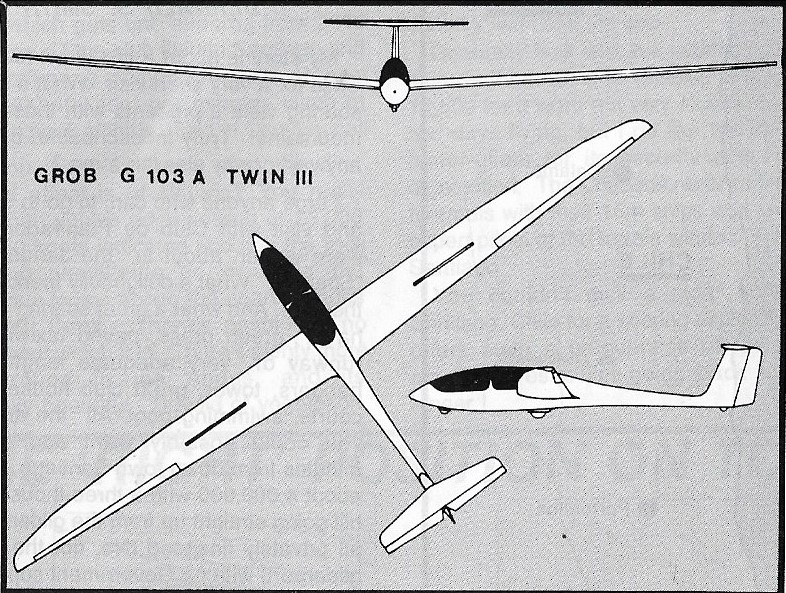
The G 103 C Twin III is a development of the Twin II with a new Discus plan wing of slightly increased span and modified airfoil section. The cockpit has detailed improvements including better ventilation, relocated airbrake levers to give better purchase, and canopies restrained by gas-filled struts. The unpowered sailplane is cleared for aerobatics similar to the Twin II Acro. The self-launching version (Twin III SL), which is non-aerobatic, has an electrically actuated mast-mounted retracting engine and steerable nose wheel. Fuel is stored in a main tank in the fuselage close to the engine, and in an auxiliary tank in the left wing root from which fuel is moved by a transfer pump. The variable pitch propeller has climb and cruise setting.

Gallery

Twin Astir G 103
Wing span: 17.5 m / 57 ft 3 in
Wing area: 17.89 sq.m / 192.6 sq.ft
Length: 8.1 m / 26 ft 8.75 in
Height: 1.6 m / 5 ft 3 in
Empty Weight: 390 kg / 859 lb
Payload: 286 kg / 631 lb
Gross Weight: 676 kg / 1490 lb
Wing Load: 37.79 kg/sq.m / 7.73 lb/sq.ft
Water Ballast: 90 kg / 198 lb
Aspect ratio: 17.1
Airfoil: Eppler E 603
Max speed: 155 mph / 135 kt / 250 km/h (smooth air)
Max aero-tow speed: 105 mph
Stalling speed: 40 kt / 74 km/h
MinSink: 0.68 m/s / 2.23 fps / 1.32 kt at 56 mph / 40 kt / 75 km/h
L/DMax: 38 at 109 kph / 59 kt / 68 mph
Seats: 2

Grob G-103 Twin II
Span: 57 ft 5 in
Length; 26 ft 10 in
Height: 8 ft 1 in
Wing area: 191.6 sqft
Aspect ratio: 17.2
Empty weight: 794 lb
Max take-off weight: 1,278 lb
Max speed: 155 mph (smooth air)
Max aero-tow speed: 105 mph
Min sinking speed: 2.1 0 ft/sec at 50 mph
Best glide ratio: 37:1 at 65 mph

Twin II and Twin II Acro G 103A
Wing span: 17.5m / 57.4ft
Wing area: 17.8sq.m / 191.6sq.ft
Empty Weight: 368kg / 811lb
Payload: 212kg / 468lb
Gross Weight: 580kg / 1279lb
Wing Load: 32.58kg/sq.m / 6.67lb/sq.ft
Water Ballast: 0
L/DMax: 35 105 kph /56 kt / 65 mph
MinSink: 0.75 m/s / 2.45 fps / 1.45 kt
Aspect ratio: 17.2
Airfoil: Eppler E 603
Seats: 2
No. Built: 549

Twin III Acro and III SL G 103 C
Wing span: 18m / 59ft
Wing area: 17.5sq.m / 188.4sq.ft
Empty Weight: 390kg / 860lb
Payload: 210kg / 463lb
Gross Weight: 600kg / 1323lb
Wing Load: 34.29kg/sq.m / 7.03lb/sq.ft
Water Ballast: 0
Aspect ratio: 18.5
Airfoil: Eppler E583
L/DMax: 36 107 kph / 58 kt / 67 mph
MinSink: 0.70 m/s / 2.3 fps / 1.36 kt
Engine: SL model only
Seats: 2
No. Built: 167

Twin Astir G 103

Grob G.102 Astir / CS-77

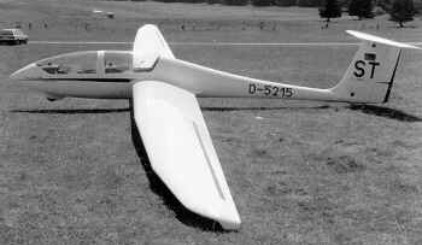
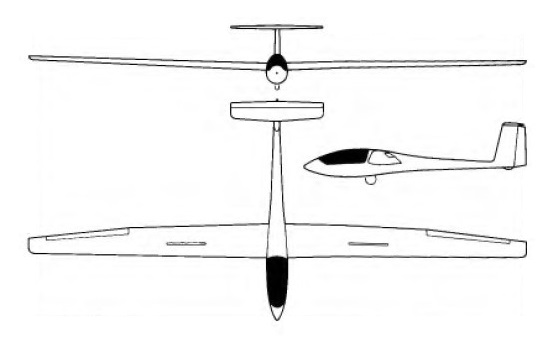
The G-102 Astir is a single seat glassfibre Standard Class sailplane, designed by Burkhart Grob. It was the first Grob-designed sailplane.

Construction of the prototype Astir CS began in March 1974. It features composite (fiberglass/resin) construction, a large wing area, a T-tail and water ballast. A Standard Class Sailplane, the large wing area gives good low speed handling characteristics. The main gear retracts. It first flew on 19 December 1974 and it went into production in July 1975 and soon proved to be popular, a total of 534 being delivered.

The cantilever mid wings have glassfibre roving main spars and a glassfibre/epoxy resin sandwich skin except for the ailerons, which are of glassfibre sandwich. There are Schempp-Hirth aluminium air brakes in the wing upper surfaces, but no flaps, and up to 220lb of water ballast can be carried in tanks in the wings, being jettisoned via a dump valve in the fuselage. Rigging is carried out without any separate removable parts as the wings and the tailplane are attached by a system of ‘snaplock’ connectors. The glassfibre semi-monocoque fuselage has a towing/launching hook, and the large one-piece cockpit canopy opens sideways to starboard.
Construction of the T-tail unit is the same as that of the wings.

This was followed by the Club II with similar fixed gear. A slightly improved version, the CS-77, was introduced in 1977. The CS-77 has a different rudder profile fuselage similar to that of the Speed Astir. The Astir CS 77 made its first flight on 26 March 1977; nearly 400 of the CS 77 and Club Astir had been built by the end of 1978.

The Club Astir II and the Standard Astir II featured the new fuselage of the Speed Astir II. with a one piece canopy, as well as the elasticated flaps of the Speed version and a new wing tip profile.

The Astir CS 77 has a retractable monowheel with an internally-expanding drum brake located ahead of the center of gravity, which folds up behind closed doors, and there is also a rubber-sprung tail wheel. The Astir CSM was a powered version under development in mid-1976 with a 25hp Fichtel & Sachs Wankel KM24 rotating piston engine on a retractable pylon aft of the pilot, driving a two-blade Hoffman tractor propeller. A 6.6 gal fuel tank is fitted.

G-102 Astir

The Astir CS Jeans was of similar configuration to the CS 77, but with fixed wheel, and a tailskid.

The Standard III followed in the early 1980’s reverting to the higher profile fuselage and with reduced empty weight and increased payload. The Club III has a fixed main gear ahead of the center of gravity, and a tailwheel. The Club IIIB has a cockpit almost identical to the front seat of the two-place G 103 Twin II with a fixed main gear aft of the center of gravity and a nosewheel. Air Transport Certified (except Club II which is EXP). One, flown by R.R. Harris of the U.S., won the world absolute altitude record at 14.938 m/ 49.009 ft in 1986.

Production variants were the Club Astir III, IIIB and Standard Astir III, which have a roomier cockpit and reduced empty weight.

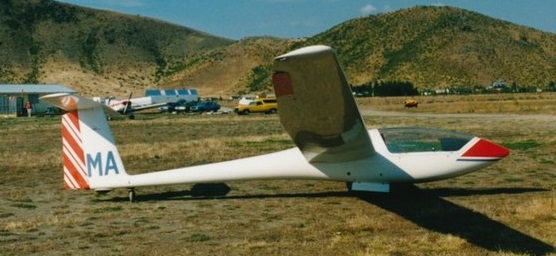
Grob G-102 Astir CS77 ZK-GMA

Grob 102
Wingspan: 15.00 m (49 ft 3 in)
Wing area: 12.4 sq.m (133 sq.ft)
Water ballast: 50 kg (110 lb)
Aspect ratio: 18.2
Empty weight: 255 kg (561 lb)
Gross weight: 450 kg (990 lb)
Maximum glide ratio: 38
Glide Ratio: 36 at 50 kt (92 km/h) / 5.9 nm (10.97 km) per 1000 ft
Sink rate: 141 ft/min (0.71 m/s) at 50 kt
Glide Ratio: 34 at 41 kt (76 km/h) / 5.6 nm (10.36 km) per 1000 ft
Sink rate: 122 ft/min (0.62 m/s) at 41 kt
At 90 knots (166 km/h)
Glide Ratio: 23 at 90 kt (166 km/h) / 3.8 nm (7.01 km) per 1000 ft
Sink rate: 393 ft/min (2.00 m/s) at 90 kt
Stall: (without airbrakes) 32 knots (60 km/h)
Stall: (with airbrakes) 35 knots (65 km/h)
Never Exceed: 135 knots (250 km/h)
In Rough Air: 135 knots (250 km/h)
Manoeuvering: 92 knots (170 km/h)
On Aerotow: 92 knots (170 km/h)
On Winch: 64 knots (120 km/h)
Airbrakes: 135 knots (250 km/h)
Gear Down: 135 knots (250 km/h)
Minimum Payload: 70 kg
Maximum Payload: 110 kg
Crew: One pilot

Astir CS Jeans
Wing span: 15m / 49.2ft
Wing area: 12.4sq.m / 133.5sq.ft
Empty Weight: 248kg / 547lb
Payload: 132kg / 291lb
Gross Weight: 380kg / 838lb
Wing Load: 30.64kg/sq.m / 6.27lb/sq.ft
Water Ballast: 0
Aspect ratio: 18.2
L/DMax: 33.3 93 kph / 50 kt / 58 mph
MinSink: 0.70 m/s / 2.3 fps / 1.36 kt
Airfoil: Eppler E 603
Seats: 1
No. Built: 337

G 102 Astir CS
Wing span: 15m / 49.2ft
Wing area: 12.4sq.m / 133.5sq.ft
Empty Weight: 255kg / 562lb
Payload: 195kg / 430lb
Gross Weight: 450kg / 992lb
Wing Load: 36.92kg/sq.m / 7.43lb/sq.ft
Water Ballast: 0
Aspect ratio: 18.2
Airfoil: Eppler E 603
L/DMax: 38 105 kph / 56 kt / 65 mph
MinSink: 0.70 m/s / 2.3 fps / 1.36 kt
Seats: 1
No. Built: 864

Grob G-102 Astir CS77
Span: 49 ft 2.5 in / 15.0 m
Length: 21 ft 11.25 in / 6.69 m
Height: 4 ft 7 in / 1.4 m
Wing area: 133.5 sq.ft / 12.4 sq.m
Aspect ratio: 18.2
Wing section: Eppler E603
Empty weight: 595 lb / 270 kg
Max weight: 992 lb / 450 kg
Water ballast: (220 lb / 100 kg
Max wing loading: 7.43 lb/sq ft /36.3 kg/sq.m
Max speed: 155 mph / 135 kt / 250 km/h
Stalling speed: 32.5 kt / 60 km/h
Max aero-tow speed: 105 mph
Max rough air speed: 135 kt / 250 km/h
Min sinking speed: 0.6 m/sec / 1.97 ft/sec at 47 mph / 40.5 kt / 75 km/h
Best glide ratio: 38:1 at 65 mph / 56.5 kt / 105 km/h

Grob / Burkhart Grob Luft- und Raumfahrt GmbH & Co KG.

1926: Company foundation in Munich
Aviation work began in 1971 and has since built many thousands of motorgliders, lightplanes and other aircraft.
1974: Foundation of aircraft plant in Mattsies
Burkhart Grob Flugzeugbau GmbH built the Schempp-Hirth Standard Cirrus under licence during 1972-75.
Recent aircraft include the G 103 Twin III and G 109 series of gliders/motorgliders, piston-engined G 115 two-seat lightplane (some versions suited to training and aerobatics; first flown November 1985), GF 200 pusher piston-engined and pressurised 4/5-seat lightplane (first flown November 1991, turboprop-powered G-520 Egrett and Strato 1 high-altitude and long-duration research platforms capable of carrying different electronic payloads in 12 separate compartments (first flown June 1987 in G-500 Egrett form), and the most recent G-850 Strato 2C high-altitude and long-duration atmospheric/ stratospheric/ climatic research aircraft with a unique compound propulsion system using two turbocharged piston engines and two gas generators (first flown March 1995).

Gribovski G-31

When the production of the Gribovski G-11 was restarted in 1943 at the Ryazan Factory, Gribovski began the development of an improved version based on the experience accumulated during combat operations.

The project of this new moto-glider would receive the name G-31 (Russian: Грибовский Г-31) from the OKB and by April 1944 it was ready for discussion.

The G-31 also featured a high wing monoplane structure, but in this model with bracing to the fuselage by uprights. The wing design with R-II profile was maintained. The centroplane had a rectangular shape and the wing consoles were fixed to it with inflection on the leading edge and the straight trailing edge. Wing mechanization included ailerons and flaps, located in the wing soffit and intended to improve landing characteristics.

Another difference that was obvious to the naked eye was the new semi-monocoque fuselage with an oval cross section.

In the nose there was a two-seater cabin with double control and side-by-side seating. The entire nose could be opened to one side in order to allow the loading of large packages or equipment in the cargo hold.

At the request of the Landing Troops (VDV), the possibility of using one or two M-11 engines was maintained.

Despite the fact that the G-31 project was considerably more refined than that of the G-29 and was approved by the NKAP committee of experts during its presentation, it was decided not to proceed with its production. A little earlier, SA Moscaliov had presented a similar project that led to the SAM-28 glider and its development had already been approved.

Gribovski G-29 / Gr-29

With the beginning of the war the OKB-28 received a new task of creating a landing glider capable of transporting 11 people. The order to begin development of the glider was announced by the NKAP leadership on July 7, 1941. That day, the deputy commissioner for the experimental construction of the NKAP, AS Yakovlev asked Gribovski how long it would take to project the glider. Gribovski, without much thought, replied that two months. Considering the response little serious, Yakovlev asked him to put this commitment in writing and signed.

The first plans for the construction of the G-29 (Russian: Грибовский Г-29) were delivered to the production workshops on July 11 and by August 2 the glider was practically finished. On September 1, with a few days remaining for the two months, the new model, named by the OKB G-29 (Gr-29), was ready for the first flight.

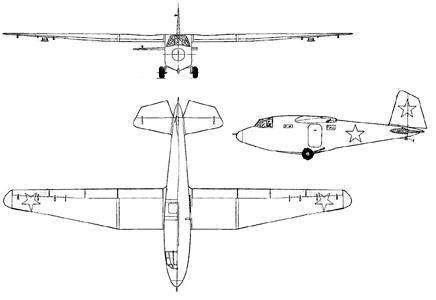
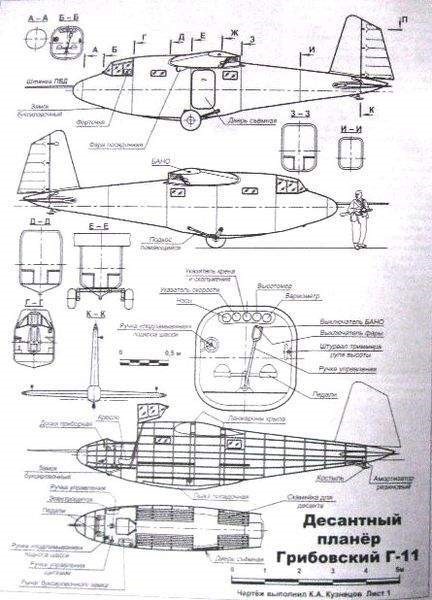
The G-28, also known as the Gr-29, was designed as a landing glider with a monoplane structure with a high cantilever wing and entirely made of wood.

The wing had a box-shaped double spar structure, made of wood. The wing profile used was the R-II. The centroplane had a rectangular shape and the wing consoles were fixed to it with inflection on the leading edge and the straight trailing edge. Wing mechanization included ailerons and flaps, located in the wing soffit and intended to improve landing characteristics. In the upper and lower part of the fuselage there were emergency hatches measuring 0.51×0.46 meters, which could also be used for the defense of the glider.

The fuselage was box-shaped with a rectangular cross section. The entire construction had been conceived paying great attention to the simplicity of production and the necessary structural strength. In the central area of the fuselage, there were two master frames to which the centroplane was attached. The cargo cabin, 3.24 meters long and 1.36-1.25 meters wide, featured 1.2 x 0.7 m cargo doors on both sides, as well as two small rectangular windows, which could be opened for operation. shot from them. Wooden benches were placed on both sides of the walls to accommodate the landing troops.

G-11 landing glider transport cabin interior

The tail was of the conventional monoplane type with large surface rudders.
The landing gear was a fixed combination type, with 600 x 250mm wheels used during takeoff and a ski on the underside of the fuselage for landings. A crank on the left side of the cockpit allowed the main landers to be retracted for landing. The use of skis significantly decreased the landing roll.

In the nose area there was a single-seater cockpit for the pilot with the steering organs and covered by a transparent lantern that opened up and back, pivoting on a hinge. The cabin equipment was quite austere (a clock, a speedometer, a barometer, an angle indicator and an altimeter).

The first test flight was on 1 of September of 1941 performed by VL Rastorguyev. The good results obtained resulted in the approval of the serial construction of the model in two factories on September 18: number 471 in Shumerlya city and 494 in Kozlovka village.

At the end of September, the military acceptance tests were carried out, which showed totally acceptable results. As a conclusion, a request was made to slightly advance the wings to achieve the necessary centering of the plane once it had been abandoned by the paratroopers.

The tests also showed that with the glider empty and the flaps extended, the tail creaked. This was eliminated by introducing perforations in the flaps.

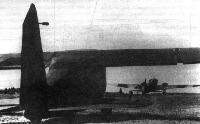
G-11 glider with flaps extended

The 28 as September as 1941, as soon as they finished the tests, Gribovski traveled to the Factory No.471 and his deputy, Landyshev the Factory No.494. Already on October 18, the first base prototype for production arrived in Shumerlya together with a group of specialists from the OKB-28. By the end of the year, Factory No.471 had finished 10 copies, which soon entered service with the Landing Troops (VDV), receiving the name G-11 (in view of the number of places).

The production of the G-11 was maintained until June 1942, when it was concluded that the military was not prepared for the execution of large landing operations with gliders. The lack of prepared crews in tow and glider pilots was being felt. The absence of conditions for the conservation of these airplanes caused them to be affected by weather conditions, which affected their resistance and reliability.

As a result of this situation the production of the G-11 glider was stopped in 1942 . The OKB-28 collective was reassigned as technical personnel to Factory No.471, which at that time received the mission to start producing the Yakovlev Yak-6. Gribovski was placed at the disposal of the Commissariat for the Aeronautical Industry (NKAP).

In the year of closure of production, Factory No.471 had produced 127 copies (to which must be added the 10 produced in 1941 and the prototype), while Factory 494 delivered 170 copies. Thus, the total number of units produced in this first stage reached 308 copies.

At the end of 1943, the logistical supply needs for guerrilla and combat groups caused the restart of production. This time the Ryazan aviation factory was chosen as the production base. Vladislav Gribovski would be appointed chief builder.

The first G-11 produced in Ryazan was tested in March 1944 by the glider test pilot Lieutenant Chubukov, who even performed spins, inverted flight and barrel roll.

During production various modifications were made. Starting from the standard number 21 on the left side, an increased door 1.4 meters wide with two-leaf opening was introduced. The cargo door located on the right side, present in previous versions, was eliminated. The number of copies produced at this stage, which would last until 1948, is unknown. It is estimated that the total number produced was between 500 and 600 copies.

By the final stage of the war, the VVS leadership had internalized the importance of the gliders in the actions of rapid troop transfer, carrying out surprise attacks on enemy positions, supporting offensive missions and supplying logistics to units. The experiences during the war had not been good, so it was necessary at high speed to start working on the preparation of glider crews and the development of preparation exercises in this type of operations.

Dual control cockpit

As of October 1944, the manufacture of landing gliders equipped with dual flight control, a landing ski suspension system and structural reinforcements would begin in Ryazan. This version would be renamed G-11U.

Production of the G-11U version was closed in mid- 1945, but a little less than a year later it would be resumed, remaining until 1948.

In 1942 Gribovski proposed to develop on the basis of the G-11 a motor glider with an M-11 engine, which would eventually be produced in prototype form under the company name G-30, although it was also known as G-11M.

The landing actions carried out in the USSR during the war were scarce and in some cases catastrophic. The main use of gliders was restricted to specific supply operations, fundamentally to guerrilla groups and the transport of small sabotage units, which operated in the enemy rear.

Perhaps the most brilliant performance of the landing gliders took place in 1943 when they were used in supplying the Belarusian guerrillas in the Minsk region. The gliders were prepared to transport fuel, weapons and ammunition, including those for cannons.

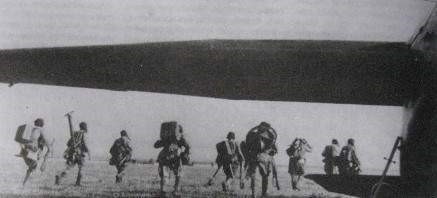
Landing troops board the G-11

The glider launch operation over Belarus was kept a great secret, so for the Germans it was totally unexpected. This operation was directed by the headquarters of the Air Landing Troops (VBV) and its development was personally followed by Stalin.

It was planned to be executed at night. Ilyushin DB-3F and Lisunov Li-2 towed Moscaliov and Gribovski gliders in pairs, releasing about 50 to 60 km from the target. The guerrillas had prepared surfaces for the landing and at the agreed time they lit bonfires as signalling. This operation was successful and allowed the Belarusian partisans to achieve significant successes against the fascist groups.

A G-11 glider prepares to be towed by an Ilyushin Il-4.

The aeronautical designers OK Antonov, AS Moscaliov and VK Gribovski received the 2nd rank “Guerrilla of the Great Patriotic War” medal for their contributions to the partisans, which was one of the few exceptions for the delivery of this medal to personnel from the deep rear.

The G-11 gliders were also used on a small scale during the crossing of the Dnieper, carrying guns and mortars from one shore to the other. Another notable action was the creation of a supply bridge between Moscow and Stalingrad in November 1942 to carry deicing fluids for Soviet tanks, which were preparing for the offensive.

Versions:

G-29 (G-11)
Original version as a transport glider from 1941 with capacity for 11 people and a rectangular section fuselage. Built 308 copies in factories 471 in Shumerlya city and 494 in Kozlovka village.

G-11U
1944 training version with dual controls, structural reinforcements and changes to the landing gear. The quantity produced is unknown.

G-30 (G-11M)
Motorized version of the G-29 with M-11 powerplant. A prototype was built in 1942. With the closure of production in 1942 the development would be abandoned.

Specifications
G-11
Wingspan: 18.00 m
Wing area: 30.00 m²
Length: 9.71m
Height: 2.7 m
Empty weight: 1250 kg
Maximum takeoff weight: 2400 kg
Wing loading: 83 kg / m²
Payload: 10 equipped soldiers or 1200 kg
Surface of the horizontal planes: 5.64 m²
Vertical plane surface: 2.7 m²
Spoiler area: 3.1 m²
Maximum towed speed: 370 km / h
Maximum planing speed: 146 km / h
Glide ratio: 16
Accommodation: 1