The Heath Super Soarer biplane glider, built 1930, was first unpowered aircraft to loop-the-loop.
Glider
Heath Aircraft Co

Edward Bayard Heath was born on November 17, 1888 in Brooklyn, New York to Clark Heath and Ada M. Johnson.
Heath designed and built a series of aircraft starting in 1909 with a Bleriot-inspired monoplane. His first flight was on 10 October 1909 in Amsterdam, New York resulting in a broken landing gear. On July 4, 1910 Heath made $500 in appearance fees and $200 in photograph revenues from his aircraft that flew 3 feet above the ground.
In 1911 Heath went to work for Glen Curtiss in Hammondsport, New York as a motorcycle mechanic, next to the Curtiss aircraft factory where he built a second aircraft with Walter Eales making short aerial runs. After purchasing the Chicago-based Bates Aeroplane Company in 1912, Heath founded the E.B. Heath Aerial Vehicle Co., later becoming the Heath Airplane Company.
His company produced the Heath Feather and Heath Favorite after World War I, and later the Heath Parasol series of aircraft powered with Henderson Motorcycle engines.
The 1928 Heath Baby Bullet mid-wing monoplane racer exceeded 100mph (160kmh) on only 32 hp. Heath Super Soarer biplane glider, built 1930, was first unpowered aircraft to loop-the-loop. Heath Parasol of 1931, designed to be powered by a converted motorcycle engine, sold in large numbers to amateur builders.
Married to Berna Heath, Heath died on February 1, 1931 (aged 42) in Maine Township, Cook County, Illinois. He was in an aircraft accident while testing a new low-wing aircraft design.
Heath’s company was eventually purchased and after World War II, changed its product to kit electronics. Heathkit filed for bankruptcy and closed in 2012. As of 2019, the company has a live website at http://www.heathkit.com.
HB-Aircraft HB-23 Hobbyliner / Scanliner
HB-Aircraft Industries Luftfahrzeug AG. developed HB-23 Hobbyliner two-seat light aircraft/motorglider and Scanliner surveillance/observation/patrol variant, principally produced in 1980s. Company renamed HB Flugtechnik 1992, but halted production. Aircraft currently produced by HB Aviation International
HB-Aircraft Industries Luftfahrzeug AG. / HB Flugtechnik
Austria
Developed HB-23 Hobbyliner two-seat light aircraft/motorglider and Scanliner surveillance/observation/patrol variant, principally produced in 1980s. Company renamed HB Flugtechnik 1992, but halted production. Aircraft currently produced by HB Aviation International
2009: HB Flugtechnik A-4053 Haid-Ansfelden, Austria
Hawkridge Venture
A two seat side-by-side sailplane of conventional wooden construction. Designed and built by Hawkridge Aircraft Ltd during 1946/7.
The undercarriage was a main skid, main wheel of fixed centre, plus a tail bumper. No flaps were fitted, but it was fitted with spoilers on the upper surfaces of the wings. It is believed to have flown first at Dunstable in 1947.
Wingspan: 16.76 m / 55 ft 0 in
Length: 7.42 m / 24 ft 4 in
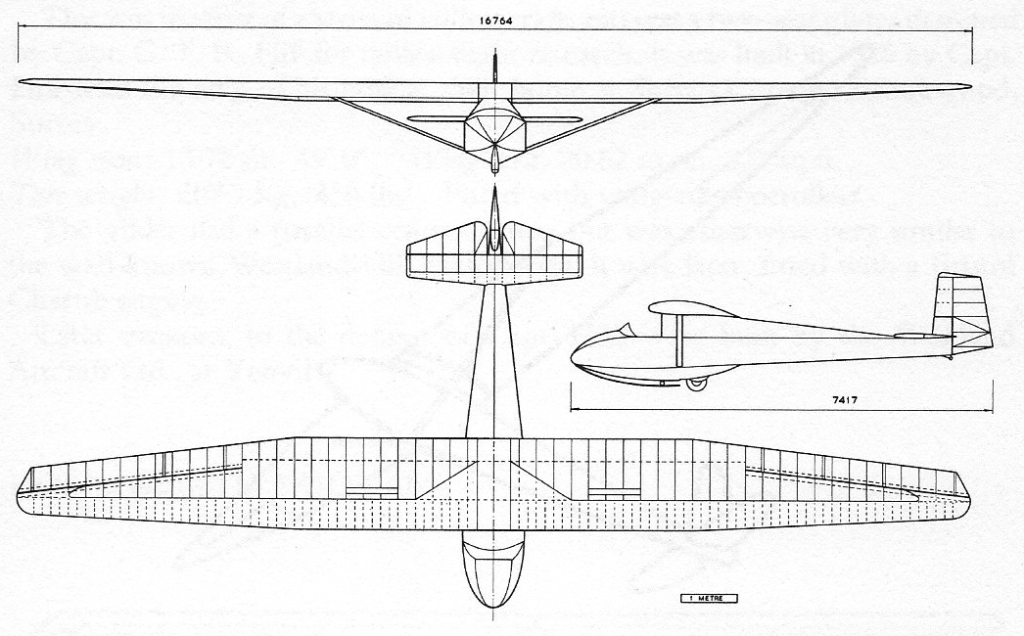
Hawkridge T.M.2
A single-seat sailplane designed to have a laminar-flow wing section. It was designed by Hawkridge Aircraft Ltd.
Although this glider was featured in Hawkridge advertisements in ‘Sailplane and Gliding’, if construction commenced it was not completed. BGA C of A No. 574 was allocated to a sailplane with the name of ‘T.M.2’ in 1948, but it is presumed this was a reservation only.
Hawkridge Kittiwake
The Slingsby T.15 Gull 3 was purchased by Hawkridge after the war as a wreck. The fuselage was in two pieces and both wings had had their spars broken. The Gull 3 was, at that time, finished in the standard pre-war finish of clear varnish but RAF roundals had been applied, and the name ‘Kittiwake’ had been stencilled on the fuselage underneath the cockpit. No RAF serial was allocated to the Gull, and the open cockpit was of the same shape as the Slingsby T.12 Gull 1.
Hawkridge repaired and rebuilt the Gull using the name Kittiwake, and incorporated many modifications including the fitting of a bubble-type canopy.
C of A No. BGA 643 was issued in November 1949, using the name Kittiwake, and it was owned by Prince Bira in the late forties/early fifties. It was later based at Weston-on-the-Green with members of the Oxford Gliding Club where it was generally referred to as the ‘Cantilever Gull’.
Hawkridge Dagling
A primary glider built by Hawkridge Aircraft Co. post-WW2. A version of the R.F.D. Dagling and the Slingsby T.3 Primary.
Hawkridge Aircraft Co
Formed by E.P. Zander and H.E. Bolton in 1945, the company initially took office space at 68 Victoia St, London. A small workshop was established at Bolton’s home in Denham, Buckinghamshire, and a factory was later acquired in High St, Dunstable, to build and service gliders.
A two-seat side by side training sailplane known as the venture was designed and built by the company, also, a small batch of primary gliders and two Grunau Baby gliders. Repair and service work was carried out on a wide variety of gliders, including the Slingsby Gull 3. This sailplane was extensively modified and repaired, and was, for sometime afterwards, referred to the Hawkridge Kittiwake in company advertisements. Only one example was produced, and another new type, known as T.M.2, apparently only reached the project stage.
Zander left the company in 1947 and emigrated to Canada, but the firm continued under Bolton. By early 1950 the Dunstable factory had been closed and all the work was carried out at Denham. The last company advertisement appeared in ‘Sailplane and Gliding’ in March 1952 after which the company dissolved. Bolton emigrated to America, and in the meantime Zander travelled to Argentine then retired near Christchurch on the South coast of England.
Haufe Hobby HA-S-3
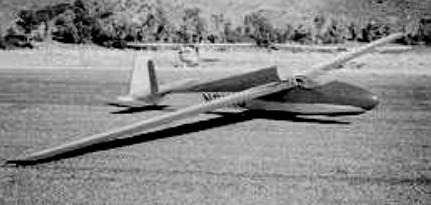
The Ha-S-3, designed by Bruno Haufe, which first flew in 1971, is a development of the HA-S-2 Hobby, which had wings of shorter span (12.86 m. / 42.2 ft) and cockpit 2 in/ 5 cm narrower. It has a fixed main gear, with approach control by spoilers.
Wing span: 13.1m / 43ft
Wing area: 10.41sq.m / 112sq.ft
Empty Weight: 187kg / 412lb
Payload: 85kg / 188lb
Gross Weight: 272kg / 600lb
Wing Load: 26.13kg/sq.m / 5.36lb/sq.ft
L/DMax: 28 85 kph / 46 kt / 53 mph
MinSink: 0.89 m/s / 2.92 fps / 1.73 kt
Airfoil: Clark Y
Aspect ratio: 15.9
Seats: 1
No. Built: 1
 All Aero