Walter and Reimar Horten conducted flying-wing experiments prewar, building a series of tailless high-performance gliders. The Horten Ho V and Ho VI were both powered aircraft, leading to the turbojet-powered Ho IX flown in the summer of 1944. Before being destroyed in a landing accident after only a few hours flight, it had been flown at a speed of 800km/h. This was developed by Gothaer Waggonfabrik as the Gotha Go 229 V3 single-seat fighter, but the Gothaer works were captured by advancing U.S. forces before this prototype was completed.
Glider
Holmes KH-1 / JSH Scorpion
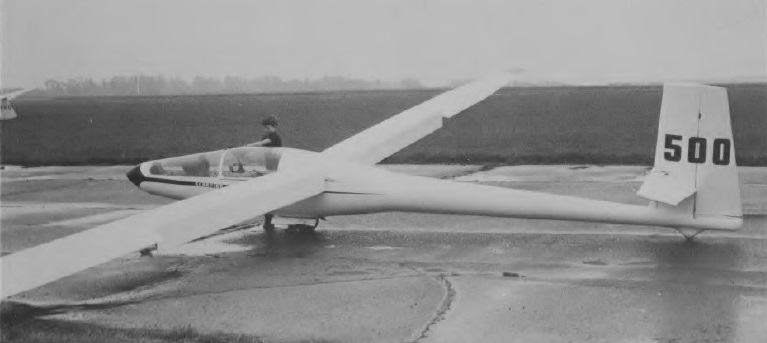
Designed and built entirely by Mr Kenneth Holmes, a meteorologist, this British high performance single seater is characterised by a very high aspect ratio (31.0) wing and a slim fuselage of minimum cross-sectional area; construction is largely of wood.
Design work on the KH-1 began in1968, construction commenced in the following year and the prototype flew for the first time on 24 November 1971. The cantilever shoulder wings are of largely wooden construction with single aluminium spars bonded by epoxy resin and also pop riveted to plywood webs. The spars and closely spaced ribs are covered by a pre-moulded plywood/balsa sandwich to the 50% chord line, by a 2mm thick plywood skin for a further 20% of the chord and with fabric for the remainder of the wing. Small-span trailing edge flaps also act as air brakes, but spoilers are not fitted. The fuselage is built of plywood frames and spruce longerons covered with a birch ply skin, and the landing gear consists of a retactable monowheel and a tail bumper. The tailplane is an all-moving surface with anti-balance tabs controlled by a spring trimmer in the cockpit, and the tall fin and rudder is unswept. A tail braking parachute is fitted for control during the approach and in short field landings.
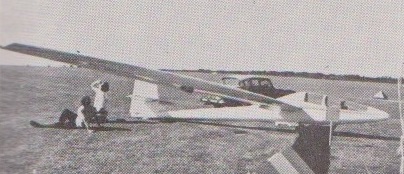
A second example of the KH-1 named the JSH Scorpion was built by Mr John Halford and first flew in July 1977.
KH-1
Span: 60 ft 8.5 in / 18.5 m
Length: 23 ft 9 in / 7.24 m
Height: 5 ft 0 in / 1.52 m
Wing area: 120 sq.ft / 11.15 sq.m
Wing section: Wortmann FX-61 -184/60-126
Aspect ratio: 31.0
Empty weight: 490 lb / 222 kg
Max weight: 710 lb / 322 kg
Max wing loading: 28.9 kg/sq.m / 5.92 lb/sq ft
Water ballast: None
Max speed: 97 mph / 84.5 kt / 157 km/h
Max rough air speed: 75 kt / 139 km/h
Stalling speed: 36 kt / 67 km/h
Best glide ratio: 37:1 at 55.5 mph / 48 kt / 89 km/h
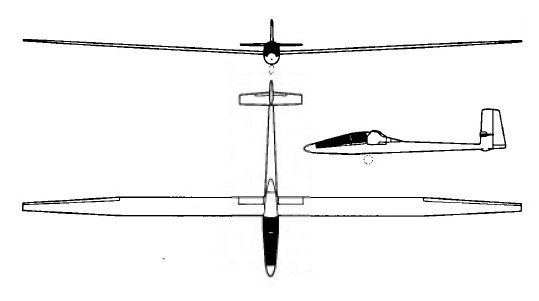
Hollfelder Greif 1
Soaring plane, Germany, 1962
Holdsworth 1931 Sailplane
The Holdsworth Sailplane was a single seater designed and built in 1931 by H.Holdsworth, the ground engineer of the Bradford & County Gliding Club.
Of conventional wooden construction, it was designed to have a high wing loading.
Only one was built and no CofA is recorded.
Hiscox Dunstable Devil / Hyper-Hols
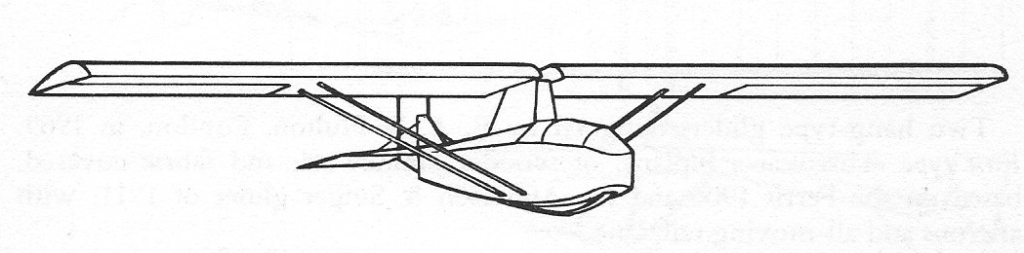
The Dunstable Devil, also known as the Hyper-Hols, was a modified Hors-der-Teufel built by D.G.Hiscox and first flown on 19 August 1934.
It featured a streamlined fuselage nacelle, strutted rear fuselage, and twin fins and rudders.
Only one glider was so modified. C of A BGA.238 was issued in November 1935.
Hirth Moatzagotl
A unique design glider of Wolf Hirth circa 1934.
Hirth Go-4 Goevier
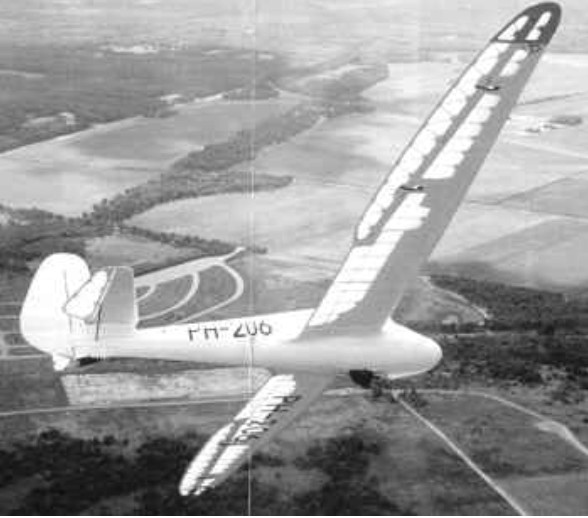
Designed by Wolf Hirth and Wolfgang Hutter.
Go-4 Goevier III
Wing span: 14.84 m
Wing area: 19 sq.m
Empty Weight: 235 kg
Gross Weight: 410 kg
Wing Load: 21.6 kg/sq.m
Aspect ratio: 11.53
Airfoil: Joukowsky
L/DMax: 20 70kph
MinSink: 0.90 m/s 60 kph
Seats: 2
No. Built: 130
Hirth Kria
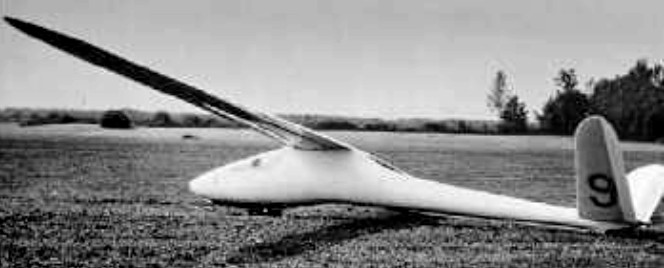
Designed by Nagele, Eppler, and Hirth.
Wing span: 11.9 m
Wing area: 9.88 sq.m
Aspect ratio: 14.33
Airfoil: Eppler 27
Empty Weight: 120 kg
Gross Weight: 220 kg
Wing Load: 22.3 kg/sq.m
L/DMax: 30 92 kph
MinSink: 0.70 m/s / 68 kph
Seats: 1
No. Built: 1
Hirth LO-150
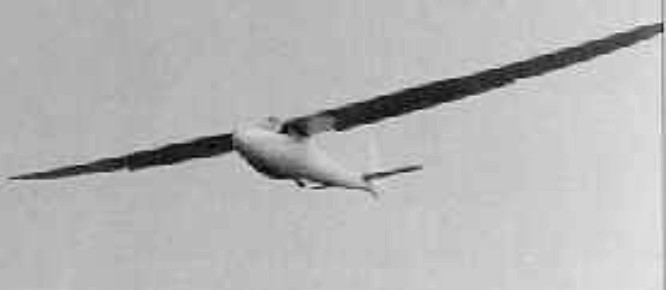
A development of the 10m straight wing LO-100 aerobatic glider, the LO-150 features a two- piece, plywood covered, single spar wing and uses flaps for glidepath control. Designed by Alfred Vogt, the fuselage is a wooden monocoque with a cantilever tail. Early models had a skid and jettisonable dolly instead of a fixed main wheel. A.J. Smith won the 1961 Nationals in a LO-150 and Harold Jensen flew another 700 km/ 435 miles to win the 1962 Barringer Trophy.
Wing span: 15 m / 49.2 ft
Wing area: 10.9 sq.m /117 sq.ft
Aspect ratio: 20.6
Airfoil: Clark Y
Empty Weight: 100 kg / 441 lb
Payload: 110 kg / 242 lb
Gross Weight: 310 kg / 683 lb
Wing Load: 28.44 kg/sq.m /5.8 lb/sq.ft
L/DMax: 34 105 kph / 57 kt / 65 mph
MinSink: 0.68 m/s / 2.2 fps / 1.24 kt
No. Built: 15
Seats: 1
Hirth LO-100
A development of the 10m straight wing LO-100 aerobatic glider, the LO-150 features a two- piece, plywood covered, single spar wing
 All Aero