HP Aircraft HP-11 Airmate / Bryan HP-11 / Airmate HP-11

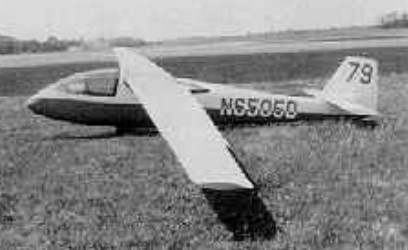
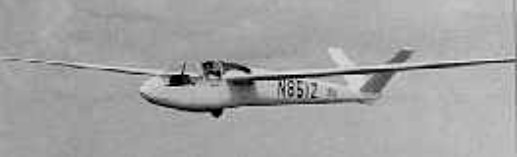
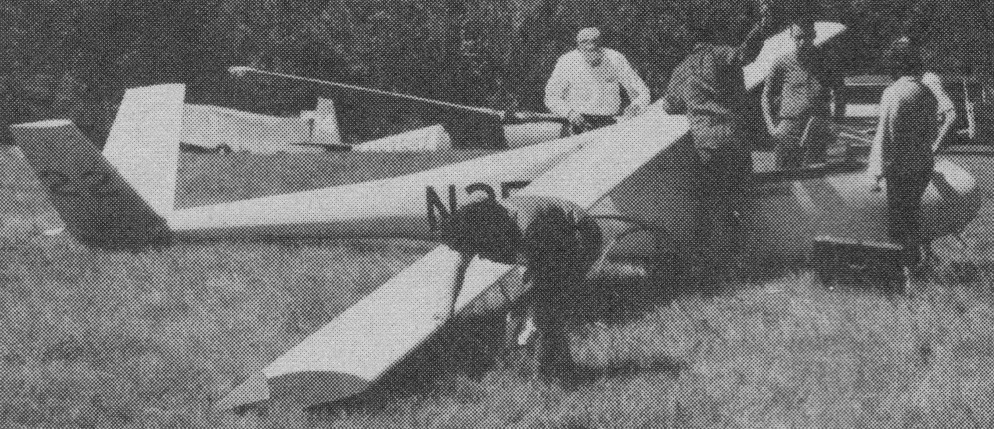
The all metal HP-11 was produced in 1962 in time for the 1962 U.S. Nationals, in which Schreder placed third and made the longest flight, 754.8 km/ 469 miles; he later placed third in the Open Class at the 1963 World Championship at Junin, Argentina.

The HP11A, an improved version, has a retractable wheel. Some significant modifications were made in a number of the kit- built HP-11s including, for example, the Kohler Alpha which mated a new fuselage on to the wings of an HP-11. Michael Bowlus used the tail of an HP-18 and the wings of an HP-11, reduced to 15 m., to develop his BZ-1, which first flew in 1984.

One HP-11 belongs to the National Soaring Museum.

One of America’s sailplane designers and pilots is Richard E. Schreder who built the HP-10, and the HP-11 and HP-11 A competition single-seaters, the HP-11 being placed third in the 1963 World Championships, and the Standard Class HP-12 derived from the HP-11.
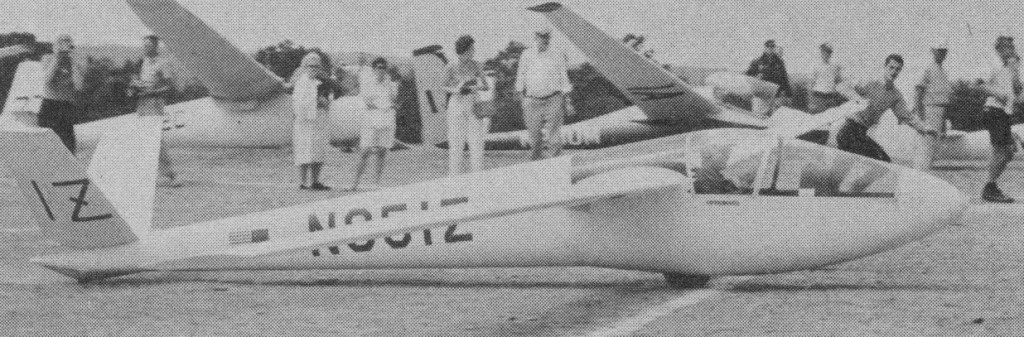
The HP-11, HP-11A and HP-12 were built by Airmate at Toledo, Ohio, a company formed by Richard E. Schreder.

Bryan Aircraft Inc of Bryan, Ohio, also produced plans of the HP-11 A for homebuilders.

Wing span: 15.85m / 52ft
Wing area: 9.66sq.m / 104sq.ft
Empty Weight: 181kg / 400lb
Payload: 113kg / 250lb
Gross Weight: 294kg / 650lb
Wing Load: 30.43kg/sq.m / 6.25lb/sq.ft
Water Ballast: 0
Aspect ratio: 26
Airfoil: NACA 65 (3)-618
L/DMax: 37 89 kph/ 48 kt / 55 mph
MinSink: 0.55 m/s / 1.8 fps / 1.07 kt
Seats: 1
No. Built: 42
HP Aircraft HP-10 Airmate / Bryan HP-10 / Helisoar Aircraft HP-10

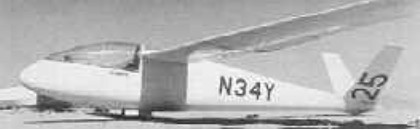
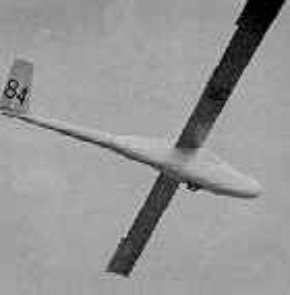
The all-metal V-tail HP-10 was flown by designer R. E. Schreder in the 1961 U.S. Nationals, winning the Stroukoff Trophy for a 57 kph/ 31 kt/ 35.5 mph 229 km/ 142 miles Goal & Return flight.

The HP-10 was modified by Steve du Pont.

Helisoar bought the production rights and produced the HP-10 in kit form. Some ships were modified with fiberglass Hoerner wingtips made available by Helisoar.

One belongs to the National Soaring Museum.

Wing span: 14.63m
Wing area: 10.59sq.m
Empty Weight: 243kg / 525lb
Payload: 111kg / 245lb
Gross Weight: 354kg / 780lb
Wing Load: 33.43kg/sq.m / 6.75lb/sq.ft
Water Ballast: 0 Aspect ratio: 20.2
Airfoil: NACA 65 (3)-618 mod.
L/DMax: 35 97 kph / 52 kt / 60 mph
MinSink: 0.67 m/s / 2.2 fps / 1.30 kt
Seats: 1
No. Built: 9

HP Aircraft HP-9 Airmate / Bryan HP-9

The R. E. Schreder designed all metal HP-9 was intended to fly in the Standard Class at the 1960 World Championships, but was not completed in time. It has an all-moving horizontal tail, retractable wheel, airbrakes and Fowler flaps which increase the wing area to 13.35 sq.m/ 143.7 sq.ft when extended, reducing the sink to 0.64 m/s/ 2.11 fps./ 1.25 kt. @ 76 kph/ 41 kt/ 47 mph.

Wing span: 14.87m / 48.84ft
Wing area: 11.84sq.m / 127.4sq.ft
Empty Weight: 295kg / 650lb
Payload: 88kg / 195lb
Gross Weight: 383kg / 845lb
Wing Load: 35.35kg/sq.m / 6.63lb/sq.ft
Water Ballast: 0
L/DMax: 36 100 kph / 54 kt / 62 mph
MinSink: 0.69 m/s / 2.26 fps / 1.34 kt
Aspect ratio: 18.6
Airfoil: Wortmann FX-191
Seats: 1
No. Built: 1

HP Aircraft HP-8 Airmate / Bryan HP-8

R. E. Schreder built the improved all-metal HP-8 in 1958 and won the Nationals with it in that year again in 1960. He set world records with it in all three speed categories in 1959, and two of these were raised again by the same ship flown by George Moffat. The solo example belongs to the National Soaring Museum.

Wing span: 12.19m / 40ft
Wing area: 10.22sq.m / 110sq.ft
Empty Weight: 280kg / 618lb
Payload: 105kg / 232lb
Gross Weight: 385kg / 850lb
Wing Load: 37.67kg/sq.m /7.53lb/sq.ft
Water Ballast: 0
L/DMax: 37 108 kph / 58 kt / 67 mph
MinSink: 0.67 m/s / 2.2 fps / 1.30 kt
Aspect ratio: 24
Airfoil: NACA 65 (3)-618
Seats: 1
No. Built: 1

Howard XLRH-1

During 1942 the U.S. Navy let contracts for the development of several amphibious transport gliders, but very little informa¬tion has been revealed concerning them.
The Howard Aircraft Company also received a contract to produce a similar glider, the XLRH 1, two prototypes of which were ordered (BuAer Nos. 11649 and 11650) plus fifty production LRH 1 gliders (BuAer Nos. 31586 635), but it is not certain if either XLRH 1 was completed.

Horton Parabel

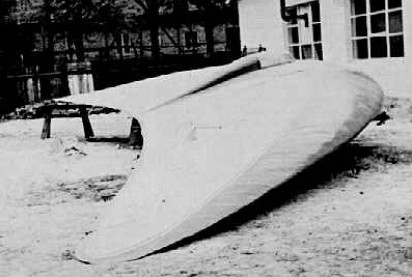
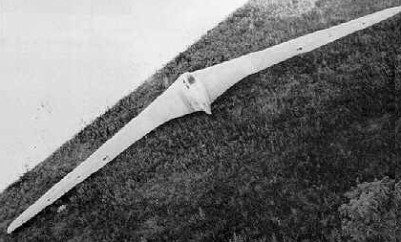
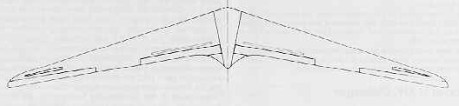
According to Reimar Horten this planform is theoretically the most efficient and has the minimum induced drag. The validity of the theory is not known. The glider was constructed in a burst of enthusiasm but proved rather awkward to make because of its curves and was damaged during transport and never flown.

Wing span: 12m
Wing area: 33sq.m
Empty Weight: 90kg
Payload: 80kg
Gross Weight: 170kg
Wing Load: 5.15kg/sq.m
Aspect ratio: 4.4
L/DMax: 19.5 61.5 kph
MinSink: 0.8 m/s 45 kph
Seats: 1

Horton Ho XIV

This was a sports sailplane designed to conform to the 1939 Olympic Games specification. It was designed for simplicity and ease of production. The first aircraft was built from sketches and proper drawings for the production type were made later with slight modifications. Construction was carried out at Hersfeld.
Span was 15 m and aspect ratio 16.2. The wing had 23 degree leading edge sweep and 8.6 degree total twist. Sections were 4% camber and 17% thickness at the root with 10% thick symmetrical tips. Empty weight was 120 kg giving a flying weight of 225 kg.
Controls consisted of one Frise nose elevon per side with rudders and dive brakes of H IV design. The glider trimmed at CL=1.0 with elevons neutral.
The pilot was put in a prone position as on the H IV and the undercarriage arrangement was also similar but for the replacement of the rear skid by a wheel.

Wing span: 16m
Wing area: 15.76sq.m
Empty Weight: 150kg
Payload: 80kg
Gross Weight: 230kg
Wing Load: 14.6kg/sq.m
Aspect ratio: 16.2
L/DMax: 30 70 kph
MinSink: 0.62 m/s 55 kph
Seats: 1