Yugoslavia Formed at Novi Sad in 1923, Ikarus was one of the country’s largest aircraft manufacturers. Initial production centered on a number of S.M. training flying-boats, followed by a military type I.O. In 1926 the company acquired a license to build the Potez 25 biplane, and established a new factory at Zemun for its production.
Four out of five Yugoslav aircraft plants were in close proximity to each other, built in and around Belgrade: Ikarus, Rogožarski, Zmaj and Utva. The fifth one was DFA (Državna Fabrika Aviona – State Aircraft Factory) which was located in Kraljevo.
The production facilities of Ikarus were destroyed in World War Two but rebuilt in 1946 and soon nationalised by the new Tito lead Yugoslav communist government.
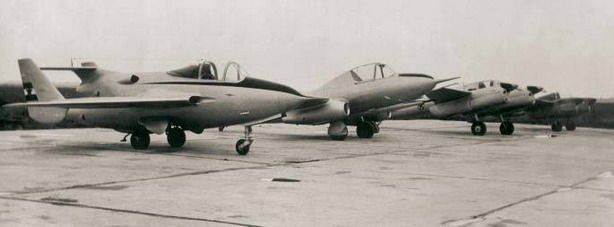
In the early 1950’s Ikarus continued to develop a number of experimental research aircraft protoypes. These included a number of early jet aircraft under the Ikarus 451 designation a number which all featured the same basic airframe of the piston engined S-451 but all served different purposes in testing and evaluation. The 451 designated jet aircraft included the first jet designed and built in Yugoslavia (S-451M), a more advanced jet design (S-451M Zolja), a close support military jet development (J-451MM Stršljen) and jet training aircraft (S-451MM / T-451MM).
Ikarus experimented with further jet designs in the early 1950’s. The Ikarus 452M and 453 aircraft were both unconventional designs that were briefly used for flight testing
Ikarus 451 experimental research aircraft at the Yugoslav Aeronautical Testing Centre in the 1950’s – Ikarus 452M, S-451M, S-451 and 232 Pionir
None of the Ikarus experimental aircraft went into wide production but they did provide a stepping stone for future aviation technology development in Yugoslavia. By the early 1960’s aircraft development ceased at Ikarus and had been taken over by Soko based in Mostar, Bosnia-Herzegovina (Ikarus manufacturing buses).
Built in Romania, a 17m sailplane with flaps, semi-retractable undercarriage and all metal construction. First year built 1975. No. of aircraft built to 6/30/81 450. 1982 Standard price $24,900.
Seats: 2. Max useful load: 506 lb. Length: 26.5 ft. Height: 5.9 ft. Wing loading: 6.5 lbs/sq.ft. Wing span: 26.8 ft. Minimum sink: 136 fpm at 43 kts. Wing area: 196.3 sq.ft. Max speed: 143 kts. Wing aspect ratio: 15.8 Stalling speed: 38 kts. Max wt: 1,300 lb. Glide ratio (L/D): 36:1 at 54 kts. Standard empty wt: 794 lb. Rough-air airspeed: 124 kts.
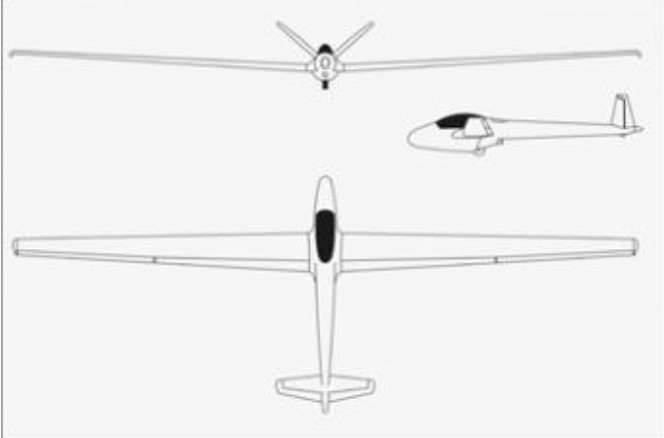
This two-seater design was intended to fill the roles of training, solo flying and aerobactic flying and first flew in prototype form on 14 September 1960, duly going into service with the Romanian gliding clubs. The IS-8 is of very similar plywood- and fabric covered wooden construction to the IS-3, and is characterised by cantilever shoulder wings with a distinctive 7° forward sweep at the 25% chord line,and with a rectangular centre section and tapered outer panels. The wings are all-wood single spar structures with a leading edge torsion box, 70% fabric covered, and the slotted wooden ailerons are plywood- and fabric-covered. The fuselage is a metal and plywood monocoque and has an air brake on each side of it, instead of in the more usual wing mounted position. The wooden tail unit is also ply and fabric-covered and there is an unsprung nonretractable monowheel without a brake, and a rubber-mounted skid. The pilot and pupil sit in tandem under a moulded plastic canopy.
IS-8 Span: 43 ft 9.5 in Length: 24 ft 1.5 in Wing area: 166.3 sqft Aspect ratio: 11.5 Empty weight: 463 lb Max weight: 882 lb Max speed: 112 mph (in smooth air) Max aero-tow speed: 74.5 mph Min sinking speed: 3.22 ft/sec at 43.5 mph Best glide ratio: 23:1 at 53 mph
The ICA-Brasov or Intreprinderea de Constructii Aeronautice Brasov (Aircraft Construction Factory Brasov) is responsible for all sailplane development and production in Romania, and their principal designer is Professor losif Silimon, who has created a long series of sailplanes that are widely used in the national clubs; these are prefixed by the letters ‘IS’ which form the Professor’s initials.
Among the earliest of these was the IS-3D training or Standard Class single-seater, the prototype of which, the IS-3 Traian Vuia, was built in 1956.
This design has a pointed top to the fin and rudder and is fitted with a drogue parachute for deployment in short-field landings. It is of conventional wooden construction with plywood and fabric covering, the single-spar high cantilever wings being plywood-covered from the leading edge to the spar and fabric covered aft of the spar to the trailing edge; there are air brakes in the wing upper and lower surfaces and wing tip ‘salmon’ fairings are fitted. The all-wood fuselage is of oval cross-section and the fin and tailplane are plywood covered, the elevators and rudder being fabric covered; there is a Flettner-type trim tab in the starboard elevator. The landing gear consists of a fixed monowheel forward of the eg with a pneumatic tyre and mechanical brake, and a short nose skid and tailskid. The pilot sits under a large sideways hinging cockpit canopy.
The IS-3D continued in production at Brasov until the early 1970s, being widely used in the Romanian clubs.
IS-3D Span: 50 ft 3.5 in Length: 23 ft 9.5 in Height: 5 ft 3 in Wing area: 164.6 sqft Aspect ratio: 15.30 Empty weight: 485 lb Max weight: 754 lb Max speed: 150 mph Max aero-tow speed: 75 mph Min sinking speed: 2.23 ft/sec at 40 mph Best glide ratio: 28:1 at 46 mph
During 1945 and 1946, Tadeusz Chyliński took part in a competition of the Civil Aviation Department for developing a training motor glider. He won first prize for his project, the HWL Pegaz motor glider. From 1946 to 1947, Tadeusz Chyliński based on an agreement with the Department of Civil Aviation (Departament Lotnictwa Cywilnego) with the help of Bronisław Żurakowski, developed the construction plans for the “Pegaz”. The motor glider was designed to train class “C” glider pilots in stand-alone (without dual-controls) motor piloting, as well as for training and pursuing aeronautic sports in inexpensive aircraft.
The engine for the “Pegaz” was designed by Stefan Gajecki, who was well known for designing skimming boat motors. Construction began on the “Pegaz” at the HWL (Harcerskie Warsztaty Lotnicze – Scouts’ Aircraft Works) in Warsaw.
In 1948, the work was taken over by Warsaw’s Gocław Aircraft Plant 6. The motor glider (one for flying and two unassembled) was finished in spring of 1948. The engineless plane was on display at the Aviation Day in 1948.
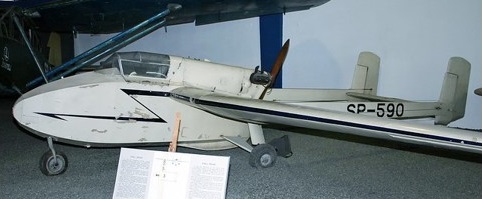
It is a dual-boom monoplane with pusher propeller, three-wheel landing gear with forward steerable wheel, all wood construction. The fuselage is composed of a laminated-wood-sheathed pod containing an enclosed cabin, the engine and two lateral laminated-wood-sheathed boom joining the wing with the directional and diving rudder. The fuselage pod is hexagonal. The instrument panel is fitted with an airspeed indicator, altimeter and vertical speed indicator, a magnetic compass, turn indicator, ignition switch and fuel pump. The cabin also features an air throttle valve and decompressor, a fuel gauge and fuel valve. The motor glider is steered by a stick and rudder bar. The pilot’s seat is made to accommodate a backpack parachute.
The wooden cantilever wing is sheathed in laminated wood and canvas. The wing is a right-angle trapezoid with rounded tips and has three structural sections: a central section and two removable outer sections joined to the central section by three pins. The dual-spar central section is unitized with the fuselage pod and tail booms. The removable monospar outer sections have an oblique auxiliary spar. The canvas-sheathed slotted ailerons are aerodynamically-compensated, differentially displaced 30° upward and 18° downward. The wing has a fixed slot at the edge of attack.
The twin vertical tail is located at the boom tips. The elevator unit is located between them. The monospar fins are sheathed in laminated wood. The control surfaces on the wooden frame are canvas-sheathed.
The three-wheel landing gear has a forward steerable wheel. The main landing gear is tri-strutted with rubber-string shock absorbers. The wheel tires are low-pressured. The aft of the fuselage pod between the wheels is protected against major deflection of the landing gear by an ashwood skin with an inner-tube shock absorber.
The motor glider is powered by an XL-GAD prototype engine. It is a four-cylinder flat two-cycle air-cooled engine. Two cylinders have a decompressor to facilitate startup. The wooden pusher propeller has a fixed pitch and diameter of 1.42 meters. The 30-liter fuel tank is located to the fore of the engine.
The “Pegaz” was painted a cream color. The wing’s edge of attack, registration number and fuselage arrow were painted navy blue.
“Pegaz” was test-flown on July 16, 1949, piloted by Bronisław Żurakowski and Jerzy Szymankiewicz. The factory and certification test were conducted at the National Aviation Institute in Warsaw and completed in May 1950. “Pegaz” was in three air shows on Aviation Day in 1949, 50, 51.
The “Pegaz” proved to be very safe and easy to pilot during testing and operation. It was stable in every axis with the controls released. By stalling and releasing the stick with the engine running, the motor glider was able to make about decreasing changes in velocity, going into a fixed climb rate of 1.5 m/s with a trajectory speed of 90 km/h. Also by stalling and releasing the stick with the engine throttled, the velocity amplitude changed two to three times, after which the aircraft went into a fixed glide at a speed of 110 km/h and a descent rate of 2.0 m/s. When stalled with the rudder released, the motor glider displayed no tendency to spin. It was hard to get the “Pegaz” to go into a tailspin. The speed necessary to go into a tailspin was 55 km/h, with an altitude loss at one spin of 75 meters. Landing speed was 130 km/h. The motor glider performed acrobatic figures with a gravity load range up to 4 g. It could do loops at a speed of 125 km/h without losing altitude and ended loops with the same speed. The “Pegaz” behaved totally normal in dives at 210 km/h.
At first, the plan was to build 80 “Pegaz” planes for various flying clubs. “Pegaz” passed the National Approval Test with a very good rating, however it was never put into production. There was the order from the USSR to stop work on national aviation projects. The “Pegaz” was assigned the registration number SP-590 and was given to the Warsaw Aviation Club to use, piloted by many glider pilots. It has been on display at Polish Aviation Museum in Kraków since August 1964.
HWL Pegaz (SP-590 Engine: 1 × XL-GAD prototype air-cooled 4-cylinder flat engine, 31 hp (23 kW) Wingspan: 11.70 m (38 ft 4⅝ in) Wing area: 14.80 m² (159.25 ft²) Length: 6.85 m (22 ft 5⅝ in) Height: 1.60m (5ft 3 in) Empty weight: 290 kg (639 lb) Loaded weight: 397 kg (893 lb) Maximum speed: 129 km/h (69 kt, 80 mph) Cruise speed: 110 km/h (59 kt, 68mph) Stall speed: 59 km/h (32 kt, 37 mph) Range: 275 km (148 nm, 171 mi) Service ceiling: 3,000 m (9,843 ft) Rate of climb: 2.0 m/s (394 ft/min) Crew: 1, pilot
In 1954 Eugen Hänle was then Assistant Professor Ulrich Hütter in a company engaged in the manufacture of large wind turbines for electricity production. The design of the 17 meter blades used fiber reinforced plastic glass.
With this experience, Eugen Hänle, established Glasflügel in 1957, to produce helicopter rotor blades for Bölkow.
Meanwhile, he began with his wife Ursula, the construction of a 1946 Wolfgang Hütter H30 glider. The plans were followed, but replacing the plywood – balsa sandwich for all the shell (fuselage, wing, fin) by a balsa sandwich – laminate, and the first unidirectional fiberglass wing and epoxy resin spar .
The H-30, with a 13.60 m wingspan, was started in late 1957 and finished in 1960.
Meanwhile, Eugen Hütter had developed the H-30TS glider, derived from the H-30, with a modified fuselage to accommodate a small BMW turbojet and a new wing of 15 m with plastic flaps, but with glued aluminum sheet metal spar.
Hütter 30 TS [Turbinensegler]
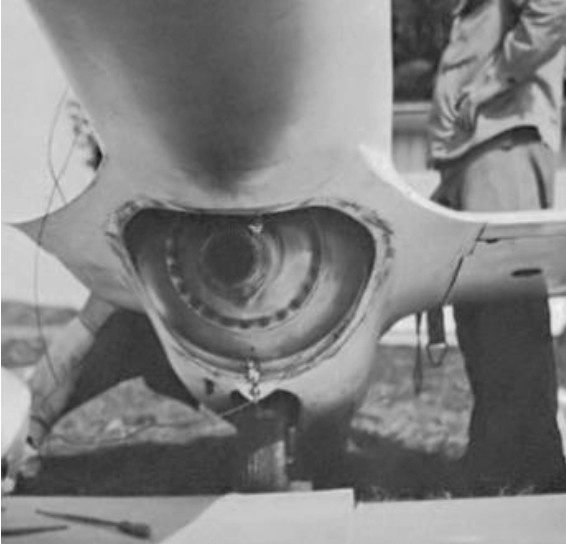
The H30 TS was first fitted with a BMW 6011 (8025) turbojet of 36 kg thrust to 45,000 rev/min in September 1959. Then, in May 1961, following major modification, it was to be equipped with a BMW 6012 (8026) 40 Kp thrust to 46,000 rev / min .
Hütter 30 TS [Turbinensegler]
Due to problems with the turbine and especially the noise it produced, the project was stopped and the unit was re- turned as a pure glider. He was lost in August 1968 following an accident during a winch launch.
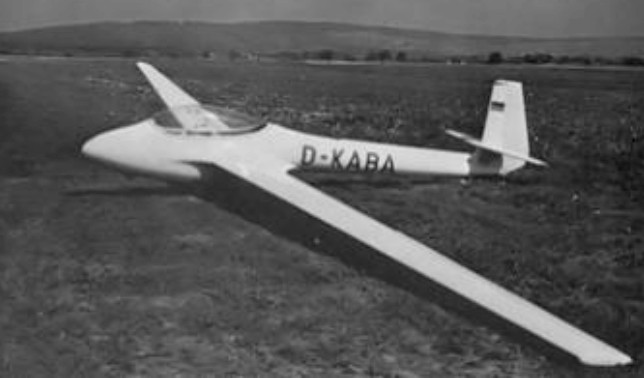
Hänle then used the molds to produce wings in the Schempp-Hirth workshop. Two sets of wings with glass fiber spar were made. One of the wings was the first H-301 libel, other than the first Swiss Diamond, with its original 15 m wingspan.
Hütter 30 TS [Turbinensegler] Engine: BMW 6011 (8025), 36 kg thrust to 45,000 rpm Wingspan: 15.00 m / 49 ft 2.5 in Length: 5.70 m / 18 ft 8.5 in Height: 1.02 m / 3 ft 4.5 in Max rate of climb: 150 m/min / 490 ft/min Min sink: 0.60 m/sec / 1.97 ft/sec Practical ceiling: 2500 m / 8200 ft
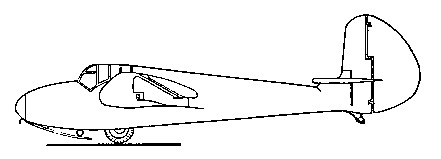
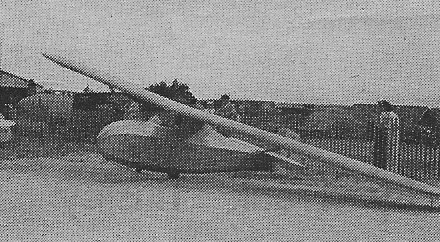
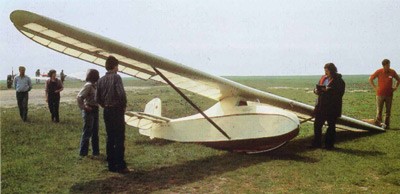
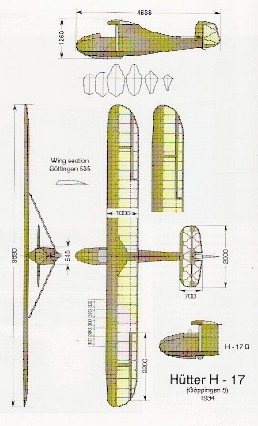
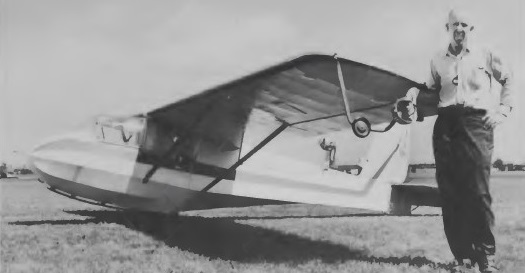
The H 17 was designed by the Hutter brothers, Ullrich and Wolgang, in Salzburg, Austria. The ‘17’ indicated the glide ratio. They sold plan sets until they joined Schempp-Hirth, which then built about five as the Goppingen 5 with the addition of a windshield and main wheel. Many were built from plans worldwide and several are still flying. A post-war version was developed and marketed as the H 17 B with enclosed cockpit, lengthened fuselage and airbrakes. The H 17B has slightly increased span and empty and loaded weights increased about 50%. One H 17 belongs to the National Soaring Museum. The Vintage Sailplane Association has plans.
1938
The structure was all wood, D-tube single-strut wing, plywood over simple frame fuselage, fabric cover.
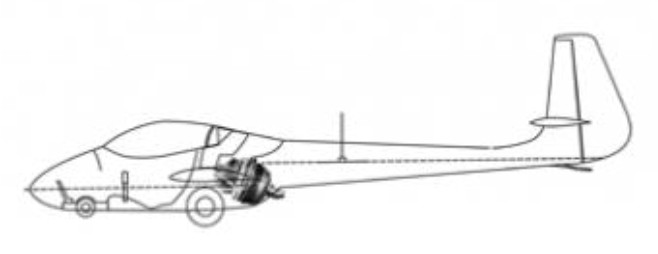
Devised and made by Mr Sandy Hudson Jr, a law enforcement operator of Black Mountain, North Carolina, the Tri-Motor is a powered conversion of a Schweizer SGU 1-19 single-seat sailplane fitted with three West Bend go-kart engines producing a total of 17.3hp and each driving a 2ft 1 in diameter two-blade wooden pusher propeller. Two West Bend Model 70013 engines are mounted on pylons on each side of the fuselage aft of the cockpit and between the wing bracing struts, and a West Bend Model 70012 is carried on a pylon on top of the rear fuselage in front of the fin. The total fuel capacity is approximately 2 US gallons, a small separate tank for the rear engine being mounted on the fin leading edge.
This powered conversion of SGU 1-19 N91817 was started in May 1962 and completed in September 1963 at a cost of $1,000; Mr Hudson won an award for the lowest powered aircraft with the Tri-Motor at the 1963 Fly-In of the Experimental Aircraft Assocation.
The standard SGU 1-19 is a utility and training single-seater of early postwar design with an all wood constant chord fabric-covered wooden wing with two spruce spars, spruce and mahogany plywood ribs and a ply leading edge. The fuselage is a fabric-covered welded chrome-molybdenum steel tube structure, and the landing gear is an unsprung monowheel with a single skid mounted on rubber blocks ahead of it, and a rubber-mounted tailskid. The tailplane and elevators are fabric-covered welded steel tube surfaces, the tailplane being braced, and the fin and rudder are either of fabric covered wooden construction when the SGU 1-19 is supplied in kit form for amateur builders, or of fabric covered steel and aluminium alloy when factory built. The pilot could sit in an open cockpit, or a transparent canopy could be provided as an optional ‘extra’.
Tri-Motor Span: 36 ft 5 in Length: 21 ft 0 in Height: 5 ft 6 in Empty weight: 449 lb Max weight: 670 lb Max level speed: 55 mph at sea level (power on) Cruising speed: 45 mph (power on) Rate of climb: 150 ft/min at sea level Take-off run: 750 ft (power on) Endurance: 8 min
 All Aero