The Polish Instytucie Szybownictwa (gliding institute) IS-1 Sęp single-seat high-performance glider first flew on 2 June 1947.
Glider
IPT IPT-3 Saracura
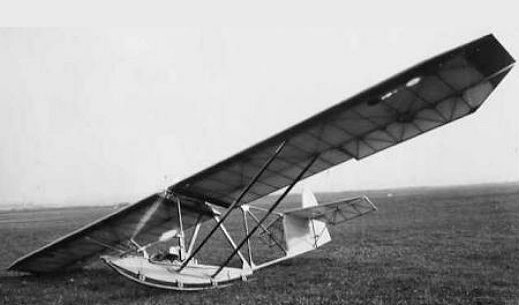
The IPT-3 glider, called Saracura, was a copy of the German Zoegling, intended for pilot training. The IPT-3 first flew in September 1942. It was a simple model, easy to handle.
Saracura = Saracura rail (Aramides saracura), bird from Latin America
IPT IPT-2 Aratinga
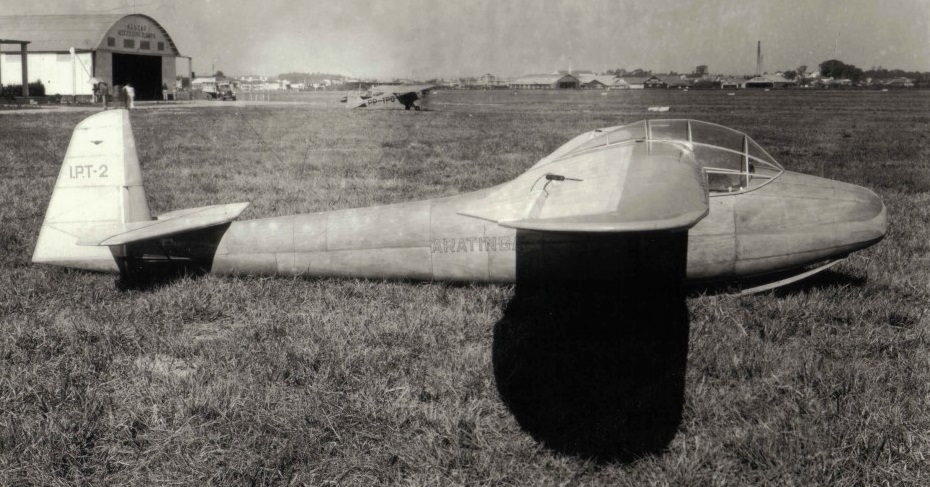
The IPT-2 Aratinga was a glider produced by the Brazilian Instituto de Pesquisas Tecnologicas (IPT).
In the early 1940s, the Wood Research Department of the Instituto de Pesquisas Tecnologicas carried out intensive research into the use of indigenous woods in aircraft construction. The results were so promising that it was decided to set up its own aviation department. Its first director was Frede Abranches Brotero, who gathered a team of young engineers around him. Silvio de Oliveira was entrusted with the development of a new advanced glider and decided to revise the Grunau Baby, which was already used in Brazil.
The IPT-2 Aratinga was designed as a shoulder-wing aircraft with a conventional tail unit and a closed single-seat cockpit. A skid was under the hull. The machine was a wooden structure made from local woods, with the hull partly covered with plywood and partly covered with fabric. The wings were completely covered with fabric.
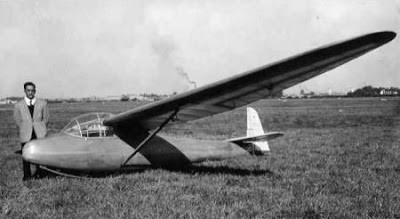
The only prototype IPT-2 Aratinga glider performed its maiden flight in July 1942.
The machine was later used by José Carlos de Barros Neiva, who developed it into a successful glider, the Neiva B Monitor.
Wing span: 10 m
Wing area: 8.7 m²
Length: 5.52 m
Empty weight: 185 kg
Minimum speed: 55 km / h
Top speed: 130 km / h
Seats: 1
IPT IPT-1 Gafanhoto
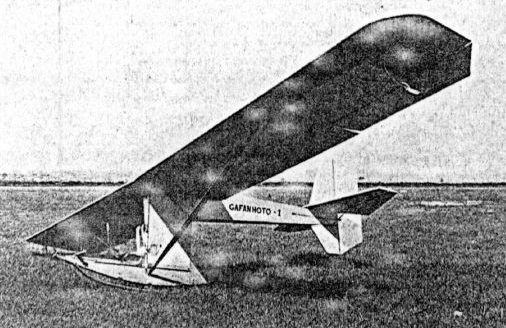
In 1948, the Divison of Aeronautics of the IPT was created, originated from the Section of Aeronautics. The IPT designed a glider for primary instruction, the Gafanhoto, which was designated IPT-1 Gafanhoto (Grasshopper). A public-domain report was published by IPT containing the required information to build the glider.
To enable budding pilots to take their first steps, the Brazilian aero clubs needed a simple beginner glider. The IPT-1 Gafanhoto was the first aircraft designed by the newly established Instituto de Pesquisas Tecnologicas in São Paulo. The plan was to construct a simple plane that could be built from interested clubs themselves and could launch pulled by a winch or by a vehicle.
The gafanhoto was made entirely from local woods. The aircraft was a braced, braced high-wing aircraft. The fuselage, under which a single skid with rubber buffers was attached, consisted of a wooden frame and was clad with plywood. As with the SG 38 school glider, the pilot sat completely outdoors. The wings and the tail unit were a wooden structure covered with fabric. In the course of the flight tests it turned out that the wings had to be lowered, which led to the central struts being shortened by 20 cm.
First flown in 1942, the only machine built flew for several years, there was no series production.
Wing span: 10.35 m
Wing area: 15.3 m²
Length: 5.40 m
Empty weight: 115 kg
Max. Takeoff weight: 205 kg
Minimum speed: 55 km / h
Top speed: 120 km / h
Seats: 1
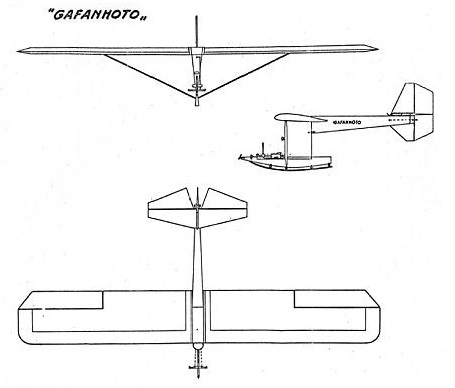
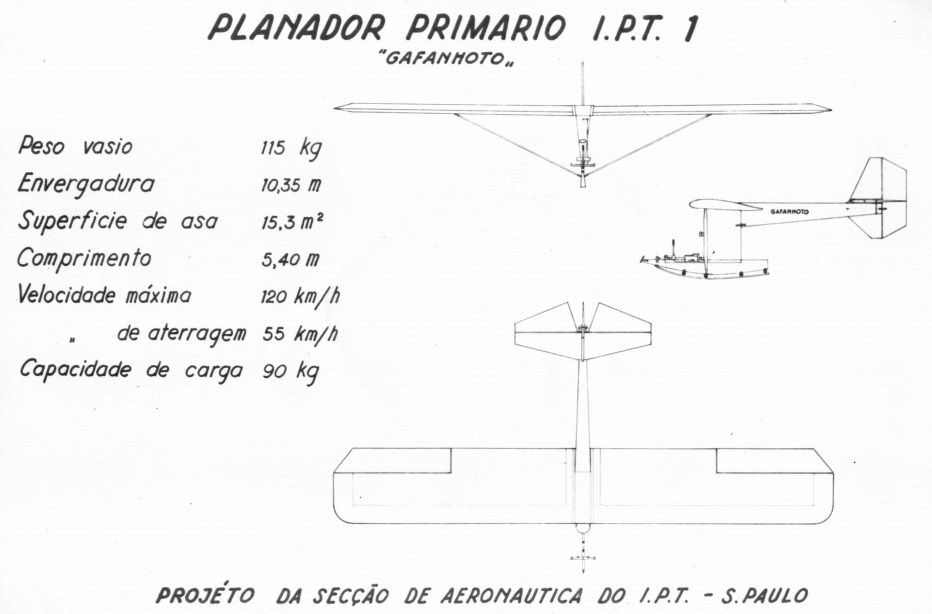
Instituto de Pesiquas Technologicas / IPT
In 1899 in São Paulo the Strength of Material Laboratory of the Engineering Faculty Escola Politécnica was created. In the first years of its existence, the Laboratory performed tests with materials mostly employed in the civil construction. In 1926, the Laboratory evolved itself into the Laboratory for Material Testing also gaining research attributions and in turn gave later birth to the Instituto de Pesquisas Tecnológicas (IPT). The interest of IPT in aviation appeared from studies looking for application areas of wood in engineering. A report containing properties of numerous wooden elements, result of an extensive and systematic research, was published by IPT and was worldwide acknowledged. In 1938, Frederico Brotero and Orthon Hoover designed a monoplace aircraft of wooden structure. The first one of the four prototypes of the aircraft was constructed in the IPT facilities and finished in Rio Claro, a city located in the countryside in the State of São Paulo. The airplane was nicknamed Bichinho de Rio Claro (Rio Claro’s mascot) but later it gained the IPT-0 denomination.
In 1948, the Divison of Aeronautics of the IPT was created, originated from the Section of Aeronautics. The IPT designed a glider for primary instruction, the Gafanhoto, which was designated IPT-1. A public-domain report was published by IPT containing the required information to build the glider.
IPT built 17 different types of aircraft along its aeronautical activities.
Institute of Glider Technology / Instytut Techniki Szybownictwa
Instytut Techniki Szybownictwa (Institute of Glider Technology) was a research and certification institution located in Lwów (using facilities of local Institute of Technology) created in 1932. Under it’s auspices during the 1930s a number of glider designs were made (some of which were subsequently built) and final years of the decade a series of designs for light but aerodynamically advanced sports aircraft was made: ITS Drozd (Thrush), ITS Jaskółka (Swallow) and ITS Wróbel (Sparrow).
IKV IKV-3 Kotka
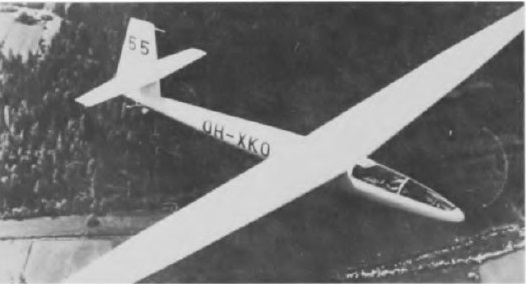
This Finnish high performance single-seater was designed by Mr Tuomo Tervo and Mr Jorma Jalkanen, whose earlier designs included the PIK-16C Vasama and Havukka sailplanes. Design work on the Kotka (or Eagle) began in December 1964 and the prototype was built by members of the Aeroclub Vasama or IKV, in association with K.K. Lehtovaara O/Y, construction starting in mid-1965; the Kotka made its first flight in May 1966; the type was later going to be put into series production by llmailukerho Vasama, but only the prototype was built.
The Kotka is of conventional wooden construction with some use made of plastic foam and glassfibre; the cantilever shoulder wing is a boxtype single-spar wooden structure from almost the leading edge to the 55% chord line and entirely plywood-skinned, with a small number of wooden or plastic foam ribs at the trailing edge, and a glassfibre leading edge. Both the plain ailerons and the flaps are of plywood covered plastic foam construction. There are two pairs of light alloy air brakes in each wing, on the upper and lower surfaces. The wooden fuselage is glassfibre-covered from the nose to the wing trailing edge, and plywood-skinned aft of the wing. Some plastic foam is employed in the wooden tail unit, the variable incidence tailplane and fin being plywood covered and the rudder and elevators fabric covered. There is a mechanically retractable monowheel with drum-type brakes and also a detachable tailwheel for ease of ground handling. The pilot is seated in a semi-reclining and adjustable seat under a long, flush-fitting cockpit canopy which, together with the tall angular fin, gives the Kotka a distinctive appearance. The instrumentation included radio, an oxygen system, a central electric control panel and a landing gear warning system being provided.
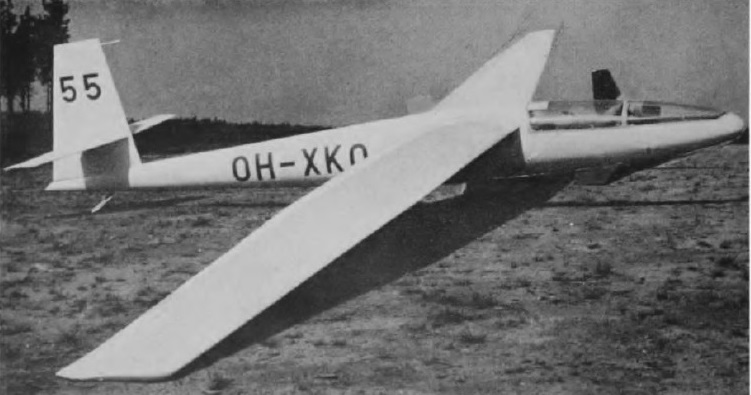
On 6 May 1968 Kotka flown by Seppo Hamalainen set up a Scandinavian goal-and-return record distance of 374 miles.
IKV-3 Kotka
Span: 18.2 m / 59 ft 8.5 in
Length: 7.75 m / 25ft 5 in
Height: 2.0 m / 6ft 6.5 in
Wing area: 17.0 sq.m / 183 sqft
Aspect ratio: 19.0
Wing section: Wortmann FX-62-K153/FX-60-126
Empty weight: 340 kg / 749 lb
Max weight: 450 kg / 992 lb
Water ballast: None
Max wing loading: 26.47 kg/sq.m / 5.42 lb/sq ft
Max speed: 155 mph / 135 kt / 250 km/h (in smooth air)
Max rough air speed: 93 kt / 172 km/h
Stalling speed: 28 kt / 52 km/h
Min sinking speed: 1.74 ft/sec / 0.53 m/sec at 43.5 mph / 37.5 kt / 70 km/h
Best glide ratio: 38:1 at 62 mph / 54 kt / 100 km/h
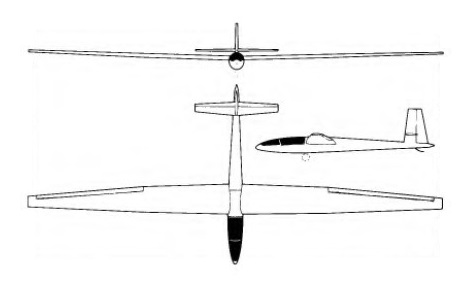
Ikarus AD Orao
The Orao II, designed by Boris Cijan, Stanko Obad and Miho Mazovec, had been flown into third place in the 1950 World Championships at Oerebro in Sweden.
Ikarus AD Meteor
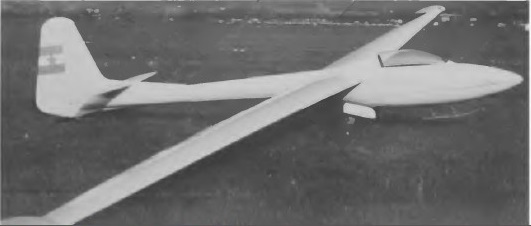
The all-metal Meteor was designed in 1954 by Boris Cijan, Stanko Obad and Miho Mazovec. The Meteor high performance single-seater with its laminar flow wing, camber-changing flaps and very slim fuselage to give minimum cross sectional area set a pattern for the high performance types of today when it first flew from Belgrade on 4 May 1956. It soon made its mark in competition flying, taking fourth or fifth place in the Open Class in the World Championships of 1956, 1958 and 1960 and for a time it held the world speed records for the 100 and 300km triangular closed circuits.
The ailerons are divided into inboard and outboard sections, of which the inner sections can be drooped in conjunction with the flaps for landing, and modified DFS-type air brakes are fitted in the wing upper surfaces. The semi-monocoque all-metal fuselage is built in two sections for ease of repair, the rear section being straight tapered with stringers and a stressed skin. The landing gear consists of a bow-shaped front skid that extends some way out from under the forward fuselage, and a retractable monowheel with brake. The pilot is seated under a detachable one-piece canopy.
Meteor 60
Span: 65ft 7.5in / 20.0 m
Length: 26ft 5in / 8.05 m
Wing area: 172.2 sqft / 16.0 sq.m
Aspect ratio: 25.0
Wing section: NACA 633 616 5
Empty weight: 829 lb / 376 kg
Max weight: 1,113 lb / 505 kg
Water ballast: None
Max wing loading: 31.5 kg/sq.m / 6.45 lb/sq ft
Max speed: 135 kt / 250 km/h / 155 mph (in smooth air)
Max rough air speed: 67.5 kt / 125 km/h
Stalling speed: 36 kt / 67 km/h
Min sinking speed: 1.77ft/sec / 0.54 m/sec
Best glide ratio: 42:1 at 56mph / 48.5 kt / 90 km/h
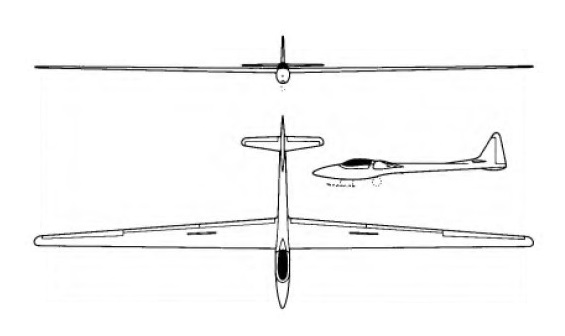
Ikarus AD Kosava
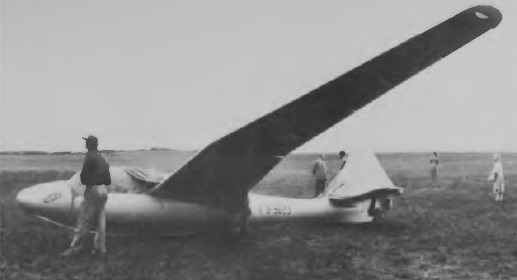
The Kosava (or North Wind) was a high performance two-seater intended to replace the DPS Kranich then in use in Yugoslav clubs; its design was commissioned by the Yugoslav Flying Sports Organisation from Milos Ilic and Adryan Kisovec, and the prototype made its first flight in March 1953. A few weeks later Bozo Komac flew it to victory in the Yugoslav National Championships, and the type went on to win many prizes in contest flying in the two-seater class, taking first place in this category in the 1954 World Championships at Camphill, Bedfordshire, and second place in the 1956 World Championships at St Yan in France.
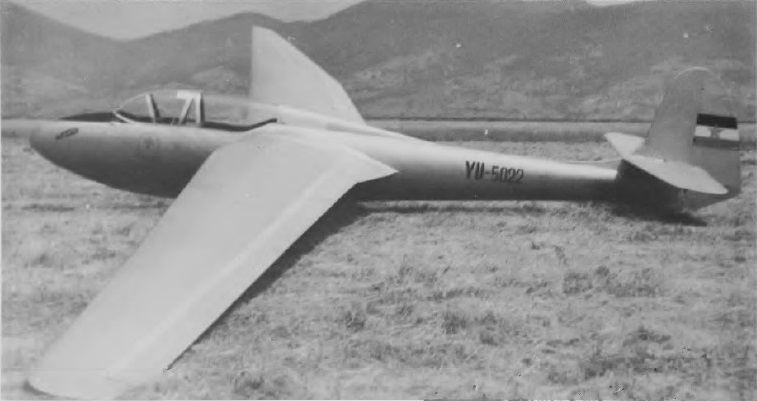
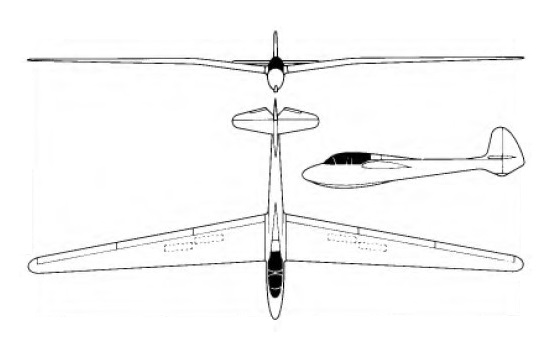
Of conventional wood and fabric construction, the Kosava had a shoulder-mounted gull wing with a slight forward sweep at the leading edge and a more marked trailing edge sweep; the forward sweep served to maintain the cg at a suitable place when the Kosava was being flown solo. The ailerons were divided into inner and outer halves, and underwing spoilers were fitted, as well as trailing edge flaps which operated in conjunction with the ailerons, being used separately during landing. The second prototype Kosava was fitted with Schempp-Hirth air brakes. The two pilots are seated in tandem under a two-piece canopy and the landing gear consists of a single skid under the forward fuselage.
The Kosava-2 was a redesigned version intended for training from basic to advanced levels, including blind flying training, aerobatics and high altitude soaring. It features a new more streamlined fuselage with the pilots in tandem under a flush-fitting cockpit canopy divided by a centre frame; the two canopy sections are jettisonable, and there is provision for an oxygen system for the pilots. A retractable monowheel and tail bumper replaces the skid of the earlier Kosava, and the fin and rudder are swept back and the mid-set tailplane’s span increased, whereas the earlier Kosava’s tail unit, fuselage and cockpit resembled those of the DPS Kranich it was designed to replace. The Kosava-2’s wing is very similar in plan to the earlier Kosava’s, but has dihedral from the roots and is of 18m span (59 ft 0.75 in), with one piece ailerons, air brakes in the upper surfaces and no flaps.
Kosava
Wing span: 19.13 m (62 ft 9 in)
Length: 8.33 m (27 ft 4 in)
Wing area: 21.12 sq.m (227.4 sq ft)
Wing section: Gottingen 549/CAGI 731-M
Aspect ratio: 17.3
Empty weight: 336 kg (741 lb)
Max weight: 575 kg (1,268 lb)
Water ballast: None
Max wing loading: 27.2 kg/m 2 (5.57 Ib/sq ft)
Stalling speed: 29 kt (53 km/h)
Max speed: 136 mph / 119 kt / 220 km/h
Min sinking speed: 2.17 ft/sec / 0.66 m/sec at 46.5 mph / 40.5 kt / 75 km/h
Best glide ratio: 33.5:1 at 54 mph / 47 kt / 87 km/h
 All Aero