Jurkštas, Ramunas

Ramūnas Jurkštas

After graduating from high school in Klaipeda Baltic went to study in the aviation school in Kaluga in Russia, flew L-29, MiG-15, MiG-17. While still a student in 1977 R.Jurkštas began to glide at Klaipeda Aeroclub.
The first teachers were the club fliers A. Dust, E. Ramon V. Tamošiūnas, J.Aleknavičius.

Ramunas Jurkštas became Silute Aero Club instructor pilot.

Junkers Ju.322

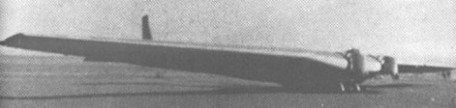
A 1941 flying-wing transport glider, built in competition with the Me 321. The RLM insisted that the Ju 322 would be built of wood, a construction technique not used by Junkers since 1918.
Junkers employed a wing like that of the G 38 on a transport glider design, the Ju 322 Mammut (Mammoth) but stability problems showed up on its first test flight.

The RLM had ordered 200, but the Ju 322 was cancelled after the prototype proved unstable. The Me 321 was selected for production.

The 62 m (203 ft) span glider was towed by a Ju 90 towplane (for whose take off 5 km (3 miles) of forest had been cleared from the end of the Junkers airfield at Mersburg) and had to be cast off. It landed in a meadow where it lay for two weeks before it was towed back to the airfield by the two tanks it had been designed to carry. Both it and 99 other Mammuts under construction were sawn up into firewood.

Wing span: 62 m (203 ft)

Junkers / Junkers-Fokker-Werke AG / Junkers Flugzeugwerke AG / Junkers Flugzeug und Motorenwerke AG

Professor Hugo Junkers (1859-1935) became enthusiastically interested in aircraft development and worked for several aero-engine manufacturers. Convinced that all metal structure was the ultimate answer to successful aircraft design, he produced the experimental J.1 “Blechesel” (Tin Donkey) to exemplify his 1910 patent for a cantilever all-metal wing. The J.1 flew on December 12, 1915, giving unexpectedly stable performance.

Hugo Junkers Article

Six J 2s were then built, but when J 4 ground-attack biplane was ordered for German Army, he was not geared for mass production. Thus, Junkers-Fokker-Werke was formed at Dessau on October 20,1917, with equal shares held by Junkers and Anthony Fokker. Conflicts of personality caused Fokker and Junkers to separate in 1918, and the Junkers re-formed following April as Junkers FlugzeugwerkeAG at Dessau April 24,1919, first concentrating on all-metal civilian transports such as F13 four-passenger monoplane (more than 350 built).

Representatives of the Junkers Flugzeugwerke (Jfa), the German Government (Reichswehrsministerium, RWM) and the Soviet Government (Trotsky) signed a final agreement on November 26, 1922, and a former motor car factory at Fili, situated south of Moscow, was taken over by Jfa and expanded. Back in the Dessau design office headed by Dipi Ing Emst Zindel, work had begun during 1922 on three new military types intended for production at Fili the J20 two seat low wing reconnaissance floatplane and the J21 two seat reconnaissance and J22 single seat fighter parasol wing aircraft. The parasol wing configuration of the two last mentioned types turned out to be a failure, even though the J21 was built in quantity at Fili.

Junkers established a Swedish subsidiary, AB Flygindustri, near Malmo, and formed Junkers Motorenbau GmbH for production of aero engines. After death of Hugo Junkers the company became state-owned and, amalgamating with the aeroengine firm, became Junkers Flugzeug und Motorenwerke AG in 1936, then the largest aviation company in the world. For German rearmament program, Junkers built factories in many other parts of Germany, and in Czechoslovakia and France.
Avions Metalicos Junkers was founded at Madrid in 1923 to provide facilities for the construction of Junkers aircraft in Spain. A two-seat all-metal monoplane was in production in 1924.

Major types produced included G24 and G31 airliners of 1925/1926: W33 and W34 cargo transports, used also as trainers by Luftwaffe; the G38 “flying wing”of 1928 (prototype flew November 6,1929; production models carried 34 passengers plus seven crew). Some used as military transports in early stages of Second World War. On October 13,1930 came the first flight of famous Ju 52 cargo transport. Three-engined Ju 52/3m based on latter used in wide variety of roles before and during Second World War, production totalling more than 4,850. Prewar production continued with Ju 60 and Ju 160 airliners, Ju 86 bomber, transport and trainer, and Ju 87 dive-bomber in many versions. The 87 was followed by the Ju 88/188/388 family of twin-engined bombers. The Ju 90/290/390 family began as four-engined 38/40-seat airliners, converted as heavy transport/reconnaissance types in Second World War. Junkers was among first companies to produce military jet aircraft. Two prototypes of its Ju 287 with forward swept wings were captured by Russians in 1945.

After Second World War aircraft production ended, Junkers joined with Messerschmitt in 1966, and with absorption of small aero-engine plant by Messerschmitt group in 1975, the Junkers name disappeared entirely.

Jonker JS1 Revelation

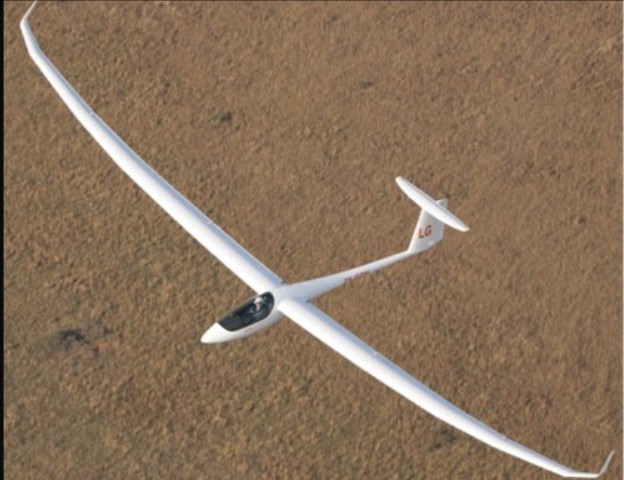
The JS1 Revelation is a high-performance FAI 18-metre Class sailplane, fully-equipped in its baseline standard. An optional jet sustainer system is available. With the introduction of the JS1C variant, there was also the additional option of 21-metre wingtips for an ‘agile’ Open Class sailplane.

The design process of the JS1 Revelation started with development of the main wing aerofoil. After wind tunnel tests together with new technology and research on techniques that might help climbing performance, then after making hundreds of iterations, they ended up with the T12 aerofoil.

To optimize climbing in turbulent thermals the T12 does not have the typical flat top Cl-Alpha curve at high lift coefficients.

T12 characteristics:
Maximum thickness/chord ratio 12.7%
14% camber changing flap
Low drag with extensive regions of laminar flow
Laminar to turbulent transition on the lower surface occurs at 93% where artificial transition is applied for negative flap settings
Transition on the upper surface occurs at approximately 65% for a 0° flap setting and 2° angle of attack
The top surface is smooth at 13.5° with almost 70% laminar flow

Although aerodynamically optimised, there are structural challenges using such a thin aerofoil. At the time the T12 aerofoil was the thinnest main aerofoil used on modern sailplanes.

The aerodynamic design of the wing root reduces separation problems at the trailing edge and optimised overall drag. Six different aerofoils are used in the wing for maximizing the performance of the glider. All are derived from the main T12 aerofoil, optimised at each spanwise station for the specific chord length and Reynolds number. The wingtip aerofoil is designed with an ample lift reserve to help handling characteristics and avoid any tendency for wing drop.

The optimum wing planform has an elliptical lift distribution for minimum induced drag at low speeds, and a small wing area for reduced profile drag at high speed. The wings of the JS1 Revelation have six tapered polyhedral sections along the wing span, with aerofoils based on the T12 aerofoil optimised at each spanwise position for the specific chord length and Reynolds number. The polyhedral also contributes to the handling qualities.

The winglets for the JS1 Revelation were specifically tailored for the wing shape and tip airfoil. For all operational angles of attack, the load on the tip region was kept within limits of the maximum airfoil lift coefficient, for safe handling characteristics. Due to the polyhedral wing configuration of the JS1 Revelation, the last wing panel is already at an angle of 24 degrees which increase the angle between the winglet and wing. This reduces the detrimental 3D flow effects at the junction corner due to super positioning of adverse pressure gradients which causes separation.

Conventional structures (such as the controls and landing gear) were designed using traditional calculation methods, with hand calculations for simple geometries and laminate analysis for simple composite structures. The more complex structures were designed using FEM analysis techniques.

A combination of glass-fibre, aramid (Kevlar) and carbon-fibre is used in the load bearing structure of the JS1 Revelation. The very thin wing section (12.7%) posed a challenge for the designers, especially in the wing root area where the maximum thickness is only 100mm.

All structural design was according to the certification standards set in CS-22 and with a general safety factor of 1.725.

Standard features include a multi wingspan, including 18m wingtips with provision for 21m wingtips, a nose release hook and provision for a belly hook enclosed by main wheel doors, a fixed pneumatic tail wheel (brass or Vesconite), a multi-probe (pilot, static pressure and Total Energy), and two recessed battery boxes in baggage compartment and battery compartment in vertical stabiliser

The cockpit has a gooseneck dynamic microphone attached to canopy frame, tick mounted PTT switch and twin speakers for radio and navigation computer, a radio antenna in vertical stabiliser and provision for Dolba transponder antenna installation inside vertical stabiliser.

Boundary layer control is with blowholes and soft tripping turbulators. Integrated main water ballast tanks (approximately 2 x 90 litres) are in the main wings with automatic coupling and maintenance-free valves. An integrated non-dumpable C.G. water tank is in the vertical stabiliser (for optimum C.G. when compensating for pilot and equipment)

Triple-panel upper-surface airbrakes are fitted and the retractable undercarriage has elastomeric shock absorbers. Hydraulic disc brake are activated by full aft travel of airbrake handle.

Jonker Sailplanes selected the M&D Flugzeugbau TJ42 jet turbine engine as an option.

Finite Element Modeling (FEM) allows for the whole structure to be represented as a wire frame of cells or elements called “the mesh”. Loads can then be applied to the mesh and the stresses calculated at each point. The result is a colorful representation of the stress condition throughout the structure. This shows exactly where the structure needs strengthening and where weight can be saved. The figure below shows the stress condition in the front and aft fuselage due to a load on the tail, and a high-g pullout maneuver.

In March 2010 the JS1 Revelation gained its official certification by the South African Civil Aviation Authorities (SACAA). With SACAA Type Certification to CS-22 and with an SACAA ICAO- compliant Certificate of Airworthiness the JS1 Revelation should be able to be flown without restriction in any ICAO-signatory country.

However JS recognises that EASA (and its predecessor, JAA, and the German LBA) are widely acknowledged as the experts in glider certification and that it is important to gain EASA Type Certification (TC) or Type Validation (TV) of the JS1 Revelation, both for market confidence and to enable local registration of the JS1 in Europe. Local registration would allow local maintenance procedures to be applied.

JS and SACAA have been in discussion on how to best proceed with EASA TC/TV. A full EASA TC exercise would require repeating all ground and flight tests with EASA witnesses and re-submitting every report and analysis for EASA scrutiny. This would be unnecessarily time-consuming, expensive and inefficient as it would completely ignore everything done for the SACAA Type Certification. This would be inconsistent with the advice provided by EASA to SACAA and JS, namely to gain local South African Type Certification before presenting this to EASA.

An EASA Type Validation exercise allows EASA to take advantage of the tests, reports and analyses already accepted by SACAA – while at the same time reserving the right to require extra information for any areas of special interest or concern. However in order to use a Validation process (rather than a full Certification process) it is necessary to establish a Working Arrangement between SACAA and EASA – simply a legal framework to allow EASA to accept SACAA findings on the basis that SACAA have followed a robust and rigorous process.

For the SACAA, establishing a Working Arrangement with EASA is part of a longer term strategy to advance the worldwide credentials of SACAA as a competent professional airworthiness authority. In December the Director of Civil Aviation, SACAA formally requested discussions with EASA with the aim of setting up a Working Arrangement for EASA Type Validation of the JS1 Revelation.

This was a major step forward for Jonker Sailplanes; to have the direct involvement and support of the SACAA at the highest level for EASA Type Validation.

ICAO Type Certificate Details
Manufacturer: Jonker Sailplanes cc
Type Certificate: J15/12/550
Issued by: South African Civil Aviation Authority
Model: JS1-A “Revelation” JS1-B “Revelation”
JS1-C 18 “Revelation” JS1-C 21 “Revelation”
MCTOW 600 kg (with water ballast) – JS1-A, JS1-B, JS1-C 18
437 kg (without)
720 kg (with water ballast) – JS1-C 21
520 kg (without)
Max. No. of Seats: 1

Type Acceptance Certificate No. 11/21B/25 from the NZ CAA was granted on 21 November 2011 to the Jonker JS1-A and JS1-B based on validation of SACAA Type Certificate J15/12/550.

The Jonker JS1-A and JS1-B are single-seat 18m class sailplanes with winglets, water ballast provisions, full-span flaperons, upper-surface airbrakes, constructed from composite materials. The configuration includes a shoulder wing, T-type empennage and retractable main landing gear. The JS1-B is identical to the JS1-A except for a smaller tailplane and tail surfaces and is the main production model after s/n 004.

The Jonker JS1-A and JS1-B sailplanes are the first indigenous aircraft Type Certificated
by the South African Civil Aviation Authority.

The JS1-C models are identical to the JS1-B except the outer wing is removable, with two different span wing tips available, 18m and 21m. The JS1-C has been the standard production model since s/n

  1. The JS1-C 21 has wing-tip water tanks and an increased maximum weight, but is not eligible for cloud flying or basic aerobatics.

ICAO Type certificate:
SACAA Type Certificate J15/12/550 issued 12 March 2010
SACAA Type Certificate Data Sheet J15/12/550 Issue 4.0 dated 24 May 2013
JS1-A, JS1-B models approved 12 March 2010
JS1-C 18, JS1-C 21 models approved 23 May 2013

Airworthiness Limitations:
The airframe has a specified service life of 12,000 hours, and requires special inspections at set
intervals to reach it.

JS-21 18m
Wingspan: 18m / 59.06 ft
Wing area: 11.20 sq.m / 120.56 sq.ft
Aspect ratio: 28.8
Fuselage length: 7.165m / 23.51 ft
Fuselage height: 1.32m / 4.33 ft
Max weight: 600 kg / 1323 lb
Wing loading (w/70kg pilot): 35.3 kg/sq.m / 7.23 lb/sq.ft
Max wing loading: 53.6 kg/sq.m / 10.98 lb/sq.ft
Best glide ratio: 1-53
Best glide speed at MAUW: 120 kph / 65 kt
Best glide speed at 450 kg: 100 kph / 54 kt
Min sink rate: 0.50 m/s / 100 ft/min
Vne: 290 kph / 157 kt
Rough air speed: 203 kph / 110 kt
Flight loads at Vra: +5.3 / -2.65 G

JS-21 21m
Wingspan: 21.00 m / 68.90 ft
Wing area: 12.27 sq.m / 132.07 sq.ft
Aspect ratio: 35.9
Fuselage length: 7.165m / 23.51 ft
Fuselage height: 1.32m / 4.33 ft
Max weight: 720 kg / 1587 lb
Wing loading (w/70kg pilot): 33.8 kg/sq.m / 6.92 lb/sq.ft
Max wing loading: 58.7 kg/sq.m / 12.02 lb/sq.ft
Best glide ratio: 1-60
Best glide speed at MAUW: 120 kph / 65 kt
Best glide speed at 450 kg: 100 kph / 54 kt
Min sink rate: 0.48 m/s / 95 ft/min
Vne: 270 kph / 146 kt
Rough air speed: 203 kph / 110 kt
Flight loads at Vra: +5.3 / -2.65 G

Jongblood Primary

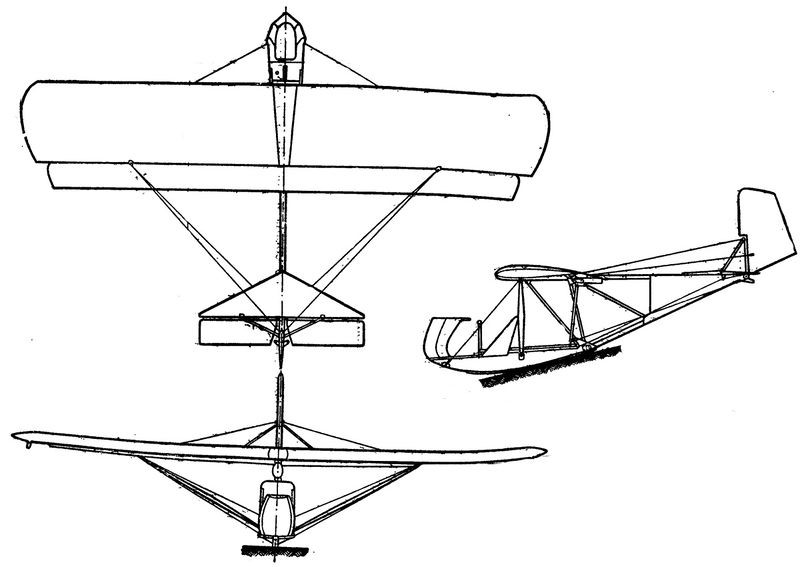
Mike Jongblood of southern California designed and built this single-seat, primary glider in 1966, with assistance from Hugh Knoop. The design was original and includes an original airfoil design as well, designated as a Jongblood II section.

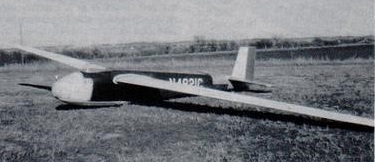
The aircraft is built from wood and covered in doped aircraft fabric covering. The glider has a detachable pod to cover the pilot or can be flown open cockpit. It has a constant chord wing with a 4 ft (1.2 m) chord and a 32.5 ft (9.9 m) span. The wing features dual parallel struts and jury struts, but has no spoilers or other glidepath control devices. The tailplane is also strut-braced. Unlike most earlier primary glider designs that land on a fixed skid, this aircraft has a fixed monowheel.

The Primary had accumulated over 200 auto-tows and seven aerotows, along with nine hours of flying time, by the end of 1968 and by 1983 had flown 22 hours total. It had flown a single three-hour flight and had recorded a height gain of 8,000 ft (2,438 m).

The sole example constructed was reported as “in storage” in 1983. In May 2011 it was still on the Federal Aviation Administration registry listings, although its registration had expired on 31 March 2011.

Wingspan: 32 ft 6 in (9.91 m)
Wing area: 125 sq ft (11.6 m2)
Aspect ratio: 8:1
Airfoil: Jongblood II
Empty weight: 270 lb (122 kg)
Gross weight: 450 lb (204 kg)
Maximum glide ratio: 8:1 at 30 mph (48 km/h)
Crew: one

Johnson RHJ-6 Adastra

Johnson RHJ-6 Adastra N4921C

The Johnson RHJ-6 Adastra (English: Star) was conceived by Johnson as a mid-wing, two-place competition aircraft.

The aircraft was of mixed construction. The fuselage was built from wood and was a monocoque design. The wing had a wooden structure, with fiberglass leading edge. The tail surfaces were constructed of wood. The wings aft of the leading edge, the tail surfaces and all control surfaces were covered with doped aircraft fabric.

Originally the aircraft employed an Eppler 150 airfoil section, but Johnson later modified it by adding a 10% wing chord extension, turning the airfoil into an Eppler 151. Later new wings were built with an Eppler 414 airfoil to improve low-speed performance. The new wings used a foam-filled fiberglass leading edge. The tail was originally a “Y” tail, but this was later replaced with a conventional tail, with a low-mounted tailplane.

The individual cockpits were covered with independent bubble canopies, although the aircraft was most often flown solo, with a flat hatch replacing the rear canopy to reduce aerodynamic drag. In 1983 it was reported that a single canopy was being designed for the aircraft.

The Adastra was first flown on 3 April 1960 by Dick Johnson. Only one Adastra was built.

In its original configuration Johnson flew the Adastra in the 1960 World Gliding Championships in Cologne, West Germany and finished in 15th place. After extending the wing chord and altering the airfoil he flew it in the US Nationals to a seventh-place finish in 1961 and second place in 1962.

The aircraft was later owned by Jesse Womack of Graham, Texas. The Federal Aviation Administration registry records indicate that the aircraft was destroyed and was removed from the registry on 6 April 1992. The National Soaring Museum lists the aircraft as being part of their collection and in storage.

Adastra – later configuration
Wingspan: 56 ft 4 in (17.17 m)
Wing area: 178 sq ft (16.5 m2)
Aspect ratio: 17:84
Airfoil: Eppler 414
Empty weight: 649 lb (294 kg)
Gross weight: 1,040 lb (472 kg) when flown solo, 1,166 lb (529 kg) dual
Stall speed: 36 mph (58 km/h, 31 kn)
Never exceed speed: 140 mph (225 km/h, 121 kn)
Rough air speed max: 120.5 mph (193.9 km/h; 104.7 kn)
Aerotow speed: 120.5 mph (193.9 km/h; 104.7 kn)
Winch launch speed: 80 mph (128.7 km/h; 69.5 kn)
Terminal velocity: with full airbrakes 140 mph (225.3 km/h; 121.7 kn)
Maximum glide ratio: 42.5:1 at 60.9 mph (98 km/h; 53 kn)
Rate of sink: 120 ft/min (.61 m/s) at 57.2 mph (92 km/h; 50 kn)
Wing loading: 5.8 lb/sq ft (28.5 kg/m2) when flown solo, 6.96 lb/sq ft (34 kg/m2) dual
Crew: One
Capacity: One passenger

Janka Gyongyos 33

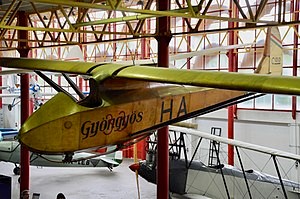
The Gyöngyös 33 was the first Hungarian designed sailplane and was named after its place and year of manufacture. It was designed by Zoltán Janka and built in the MOVERO (Aviation Section of Hungarian National Defence Association) workshops at Gyöngyös. His design target was to produce an aircraft that would out-perform the 1928 RRG Professor.

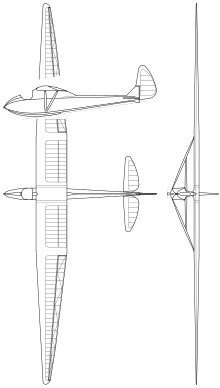
It was an all wood monoplane with a two-part wing built around a forward main spar and a rear false spar. The inner area of each part was rectangular in plan, tapering strongly outboard. The leading edges ahead of the main spar were plywood-covered, as was the whole wing at the inner-outer junction; the rest was fabric-covered. An aileron filled the whole trailing edge of each outer section. The two parts joined at a narrow centre-section on a raised fuselage pylon and were braced on each side with a V-strut from the fuselage bottom to the wing spars at the inner-outer junctions.

The Gyöngyös 33’s six-sided fuselage was formed by a wooden frame and was plywood-covered. The pilot had an open cockpit ahead of the wing leading edge with the wing pylon immediately behind him. A rubber-sprung landing skid below him ran from the nose almost to the trailing edge. The fuselage tapered rearwards to a cantilever empennage. The fin was small and ply-covered with a tall rudder which, like the all-moving tailplane apart from its leading edge, was fabric covered.

The first flight took place on 11 June 1933. A fortnight later the Gyöngyös 33 slope-soared for 5 h 43 m, gaining 1,140 m (3,740 ft) of altitude, a Hungarian record. On 27 June it set a national duration record of 10 h 7 m. In 1934 it made a 64 km (40 mi; 35 nmi) flight.

The Gyöngyös 33 is now on display in the Hungarian Technical and Transportation Museum, Budapest.

Length: 7.37 m (24 ft 2 in)
Wingspan: 18.55 m (60 ft 10 in)
Wing area: 19.3 sq.m (208 sq ft)
Aspect ratio: 17.8
Airfoil: Göttingen 549
Empty weight: 179 kg (395 lb)
Gross weight: 250 kg (551 lb)
Maximum glide ratio: >20 at 55 km/h (34 mph; 30 kn)
Rate of sink: 0.6 m/s (120 ft/min) minimum

JAI JAI-9

In the late 1930s, more modern gliders with improved aerodynamics were developed in various Soviet cities, designed to set new competition records. Among these models was the JAI-9 (Russian: ХАИ-9) single-seat monoplane glider designed by AV Kovalenko built by JHA students in 1937.

The JAI-9 wing presented a cantilever configuration with high aspect. In the JAI-9, for the first time, the TsAGI flaps were installed. It is worth noting the JAI-9 high wing loading.

The pilot was located in a cockpit closed by a transparent cover, which barely protruded in the contours of the glider’s fuselage.

The tests showed that the JAI-9 flew well and was easy to control in the air.

JAI JAI-28 / BRO-DPK

In 1972 at the request of a group of students from the institute and under the direction of the head of the aeronautical construction laboratory A. Barannikov, within the structure of OSKB JAI, the Aviation Construction Club (KAK) was created.

The SKB students wanted to fly, but according to the institute’s rules this was impossible. There was no model whose piloting was simple enough to allow them to use it. For that reason it was decided to test the construction of such an airplane. By that time the simple Oshkinis BRO-11 glider had spread and was flying successfully throughout the USSR, so the students decided to copy it.

The BRO-11 Pioner was designed by BI Oshkinis in 1954 and built at the Kaunas Glider Station. The technical documentation for its series production and static tests were developed at the Moscow Aviation Institute. It was a cheap glider, capable of being built in any workshop from the plans published in the technical literature and the press.

The JAI-28 glider was designed as a high-wing monoplane braced by two uprights. It used hanging ailerons, occupying practically the entire wingspan and with a kinematic link with the elevator.

The construction was basically of wood, with some use of metal joints and components. All the elements, with the exception of the ash tail skate, were made with aviation pine wood. The covering was three-layer plywood.

The metal details were made with brand 25 steel sheet and brand 20A steel tubes. D16 duralumin was used for the washers, trim strips, rudders, ailerons and other components.

As in the BRO-11 the fuselage does not exist, Instead a piece is implemented to which the wing, ailerons, tail unit, floor, foredeck, seat, pedals, lever and the landing skid.

The wing is made up of two sections and is attached to the central bar at three points. The ailerons are hung under the wing and are fixed by two points, occupying almost the entire span.

The tail was of the conventional type and featured a simplified construction. The horizontal plane consisted of the stabilizer and two halves of the elevator. The vertical plane featured an empennage and rudder. The keel was braced to the outrigger by two struts.

The stabilizer had a triangular shape in the plane and in its structure it had a spar, seven ribs and a front rib.

The first BRO-DPK glider, later named JAI-28 (Russian: ХАИ-28 (БРО-ДПК)), was designed and built by a group of students, among which were V. Silyukov, S. Alexandrov, N. Lavrov and V. Byzov. The screening was finished in 1973.

The first JAI-28 glider was built in 1974 and on June 17, 1975 it made its first flight with A. Barannikov at the controls.

The students soon learned to fly on it from small hills. The launch of the glider was carried out by means of a rubber band of about 30 meters. At one end there was a ring to fix the glider. The other end was divided into two points of about 5 meters. This end was tensioned for the glider to take off. Take-off could also be done by dragging, using a rope.

Thanks to its low weight, the glider could also be used for ground control training.

In total, three copies of the JAI-28 were built, in which 75 pilots received their initial training.

The JAI-28 would be used as the basis for developing the JAI-29 “Korshun” motor glider.

JAI-28
Wingspan: 8. 8 m
Wing area: 12.2 m²
Aspect ratio: 6.8
Empty weight: 58 kg
Normal flight weight: 118 kg
Payload: 70 kg
Maximum payload: 85 kg (with installation of tail weights)
Glide ratio: 12.5
Minimum descent: 1.1 m / s
Landing speed: 30 km / h
Stabilizer surface: 0.78 m²
Elevator area: 0.65 m²
Empennage surface: 0.5 m²
Rudder surface area: 071 m²
Accommodation: 1