Khevenhüller Schwingengleiter

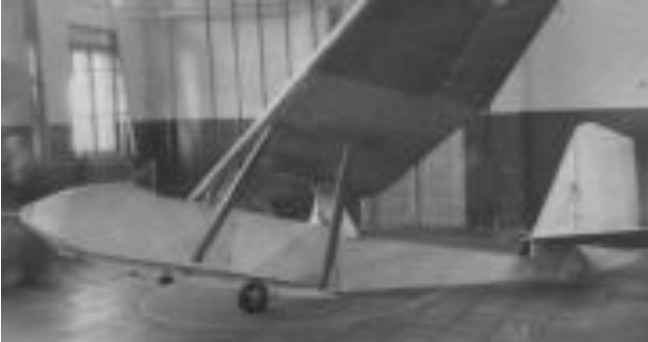
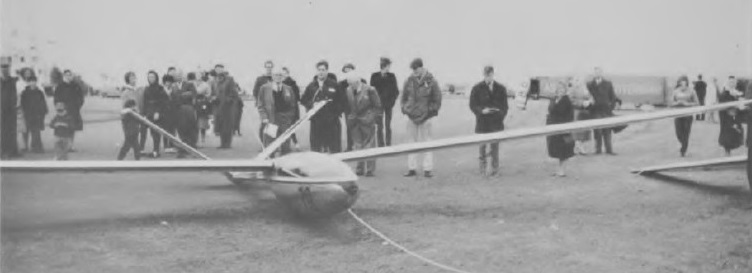
A wing-flapping glider built and tested with moderate success by early Austrian experimenter and nobleman Graf Georg Khevenhüller at his castle, Burg Hochosterwitz, in Kärnten. In 1913 Count Khevenhüller built his last Schwingenflieger (as photographed), without any help of Wels. The machine had a weight of 50 kg and was constructed from bamboo, metal tubing and the wings of duralumin and balloon silk. The Count had the idea to flap the 12 meter span wings using human power, whereby a pulley construction was devised so that a person could beat the wings and hold the machine in the air. To give the glider its needed initial speed, a launching railway of 40 meters was laid down with a maximum slope of 20 degrees on the eastern part of Burg Hochosterwitz. Although this aircraft purportedly flew up to 100 meters in October 1913, all the attempts failed to make more than one flap of the wings, partly because of the instability of the machine in the air. After a severe crash, further attempts to fly the machine were halted and apparently remains preserved at Hochosterwitz.
Khevenhüller, Graf Georg

Graf Georg Khevenhüller had begun in 1905 with a glider he himself built and in 1911, to further his experiments, the Count partnered with Franz Xaver Wels. From here the bar was set higher: to realize a glider with flapping wings. A machine seems to have been built, yet it was not successful and the men parted company soon after.

Kazan BK-7 / LAK-9 Lietuva

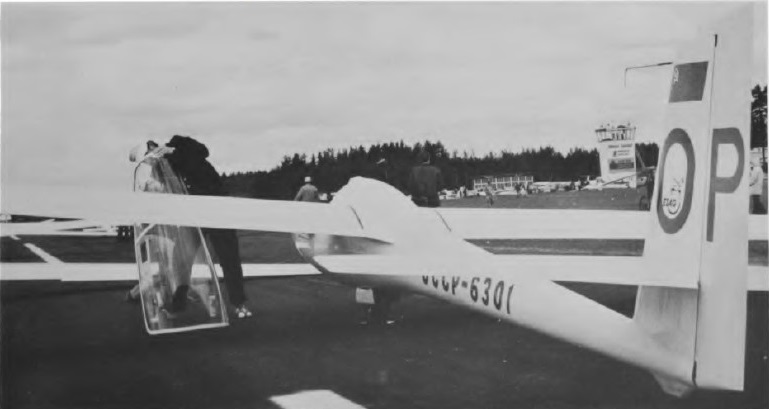
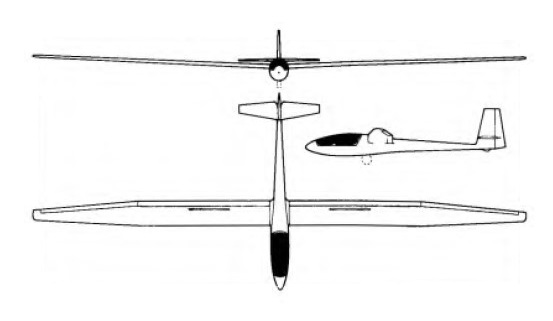
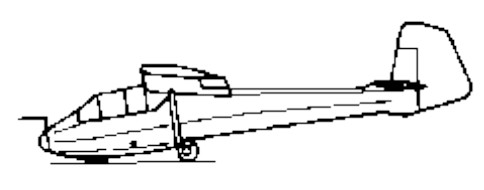
It is believed to have been designed originally by Balys Karvyalis and first flown, under the designation BK-7, in 1972. It had a Wortmann FX-67-K-170 wing section and a retractable monowheel landing gear, with tailskid. The BK-7, which was of glassfibre construction, was subsequently reported to have entered series production and a Polish journal later referred to a ‘BK-7A Lietuva’ with a wing span of 20 m (65 ft 7.5 in), length of 7.27 m (23 ft 10.25 in), weight of 380 kg (837 lb), best glide ratio of 46 and max speed of 210 km/hr (113 kt).

An almost identical aircraft was flown by O. Pasetnik in the Open Class of the June 1976 World Championships in Finland but withdrew from the last two days of the competition because of aileron damage. This aircraft was referred to as the LAK-9 Lietuva and it was reported that the three LAK-9s then built had not, at that time, fully completed flight testing. The LAK-9 is the first Soviet sailplane to compete in the World Championships since 1968.

LAK-9 Lietuva
Wing span: 20.02 m / 65 ft 8 in
Length: 7.27 m / 23 ft 10.25 in
Height: 1.53 m / 5 ft 0 in
Wing area: 14.99 sq.m / 161.4 sq ft
Wing section: Wortmann FX-67-K-170
Aspect ratio: 26.8
Empty weight: 380 kg / 838 lb
Max weight 580 kg / 1,278 lb
Water ballast: 100 kg / 220 lb
Max wing loading: 38.69 kg/sq.m / 7.92 lb/sq ft
Max speed: 121 kt / 225 km/h
Stalling speed: 35 kt / 64 km/h
Min sinking speed: 0.51 m/sec / 1.67 ft/sec at 40 kt / 74 km/h
Max rough air speed: 113 kt / 210 km/h
Best glide ratio: 48 at 55.5 kt / 103 km/h

Kazan KAI-14

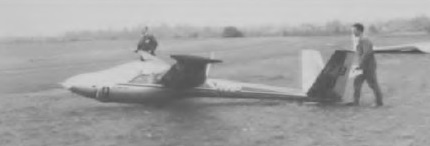
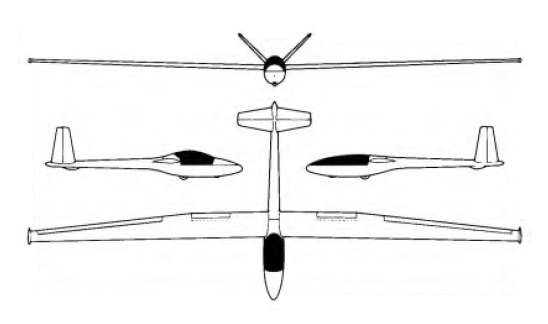
The Kazan Aviation Institute at Kazan designed and produced the KAI-14 high performance Standard Class single seater. Designed by a team headed by M. P.Simonov; of all-metal construction it made its first flight in about 1962, and two KAI-14s were entered in the 1965 World Championships held at South Cerney in England.

Two versions of the type have been produced, the first being for competition flying with the pilot seated in a reclining position under a long flush-fitting one-piece transparent canopy; this version has a polished metal finish to reduce drag.

The second version, intended for series production, is similar except that the pilot sits upright in a conventional seat under a raised cockpit canopy, and is unpolished. Both versions are otherwise the same, with cantilever shoulder wings with a forward sweep of 2° at the leading edges and compound taper on the trailing edges; the inset ailerons are each in two sections and small trailing edge air brakes are featured. The wings are metal-covered as is the semi-monocoque fuselage, in which the forward section tapers to a slimmer rear half carrying the all-metal cantilever ‘butterfly’-type V-tail. The landing gear consists of a non-retractable monowheel faired into the bottom of the fuselage, with a brake that is linked to the air brakes, and a tail bumper.

KAI-14
Span: 49 ft 2.5 in / 15.0 m
Length: 19 ft 1 in / 5.82 m
Wing area: 107.7 sq.ft / 10.0 sq.m
Aspect ratio: 22.5
Max weight: 573 lb / 260 kg
Water ballast: None
Max wing loading: 26.0 kg/sq.m / 5.32 lb/sq ft
Max permissible diving speed: 155 mph / 135 kt / 250 km/h
Max aero-tow speed: 87 mph
Landing speed: 43.5 kt / 80 km/h
Min sinking speed: 1.90 ft/sec / 0.58 m/sec at 56 mph / 48.5 kt / 90 km/h

Kazan Aviation Institute

Russia
Founded 1939, and since 1951 has manufactured Mil helicopters.
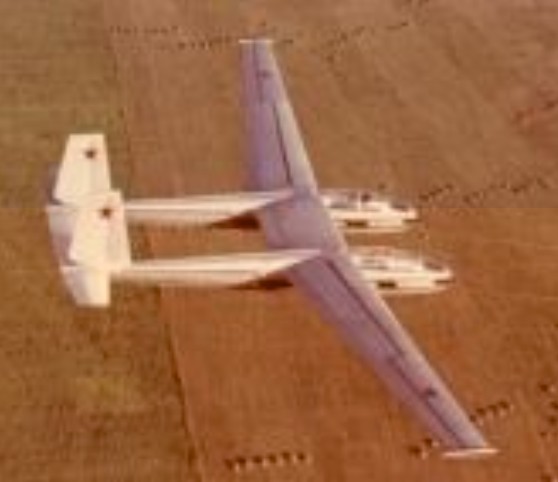
The Kazan Aviation Institute at Kazan on the River Volga, nearly 500 miles east of Moscow, has designed and produced some of Russia’s most notable sailplanes, especially the very advanced KAI-19 high performance all-metal single-seater which, in two-seater form, broke the world’s 300km closed circuit speed record on 1 August 1964, and the KAI-17 training glider.
Own designs are Ansat twin-turboshaft light multipurpose helicopter (first flown 1998) for up to 10 persons, and Aktay three-seat piston helicopter (to fly about year 2000).