As with many homebuilts, a number of builders have made design changes to their HP Aircraft HP-14. In some cases these have been substantial. Andre Krutchkoff built his SHP-1 with his own design of fuselage with T-tail.
Glider
Kronfeld Wein

Circa 1930.
Kronfeld Ltd
UK
Formerly The British Aircraft Co (1935) Ltd. of London Air Park, Feltham, Middlesex. Renamed as Kronfeld Ltd in 1936, in which year 20 Drone ultralight monoplanes were built, one model becoming known as Kronfeld Super Drone.
1936: British Aircraft Co., London Air Park, Feltham, Middlesex, UK.
When designer and company owner C. H. Lowe Wylde was killed while flying on 13 May 1933, the British Aircraft Company (1935) Ltd taken over by Austrian pilot Robert Kronfeld, becoming Kronfeld Ltd.
The firm was re-organised and a new factory was opened in Victoria Road, Feltham, Middlesex, where the Drone was produced.
The Kronfeld Monoplane of 1937, likewise a pusher, was intended as a Drone successor, but only one was built.
The name of the firm was changed to Kronfeld Ltd in 1936 but it closed down in 1937 after twenty-eight Drones and one Kronfeld Monoplane, a revised Drone, had been built.
Kramme & Zeuthen KZ.G-I / SAI KZ.G-I
The KZ G-I was a 1943 Glider.
Korolyev RP-1
The Korolyev RP-1 was a powered version of the Cheranovsky BICh-11 experimental tailless glider, designed together with Friedrich Zander (Tsander) and other Korolev’s friends from GIRD (ГИРД – Jet Propulsion Research Group).
It was planned to be a rocketplane (therefore RP index) and the Zander OR-2 rocket engine (500 N thrust) was designed especially for it. Development of the engine was very difficult, and Zander didn’t achieve success; furthermore on March 28, 1933 he died of typhus in Kislovodsk. The two RP-1 prototypes were tested in 1932-33 only as “ordinary” powered gliders, each with a 25-hp Scorpion piston engine.
The first of them was flown on June 8, 1932 – Korolyev himself was a test pilot. Totally 34 flights were made by him, but only 5 with the engine powered up.
Engine: 25-hp Scorpion
Wing span: 12.1 m
Length: 3.81 m
Wing area: 20.5 sq.m
Korolyev SK-6 / SK-7
The Korolyev SK-6 experimental two-seat, twin-boom glider of very compact design, made wide usage of Elektron magnesium alloy in the structure. Built in 1931 or early 1932, there is very little information about this glider. It never participated in any All-Union gliding contest and wasn’t among Korolev’s favorite designs. Only one photo remained which is identified as SK-6 glider.
It was designed (very similar project, anyway) in April 1931 as two-seat training aerobatic glider, but under the designation SK-7. The historian Georgy Vetrov guess it’s the same design. But why Korolev changed the designation – it is another mystery.
Calculated, for SK-7 project from April 1931
Wing span: 10.0 m
Length: 5.45 m
Wing area: 17 sq.m
Flight weight: 230 kg
Gliding ratio: 15:1
Rate of sink: 0.9 m/s
Korolyev KPIR-3
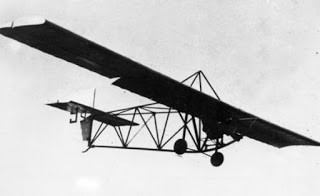
Sergei Korolyov decided to enrol in the Kiev Polytechnic Institute, where at that time it was supposed to begin training aviation engineers at the mechanical faculty.
There was a globular circle at the institute. His work was monitored and helped by many prominent scientists who taught at the KPI. Sergey Korolev became a member of it. He worked, as all are many and enthusiastic. Often at night. Korolev slept sometimes in the workshop on the shavings. He loved to work and was a master of all trades. After that, they never altered anything. Gliders built in the institute workshops, participated in international competitions, receiving the highest marks. At circles there was a rule: who built a glider, he flew it.
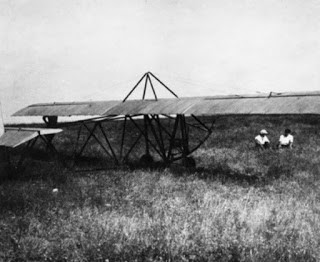
A training glider KPIR-3 was built, he contributed a share of his work and Korolev. Sergei flew on it. One of the flights almost cost him his life. On the border of the site – wasteland, where the gliders were tested, from a pile of garbage a water pipe was sticking out. Sergei did not notice and planted a glider on it. The blow was strong enough and Korolev lost consciousness for a while.
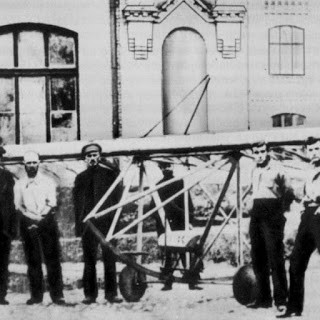
In 1926, after two years of studying at the KPI, Sergei Korolyov was transferred to Moscow for a special evening group on the aerodynamics of the Moscow Higher Technical School.
Korolyev K-5
Korolev was born to a Russian literature teacher in the town of Zhitomir in the Ukraine. He was fascinated with aircraft at an early age and became a pilot. At the age of 17 he had designed his first glider, the K-5.
Sergei Korolev’s designation system was very irregular and complicated (if there was a system at all). His very first glider project, designed in 1924 at aviation enthusiasts circle in Odessa inhering to ChAG (ЧАГ – Black Sea Aviation Group) when Korolev was 17 years old, was designated “K-5” for some reasons. This project was highly appreciated by aerotechnical department of Odessa OAVUK branch (ОАВУК– Aviation & Aeronautics Society of Ukraine) and recommended for realization. But it was necessary to approve it at OAVUK Central sport section in Kharkov, which allocated funds for construction of gliders to different Ukrainian aviation circles. Korolev sent his project (11 drawing sheets with explanatory comment) to Kharkov… and it was lost somewhere by the post service. So, the first Korolev design became a mystery. It’s known only that Korolev preferred to call it “motorless airplane”, not “glider”.
Korolyev AVF-27
Glider 1925
Korolyev S.K.9
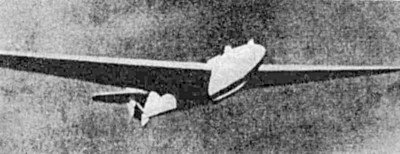
The two-seat SK-9 was designed by S.P.Korolev in 1934 – 1935 and was built at Osoaviakhim’s Planernyi Zavod (“Glider factory”, Tushino, near Moscow) in the Fall of 1935. The glider was built as a two-seater and had an unusual for sailplanes airframe: SK-9 had very high wing load and was capable to withstand loads up to 7g.
Chosen parameters were based on earlier experiments with BICh-11 glider, which was never flown with rocket engine just because light wooden airframe “expired” prior to arrival of the powerplant.
The SK-9 was an all-wooden aircraft. Box-type spars, ribs and 1mm plywood skin formed rigid box with strong resistance against bending and twisting. Fuselage of the oval crossection had 1mm to 1.5mm external skin and internal 1mm plywood skin for extra rigidity. Wing carried 2-section slotted ailerons covered with fabric.
Landing gear included a ski and fixed tailskid. The wooden ski was covered with steel and linked to the fuselage by set of rubber rings protected with fabric cover.
Pilot’s and passenger cockpits – of the open type. Pilot is protected by small plastic windshield. Rear cockpit had a removable set of controls.
During the Fall of 1935 the SK-9 passed factory trials at Tushino airfield, performing number of flights both towed by the airplane and in free flight.
It was flown (towed by an R-5) from Moscow to Koktebel for participation in the XIth All-Union Glider Convention (September 6 – October 6, 1935) in Koktebel (it flew there from Moscow on tow, as part of an “aerotrain”, with Korolev onboard as a passenger). During overflight and at the Convention SK-9 proved its high performance and good handling at speeds up to 180km/h even in “rough air” conditions. During flight from Moscow to Koktebel and back the SK-9 was piloted by glider-pilot Romanov and S.P.Korolev himself (he was a licensed pilot too).
The SK-9 was designed to be converted into a Rocketoplane – aircraft propelled by a rocket engine, and was later converted into the RP-318-1 rocket-plane.
The SK-9 fuselage and leading edges of the wing were painted bright-red. Wing, tailplane, rudder and nose section of the fuselage – ivory. Landing ski – black.
SK-9
Wingspan: 17.0 m
Wing area: 22 m2
Wing aspect ratio: 13.1
Length: 7.33 m
Height: 2.64 m
Empty weight: 300 kg
Loaded weight: 4605 kg
Wing loading: 23 kg/sq.m
Takeoff speed: 71-76 kph
Tow speed: 130-140 kph
Min glide: 85 kph
Normal glide: 100 kph
Max glide: 200 kph
Glide ratio: 19:1 (23:1 by another source)
Landing speed: 70 kph
Minimal descent: 0.94 m/sec
Normal descent: 1.4 m/sec
Crew: 2
 All Aero