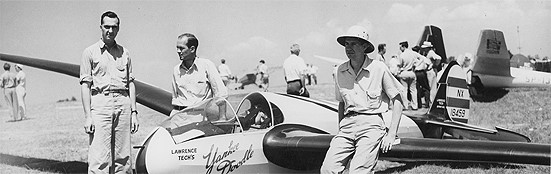
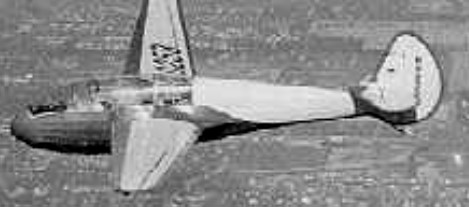
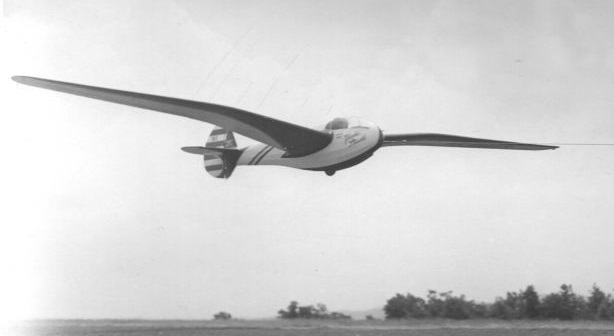
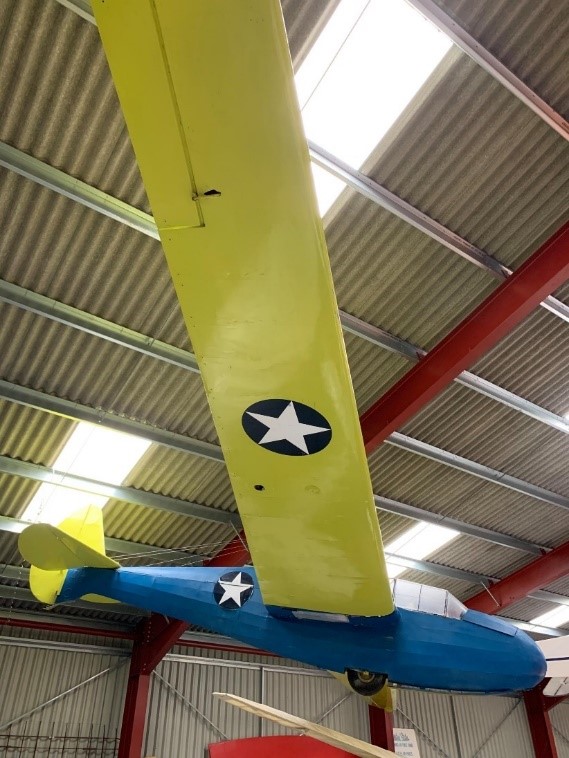
With the need for military trainers on the outbreak of World War II, Laister designed the two-place Yankee Doodle 2 from the original LK-10A / Lawrence Tech Sailplane with straight wings and automatic control hook-ups. Under the sponsorship of John Kauffmann, a St. Louis businessman, simplified versions were produced in quantity as TG-4A’s for the USAAC in 1942-43.
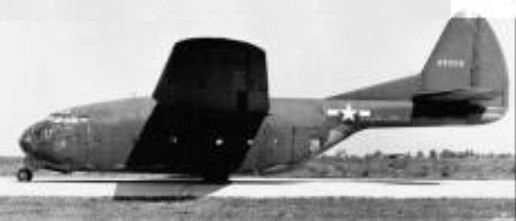
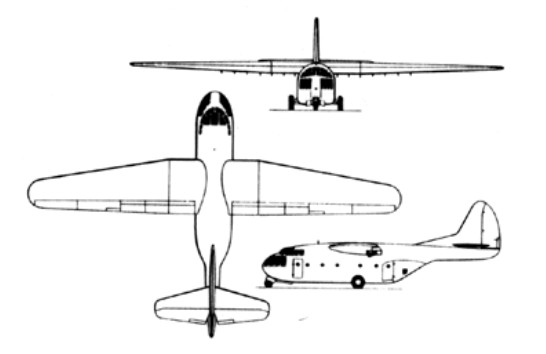
The XCG-10 is a large military glider capable of accommodating 30 troops or a freight load of 5 short tons. It is a high-wing cantilever monoplane with a deep forward fuselage tapering to a tadpole boom which supports the tail unit. At the break in the bottom lines of the fuselage clam-shell doors give access to the main hold 30 ft.(9.15m) long, 7 ft. (2.14m) wide and 8 ft. 6 in. (2.59m) high, which can accommodate a 155mm howitzer or a 2 1/2 ton truck. Structure is entirely of wood with plywood covering. The wings are fitted with Fowler-type landing flaps and have an overall span of 105 ft. (32m).
The XCG-10 and XCG-10A were two different craft. The 10A was 42 place. Although some sources say the 10 did not exist and the project was changed to 10A in design stage, the 10 was built both as a static test article and a flight test article. The internal hold size was slightly larger for the 10A to accommodate the GM 6X6 truck. The wingspan stayed the same.
In 1938 Jack Laister completed a gull-wing sailplane, which was referred to as the Lawrence Tech Sailplane after its sponsor. Repainted red, white and blue and renamed the ‘Yankee Doodle’ it competed in a 1939 aerobatic competition at the Paris airshow.
Yankee Doodle
With the need for military trainers on the outbreak of World War II, Laister designed the two-place Yankee Doodle 2 from the original that utilized some of the features and technology from the LT-IV but transitioned to a dual cockpit and straight wing arrangement.
Lawrence Tech
A flat-top Version with increased performance also has an ATC. A ‘bunnynose’ LK, flown by Harold Hutchinson, held the national multiplace goal record of 399 km/ 248 miles from 1956 to 1967.
The Vintage Sailplane Association has copies of the military manuals, color scheme drawings and paint chips available.
One LK-10A belongs to the National Soaring Museum.
LT IV
Laister-Kauffman TG-4A
LT IV Wing Span: 14.173 m Wing Area: 12.5 sq m Structure Weight: 124.7 kg Flying Weight: 214.3 kg Wing Loading: 17.14 kg/sq m Root Chord: 137.2 cm Tip Chord: 50.8 cm Aspect Ratio: 16 Fuselage Length: 5.867 m Stabilizer Span: 269.2 cm
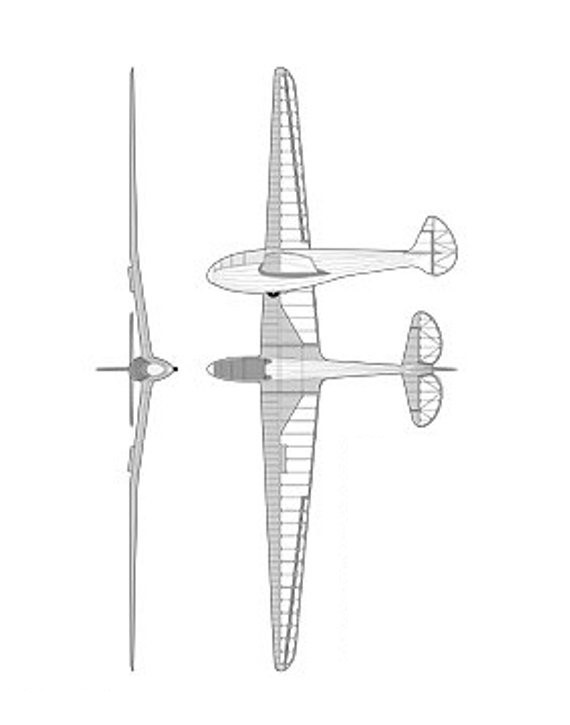
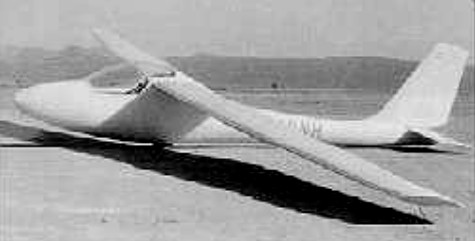
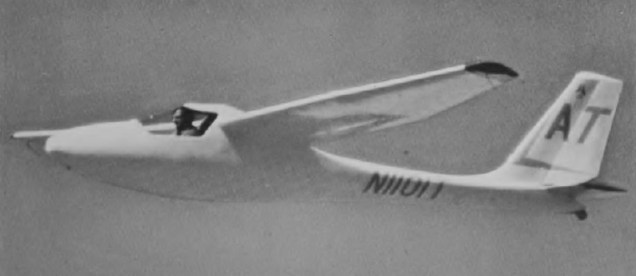
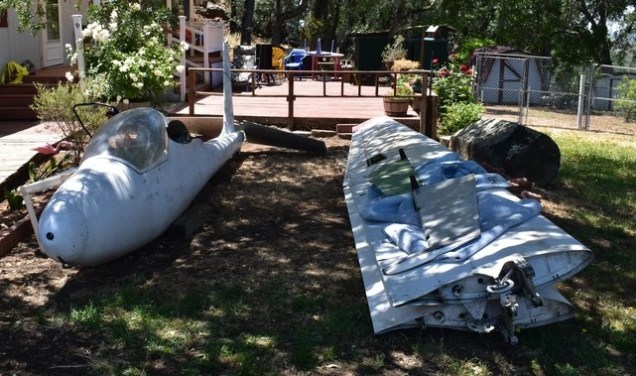
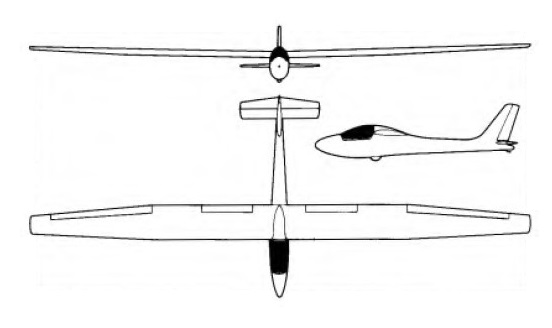
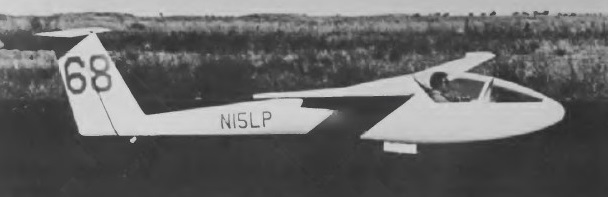
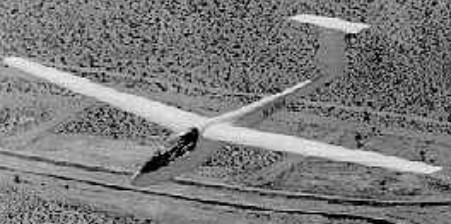
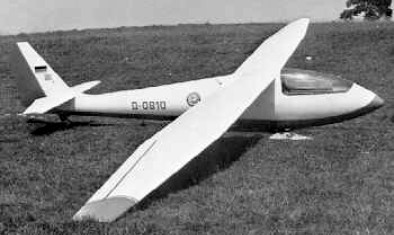
The LP-49, popularly known as the ‘Forty Niner’, is a Standard Class single-seater that was first rolled out in prototype form, designated LP-46, on 4 July 1966. It is of metal and glassfibre construction, but designed to be sold in kit form for the amateur constructor, and more than 50 LP-49 kits had been sold by early 1976, about 35 of which had been completed and flown.
The high cantilever wings are of laminar flow section, the extruded aluminium main spar booms being curved in a chordwise direction to follow the aerofoil section; the roll contoured aluminium sheet wing skin is butt jointed and flush riveted with blind pop rivets. The semimonocoque fuselage is made up of two premoulded glassfibre halves joined over aluminium bulkheads and fittings. The tail unit is of aluminium with a swept back fin and rudder, and the landing gear consists of a shock- strutted retractable monowheel with a brake and a glassfibre nose skid with a steel shoe; a fixed shrouded tailwheel replaces the retractable tailwheel of early production aircraft. The LP-49 has an automatic aileron and dive-brake control hookup and internal control- surface counterweights.
LP-49
The ship is approved for spins, loops and wing-over, and has been static tested to 12 g. The LP-49 was sold in both kit form and as a complete, ready-to-fly sailplane.
Jerry Haynes haynesja@yahoo.com Need help to find Stabilizer ? Elevator / pictures / drawings to build a new tail group
28 May 2018
LP-46 Span: 13.56 m. / 44.5 ft.
LP-49 Span: 15.0 m / 49 ft 2.5 in Length: 20 ft 7.25 in Wing area: 13.29 sq.m / 143 sq ft Aspect ratio: 16.9 Airfoil: NACA 64(3)-618 Empty Weight: 215 kg / 475 lb Gross Weight: 408 kg / 900 lb Payload: 125 kg /275 lb Water ballast: None Max wing loading 30.72 kg/sq.m / 6.29 lb/sq ft Max speed: 135 mph /117 kt / 217 km/h Stalling speed: 30 kt / 56 km/h Max rough air speed: 117 kt / 217 km/h Min sinking speed: 0.63 m/sec / 2.07 ft/sec at 50 mph / 43 kt / 80 km/h Best glide ratio: 36.5:1 at 58 mph / 50 kt / 92.5 km/h No. of Seats: 1 No. Built: 53
Laister-Kauffman Aircraft Corp was later succeeded by Laister Sailplanes Inc and in 1970 Jack Laister and his son Bill, an aerodynamicist, started design work on the LP-15 Nugget Standard Class single-seater of metal construction.
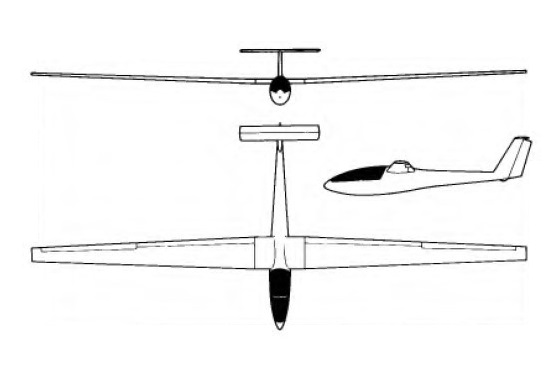
It is a cantilever shoulder-wing monoplane with a T-tail and long-span flaps which are raised slightly for high speed flight, are lowered 8° for soaring in thermals and can be extended to 85° for use as air brakes. Up to 185lb of water ballast can be carried on the center of gravity. The wings and top-hinged plain ailerons are of Chem-Weld bonded aluminium alloy construction, while the semi-monocoque fuselage has the forward portion of moulded glassfibre and the rear part of bonded aluminium alloy construction which incorporates the swept fin. Landing gear consists of a retractable monowheel and the pilot sits in a semi-reclining seat under a two-piece canopy with a removable section and a sliding ventilation panel.
They decided to wait for the recommendations of the CIVV conference on Standard Class requirements before starting construction of the prototype in February1971, and this first flew in June that year, its maiden flight also being a contest flight; the Nugget was certificated in mid-1975.
The ship was available only as a factory-built product and 15 were built. One Nuget belongs to the National Soaring Museum.
Wingspan: 15.0 m / 49 ft 2.5 in. Wing area: 10.13 sq.m / 109 sq.ft Airfoil: Wortmann FX 67170/150 Wing aspect ratio: 22.2 Length: 6.1 m / 21 ft Height: 1.27 m / 4 ft 2 in Gross Weight: 408 kg / 900 lb Empty Weight: 193 kg / 425 lb Wing loading: 40.27 kg/sq.m / 8.26 lb/sq ft Payload: 215kg / 475lb Water Ballast: 84 kg / 185 lb Max airspeed: 135 kts 126 kt / 233 km/h Rough air speed: 126 kt / 233 km/h Stall: 34 kt / 63 km/h Lift to drag: 37 at 93 kph / 50 kts / 58 mph Sink: 0.66 m/s / 2.16 fps / 1.29 kt at 43 kts Seats: 1
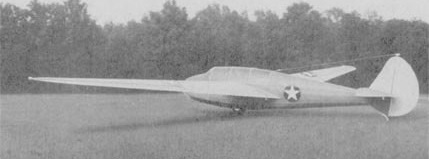
One of the pioneer US sailplane designers, John W. (or Jack) Laister built his first design, a gull-winged acrobatic sailplane in 1938 and later formed, with John R. Kauffman, the Laister-Kauffman Aircraft Corp. This produced, among other types, the TG-4A training glider version of the LK-10 for the USAAF and was one of the 16 firms taking part in the Waco CG-4A Hadrian programme, building 310 out of the nearly 14,000 CG-4As completed. Laister-Kauffman also produced one of the biggest troop-carrying gliders of the war, the 42-seat XCG-10A, which had a span of 105ft and could carry a 155mm howitzer or a 2½ ton truck.
A flying replica Me 163B was constructed between 1994 and 1996 by Joseph Kurtz, a former Luftwaffe pilot who trained to fly Me 163s, but who never flew in combat. In 1944-1945 Josef Kurz was in training for Me 163B service, but the end of the war prevented him from flying the real thing.
Construction was started in 1994 in Germany. The replica is an unpowered glider whose shape matches that of an Me 163, although its construction completely differs – the glider is built of wood with an empty weight of 285 kilograms (628 lb), a fraction of the weight of a wartime aircraft. Maximum weight is around 400 kg.
Kurz used a microfilm set of 2500 drawings, which he printed on A3 size. From this set of drawings Kurz developped his own drawings. These are not really suitable for other builders, since they lacked many notes and details. Especially the fuselage was constructed completely different than the original (wood replaced metal). The external shape is similar however. One example were the fuselage frames. The real one has circular frames, covered with skins, to which fairings are added on the top and bottom and sides (wing root fairings). Kurz built frames incorporating these fairings. The new structure was designed and stressed by people of the Oskar Ursinus group. The wing section was Göttingen 765, just like the original. The trouble-prone skid was replaced by a single wheel, with a white skid painted on. The tail wheel is completely faired in, which is different from the original. The rear-view windows are omitted. The flight control system is an exact copy.
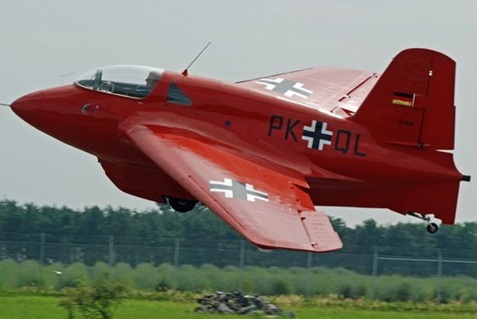
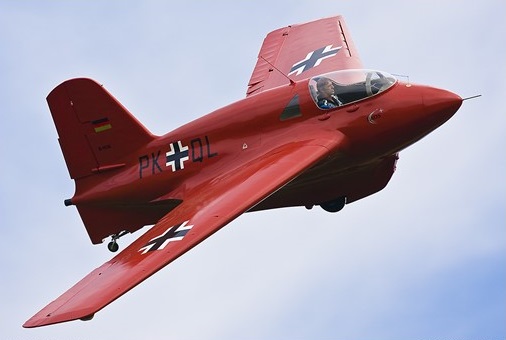
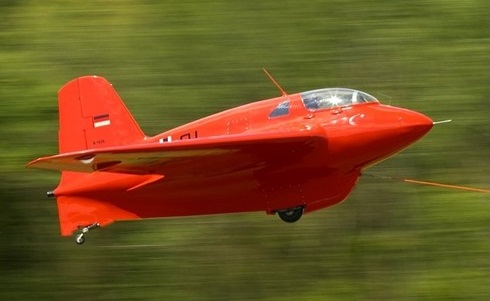
Kurz painted his replica Komet in the markings of the most famous Me 163- the Me 163B flown by Erprobungskommando 16 (EK16- an operational test unit) commander Wolfgang Späte on the Komet’s first operational combat mission in 1944. His crew chief had painted the aircraft red in honor of the Baron von Richtofen (the Red Baron). The paint added 40 pounds to the aircraft weight. Späte did not share his crew’s confidence in the aircraft’s performance and ordered it repainted in standard camouflage. No known photos exist of the red Me-163 but was described in detail in Späte’s memoirs. Kurz used the descriptions to replicate the paint job and markings.
Kurz first flew his Komet replica on 18 June 1996 from the airfield at Ziegenhain with the registration D-ESJK. Designating his glider the Me 163BS, Kurz made numerous short test flights before unveiling it at a vintage aircraft fly-in in September 1997. Its last flight in Kurz’s hands was at the Berlin ILA 2000 air show.
Kurz reported that the flying characteristics are excellent. This was also confirmed by another pilot present who had recently flown the aircraft. Stall is extremely gentle, without any rolling. Controls are very well harmonised. Kurz guessed the L/D was around 25 (compared to 17 of the original). Flaps are not installed.
With only five flight hours logged, Kurz sold the replica to EADS (European Aeronautic Defence and Space Company, which then had just been formed as the parent to Airbus Industrie and Eurocopter) in 2000 in a non-airworthy condition for display in the Flugmuseum Messerschmitt at Manching, Bavaria. The aircraft was registered as D-1634 instead of D-ESJK previously. The Komet replica is located at the EADS museum hangar at Ingolstadt-Manching in South Germany.
The Kurz Komet was exhibited at the Musée de l’air et de l’espace at Paris-Le Bourget in 2001. The museum’s agenda, which reports that the exposition opened on 26 October 2001, and is called ‘Exposition Willy Messerschmitt, Ingénieur et pionnier 1898-1977’. The agenda reports that the Museum organises the display with support of EADS. The display consists of two aircraft “that particularly illustrate the carreer of this great engineer, namely a Me 109G and a Me 163”.
From the flight manual, the performance is not really exciting, and this is more or less confirmed by EADS. There were ideas to strenghten the structure, and re-certify it for at least basic aerobatics. A budget was not yet found at that point. EADS took steps to add the Me-163 to the museum’s heritage flight. Additional modifications were made to strengthen the internal structure. The landing skid was modified to allow for better ground handling. The original paint scheme was restored minus the Nazi Swastika that is banned from display in Germany. The aircraft was re-registered as a one-off glider with the civilian registration of D-1636. EADS performed an extensive overhaul and a lot of modifications from 2004 to 2006. The aircraft became quite a different one. Two visible differences are that the triangular rear view windows and Morane antenna have been added.
It made its second maiden flight on 20 June 2006 after which it joined the EADS Heritage Flight fleet at the Flugmuseum Messerschmitt. It appears the permit was obtained as at the 8 July 2006 EADS family day at Ingolstadt-Manching, it was towed into the air by a Do 27 and then made a free flight. Pilot was reported to be Captain Philipp. It was painted as PK+QL with D-1634 is small lettering on the vertical tail and in large lettering under the wing.
By the end of 2010 the replica Komet had flown forty hours. Two pilots with the EADS Heritage Flight were rated in the glider, using a Dornier Do 27 tow plane to get to altitude. Taking 10 minutes to reach 4,000 feet, the Komet is said to be most demanding on the tow line and is much easier to handle in free flight. As the aircraft was optimized for high speed flight, its gliding performance wasn’t on par of purpose-built sport gliders but has nonetheless been a hit at air shows in Europe.
As of 2011, it was still flying with the civil registration D-1636.
Josef Kurz was selected for the Me 163 Komet, did glider training on the Kranich and Habicht, up to the 6 meter Stummelhabicht, but then the war was over. The Stummelhabicht was very special, because the only thing to do after being released from the towplane was to get it down on the runway. Usually you were on the ground before the tow plane.
Josef Kurz doesn’t speak English, but French and Latin are the other options. Mr Kurz (Josef, or ‘Sepp’) built 14 aircraft since 1982, including the following: Udet Flamingo, Habicht, Klemm 25, Reihe, Siebel 202 Hummel, Riesele (3) and SG 38. He built the Komet basically himself.
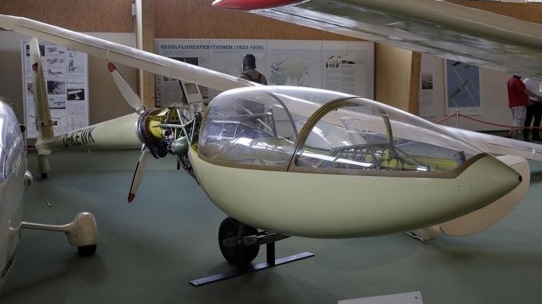
Built by Werner Kuffner (WK) as a one off in 1975, the WK-1 is a two seater motor glider with a BMW R90/S, 600cc 58 HP motor driving a foldable 3 blade prop that spins around the fuselage behind the cabin. The engine runs a toothed belt that spins a metal ring on which folding propeller blades are mounted.
 All Aero