Founded 1905 by Benjamin Wassmer. Up to Second World War was repair and overhaul organization. Started aircraft production at Issoire in 1945, building Jodel D.112 under license, subsequently building over 300 Jodel aircraft. Opened own design department 1955. First production aircraft Jodel-Wassmer D.120 Paris-Nice. In 1959 built WA.40 Super Sancey, followed by Baladou and 1966 WA.52 Europa, one of the first aircraft extensively constructed from glassfibre. WA.54 Atlantic appeared 1973 and WA.80 Piranha in 1975. Formed in 1971 with Siren SA company named CERVA to develop an all-metal four/six-seat light aircraft. Wassmer went into liquidation in 1977, and by that time sales of the WA-50 series totalled 190 aircraft. Wassmer Aviation by 1982 was Issoire Aviation.
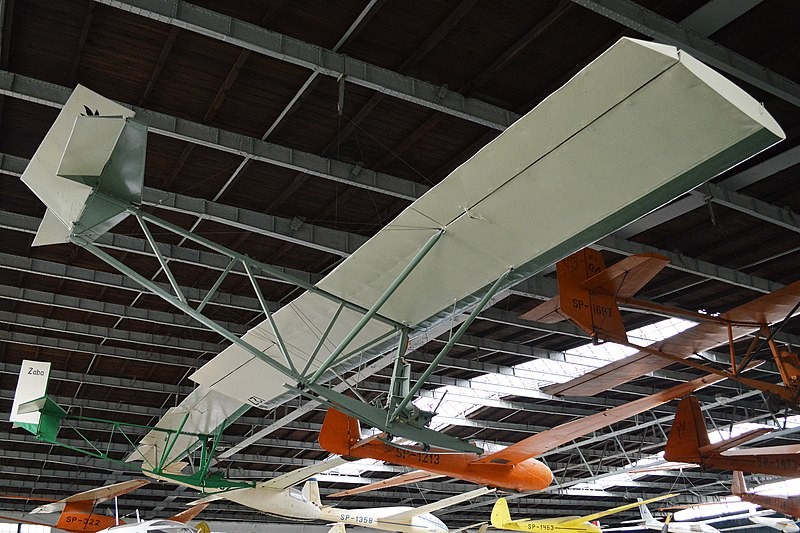
The Warsztaty Szybowcowe Wrona (Glider Workshops Crow), or Kocjan Wrona after its designer, was the most numerous and widely used Polish pre-war primary glider.
Designed by Antoni Kocjan, the Wrona was in competition with the Czerwiński and Jaworski CWJ flown in 1931. Both were simple, high-wing and open frame (flat, uncovered girder fuselage) gliders in the style of the earlier German Zögling. With LOPP funding five pre-production airframes were built by Warsztaty Szybowcowe, the first flying from Mokotów on 6 September 1932.
Its two-part wing, mounted on top of the fuselage, was rectangular in plan and built around two spars. It was plywood-covered ahead of the forward spar, forming a torsion-resistant D-box, with the rest fabric-covered. On each side a pair of parallel struts braced the spars to the lower fuselage. Long, rectangular ailerons reached from strut to tip.
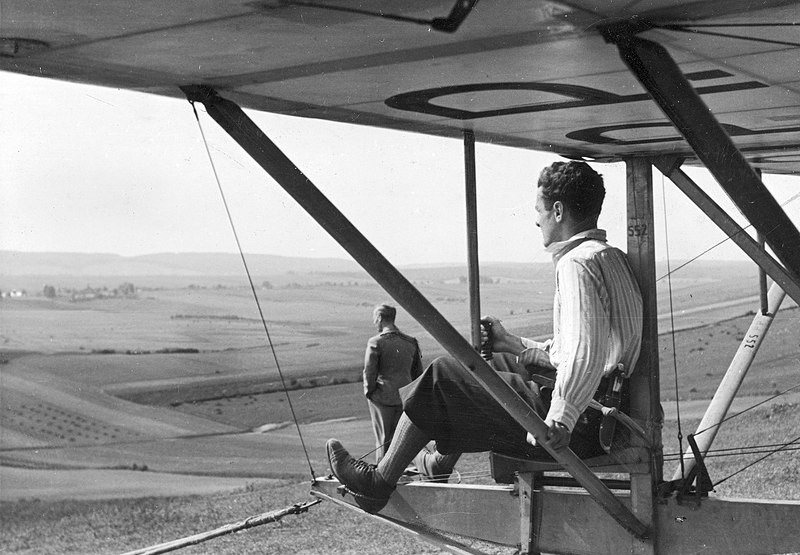
The upper and lower longerons or chords of the open-frame fuselage were joined together with vertical and diagonal braces. The pilot sat, unprotected, under the wing leading edge on a seat on the forward vertical brace. Aft, the Wrona’s triangular fin extended above and between the longerons and carried a tall, nearly rectangular rudder which reached down to the lower longeron. Its narrow, triangular tailplane, mounted on the upper longeron, carried rectangular elevators with a deep cut-out for rudder movement. Fixed tail surfaces were ply-covered and the control surfaces fabric-covered. Wronas landed on a tandem pair of sprung skids on the lower longeron.
The early Wronas had a wing with a span of 8.8 m (28 ft 10 in) and area of 13.2 m2 (142 sq ft) but by 1934 the revised Worna bis had span and area increased by about 5%. Extended exposure to novice pilots revealed a tendency to enter a spin at high angles of attack caused by over-sensitive elevators. Several proposed solutions were tested and in the later 1930s, the problem was successfully resolved when all Wrona bis had their elevator areas reduced, together with a tailplane of increased area set at a negative angle of incidence (-2º).
Wrona production began in 1933 and continued up to the Invasion of Poland in 1939, with about 100 built at Kocjan’s Warsztaty Szybowcowe factory and another 250 built under licence in at least seven other European countries. Construction drawings, materials and parts were sold, with at least 50 aircraft built by clubs and similar organizations.
It is not surprising that a basic trainer set no major records; but in June 1938, a Wrona bis made a 6.5 km (4.0 mi; 3.5 nmi) cross-country flight, a first (and last) record for an open girder glider in Poland. In April 1935 another, accompanied by a Warsztaty Lotnicze Czajka, made the first winch launchings in the country.
Only one or two survived the war. One Wrona bis remained in use until 1950, after which it became a museum exhibit. In December 1963 it was acquired by the Polish Aviation Museum in Krakow, where it remains on display.
Variants:
Wrona Prototypes and 1933 production variant.
Wrona bis Superseded Wrona in 1934 production with a wing of greater span and area. Modified in the late 1930s to overcome over-sensitive elevators and associated spinning tendencies. Wingspan: 9.31 m (30 ft 7 in) Wing area: 13.9 m2 (150 sq ft) Length: 5.6 m (18 ft 4 in) Height: 1.9 m (6 ft 3 in) Empty weight: 75 kg (165 lb) Gross weight: 150 kg (331 lb) Maximum glide ratio: 11 at 50 km/h (31 mph; 27 kn) Rate of sink: 1.2 m/s (240 ft/min) at 48 km/h (30 mph; 26 kn) Minimum speed: 45 km/h (28 mph; 24 kn) Capacity: One
Designed by Antoni Kocjan, the Orlik 2, which first flew in 1938, was a development of the 1937 14.4 m. Orlik 1. A special model (Orlik 3) was developed for the Olympic design competition for the 1940 games (won by the German D.F.S. Meise). It has unusual airbrakes on the wing undersurface, close to the leading edge, from the root to the wing bend.
Orlik 2
One example came to the U.S., and in WWII was imposed into the military as the XTG-7. Later, flown by Paul MacCready, it briefly held the world altitude record in 1948 at over 9,000 m. in the Sierra wave as well as winning the 1948 and 1949 U.S. Nationals. Structure: Wood/ fabric wing and tail, wood fuselage.
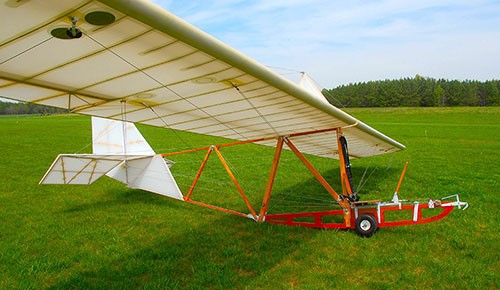
The Waco LAJ was a single place powered glider sold in kit for during 1929-30. First flown with uncovered fuselage and no gear; those were added later, power was a 20hp Jacobs B-1 engine.
An early product of the Waco Aircraft Company, the WACO glider was marketed as a low-cost training aircraft for individuals or glider clubs, intended to be flown from low hills or towed by a vehicle. About 300 were produced between 1930 and 1931.
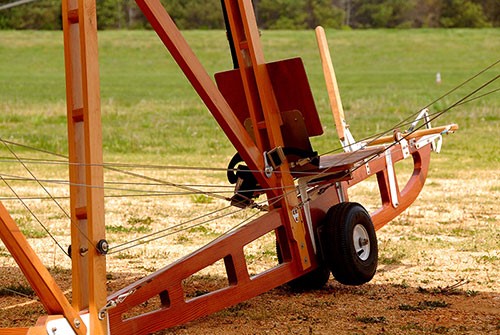
The glider was designed to fly at low airspeeds. It could maintain flight at 20 mph (32 km/h) with a 15 to 1 glide ratio. The fuselage is made of welded steel tubing. The wings use spruce spars, are wire supported and fabric covered. A releasable tow hook was mounted on the front.
The glider sold for $385 assembled, or $295 un-covered in 1930.
Replicas have been made using both steel tube, and wood frames.
Replica: Sands 1929 Primary Glider
Wingspan: 36 ft (11 m) Wing area: 157 sq ft (14.6 m2) Length: 21 ft (6.4 m) Height: 10 ft (3.0 m) Empty weight: 175 lb (79 kg) Maximum speed: 56 kn; 105 km/h (65 mph) Stall speed: 17 kn; 32 km/h (20 mph) Capacity: 1
The Waco CG-15 (Waco designation NEU) was another development of the Waco CG-4 Hadrian standard glider. Waco had essentially developed an improved version of the CG-4A. The changes consisted of a reduction in the wing span from 83 ft 8 in to 62 ft 2 in, elimination of the wing spoilers, a revised nose shape, improved cantilever undercarriage and numerous internal fitment changes. The changes increased the normal gross weight by 500 lbs (227 kg) and the towing speed increased to 180 mph (290 km/h). 427 CG-15 gliders were originally delivered to the US military. Canada acquired a single example for evaluation purposes.
Waco CG-15 Span: 62 ft 2 in (25.50 m) Length: 48 ft 4 in (14.73 m) Height: 12 ft 7 in (3.84 m) Wing Area: sq ft Max Speed: 180 mph (290 km/h) Service Ceiling: 10,000 ft (3,345 m) Armament: None Crew/Passengers: two pilots and up to 13 troops or a variety of stores
During 1942 the U.S. Navy let contracts for the development of several amphibious transport gliders. At the same lime as the requirement for a twelve seat glider was issued, the US Navy ordered a small number of Waco CG 4A (Hadrian) gliders under the designation LRW 1. At least thirteen Waco LRW-1s were delivered (BuAer Nos. 37639 481 44319, and 69990 1), and the Naval Aircraft Factory modified two further CG 4As under the designation XLRN 1 (BuAer Nos. 36431 2).
Because military planners did not want to divert scarce strategic resources and aircraft workers from powered aircraft production to build gliders, the CG-4A was built by hundreds of subcontractors with experience in woodworking, including employees of furniture companies. The only large production facility was Ford Motor Company’s wooden station wagon plant. The CG-4A was a front-loading glider de¬signed to carry a pilot, co-pilot and 13 fully equipped glider infantrymen or an equivalent load of equipment or munitions.
On the Sunday afternoon of August 1, 1943, St. Louis aircraft manufacturer William B. Robertson was hosting the first public demonstration of a new Waco CG-4 glider, built under sub-contract by his company. As a crowd of spectators watched at the Lambert St. Louis Airport, Mayor William Becker, Robertson, and other St. Louis luminaries boarded the glider that was towed along by a transport plane for a flight over the city. Immediately after the release of the towing cable, the right wing of the glider broke off, and it plummeted from an altitude of 1,500 feet, killing all ten persons on board.
August 1, 1943 demonstration for a new aircraft. As soon as it took off, its right wing broke, and all ten passengers were killed. This is the group pictured before takeoff.
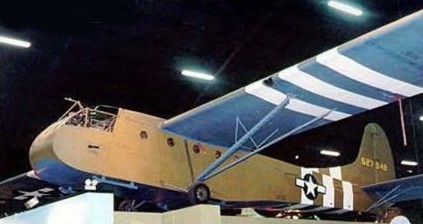
Including the two pilots in the hinged nose, it could carry 15 fully armed troops or a jeep with its crew, or an Army 75 mm howitzer with crew and ammunition. It could carry a total military load of around 3,500 lb and could land in a field 660 feet by 200 feet surrounded by 50 feet obstacles at a loaded stalling speed of 50-60 mph. The fuselage of the Hadrian was 6 feet 5 inches wide and made of a steel tubular framework covered with fabric on wooden formers with a wooden floor. The wingspan was 83 feet 8 inches and the wings and tail unit were made of wood with a plywood and fabric covering. The training undercarriage consisted of independent wheels, with shock absorbers and hydraulic brakes. The operational undercarriage could be jettisoned by parachute and was a simple cross axle with brake-less wheels. The glider then landed on skids.
Operation Husky, the Allied invasion of Sicily beginning 10 July 1943, involved 400 Dakota C-47 transport aircraft and 170 Waco CG-4A cargo gliders. The operation verged on failure. Ninety-seven of the British and US gliders released from their towropes too early plunged into the sea, and another 24 were reported missing: only 12 of the gliders, all British, landed in the target zone. Then strong anti-aircraft fire confused the paratroops in the Dakotas, so they jumped too soon and were scattered over almost 60 miles. Six of the Dakotas were shot down, and only 73 British paratroops reached their target, the Ponte Grande bridge.
In mid-June 1943, for the first time, a Dakota FD900 of the RAF Transport Command landed in Prestwick, Scotland, the end of the North Atlantic route, towing a glider. The two planes had taken off together twenty-four hours earlier from Dorval (Montreal). The glider – a Waco CG-4A Hadrian – had been built in a New York piano factory. It carried a full load of urgently needed vaccine and radio and engine parts for the Soviet Union. The pilots, Sqn.Ldr. Seys and Sqn.Ldr. Gobeil: ‘We could not take our eyes off the Dakota and the tow rope, which was especially difficult in clouds or at night. We had to stay the whole time in the same position in relation to the towplane, which kept disappearing from our field of vision. Thank God we had radio contact with our Dakota. Unfortunately, there was no heating in the glider, so our teeth chattered with cold during the night or during prolonged flight through cloud, whereas sunshine changed our cockpit into a hothouse’.
Several hundred CG-4A gliders were built in 1945 with a paper composition floor rather than the reinforced plywood box floor. The glider could carry 13 infantrymen or a Jeep. Because of the floor, a trailer or howitzer could not be carried. The floor was reinforced at the Jeep wheel locations but not reinforced where the trailer or howitzer wheels would normally be positioned.
WACO CG-4A
It was named Hadrian when in service with the British forces, and was the only American built troop-carrying glider to be used by the allied forces in the airborne invasions of Sicily and France.
Ford produced the CG-4A. Approximately 14,000 were built.
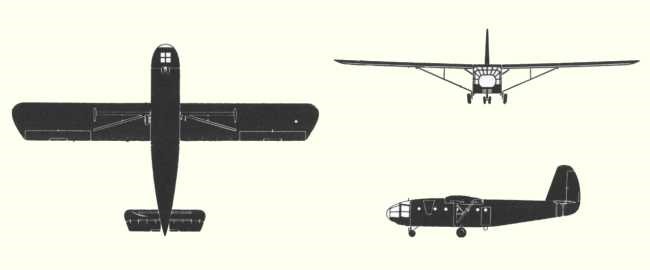
The Waco CG-13 was an American military transport glider aircraft developed during World War II. Wright Field Glider Branch realized a need for a glider larger than the CG-4A and requested designs. The response by several companies produced designs for five larger gliders. One of these designs was the XCG-13 by Waco Aircraft Company of Troy, Ohio.
The XCG-13 (Waco designation NLB) contract was for a 30-place design with an 8,000 lb (3,600 kg) useful load capacity to fly 174 mph (280 km/h) at an altitude of 12,000 feet (3,700 m) altitude. Flight testing of the prototype was performed at Clinton County Army Air Field and the type was approved on 10 March 1943. Testing found that a tricycle landing gear should be used, and that a hydraulic system be incorporated to open the top-hinged nose opening. These features were incorporated into the second XCG-13.
XCG-13
Ford Motor Company at Kingsford, Michigan and Northwestern Aeronautical at St. Paul, Minnesota built YCG-13 models and were given contracts to build the production CG-13A. WACO was not given a production contract. Northwestern Aeronautical built 49 production articles. Ford built 48 as 30 place and 37 as 42 place by adding a bench down the center of the cargo section. Between the two companies, 268 contracted articles were canceled in favor of producing more CG-4A gliders after 135 CG-13 were built.
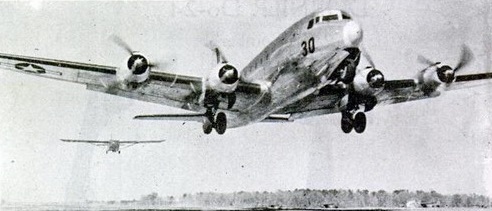
The CG-13A glider maximum useful load was 10,200 lb (4,600 kg). The 79 mph (127 km/h) stall speed was 19 mph higher than specified. One CG-13A was flown in combat in the Appari Mission in the Philippines. The CG-13A gliders were not flown in combat in Europe but were used as transports in England and France.
Waco CG-13 towed by a Douglas C-54A
CG-13A Wingspan: 85 ft 8 in (26.11 m) Length: 54 ft 4 in (16.56 m) Height: 20 ft 3 in (6.17 m) Wing area: 873 ft² (81.10 m²) Empty weight: 8,700 lb (3,946 kg) Loaded weight: 18,900 (8,572 kg) Useful load: 10,200 lb (4,626 kg) Maximum speed: 165 knots (190 mph, 306 km/h) (maximum towing speed) Stall speed: 79 mph (127 km/h) Wing loading: 21.65 lb/ft² (105.7 kg/m²) Crew: 2 pilots Capacity: 30 or 42 troops (including flight crew)
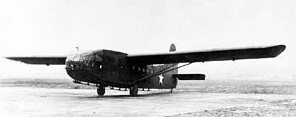
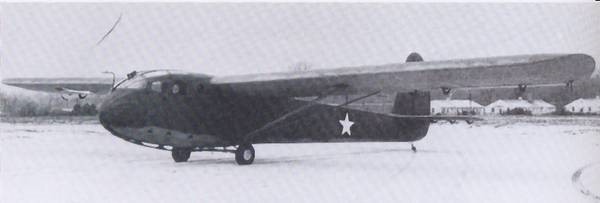
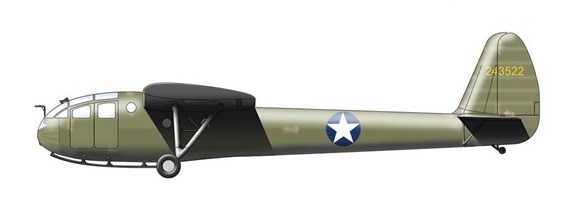
The CG-3A was the United States Army Air Force’s first production troop-carrying glider. First flown in early February 1942, 300 CG-3A 9-place gliders were initially ordered, but 200 of these were cancelled. A few of the 100 built by Commonwealth Aircraft (formerly Rearwin Aircraft) were used as trainers for the improved CG-4A, but most remained in their shipping crates in storage.
The production CG-3A was developed from the experimental XCG-3 which was the only one built by Waco and given Army Air Forces Serial No. 41-29617. Unit cost: approx $24,000.
The CG-3A became obsolete with the development of the much improved Waco designed CG-4A 15-place glider with its alternate load of military equipment. The CG-3A did not see any combat and several were used in limited training roles.
Variants XCG-3 Prototype 8-seat glider. One built 1942.
CG-3A Production 9-seat glider. 100 built by Commonwealth Aircraft.
Specifications: CG-3A Wingspan: 73 ft 1 in (22.28 m) Length: 43 ft 4 in (13.21 m) Empty weight: 2,044 lb (927 kg) Max takeoff weight: 4,400 lb (1,996 kg) Maximum speed: 120 mph (193 km/h; 104 kn) (under tow) Normal tow speed: 100 mph (87 kn; 161 km/h) Minimum control speed: 38 mph (33 kn; 61 km/h) Crew: 2 Capacity: 7 troops









 All Aero