Manuel Condor

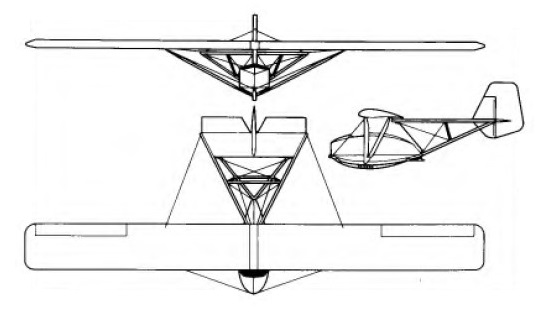
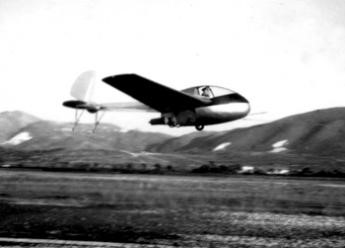
One of the pioneer British sailplane designers before the war, Mr W. L Manuel became concerned at the number of fatal accidents in hang gliding, and in the Condor has designed a simple two-seater sailplane intended especially for hill soaring and aimed at meeting the needs of those who would like to fly but who could not afford the price of a modern high performance sailplane, and who do not have the skills or the time to construct one of the homebuilt designs now on offer.

Resembling the primary trainers of the early 1930s in appearance, the Condor has a short boat-shaped fuselage nacelle of metal tube construction with comfortable side-by-side seating for two in an open cockpit; at the rear of the nacelle is a pylon on which the high constant chord wings are mounted, these being braced by V-struts on each side to a keel running under the cockpit. The tail unit is carried on an open girder-type rear fuselage of aluminium tubing, the tail surfaces being of generous area with fabric covered ribs and widechord elevators. The landing gear consists of a bow shaped ash skid under the fuselage nacelle, with rubber rollers as shock absorbers.

The prototype Condor made its first flight in August 1976 and in addition to local soaring has made a number of longer distance flights.

Span: 50 ft 2.5 in / 15.3 m
Length: 21 ft 0 in / 6.4 m
Wing area: 250.0 sq ft / 23.23 sq.m
Aspect ratio: 10.0
Wing section: Gottingen 462
Empty weight: 492 lb / 223 kg
Max weight: 899 lb / 408 kg
Water ballast: None
Max wing loading 17.57 kg/sq.m / 3.6 lb/sq ft
Max speed: 86.5 mph / 75 kt / 139 km/h
Stalling speed: 32 kt / 59 km/h
Best glide ratio: 14:1

Manuel Hawk

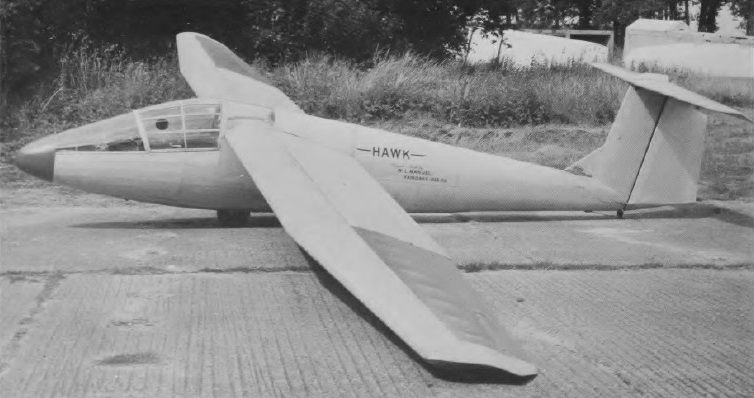
Mr W. L. Manuel, who designed the Willow Wren and other gliders during the 1930s, continued working during retirement by designing (1968) and building (1969 at Fairoaks aerodrome, Surrey) the Hawk single-seater, intended for soaring in weak thermals.

The Hawk has a wing of rather low aspect ratio (11.88) and a fuselage that, although well steamlined, is not as slim as some contemporary types. The cantilever shoulder wing is a three-piece wooden structure with a centre section and two outer panels; the single spar is of spruce with a plywood leading edge torsion box and fabric covering aft of the spar, and there are air brakes in the wing upper surfaces. The semi-monocoque fuselage is of spruce covered by plywood, with a non-retractable monowheel for landing. The T-tail is of wooden construction, with a trim tab in the starboard elevator and a small dorsal fin. Instead of the conventional one-piece cockpit canopy, a three-piece one is fitted in which the front and rear sections are fixed one-piece single-curvature transparencies and the hinged middle section is a framed double curve segment.

The undercarriage is a fixed centre main wheel plus a tail skid.

The prototype BGA.1778 c/n 1 was built at Fairoaks in Surrey during 1968-70 and made its first flight at the College of Aeronautics airfield at Cranfield on 25 November 1972. Initial flight tests revealed the need for some modifications, including revised aileron controls, removing the air brakes from the wing under surfaces and increasing the rudder area; further flight testing followed these changes.

Span: 42 ft 0 in / 12.8 m
Length: 20 ft 6 in / 6.25 m
Wing area: 149 sq.ft / 13.84 sq.m
Aspect ratio: 11.88
Wing section: Wortmann FX-61 -184/210
Empty weight: 406 lb / 184 kg
Max weight: 639 lb / 290 kg
Water ballast: None
Max wing loading: 20.95 kg/sq.m / 4.29 lb/sq ft
Max speed: 90 mph / 78.5 kt / 146 km/h
Stalling speed: 31 kt / 57.5 km/h
Max rough air speed: 64 kt / 118.5 km/h
Min sinking speed: 2.53 ft/sec / 0.77 m/sec at 38 mph / 33 kt / 61 km/h
Best glide ratio: 25:1 at 41.7 mph / 36 kt / 66.5 km/h

Manuel, W. L.

W.L.Manuel designed and built the first four types of gliders while he was serving in the RAF. He was the Channel Gliding Club instructor in 1932. In 1933 he established a small workshop at the London Gliding Club, Dunstable (which was known as the Wren Works) and built the second Willow Wren there. At that time he advertised for sale complete Wrens at £90 and Primary gliders at £45 each. In January 1935 he joined the Dunstable Sailplane Co and built a developed version of the Willow Wren which was named the Dunstable Kestrel.
In January 1968, W.L.Manuel retired from the position of Chief Planning Engineer with A.C. Cars Ltd, and, having already designed the Hawk, built this at Fairoaks aerodrome, Surrey.

Mantelli-Fossa MF.1

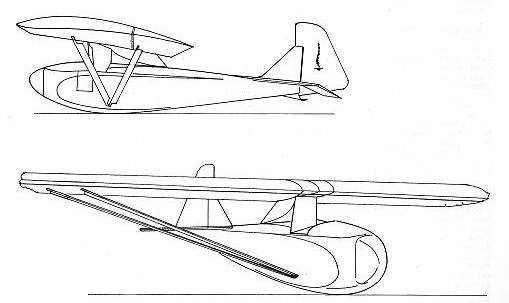
The Mantelli-Fossa MF-1 was designed by Adriano Mantelli, an experienced aircraft modeller. To fund its construction, Mantelli, his cousin Dino Sirocchi and some other aircraft modellers founded a company named SDAM after their senior partners’ initials. The MF-1 was built by Ennio Fossa in his family workshop. It was a high-wing monoplane, its wing supported centrally on a fuselage pedestal and braced on each side with a faired V strut from beyond mid-span to the lower fuselage. It was mounted without dihedral and was rectangular in plan apart from cropped aileron tips.

The fuselage, rectangular in cross-section though with a rounded decking, was entirely fabric-covered. There was an open cockpit immediately ahead of the pedestal. Aft of the wing the fuselage tapered to the tail, where a triangular tailplane with rectangular elevators was placed on top of it. The fin was small and triangular and carried a straight-edged balanced rudder which extended down to the keel, operating in an elevator cut-out. The MF-1 landed on a conventional wooden skid fitted with rubber shock absorbers, assisted by a very small tail skid.

Mantelli flew the MF-1 for the first time on 14 August 1934. Later that year he competed in it at Cantù in the Littoriali Contests.

Only one was constructed.

Wingspan: 11 m (36 ft 1 in)
Wing area: 16.50 m2 (177.6 sq ft)
Aspect ratio: 7.3
Length: 5.70 m (18 ft 8 in)
Empty weight: 95 kg (209 lb)
Gross weight: 170 kg (375 lb)
Maximum glide ratio: estimated 16:1
Wing loading: 10.30 kg/m2 (2.11 lb/sq ft)
Capacity: One

Mantelli AM 12 Palas

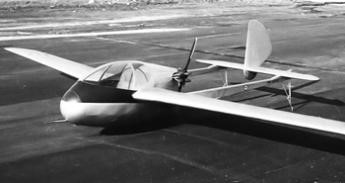
Although its origins are reminiscent of the Alaparma AM-10, the AM-12 was a glider. It was powered by a 38 hp CANC and finally with a 4-cylinder Praga 75 D HP. Three, with a long wing were built Guidonia (near Rome) by the Italian military center of gliding.

The fourth built with a shorter wing, was first flown as a glider before being changed to receive a Turbomeca Palas turbojet of 160 kgf. This engine had been recovered from the prototype of the jet Caproni F-5.

It is with this engine Mantelli, on February 17, 1962, beat the world record for altitude for jets of less than 500 kg, with 6700 m, and earn the 1962 Bleriot prize.

Later the aircraft was re-engined with a Walter Praga – D 75 piston engine. It is in this that Adriano Mantelli took the world record altitude for aircraft less than 500 kg, with 8763 m on April 16, 1964

Wingspan: 12 m
Length: 5.5 m
Height: 1.4 m
Wing area: 34.48 m²
Empty weight: 210 kg
Maximum weight: 500 kg
Maximum speed: 220 km / h
Minimum speed: 50 km / h

Mantelli, Adriano

Born 13 February 1913, in 1929 Mantelli competed in flying competitions with aircraft that were self-designed and built. In 1931 he started designing gliders.

In the summer of 1936, Adriano Mantelli was the leading Italian fighter pilot in the Spanish Civil War serving in the Regia Aeronautica. Mantelli shot down a Dewoitine piloted by British pilot Edward Hillman. Flying under the alias “Arrighi”, he would later share the title for highest scoring Ace with Mario Bonzano at fifteen victories.

In 1945 Mantelli designed the AM-6 twin boomed pusher aircraft derived from previous glider designs. Mantelli co-founded the company Alaparma with Livio Agostini to produce the AM-6, and later the AM-8 and AM-10 aircraft.

In 1951 Mantelli designed and built two gliders, the AM-10 and AM-12 “Albatross”, in Buenos Aires, Argentina In 1954, Mantelli set an Italian record for altitude in a glider in a two-seat CVV-6 Canguro glider.

Mantelli received the FAI Louis Blériot Medal in 1962, and 1964. Mantelli reached the rank of General.

He died on 6 May 1995 while waiting for a train at Firenze Santa Maria Novella railway station.

Maillot Kite

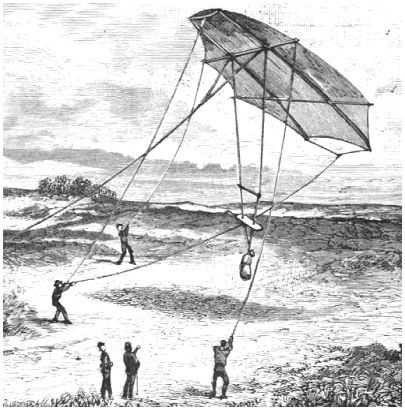
Marcel Maillot (1886-1887) of France got the attention of spectators and newspapers alike with the flight of his very large kite that was designed to lift payloads as a test for lifting a person. Accompanied by a ground crew of four manipulating the kite lines, Maillot succeeded in having the kite lift a bag of earth weighing 150 lbs (68 kilograms) in 1886. The Maillot kite sail area was 85 square yards. The frame alone weighed 150 pounds and the canvas sail and cords weighed 99 pounds according to the article.

Mahrer HB-1340 Delphin

This single-seater sailplane is an experimental variable-geometry version of the Swiss Neukom S-4A Elfe 15, and was first flown by Herr Fritz Mahrer on 6 May 1977.

It is basically a modified Neukom S-4A with new 15m span wings; these have Eppler wing sections similar to those on the Neukom AN-66C Super-EIfe, and are fitted with area-increasing Fowler-type flaps actuated electrically. When extended these flaps increase the wing area from 107.6sq ft to 121.6sq ft, and the aspect ratio of 22.5 with flaps in becomes 19.9 when they are extended.

The Delphin also has a T-tail unit similar to that of the Schempp-Hirth Cirrus replacing the Neukom S-4A’s low-set tailplane, thus avoiding tailplane buffeting when the flaps are extended. Construction of the Delphin is mainly of plastics materials.

Span: 49 ft 2.5 in
Wing area: 107.6 sq.ft (flaps in) / 121.6sq ft (flaps out)
Aspect ratio: 22.5 (flaps in) / 19.9 (flaps out)
Empty weight: 617 lb

Magnan M-2 Marin

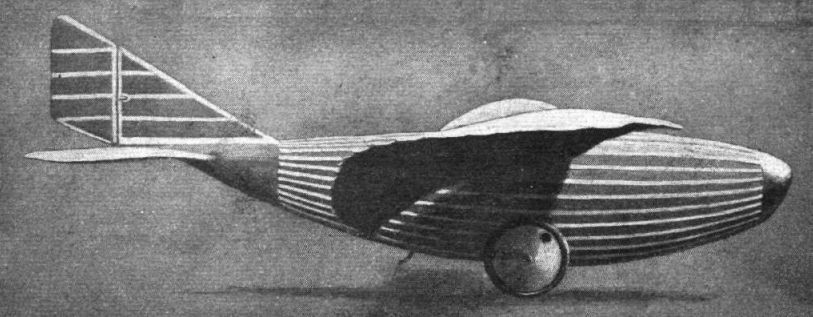
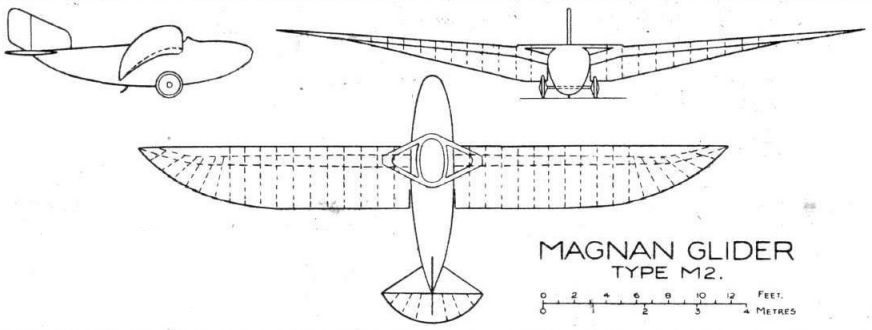
Apart from the studies made in Germany, several French experimenters have attacked the problem of “gust-soaring,” among them being Dr. Magnan, who has made a close study of bird flight, and who reached a stage when he could justify the building of a machine for the purpose of carrying out actual flying experiments. This machine is of unorthodox design, both aerodynamically and structurally.

Basing his design to some extent upon birds, in 1921 Dr. Magnan produced a cantilever monoplane, the wing of which is of uniform chord over approximately one-half of its span, but tapering to a point at the tips. The leading edge is straight and the taper is provided solely by the trailing edge. Near the root the wing is swept down suddenly and sharply to form a pronounced dihedral angle. This angle extends over but a few feet of the span, and the rest of the wing is at a smaller dihedral. The wing tapers in thickness as well as in chord, and the angle of incidence is progressively altered, being around 20 degrees at the root. In addition to the change in section and angle, the wing ribs are so constructed that they are capable of being flexed to an extent under varying loads. No ailerons are fitted. Lateral control is by wing warping.

The fuselage is short in proportion to the span, and a large portion of it projects ahead of the wing. This results in the tail being very close to the wing, only about one chord-length separating the trailing edge from the forward end of the fixed tail plane. A large rudder is fitted. The “fin area” of the forward portion of the fuselage is very considerable, of rounded section.

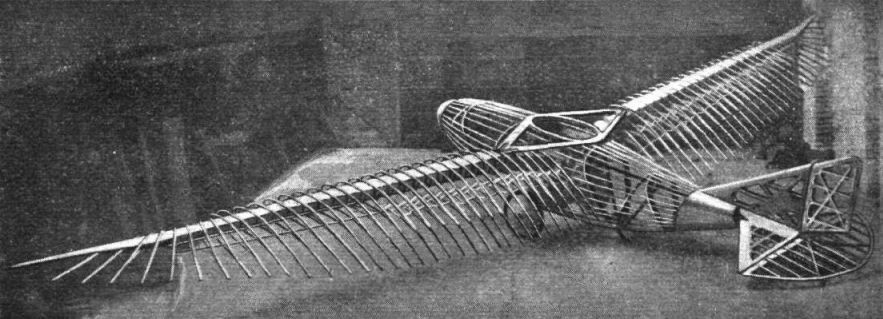
The monoplane wing has but a single spar, of box section and built of wood. There are two fairly sharp bends in each spar, one a few feet out from the body, where the horizontal cabane meets the spar, and another a few feet from the tip, where the spar tip is swept forward to meet the straight leading edge. The ribs have top and bottom flanges of ash, the lower flange, which runs from leading to trailing edge, being screwed and glued to the lower face of the spar. The top flange stops short of the trailing edge, about one-third of the chord from it, and is so attached to the lower flange and to the spar that it can slide a short distance in a fore-and-aft direction, thus allowing the trailing edge to flex.

Near the wing tips the ribs slope outwards, and also they are so mounted on the spar as to give a pronounced “wash-out” to the wing. Lateral control is by warping, but instead of the warp causing a change of angle without sensible change in camber, in the Magnan monoplane both angle of incidence and camber are altered. The fabric covering is applied in a way which was claimed to prevent wrinkling when the wing is being warped.

The fuselage is of egg-shape section, and is built up of formers alternating sloping back and forward, thus forming a series of Vees as seen in side view. To these formers are attached four main longerons and a great number of stringers, and wire bracing is employed for stiffening the structure against torsion. The fuselage is fabric covered except at the extreme nose and stern. The tail is of more or less orthodox design, but is supported on a duralumin cone bolted to the rear bulkhead of the fuselage proper.

A simple undercarriage consisting of two wheels carried on a duralumin axle is fitted, the axle being sprung by rubber cords anchored inside the lower portion of the fuselage.

The pilot’s seat is mounted on longitudinal rails, somewhat like the sliding seat in a boat, and for fore-and-aft control he can alter the position of the centre of gravity by sliding the seat along. The ordinary controls are of the usual type.

The machine was to be launched from a cliff on the coast, and glide into the wind until fairly low over the sea. During a gust the pilot would pull back the stick, and if necessary shift his seat back so as to bring the tail down quickly. As a gust dies down he would push the stick forward and slide his seat forward at the same time so as to avoid stalling the machine. During a lull it was to be the pilot’s endeavor to glide forward with the minimum loss of height, i.e., at the best gliding angle for the particular conditions. Dr. Magnan considered that another method would be to glide down-wind during the lulls and up-wind during the gusts, but that it was doubtful if the machine could be manoeuvred quickly enough to make this form of gust-soaring feasible.

Some preliminary tests over land were made with the machine, piloted by Canivet, and these were stated to have indicated that the machine should, under suitable conditions, be capable of taking advantage of a gusty wind.

As alighting on the sea was to be one of the normal functions of the machine, the fuselage and wings have been made watertight, the opening for the wheel axle being bulkheaded off from the rest of the fuselage.

Type Marin M.2
Length o.a., 4-95 m. (16 ft. 3 ins.)
Wingspan, 11-5 m. (37 ft. 9 ins.)
Chord (root), 1-3 m. (4 ft. 3 ins.)
Wing area, 10 -25 sq. m. (110 sq. ft.)
Weight of wing, 60 kgs. (132 lbs.)
Weight of machine (empty) 130 kgs. (286 lbs.)
Weight in flying trim, 200 kgs. (440 lbs.)
Wing loading, 19 kgs./sq. m. (4 lb./sq. ft.).