Messerschmitt Me 321

Junkers and Messerschmitt competed in 1940 to design and develop a very large transport glider suitable for the delivery of men or materials. Junkers’ Ju 322 Mammut (Mammoth) spanned 62.0m and would have accommodated more than 100 fully equipped troops, but when tested proved to be unstable and was cancelled by the Reichsluftfahrtministeriurn.

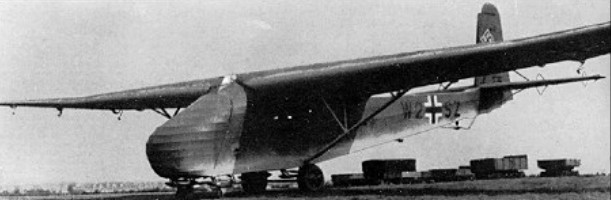
Messerschmitt’s Me 321 was a most successful design of braced high-wing configuration and with construction of welded steel tube, wood and fabric. The pilot was high on the fuselage in a single-seat cockpit, adjacent to the wing’s leading edge. Access to the main cabin was via large clamshell doors in the nose or by doors on each side of the rear fuselage.

The Me 321 VI prototype flew first in March 1941 and Me 321A-1 production aircraft entered service in May of that year. The later Me 321B-1 had a crew of three and defensive armament of four 7.9mm MG 15 machine-guns. Me 321 (175 built) were towed usually by a trio of Bf 110C or by the five-engined Heinkel He 111Z. Rocket units could be used to assist take-off from rough fields.

The Messerschmitt Me 321 spanned 54.68 m (180 ft), and was intended to ferry into combat 22.5 tonnes (22 tons) of equipment or a company of soldiers complete with 88 mm flak gun or tracked vehicle.

Messerschmitt Flugzeugbau GmbH / Bayerische Flugzeugwerke (BFW)

Founded by Willi Messerschmitt at Bamberg in 1923 as Messerschmitt Flugzeugbau and became GmbH April 28,1926.

Willie Messerschmitt Article

It was in Augsburg that on 30 July 1926, the Bayerische Flugzeugwerke (BFW) was incorporated and established itself in the former Rumperwerke factory.

S-16 powered glider flown 1924; M-18 three-passenger, single-engined airliners built for Nordbayerische Verkehrsflug AG and others 1925. Developed into M-20 and M-20b built for Lufthansa 1928. Highly successful M-23 two-seat sporting monoplane introduced 1929.

A number of crashes led Lufthansa to refuse to accept any more M20s, which resulted in the Messerschmitt company, Bayerische Flugzeugwerke (BFW) going bankrupt on 1 June 1931. An agreement was reached with all creditors in December 1932 and on 1 May 1933 the BFW AG was able to start a new career. Renamed Messerschmitt AG 11 July 1938.

Messerschmitt airplanes are variously coded with the letters Bf and Me; they refer to Bayerische Flugzeugwerke and Messerschmitt AG, respectively firm names under which he did business. The Bf designation was dropped in 1938, but designs executed before that time properly carry the prefix Bf.

After being renamed in 1938 continued production of BFW’s Bf 108 and of Bf 109 fighter, Bf 110 twin-engined long-range fighter. Rocket-powered Me 163 fighter first flown August 1941, and first of Me 262 twin-jet fighters on 18 July 1942. Bf 110 developed into Me 210 fighter-bomber first flown September 2,1939, built up to 1944, and reengined Me 410, which made maiden flight in late 1942. Me 321 Gigant troop carrier/cargo glider (54.68m wingspan) introduced 1941; 175 built together with 201 of Me 323 powered version with six Gnome- Rhone radial engines.

Reconstituted postwar company formed Flugzeug-Union Sud with Heinkel in August 1956, building Fouga Magister under license and later taking part in programs for Fiat G.91, Lockheed F-104G, Transall C.160 and Bell UH-1D.

Amalgamated with Bolkow as Messerschmitt Bolkow GmbH 1968 and then with Hamburger Flugzeugbau to form Messerschmitt-Bolkow-Blohm 14 May 1969.

Merville

France
Propeller manufacturer established in 1919, began aircraft production 1959 with SM.30 single-seat sailplane; improved SM.31 prototype flown January 11,1960. Also developed D.63 two-seat light aircraft based on Druine Condor, first flown March 23,1962, with tricycle landing gear and Potez 4 E-20 engine.

Merriam 1922 Glider

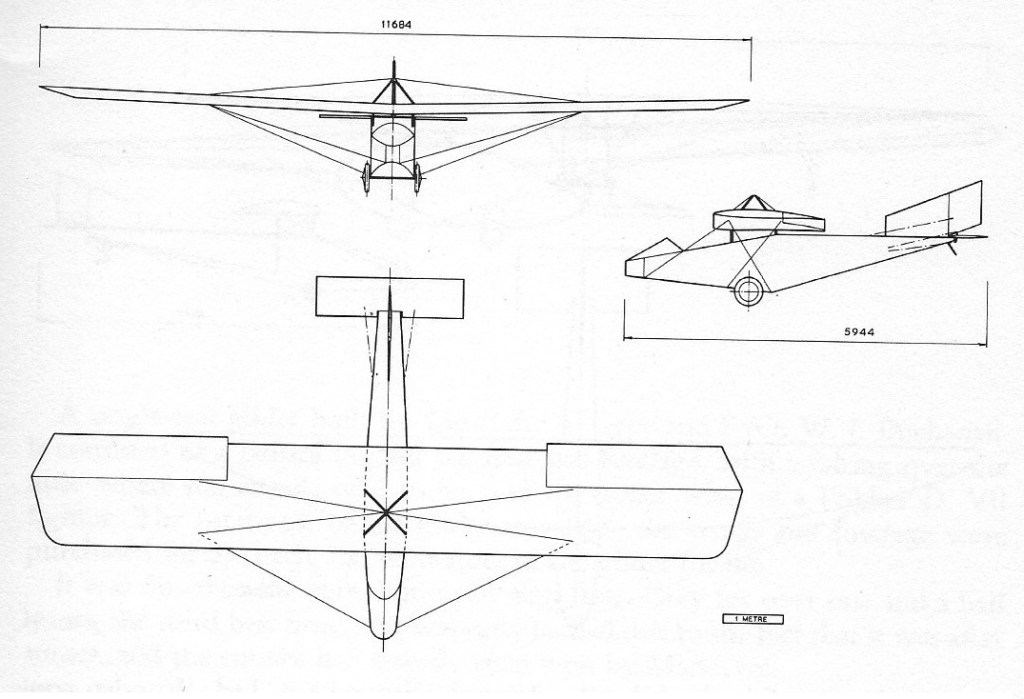
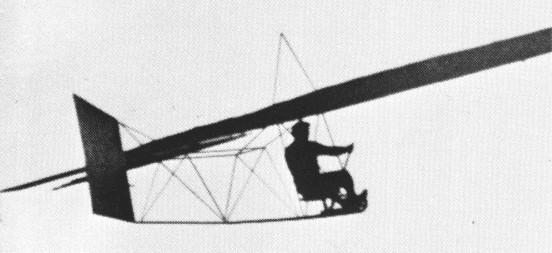
A single-seat glider designed and built by Capt. F.W. Merriam at Whiteley Bank in the Isle of Wight.

Of wooden construction with wire braced wings, the undercarriage has fixed centre twin main wheels, plus tail skid. No airbrakes or flaps ae fitted.

Only one was built, for the 1922 Itford competition as No.18. After the contest it was used at the Whiteley Bank School of gliding on the Isle of Wight, and was converted to a two-seater, with dual controls. It was still in existence at the newly formed Isle of Wight Gliding Club in 1930.

Wingspan: 11.68 m / 38 ft 4 in
Length: 5.94 m / 19 ft 6 in
Wing area: 20.90 sq.m / 225 sq.ft
Aspect ratio: 6.54
Wing section: RAF 15
Empty weight: 90.72 kg / 200 lb
AUW: 163.3 kg / 360 lb
Wing loading: 7.81 kg/sq.m / 1.6 lb/sq.ft
Seats: 1-2