During WW II, Don Mitchell became responsible for the construction of the wings of the CG-4A. In 1943 he had responsibility for the building of the XCG-16 prototype. At the same time he was working on his own flying wing, model 278.
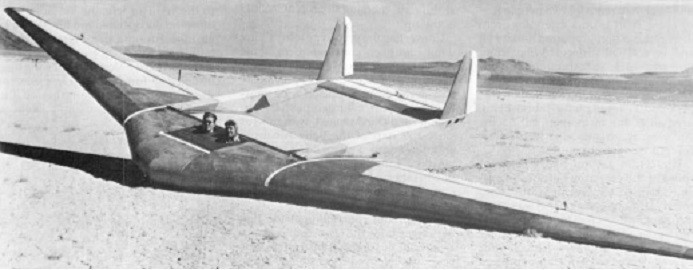
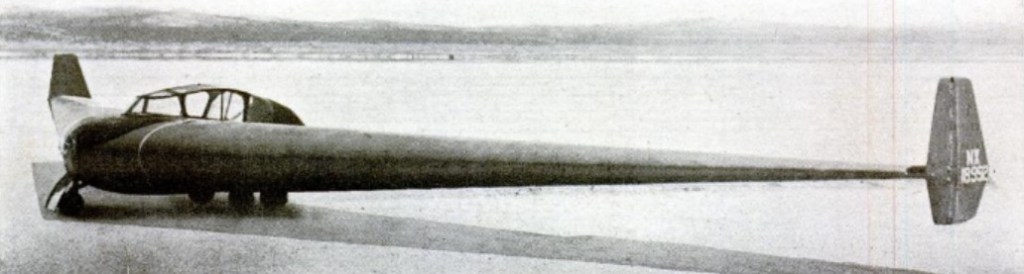
One of Don Mitchells projects was the conversion of a 1/2 scale XCG-16 which he converted into a flying wing using external stabilators for control and stability. He, along with Hawley Bowlus and Paul Tuntland, flew the wing many times at the various dry lakes. They towed with both auto and airplane with no major problems.
Later it had an engine attached.
Side-by-side two seater. Wingspan: 50 ft Glide ratio: 38-1
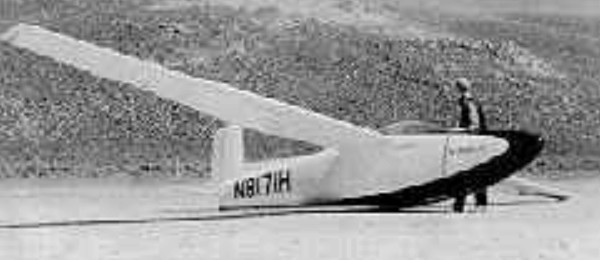
The Nimbus III was developed in 1956 by Don Mitchell from the earlier I and II models. Mitchell produced nine kits, of which four were completed. The prototype Nimbus III has a Gottingen airfoil and considerably less performance.
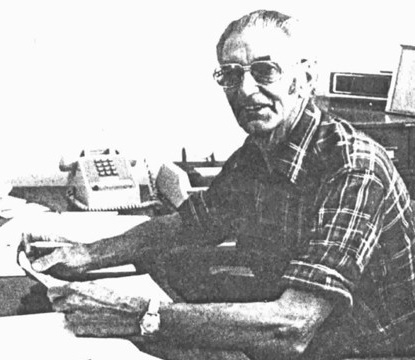
The Mitchell family of aircraft began in 1915, in Scotland, with the birth of Donald S. “Don” Mitchell. Hoping to create a better life for themselves, the family immigrated to the United States when the boy was only seven years old. He was still in school when he became fascinated with gliding. Indeed, Mitchell was a student at Alameda High School in Alameda when he built his first glider, under the tutelage of a pilot who had seen action during the First World War.
Intent on pursuing a career in aviation, Mitchell enlisted at the Boeing School of Aeronautics in Oakland.
In the 1930s, Mitchell worked for United Air Lines at Oakland and Fresno as a radio operator and station attendant. By now, however, he only dreamt of gliding. In spite of the Depression, Mitchell left his job in order to move south to San Fernando, near Los Angeles, where he visited glider pioneer William H. Bowlus – shop foreman at the factory which built Charles Lindbergh’ Spirit of St. Louis – and all but begged him to teach him how to design and build gliders.
Bowlus accepted and Mitchell trained under him for the next six years. All in all, Mitchell spent eleven years with Bowlus, working as his right-hand man on numerous projects during his last five years with his mentor. Along with another gentleman, the duo founded Bowlus Sailplane toward the end of 1936 and developed the BA-100 Baby Albatross glider, a very popular design with some structural problems, which was sold mainly if not exclusively in kits.
As the 1940s began, Mitchell designed and started to construct a large two-seat flying wing glider. To keep it under control without the usual tail, he developed a combination of aileron and elevator which he called a stabilator. All the while, Mitchell took part in demonstration flights for Bowlus Seaplane and was appointed soaring editor of Western Flying Magazine.
When he finally left Bowlus Sailplane, Mitchell went to teach aircraft welding at a technical institute located close by, at the Grand Central Air Terminal near Glendale. Leaving this position, he moved another short distance to the new Timm Aircraft factory in Van Nuys, where he helped with the molding of the fuselage of the S-160, a plastic-bonded wood basic trainer developed for use by the U.S. Navy and U.S. Army Air Corps. Mitchell later assisted the Civil Aeronautics Administration when the time came to perform the static tests of the aircraft. It passed with flying colours and later became, in April 1941, one of the first if not the very first ever plastic-bonded aircraft to receive an American Approved Type Certificate. The S-160 was later ordered by the U.S. Navy. Approximately 260 of these airplanes – now designated Timm N2T Tutors – were produced.
In early 1942, Timm Aircraft was awarded a U.S. Army Air Forces (USAAF) contract to build Waco CG-4 cargo gliders. Many other American companies received orders as well. Timm Aircraft eventually built close to 450 CG-4s. This aircraft turned out to be the most widely produced cargo glider in history.
His superiors at Timm Aircraft instructed Mitchell to organise construction of CG-4A wings in the factories of two furniture makers of the Los Angeles area. Weber Showcase, one of these manufacturers, soon hired him to take over control of their production. As all this was taking place, Mitchell nonetheless found the time to spend numerous evening and weekends with Bowlus to help with the design and construction of a pair of gliders – quite possibly two military transport gliders which proved eventually faulty under test and failed to win orders – as well as a half-size prototype of a large and rather unusual-looking transport glider designed as a private venture for the USAAF.
Confident that his design could help the war effort, Bowlus and an associate organised a company which finally became General Airborne Transport. Construction of a full-size prototype capable of carrying 42 soldiers or 10,000 pounds of freight, began. Mitchell left Weber Showcase in the spring of 1943 to work on this glider, all the while spending some time on his own flying wing design. Mitchell apparently became Director of Projects at General Airborne Transport. Sadly, the prototype of the CG-16 crashed in September 1943 during a test flight. Only Bowlus and one of the VIP passengers managed to parachute to safety. Still, the company managed to obtain permission to build a second prototype. An imposing-looking machine with good flying characteristics, the CG-16 nonetheless suffered from a number of design flaws. The program was cancelled in late 1944 and a third airplane was not built.
Following the end of the CG-16, Bowlus and a friend, Ted Nelson, started to work on a motorised version of the BA-100 Baby Albatross glider. The two of them formed Nelson Aircraft in San Fernando (California) to meet a perceived need for powered gliders now that the Second World War seemed about to end. Mitchell, who may helped with the design of the airplane, the Nelson Dragonfly, took part in the Civil Aeronautics Administration certification tests. Bowlus later appointed him supervisor of production.
In April 1946, after some years of work, Mitchell finally completed construction of his flying wing glider. After a number of successful test flights, Mitchell mounted a small engine on it and flew it as a powered airplane. In the meantime, the expected postwar light airplane boom was slowly turning into a bust and only a handful of Dragonflies left the factory. When the company closed its doors, Mitchell moved to San Leandro where he worked with Nelson and an associate on the design of new powered gliders. Their 1949 Nelson Hummingbird proved to be a better performer than the Dragonfly but its cost and relative lack of performance doomed it on the market. Only a handful were built.
As he worked on the Dragonfly, Mitchell set out on his own to build a new flying wing glider, which he called the Osprey, a single seat machine fitted with stabilators. Mitchell tested his flying wing several times near Oakland, in 1950. Unfortunately, the building in which the glider was stored burned to the ground and the flying wing was destroyed.
Faced with this, Mitchell threw himself into the design and construction of the Nimbus series of sailplanes. The Mitchell Nimbus III – which was developed around 1956 from the earlier Nimbus I and II – won the High Performance Sailplane Design Award at the 23rd National Soaring Contest held in Texas, as well as an award at the San Diego soaring meet.
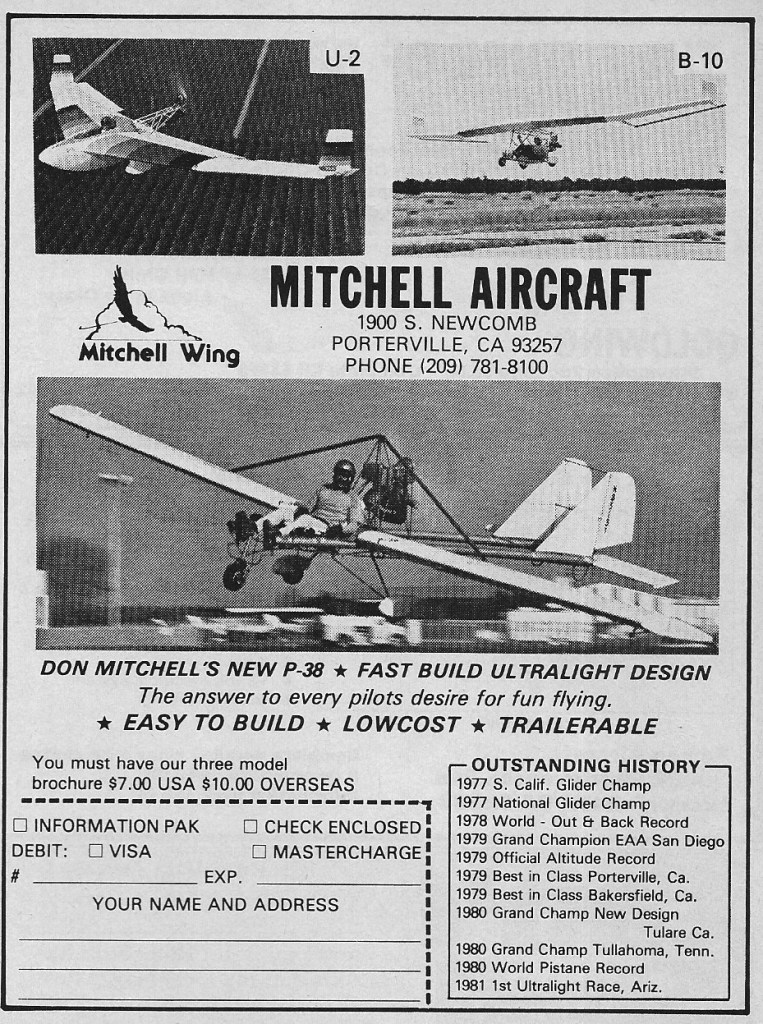
During much of the 1960 and early 70s, Mitchell kept himself occupied by repairing and customising a number of aircraft. Around 1974, as interest in hang gliding was rapidly increasing, a Dr. Howard Long became intrigued by the idea of a flying wing hang glider. He asked Mitchell to build him such an aircraft. The first foot-launched Mitchell Wing hang glider, the first rigid-wing hang glider that could be controlled in roll, pitch and yaw, flew in 1976. Its flying characteristics and performance showed such promise that Mitchell received orders to build twelve after just one public demonstration flight.
Fascinated by the idea of capturing all the official records for hang gliding newly recognised by the Fédération aéronautique internationale, American champion sailplane pilot George Worthington bought the third one built and went on to set half a dozen world records between 1976 and 1981. Interest among enthusiasts was such that Mitchell organised Mitchell Wing – later Mitchell Aircraft – at Porterville (California). Orders came in from all over North America, Europe and beyond.
In the mid 1970s, Mitchell added a tubular structure and a small engine on one of his wings, turning it into a powered glider or ultralight airplane. A prototype first flew in 1976. The new powered model gained fame as the Mitchell B-10. Mitchell took his flying wings to the world famous fly-ins at Oshkosh and was awarded top honors on numerous occasions.
Design and construction of the U-2, an ultralight fitted with an enclosed nacelle for the pilot followed in 1979. In 1983, a Mitchell U-2 set a new world altitude record for aircraft weighting less than 270 kg with a climb to about 26,000, as well as a sustained altitude record of slightly less than 26,000 ft. The Mitchell P-38 flew later on.
May 1981
1983: Mitchell Aircraft Corp, 1900 South Newcomb, Porterville, California 93257, USA. 1984: 11616 W. 59th Street South, Sand Springs, OK 74063, USA.
Over the years, Mitchell has sold hundreds of drawings and kits for the B-10, the U-2, the P-38 as well as the hang gliding version of the B-10. The designations Mitchell gave to his creations were those of great American aircraft, i.e. the very modern Martin B-10 bomber of the 1930s, the highly distinctive Lockheed P-38 Lightning fighter of the Second World War and the famous Lockheed U-2 spy plane of the Cold War era.
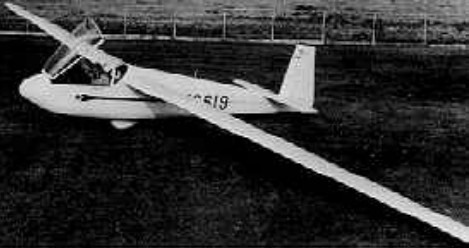
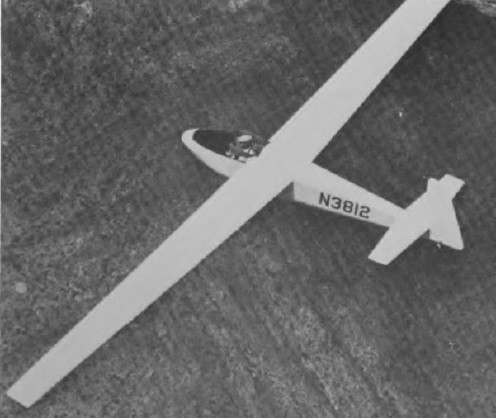
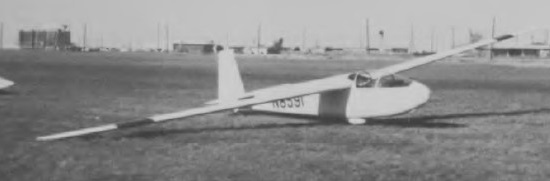
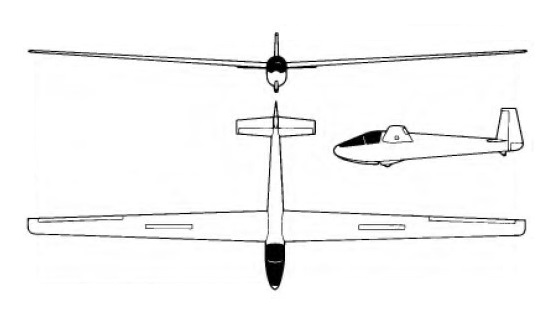
The Tern high perfomance single-seater was designed by Mr W. Terry Miller of Furlong, Pennsylvania, for amateur construction and the prototype, which was built in a total of 1,180 working hours, made its first flight in September 1965.
An improved version, known as the Tern II, made its first flight in August 1968; this featured a wing span increased by 4 ft 6 in to 55 ft 6 in, increasing the aspect ratio from 20 to 22, and giving an improved best glide ratio and minimum sinking speed. During 1968 brake parachutes were fitted to the prototype Tern, and two types of these were later made available for installation in both versions of the Tern in the base of the rudder, namely a 6 ft diameter cross parachute or a 5 ft diameter guide surface parachute.
By May 1970 nearly 100 Terns and 12 Tern IIs were under construction not only in the USA, but by amateurs in Africa, Australia, South America and Canada.
Of conventional all-wood construction, the Tern has unswept cantilever shoulder wings which are two piece two-spar spruce structures, entirely plywood covered. There are no flaps and the plain ailerons are also all wood; there are wooden spoilers in the wing lower surface used for approach and glide slope control. The semi-monocoque wooden fuselage has a plastic-reinforced glassfibre nose and plywood skinning aft of the cockpit. The cantilever all-wood tail unit has modified NACA laminar flow sections and special hinge-line contours to reduce drag and increase control effectiveness at large angles of deflection; there are no elevator or rudder tabs. Landing gear consists of a non-retractable monowheel forward of the eg housed in a streamlined pod, and skids under the nose and tail; there is a brake lever for applying pressure directly to the tyre. The pilot sits in a semi-reclining seat under a three piece canopy, the centre portion of which hinges sideways for entrance and exit, and radio can be fitted.
One Tern belongs to the National Soaring Museum.
Miller Tern 2
Tern Wing span: 15.54 m / 51 ft Wing area: 12.08 sq.m / 130 sq.ft Empty Weight: 215 kg / 475 lb Payload: 102 kg / 225 lb Gross Weight: 317 kg / 700 lb Wing Load: 26.24 kg/sq.m / 5.4 lb/sq.ft L/DMax: 34 93 kph / 50 kt / 58 mph MinSink: 0.64 m/s / 2.1 fps / 1.24 kt Aspect ratio: 20 Airfoil: Wortmann 61 Series Seats: 1
Tern II Span: 15.56 m / 55 ft 6 in Length: 6.49 m / 21 ft 3.5 in Height: 1.52 m / 5 ft 0 in Wing area 13.01 sq.m / 140 sq ft Aspect ratio: 22.0 Wing section: Wortmann 61 Series Empty weight: 249 kg / 550 lb Max weight: 363 kg / 800 1b Water ballast: None Max speed: 120 mph / 104 kt / 193 km/h (smooth air) Stalling speed: 34.5 kt / 64 km/h Max aero-tow speed: 88 mph Max rough air speed: 76.5 kt / 142 km/h Min sinking speed: 1.95 ft/sec / 0.59 m/sec at 48 mph / 41.5 kt / 77 km/h Best glide ratio: 38:1 at 60 mph / 52 kt / 97 km/h
The Militi M.B.1 is an Italian single-seat flying-boat glider designed and built by Bruno Militi. Militi started to build his design for a flying-boat glider in October 1964 and it first flew on 13 August 1967. The M.B.1 is a parasol-wing monoplane with a two-step hull and a fuselage of aluminium alloy, wood and fibreglass. The mixed construction wing is supported by two N-struts in the centre and a vee-strut outboard on each side, it has plain ailerons but no flaps. The pilot has an open cockpit with a small windscreen. From 1969 Militi developed a powered version as the M.B.2 Leonardo which first flew in 1970.
Wingspan: 8.05 m (26 ft 5 in) Length: 5.91 m (19 ft 4¾ in) Width: 0.90 m (2 ft 11½ in) Height: 1.95 m (6 ft 4¾ in) Wing area: 11.40 m2 (122.7 ft2) Aspect ratio: 5.7 Empty weight: 85 kg (187 lb) Gross weight: 165 kg (363 lb) each each Crew: 1
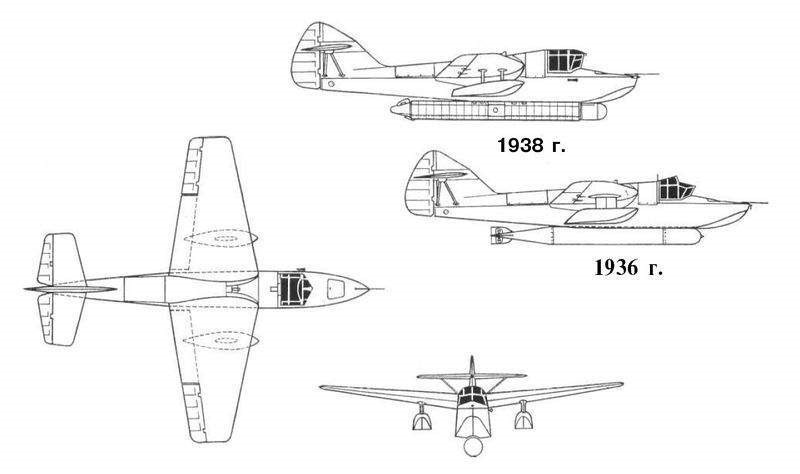
Starting in 1933, a series of projects began to be developed in the USSR under the common name of PSN, acronym for P laner S petsialnovo N aznachenya or Gliders for Special Missions. Among these projects was SF Valk’s idea of using a glider with a torpedo and an infrared or radio guidance system to attack surface ships and naval bases.
This idea had its development in a series of projects known as: LTDD – Letayushaya Torpeda Dalnevo Dieztvya (Long Range Flying Torpedo); DPT – Dalni Planerni Torpedo (Long Range Glider Torpedo); BMP – Bozduzhni Minni Planer (Airborne Mine Glider);
As a development of this conception, Mijelson would receive the task of building an experimental manned hydrofoil glider capable of carrying a torpedo and intended primarily to test remote flight control systems. This glider, called PT, was followed by a small series of copies that received the name PSN (Russian: Михельсон / Никитин ПСН).
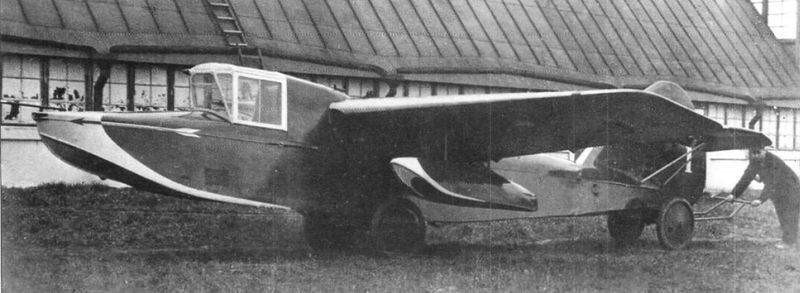
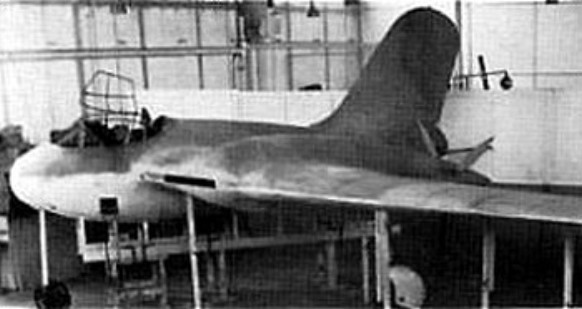
The PSN was designed as a small single-seater hydrofoil glider with stabilization floats located approximately halfway across the wingspan of each half plane. The entire construction was made of wood.
The wings presented high implantation with a trapezoidal shape in the plane. Louvered ailerons and flaps were included as control surfaces. The tail unit featured the outriggers braced by double struts high on the keel.
The pilot was located in a glass cockpit in front of the wing leading edge. At the bottom of the glider was fixed a torpedo.
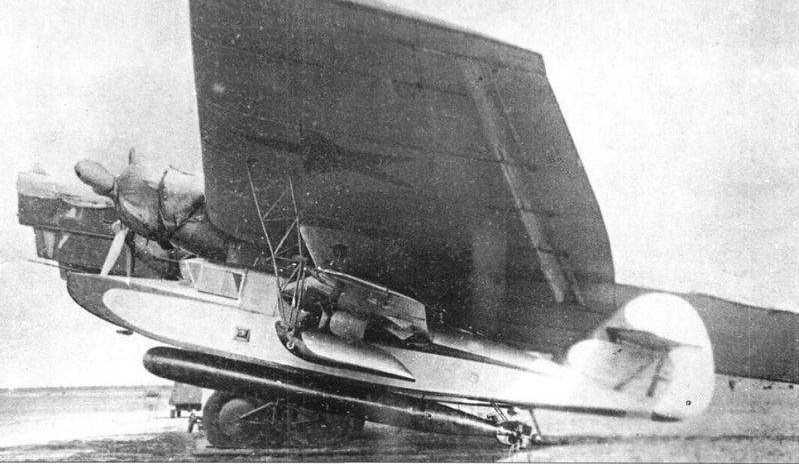
The PSN was carried by a Túpolev TB-3 or TB-7 mother bomber and was released at a pre-calculated height and distances between 30 and 50 km from the target. After launching its torpedo, the glider would land on the water.
A PSN hydrofoil glider with a torpedo under the wing of the Túpolev TB-3 mother plane.
In 1934 the first PT copies and their equipment were built and tested. The first 4 units were built in 1935 at factory No. 23 in Leningrad. In this case, it was a piloted glider version designed to evaluate the infrared guidance piloting system known as Kvant (Quanto). This project was developed under the direction of Mijelson and Nikitin was in charge of the production.
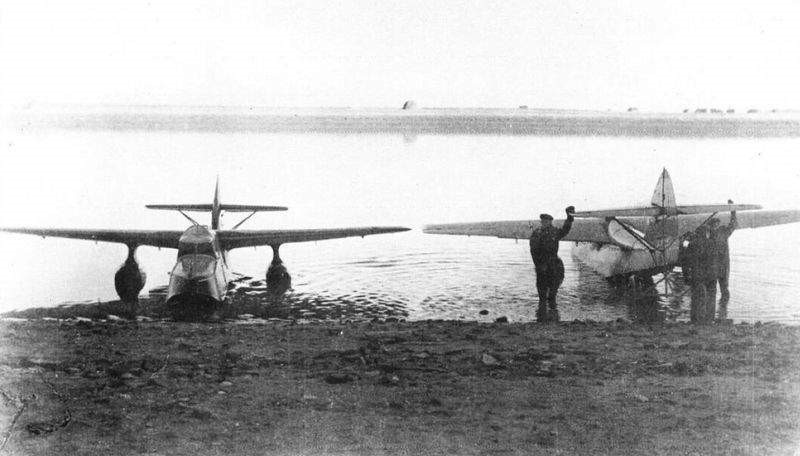
Two PT gliders during the water tests.
From June until October of August of 1936 at the Naval base Krechevits the first fixation tests PT were performed under a bomber Tupolev TB-3. During these tests the PT was piloted by N N. Ivanov.
Between 1937 and 1938 the construction of a small series of PT without a pilot was requested, which received the name PSN (or PSN-1 in some literature).
In general, 10 copies of the PSN-1 were built, which were used in different tests of the Kvant guidance system and an autopilot system developed at that time.
In March 1938, after the arrest of Mijelson, the works were interrupted. All produced copies of the PSN were destroyed.
PSN Wingspan: 8 m Wing area: 13.2 sq.m Length: 8.9 m Height: 2.11 m Empty weight: 970 kg Loaded weight: 1970 kg Speed: 150 – 350 km / h Dive speed: 500 km / h Range: 30 – 35 km Accommodation: 1
Established in 1947 in Trieste, initially manufactured series of gliders and sailplanes of various types under licence, turning to powered aircraft in 1953 when company acquired the assets of Francis Lombardi & Cie of Vercelli, further developing FL.3 light aircraft, FL.53 two-seater, three-seat FL.54, and FL.55 four-seater. Own 110 hp Alfa 2 and 220 hp Alfa 4 engines powered two-seat Meteor Bis and four-seat Meteor Super. In 1960 Meteor diversified into unmanned drones. These serving as the basis of the Sky Arrow. In 1985 Meteor changed its name to Iniziative Industriali Italiane.
 All Aero