Montgomery Glider

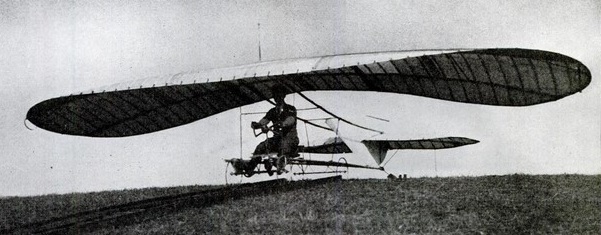
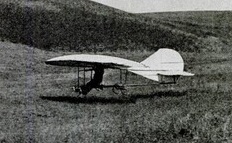
1911 glider

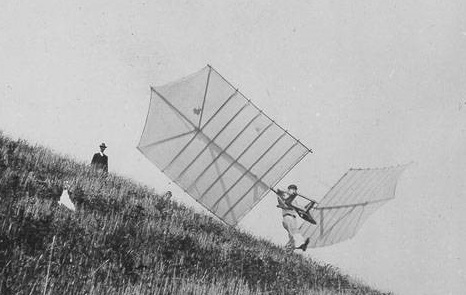
John J Montgomery, a science teacher at Santa Clara College, in California, experimented with gliders as early as 1883. Montgomery’s 1883 glider had a short, 23 foot wing span with a moveable horizontal tail. A keel-like bar (longeron) was suspended three feet below the wing longerons. The pilot ran to launch the ship by holding the upper bars, and once in flight he straddled the centre bar. He could then swing his body from side to side for lateral control and manipulate the horizontal elevator plane for lift. The craft is reported to have flown consistently well.

The first glider proved the value of the cured wing which he copied from a seagull and with it he flew 600 ft.

His second hang glider used flat wing surfaces, and proved to be totally useless. In 1905, Montgomery added a second, tandem wing to his basic design, and Daniel Maloney, a parachute jumper, made numerous exhibition flights with his plane, performing sharp turns and even barrel rolls.

His third hang glider incorporated wing warping for lateral control.
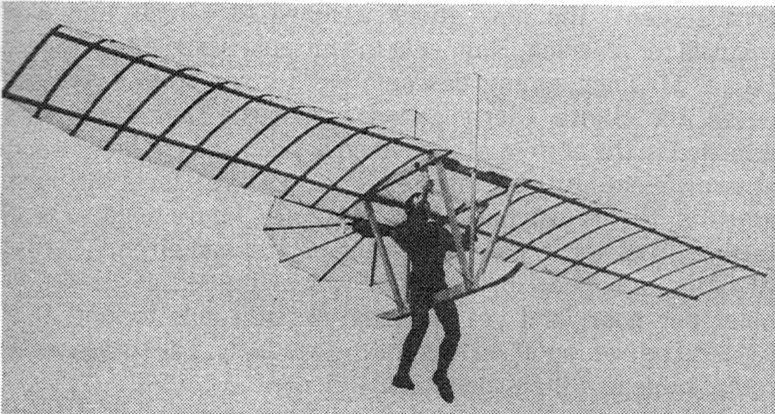
1883 hang glider

Montgomery’s first models were tested from aa cable suspended between two hill tops in California, and the gliders were dropped from them. He was able to give them such stability that they could even even themselves after being launched upside down, and glider smoothly to the ground.

Montgomery made a number of flights himself but stopped when he put his foot in a squirrel hole on one landing and hurt his leg.

He also dropped from a balloon at 4000 feet and glided gently back to a stand-up landing at his take-off point.

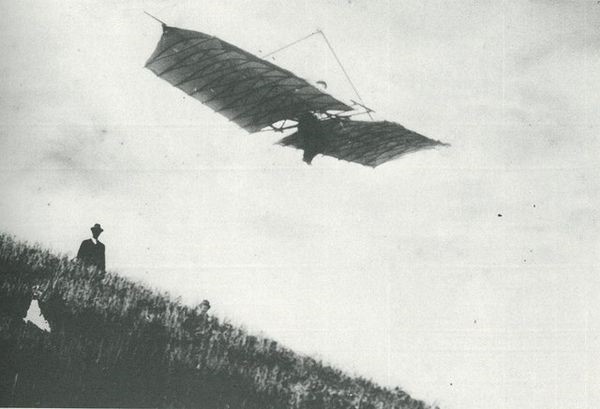
In 1905 Montgomery returned with an improved hang glider with two main wings: one placed behind the other in a tandem arrangement.
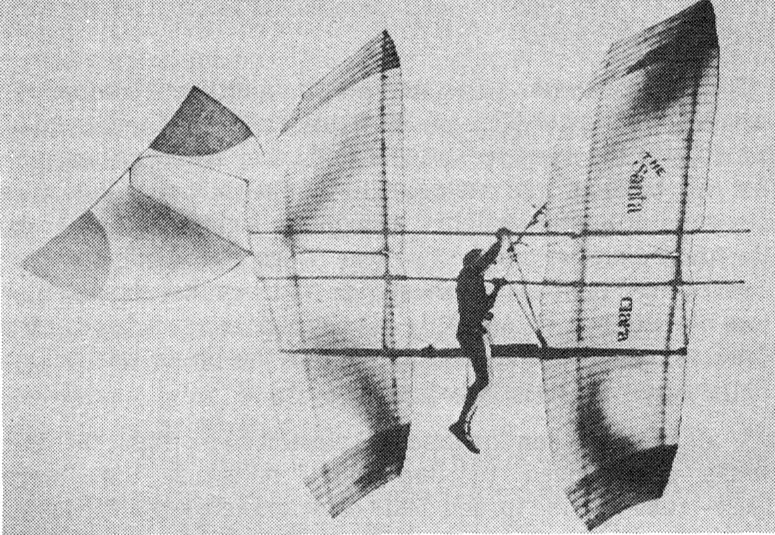
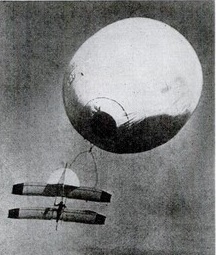
His new glider weighed 45 lb and had controls for steering. Engaging parachute jumper Daniel Maloney, many descents were made from 4000 ft above the Santa Clara college grounds. The glider was attached to the bottom of a manned balloon cut loose when at sufficient altitude. Montgomery was able to perform figure eights, dives and stalls, spiral and circling turns. At times the speed of the glider was estimated at almost 70 mph, and yet Montgomery was still able to land at a predetermined spot on his own two feet.
Montgomery also employed two other glider pilots, Wilkie and Defolco. Maloney was killed in an accident and the act was discontinued. Montgomery describes the fatal accident as follows;
“The ascension was given to entertain a military company in which were many of Maloney’s friends, and he told them he would give the most sensational flight they had ever heard of. As the balloon was rising with the aeroplane, a guy-rope dropping switched around the right wing and broke the tower that braced the rear wings and which also gave control over the tail. We shouted to Maloney that the machine was broken, but he probably did not hear us, as at the time he was saying ‘Harrah airship’ and as the break was behind him, he may not have detected it. When the machine started on its flight, the rear wings commenced to flap – indicating they were loose – the machine turned on its back and settled faster than a parachute. When we reached Maloney he was unconscious and lived only 30 minutes. The only mark of any kind on him was a scratch from a wire on the side of his neck, the six attending physicians were puzzled at the cause of his death”.
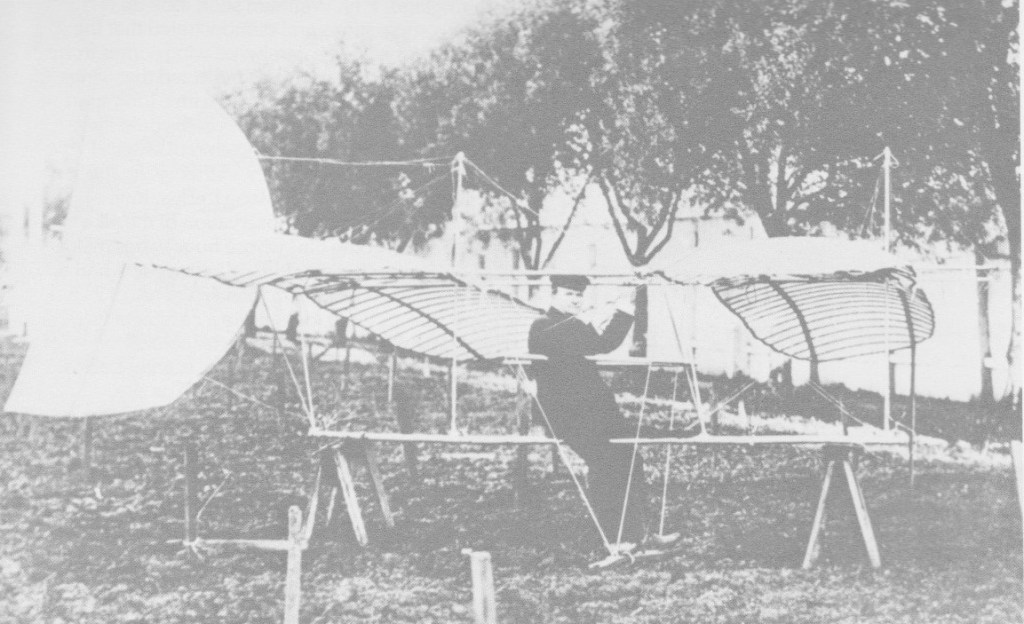
Montgomery and his double-winged glider. Note both foot and hand operated controls

Montgomery did quite a bit of research in the use of curved lifting surfaces and the movement of air around them. He had intended to carry out more experimentation, but the great San Francisco Earthquake prevented it. It wasn’t until 1911 that he again started gliding, but unfortunately h was soon killed in a fall in one of his gliders. In October, while in the air, he was struck by an unexpectedly violent gust of wind which sent his glider crashing to the ground. He hit fairly hard and injured his head and hip. At the time he did not think he was severely hurt, but later on complained of severe pains. These continued to get worse, and stayed with him until death.
A hot air balloon hauled Carnival Parachutist Dan Maloney in a Montgomery glider to 400 feet. Maloney flew eight-mile course during the glider’s descent.

Gallery

Montgomery, John J.

John Joseph Montgomery was born in Yuba City, California, USA, on 15 February 1858. After graduating from St.Ignatius College (now the University of San Francisco) as a lawyer he entered the law profession but failed. He tried storekeeping but failed.

Montgomery graduated from St. Ignatius College in San Francisco in 1879. He is often referred to as a Professor, though it is believed he didn’t have a Ph.D. He was the son of a former assistant attorney-general of the US. Two of his college classmates were James D. Phelar, mayor of San Francisco (1896-1902) and Rev. R.H. Bell, well known for his work in wireless telegraphy.

At his family ranch near San Diego he studied the flight of birds. He tried building three ornithopters with flapping wings, which failed.

At 25, he built a fixed wing glider with his sisters and younger brother assisting with the fabric. With this glider, on 20 August 1883, he soared 602 feet.

Monnet Monerai

Monnet Monerai P

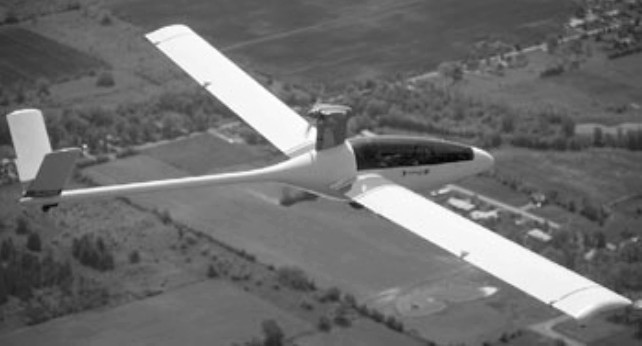
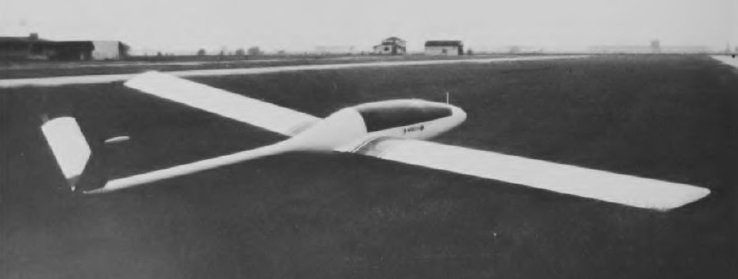
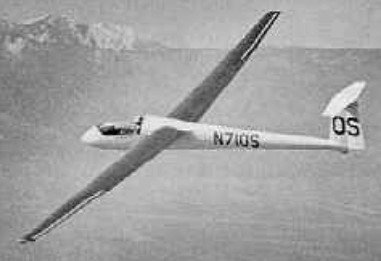
John Monnett became interested in gliding and produced a single seat average performance glider called the Monerai which had a 28/1 glide angle at 60 mph (97 kph) and a sink of 160 ft/min (0.8 m/s) and was available as a kit. The Monerai prototype flew for the first time in February 1978 with Monnett at the controls. This was later designated the Monerai S (for sailplane) after the development of the motor glider Monerai P (for powered) version.

Monnet Monerai S

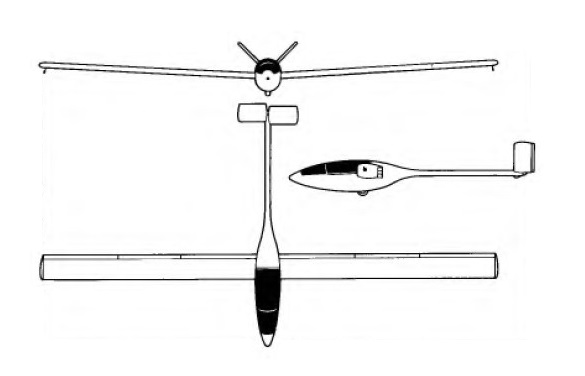
The Monerai follows the precedents set by Sonerai I and II, by offering simplified construction and economy with high performance. Designed for the first-time builder or the expert, the Monerai can be either a true sailplane for the purist or, with the addition of a pod-mounted engine (Monerai P), a self-launching sailplane for those who wish to operate independent of tow planes. A chrome-moly tubing primary fuselage structure combines with a molded fuselage shell and extruded aluminum tail boom to make up a lightweight, ultrasmooth exterior with integral structural integrity for pilot safety. The tubular aluminium tailboom is bolted to the pod. The preformed canopy, molded ABS components, sewn seat sling and simplified control-system components are offered to make construction easier. The pilot is accommodated in a reclining sling-type seat, and headrest and rudder pedals are adjustable. The control stick is mounted on the right of the cockpit. On the left a lever operates the trailing-edge flaps, which travel from —8° to +90°. The optional engine is designed to be removed easily so that the ship can be used as a pure sailplane at the pilot’s whim. The wing uses a single-piece skin bonded to an extruded main spar and completely formed pressed ribs.

Each wing panel weighs only 23.6 kg (52 lb), making rigging easy. Like the wing, the V-tail has pressed aluminium ribs. The all-moving tailplane has its port panel slightly forward of the starboard panel; the two are identical and interchangeable.

Single seat single engined mid wing mono¬plane with conventional three axis control. Wing has unswept leading and trailing edges, and constant chord; V tail. Pitch/yaw control by elevon; roll control by full span ailerons; control inputs through stick for pitch/roll and pedals for yaw. Cantilever wing; wing profile; double surface. Undercarriage has two wheels in tandem; no suspension on either wheel. No ground steering. Brake on main wheel. Aluminium tube/glass fibre totally en¬closed. Engine mounted above wing driving pusher propeller.

Neither the latter’s characteristics (max¬imum and minimum weights and wing load¬ing), nor its performance figures (maximum and minimum speeds straight and level) allow the classification of this machine as an ultralight or microlight. The Monerai P is sold as a kit for $3950 in 1983, with no precise figure for completion time, or as plans for $200. The standard motor offered is the single cylinder Zenoah G25B of 20 hp, but since the summer of 1982, this can be replaced by a twin cylinder KFM 107 engine delivering 25hp at 7300rpm. A standard Monerai feature is full span flaps (except for the ailerons) designed for negative (up) settings for high speed flight and positive (down) settings for thermalling, with 90 deg down for landing. Also notable is the single pin tail¬-surface attachment, adjustable controls and seating, and the inclusion of a wheel brake on the flap handle. A side stick is fitted with a bungee trim system, and there is provision for oxygen and radio.

The Monerai Max wingtip extension kit was conceived to add more than three feet to the span, bringing it to 12 meters, and raising the L/D to more than 30:1. It uses flaps, which can be lowered to 90 degree, for approach control.

Monerai S
Wing span: 11.0 m (36 ft 0 in)
Length: 6.0 m (19 ft 7 in)
Height: 89 cm (35 in)
Wing area: 7.25 sq.m (78 sq ft)
Wing section: Wortmann FX-61192 mod
Aspect ratio: 16.6
Empty weight: 99.8 kg (220 lb)
Max weight: 204.12 kg (450 lb)
Water ballast: None
Max wing loading: 28.12 kg/sq.m (5.76 lb/sq ft)
Max speed: 104 kt (193 km/h)
Stalling speed: 33 kt (61 km/h)
Min sinking speed: 0.85 m (2.8 ft)/sec at 48 kt (89 km/h)
Max rough air speed: 78 kt (145 km/h)
Best glide ratio: 28 at 52 kt (97 km/h)

Monerai P
Engine: Zenoah G25B, 20 hp at 6500 rpm
Belt reduction
Power per unit area 0.26 hp/sq.ft, 2.8 hp/sq.m
Fuel capacity 1.0 US gal, 0.8 Imp gal, 3.8 litre
Length overall 19.7 ft, 5.96 m
Height overall 4.3ft, 1.32m
Wing span 36.0ft, 10.97m
Constant chord 2.2 ft, 0.66 m
Sweepback 0 deg
Total wing area 78 sq.ft, 7.2 sq.m
Wing aspect ratio 16.6/1
Empty weight 270 lb, 122 kg
Max take off weight 500 lb, 227kg
Payload 230 lb, 104 kg
Max wing loading 6.41 lb/sq.ft, 31.2 kg/sq.m
Max power loading 25.0 lb/hp, 11.33kg/hp
Load factors; +5.2, 5.2 ultimate
Max level speed 90mph, 145kph
Never exceed speed 120mph, 193kph
Max cruising speed 60mph, 97kph
Stalling speed 40mph, 64 kph
Max climb rate at sea level 300 ft/min, 1.5m/s
Min sink rate 160ft/min at 55mph, 0.8 m/s at 88 kph
Best glide ratio with power off 22/1 at 60mph, 97kph
Take off distance 500 ft, 150 m

Monerai P
Engine: Zenoah/KFM 107
Wing span: 10.97m / 36ft
Wing area: 7.25sq.m / 78sq.ft
Aspect ratio: 16.6
Empty Weight: 100kg / 220lb
Payload: 104kg / 230lb
Gross Weight: 204kg / 450lb
Wing Load: 28.14kg/sq.m / 5.76lb/sq.ft
L/DMax: 28 97 kph / 52 kt / 60 mph
MinSink: 0.85 m/s / 2.8 fps / 1.66 kt
Airfoil: Wortmann Fx 61192 mod

Monnet Monerai S

Monnett

John T Monnett founded his company to sell plans and some compo¬nents for his Formula V Racer, the Sonerai, which was awarded the prize at the 1971 EAA convention at Oshkosh for the best single seat, Volkswagen engined aircraft.

1980: Monnett Experimental Aircraft, 955 Grace, Elgin, Il 60120, USA.
1982-3: Monnet Experimental Aircraft Inc, 895 W 20th Avenue, PO Box 2984, Oshkosh, Wiscon¬sin 54903, USA.

Monaghan Osprey

Designed by Richard Monaghen, the Osprey, a Standard Class sailplane which made its first flight in 1973, featuring retractable gear, 90 degree flaps and a T-tail. The structure was all-aluminum except for a fiberglass-foam-sandwich cockpit area.

Wing span: 15m / 49.2 ft
Wing area: 9.66 sq.m / 104 sq.ft
Empty Weight: 200 kg / 440 lb
Payload: 90 kg / 200 lb
Gross Weight: 290 kg / 640 lb
Wing Load: 30.02 kg/sq.m / 6.1 lb/sq.ft
Aspect ratio: 23.3
Airfoil: Wortmann 163/126
Seats: 1
Number built: 1

Molniya Buran

The Soviets began constructing this spacecraft in response to a 1972 announcement by President Nixon that NASA would try building its own new spacecraft. The shuttle’s first launch attempt came on October 29, 1988 but ended with a mechanical failure.

NPO Molniya was created 1976 to develop the Buran, Russia’s first reusable spacecraft. With less work on Buran in later years, began developing civil aircraft.

Antonov An-225 / Molniya Buran Gallery

Mohawk Aerial Navigation Company Glider

One of the gliders built by Charles Proteus Steinmetz – the “Wizard of Schenectady” – and others in 1894. While working for General Electric at Schenectady, N.Y., Steinmetz organized a band of fellow flying machine enthusiasts into the Mohawk Aerial Navigation Company, and over the summer of 1894 built and tested a man-carrying kite and two true gliders. None were particularly successful.

Mohawk Aerial Navigation Company

Charles Proteus Steinmetz he had dwarfism, was hunchback, and had hip dysplasia. While working for General Electric at Schenectady, N.Y., Steinmetz organized a band of fellow flying machine enthusiasts into the Mohawk Aerial Navigation Company, and over the summer of 1894 built and tested a man-carrying kite and two true gliders. None were particularly successful.

Mitchell Osprey

As he worked on the Dragonfly, Mitchell set out on his own to build a new flying wing glider, which he called the Osprey, a single seat machine fitted with stabilators. Mitchell tested his flying wing several times near Oakland, in 1950. Unfortunately, the building in which the glider was stored burned to the ground and the flying wing was destroyed.