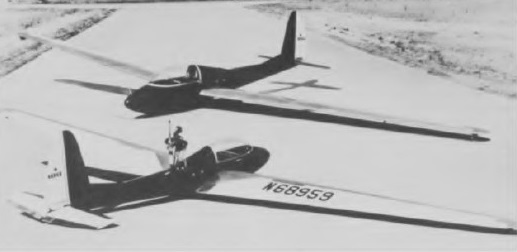
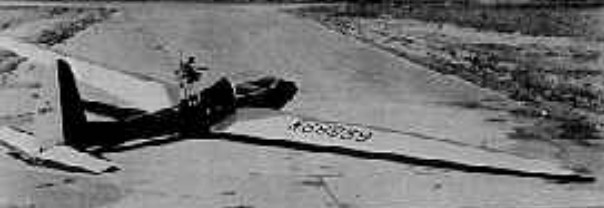
Designed by Harry Perl & Ted Nelson, Nelson developed the Hummingbird in 1953 after discontinuing the Dragonfly. It is a two-place tandem self-launching sailplane. The fixed gear is two wheels in tandem, the front one steerable with rudder pedals. It features an all-moving horizontal tail with anti-balance tab, spoilers and dive brakes, and styrofoam-filled leading edges. The original version, of which two were built, was almost all wood; later models were metal.
Built by the Nelson Aircraft Corporation of Irwin, Pennsylvania, which firm also makes the 45hp Nelson H-63CP four-cylinder horizontally-opposed two-stroke engine that powers it. This is mounted aft of the cockpit and drives a two-blade fixed-pitch pusher propeller; it retracts forward into the fuselage behind the one-piece tear drop cockpit canopy when not in use.
Three or four were built, including N68581, N68959. Two belong to the National Soaring Museum, and one belongs to the Smithsonian Air & Space Museum, Washington.
PG-185B Engine: 40 kW/ 40 bhp. Nelson H-59 Span: 54 ft 0 in / 16.46m Length: 22 ft 0 in Wing area: 185.0 sqft / 17.18sq.m Aspect ratio: 15.76 Airfoil: Go 549 (root), Go 676 (tip) Empty Weight: 363kg / 800lb Gross Weight: 544kg / 1200 lb Max speed: 120 mph Cruising speed: 90mph Stall: 39 mph MinSink: 25 at 89 kph / 48 kt / 55 mph L/DMax: 0.91 m/s / 3.0 fps / 1.78kt Seats: 2
At the end of World War II Brazil was conducting the “National Aviation Campaign”, a program of re-equipment and incentive to air clubs and the national aeronautical industry.
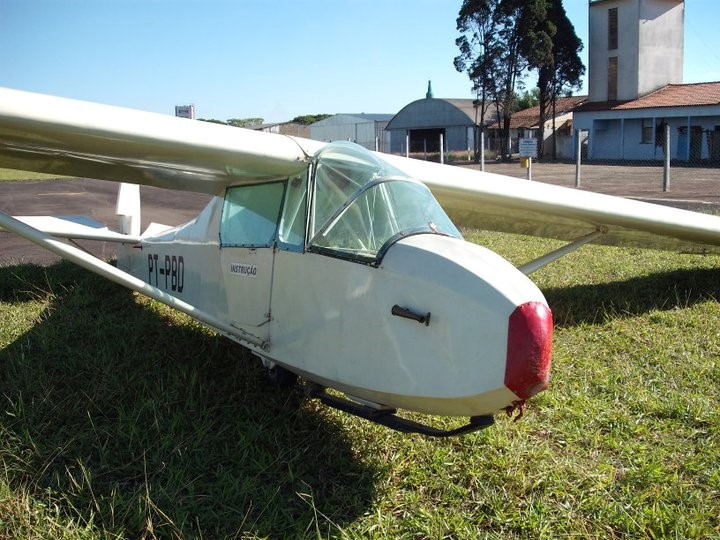
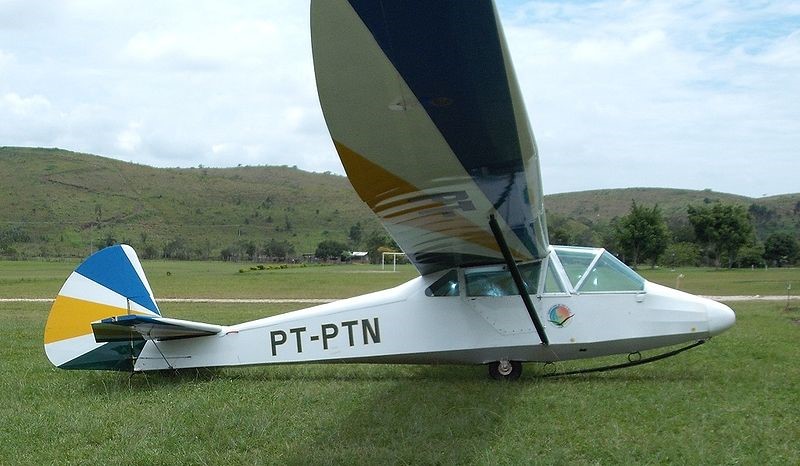
The lack of gliders to replace the Brazilian fleet, then composed mostly of German aircraft of the 1930s, was of great concern. Josė Carlos de Barros Neiva then developed a project that retained the characteristics of the Grunau Baby, (which made up a large part of the Brazilian fleet), but biplace.
The B Monitor is basically constructed of wood, high wing configuration with central torsion cabin, freijó stringer (Cordia goeldiana) and aeronautical plywood cover. The rear section to the centre of the wing is covered with fabric.
The aircraft has a dihedral of 0.5° and the wings are attached to the fuselage with wooden uprights. Ailerons are wood covered with fabric and wooden spoilers located just in the extruder of the wing.
The fuselage is mostly of wood, semi-monocoque construction and steel tubes in the wing-fuselage joint. The cockpit has dual controls, with factory instrumentation on the front seat (although some have been modified with addition of a rear panel). The empennage is conventional. The fixed landing gear has a wheel behind the centre of gravity. The aircraft has a front skid with rubber shock absorbers under compression.
The prototype, PP-PCB, made the first flight in 1945 and the type certificate was issued in 1946.
The “National Aviation Campaign” bought the prototype and another 20 units for distribution to the air clubs, built between 1945 and 1955.
The Neiva B has a low-load, which provides good performance in thermal rise and low stall speed (52 km / h). The wings, because they are heavy, have a lot of rolling inertia, making the aileron commands slow to respond. The elevator and rudder controls, however, have good efficiency. The small size of the spoilers resulted in the common use of slip during the final approach.
In 1959 Neiva developed the version Neiva B “Monitor Modified”, with different nose, and larger cockpit. The fuselage became welded steel tubes, retaining the original wing. One copy (serial number CTA-02 A-223) was built for testing at the Aerospace Technical Centre, later donated to the CVV-CTA.
The only Neiva “B modified” produced, in operation in the CVV-CTA in 2009
The “B” Monitors were distributed to several aero clubs and trained hundreds of pilots. Many Brazilian records were broken with the type. Up to 2000, was still used in aero clubs such as CVV-CTA, Rio Claro, Tatuí, Bauru and Brasília.
Wingspan: 15.86 m (52 ft 0 in) Wing area: 18.4 m 2 (198 sq ft) Aspect ratio: 13.67 Aerofoil: Göttingen 535 – NACA 0009 Length 7.1 m (23 ft 4 in) Height: 1.13 m (3 ft 8 in) Weight Empty 215 kg (474 lb) Max takeoff weight: 375 kg (827 lb) Speed Never Exceeds: 145 km / h (90 mph; 78 kn) G range: +5.33 -3.31 at 145 km / h (90.1 mph, 78.3 kn) Maximum glide ratio 18 at 67 km / h (41.6 mph, 36.2 kn) Sinking Ratio: 0.78 m / s (154 ft / min) at 55 km / h (34.2 mph, 29.7 kn) Loading: 20.3 kg / m 2 (4.2 lb / sq ft) Crew: 2
Sociedade Construtora Aeronautica Neiva Ltda Industria Aeronautica Neiva Sa
Neiva has produced over 3,200 aircraft since 1956, many under license from Piper and including Ipanemas, Urupema gliders, Cariocas, Coriscos, Tupis, Minuanos, Sertanejos, Senecas/Cuestas, Navajos, and Carajas.
Neiva produced Model N621/T-25 Universal trainers for the Brazilian Air Force and a series of lightplanes.
In March 1980 it was renamed Industria Aeronautica Neiva S.A, as a subsidiary of EMBRAER. All work on the EMBRAER/Piper series of light aircraft and production of the EMB-202 Ipanema agricultural aircraft were transferred (over 780 built).
In the summer of 1960, Neil Armstrong and Milt Thompson had heard a talk by NASA’s Langley Research Center aeronautical engineer Frank M. Rogallo. Rogallo explained the advantage of using a controllable parachute for the recovery of space vehicles.
Armstrong and Thompson asked director Paul Bikle for permission to build a simple research vehicle to test Rogallo’s concept. When Bikle refused citing commitments to the X-15 and other NASA programs, Armstrong and Thompson continued working on the design in their free time. Eventually, they arrived at a Parasev design that had a little platform slung beneath it.
Flying a Cessna L-19 on 28 June 1962, Armstrong took off with the Parasev in tow over Rogers Dry Lake and turned so sharply at the edge of the lake that the towline went slack, causing Thompson to crash land on one of the really small dry lakes east of Rogers. Armstrong was not even aware there was a problem until Bruce Peerson came into the pilots’ room and asked ‘Where’s Milt?”. From a DC-3 they saw him sitting down, shaking his fist at them. Thompson admitted “we encountered numerous problems developing a good airworthy vehicle.”
By this time, Bikle had authorised their Parasev work. Construction of the Parasev moved to Dryden’s shops, where simple light-aircraft fabrication techniques led to a functional prototype in a matter of weeks. The first free flight was made by Thompson on 12 March 1962. Armstrong flew the vehicle on 24 September 1962. He went on to fly the Parasev on the 24th, 25th and 26th of September. They were short flights, but twenty flights.
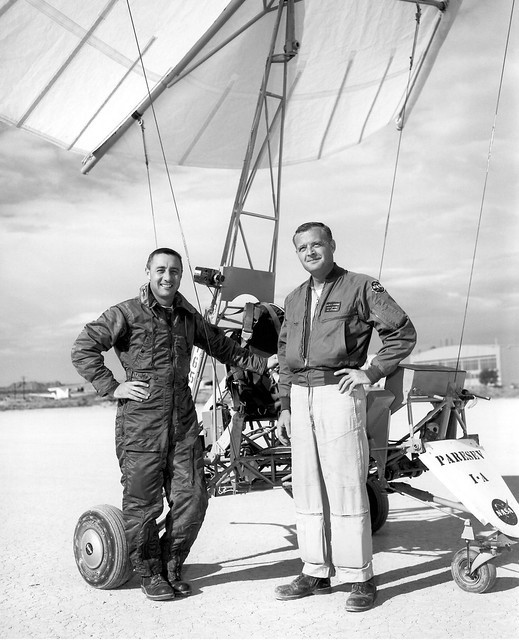
Gus Grissom & Milt Thompson with Paresev
Between 1961 and 1965 the ability of the Rogallo wing (also called “Parawing”) to descend a payload such as the Gemini space capsule safely from high altitude to ground was studied. The Paresev (Paraglider Research Vehicle) was an experimental NASA glider aircraft based upon the kite-parachute studies by NASA engineer Francis Rogallo. The Paresev was a test vehicle used to learn how to control this parachute-wing for a safe landing at a normal airfield.
NASA experimented with the flexible Rogallo wing, which they renamed the Parawing, in order to evaluate it as a recovery system for the Gemini space capsules and recovery of used Saturn rocket stages. Data developed by NASA in the late 1950s fed both the Charles Richards team and a different Ryan Aeronautical team that produced the Fleep. The Paresev used a cantilevered cross-beam but did not use a kingpost. Under a directive by Paul Bikle, NASA engineer Charles Richards in 1961–1962 designed the collapsible four-tube Rogallo wing used in the Paresev. The Paresev series included wing configurations that were tightly foldable from the nose plate for easy transport, using initially a cloth sail and later one of Dacron.
The Paresev was controlled by moving the tensionally hung pilot’s and fuselage’s mass relative to the position of the wing. This mass-shifting was effected by tilting the wing from side to side and fore and aft by using a control stick in front of the pilot that descended from the wing above. Another version translated the same weight-shift control via cables. As the Paresev was towed in a kite mode, it usually rose from the ground at about 46 mph (74 km/h) and had a maximum air speed of about 65 mph (105 km/h).
Neil Armstrong acknowledges that controlling the glider was extremely tricky; “the acceptable centre of gravity box was pretty small, and the control forces could be surprisingly big. Its speed range was very narrow, and its L/D was substantially less than a pilot would like. Yet for a first effort, the paraglider was surprisingly successful.”
The Paresev control pendulum weight-shift control system was presaged by a published patent, an early use of the hung pilot behind a cable-stayed triangle control bar in 1908 in the territory of Breslau, and then also by the “control wing” of George Spratt in the 1920s.
The Paresev 1A and 1B were unpowered; the “fuselage” was an open framework fabricated of welded SAE 4130 steel tubing, called a “space frame”. The keel and leading edges of the wing were constructed of 2.5-inch-diameter (64 mm) aluminium tubing. The leading edge sweepback angle was held at 50 degrees by a rigid spreader bar. Additional wing structure fabricated from steel tubing ensured structural integrity.
Paresev 1-A with tow plane
The basic vehicle was slightly more than 11 ft (3.4 m) high from the top of the paraglider’s wing to the ground, while the length of the center keel was 15 ft (4.6 m). Total weight was about 600 lb (270 kg) On August 24, 1962, seven weeks after the project was initiated, the team rolled out the Paresev 1.
Paresev 1 in landing, 1962
The Paresev 1, first flight on January 25, 1962, crashed on March 14, 1962. The frame was fitted with a linen membrane wing and the control stick coming from overhead in front of the pilot’s seat.
The Paresev 1A used a rebuilt frame from the Paresev 1, but had a control stick and a Dacron membrane wing. First flown on May 18, 1962, the last flight was on June 28, 1962.
The Paresev 1B first flew on July 27, 1962 and the last flight was on Feb 20, 1963.
Paresev 1-B under aerotow
The Paresev 1C had a modified frame with a half-scale version of an inflatable parawing. The first flight was on March 4, 1963 and last flight on April 14, 1964.
Towed aloft by a helicopter, the 1C was meant to inflate at 35,000 ft.
Piloted by E.P.Hetzel
With North American test pilot E.R.Hetzel at the controls of a simulated Gemini capsule the Paresev made its first manned flight in 1965. Towed to 2600 ft by helicopter for check of the glider’s control system, Hetzel made turns during the 20.5 minute flight, landing at Edwards Air Force Base. The next test was scheduled from 12,000 ft.
The Paresev vehicle was flown 341 times during a research program that ran from 1962 until 1964. Thompson made numerous ground-tow flights and claimed about 60 air-tow flights. Peterson claimed 228 flights (ground and air tows). Grissom made two flights. Champine made four flights. Kleuver made at least eight flights. It is unknown how many times Armstrong, Hetzel, and Slayton flew.
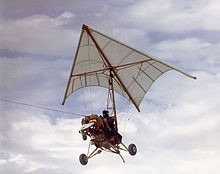
United States Gemini’s Paresev glider in flight with tow cable.
Publicity on the Paresev and the Ryan XV-8 “Flying Jeep” aircraft inspired hobbyists to adapt Rogallo’s flexible wing airfoil onto elementary hang gliders leading to the most successful hang glider configuration in history.
Using the fully flexible parawing or the tube-stiffened paraglider of the Paresev 1A, 1B, 1C as an alternate to spacecraft recovery was deemed too unreliable upon unfolding so round parachutes for water landings were used instead. The Paresev and other flexible-wing projects such as the Ryan XV-8 stopped being funded by NASA on 1965.
The Paresev was transferred to the Smithsonian National Air and Space Museum located in Washington, D.C. for display.
NASA Paresev 1A at the Udvar Hazy Center
Built and rebuilt several times, the Parasev eventually made more than 100 flights at Edwards. Among the pilots who flew it were astronaut Gus Grissom, who, during a flight at Edwards on 17 October 1962, broke its nose gear on landing. The parawing might have proven feasible for capsule re-entry but time was not available. In 1964, with both the Gemini and Apollo programs committed to water landings, NASA cancelled all of its paraglider work.
Test pilots Milton Orville Thompson, NASA FRC Robert Apgar Champine, NASA LRC Neil A. Armstrong, NASA FRC Bruce A. Peterson, NASA FRC Charles Hetzel, North American Aviation Maj. Emil “Jack” Kluever, U.S. Army Donald K. “Deke” Slayton, NASA MSC Virgil I. “Gus” Grissom, NASA MSC
Tow aircraft Piper PA-18 Super Cub (N-68P) Cessna O-1 Bird Dog (50-1675) Stearman (N69056) Boeing HC-1A helicopter (58-5515)
Crew: One pilot Length: 15 ft 0 in (4.57 m) Height: 11 ft 0 in (3.35 m) Wing area: 179 ft2 (16.6 m2) Gross weight: 600 lb (270 kg) Maximum speed: 65 mph (100 km/h)
Designed by Bobby Bailey, the Tempest is an FAI Class 4 light sailplane circa 1998, using tube and fabric construction, and composite cockpit. It can be dismantled into three parts for transport. The semi-enclosed fiberglass cockpit has a canopy that hinges to one side.
Launchable by towing from an UL, it was availablein the US as a kit for $10,000 or as a completed sailplane for $12,500, through Quest Air Soaring Canter, 6548 Groveland Airport Road, Groveland, Florida 34736.
Tempest Wing span: 13 m / 42 feet Wing area: 14 sq.m / 150 square feet Height: 5 ft Length: 21 ft Aspect ratio: 12:1 MTOW: 400 lb Empty weight: 100 kg / 220 lb Vzmin: 0.8 ẚ 40 m/sec Stalls: 29 km/h Speed max: 80 mph Glide Ratio: 25 @ 60 kph L/D: 24 @ 68 km/h L/D ratio: 5:1 Min sink: 170 fpm Seats: 1 Landing gear: single wheel Price (1998) $ 10500 (kit)
Started in 1967, Moyes Delta Gliders was a Company solely dedicated to hang gliding. 1995: 2-4 Taylor St, Waverly, 2024 NSW, Australia.
1998: 1144 Bottany Road, NSW 2019 Botany, AUSTRALIA
2001: 200 Hillcrest Dr, Auburn, CA 95603, USA. LiteFlite is owned and operated by Bill Moyes. Bill is based in Sydney at the Liteflite factory and frequently travels the world to sell and support his products. Bill has been flying and manufacturing aircraft since 1966 and has a long list of accolades to show for his efforts.
Bill Bennett and his partner Bill Moyes worked improvents into the Rogallo tow kites and Moyes towed to 1000 feet in 1967. After the towboat ran into a sand bar one day and the kite gently glided down, they began to deliberatelycut loose and experiment with untethered flight. This led the skiers up mountain sides where they made ski launches, sometimes gliding as far as five miles.
Bennett went to the USA in 1969 and began a tou of exhabitions which included flying over the Golden Gate Bridge to land on Alkatraz, and, on July 4th, circling the Statue of Liberty. American fliers were still using the Lilienthal-type parallel bars and hanging by their armpits but Bennett brought with him a trapeze style control bar and swinging seat.
After the success of his tour he settled down in LA and began to manufacture and promote hang gliders to the growing market in Southern California.
LiteFlite is a manufacturer of ultra light aircraft and hang gliding accessories. The main product from the LiteFlite stable is the Dragonfly, an ultra light aircraft most commonly used for towing hang gliders into the air. The Dragonfly has been in production since 1990 with approximately 100 aircraft being made, and is internationally recognised for its slow flying speed and great manoeuvrability.
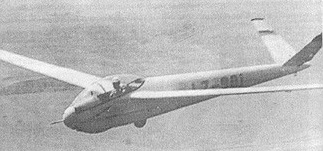
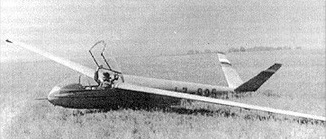
The second postwar Bulgarian sailplane designed by Eng L. Panov and D. Panchovsky, the Kometa-Standard (or Comet Standard) fully aerobatic Standard Class single-seater flew for the first time in prototype form on 5 August 1960; the type later went into small-scale production for the Bulgarian gliding clubs.
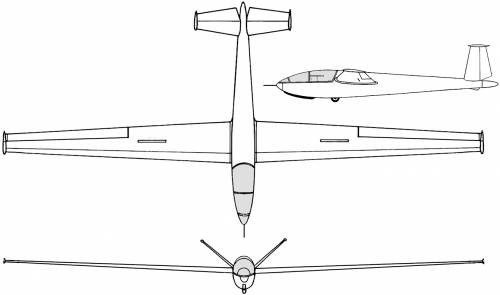
The Kometa-Standard is a cantilever midwing monoplane of conventional wooden construction with a butterfly-type V-tail with an included angle between the tailplanes of 110°. The wings, straight tapered in plan and set at mid-wing position, are single-spar wooden structures with a leading edge plywood torsion box and wing tip ‘salmon’-type fairings; the slotted ailerons are fabric-covered and there are spoilers on the wing upper and lower surfaces. They had 4° of dihedral. The Kometa-Standard had mass-balanced, slotted ailerons and spoilers at 60% chord which opened above and below the wing.
The plywood monocoque fuselage has a metal nose-cap and the landing gear consists of a non-retractable wheel with brake and a rubber mounted skid under the forward fuselage. The tail unit is of wooden construction with plywood and fabric covering, and the pilot is seated under a hinged Perspex canopy, proud of the rear fuselage line, but this was lowered and reshaped on the production Kometa-Standard II, merging into the rear fuselage from which it was hinged.
Kometa – Standard II
The cockpit was changed again in the Kometa-Standard III which had a sliding canopy over a reclining seat, making this variant 30 km/h (19 mph) faster than the Kometa-Standard II. Overall, the fuselage tapered uniformly from the cockpit to the tail. The Kometa-Standard had a 110° butterfly tail, its plywood and fabric covered surfaces terminating, like the wings, in little salmon fairings. Its undercarriage was a fixed monowheel, fitted with a brake and assisted by a forward, rubber sprung skid.
The prototype was flown for the first time on 5 August 1960 and an initial batch of 10 Kometa-Standard IIs was built, followed by two batches, each of 10, of Kometa-Standard IIIs. Flown by Bulgarian clubs, they were fully aerobatic, though not cleared for cloud flying.
Kometa-Standard II Production variant with lowered, rear hinged canopy. 10 built.
Kometa-Standard III Further revision to nose/canopy lines with reclining seat and sliding canopy. 20 built.
Specifications:
Kometa-Standard Year: 1960 Span: 49 ft 0.5 in / 14.95 m Length: 22 ft 9.5 in / 6.95 m Wing area: 136.7 sq.ft / 12.90 sq. m Aspect ratio: 17.6 Empty weight: 573 lb / 240 kg Max weight: 750 lb / 340 kg Max speed: 130 mph (in smooth air) Max aero-tow speed: 93 mph Min sinking speed: 2.69 ft/sec at 48.5 mph Best glide ratio: 28:1 at 51 mph
Kometa-Standard II Length: 6.95 m (22 ft 10 in) Wingspan: 14.95 m (49 ft 1 in) Wing area: 12.70 m2 (136.7 sq ft) Aspect ratio: 17.6 Airfoil: NACA 43012A Empty weight: 240 kg (529 lb) Gross weight: 340 kg (750 lb) Never exceed speed: 210 km/h (130 mph; 113 kn) Rough air speed max: 150 km/h (93.2 mph; 81.0 kn) Aerotow speed: 150 km/h (93.2 mph; 81.0 kn) Winch launch speed: 100 km/h (62.1 mph; 54.0 kn) Terminal velocity: with full airbrakes 220 km/h (137 mph; 119 kn) g limits: +6.25 -3.3 at 220 km/h (136.7 mph; 118.8 kn) Maximum glide ratio: 28:1 at 82 km/h (51.0 mph; 44.3 kn) Rate of sink: 0.78 m/s (154 ft/min) at 78 km/h (48.5 mph; 42.1 kn) Wing loading: 26.70 kg/m2 (5.47 lb/sq ft) Crew: One
The Jastreb (or Hawk) two-seater fully aerobatic trainer was, with the Kometa-Standard single seater, one of the two indigenous Bulgarian designs that went into production in that country after the war.
The Jastreb was designed by Eng L.Panov and D. Panchovsky, the prototype making its first fight on 6 February 1948; the type was put into small-scale production for the Bulgarian clubs.
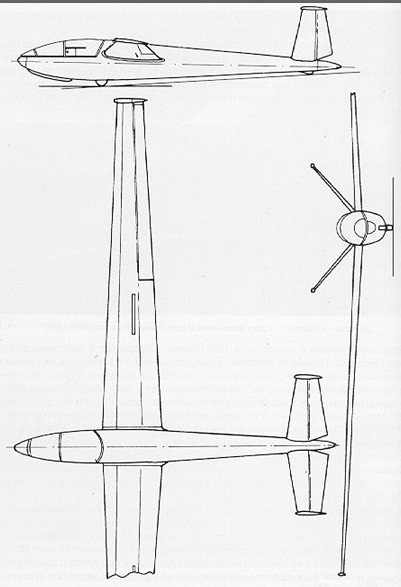
Of conventional wood and fabric construction, the Jastreb is a braced high wing monoplane with the centre section swept forward 5° at the quarter-chord line to improve the view from the rear seat, the absence of sweep on the outer panels enabling the spar to be uncranked. The wing is a single-spar wooden structure with leading edge plywood torsion box and is 30% fabric-covered; the wooden ailerons are plywood and fabric covered and there are spoilers in the wing upper and lower surfaces. The plywood-covered wooden fuselage has a metal nose-cap and the two pilots are seated in tandem under a sideways-opening Perspex canopy. The cantilever wooden tail unit is covered with plywood and fabric, and the landing gear consists of a fixed unsprung monowheel with no brake and a rubber mounted skid under the forward fuselage.
Span: 49 ft 2.5 in Length: 26 ft 3 in Wing area: 209.9 sq ft Aspect ratio: 11.55 Empty weight: 529 lb Max weight: 850 lb Max speed: 124 mph (in smooth air) Max aero-tow speed: 75 mph Min sinking speed: 2.95 ft/sec at 37 mph Best glide ratio: 20.5:1 mph
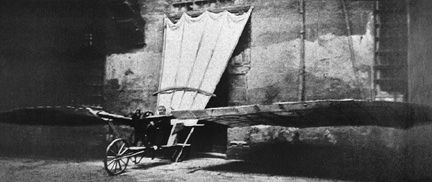
In 1881, Louis Mouillard wrote L’Empire de l’Air (Empire of the Air), in which he proposed fixed-wing gliders with cambered bird-like wings. He had been experimenting with gliders since 1856, and although his own gliders were unsuccessful, he realized the importance of gliding to the future of aviation – a perspective that was later shared by Otto Lilienthal. Photographed in Cairo, Egypt.







 All Aero