The Westmacott Skylark was a single-seat biplane glider built by R.J. & K. Westmacott at Minety. UK, in 1959.
Eventually it was stored at Minety.
The Westmacott Skylark was a single-seat biplane glider built by R.J. & K. Westmacott at Minety. UK, in 1959.
Eventually it was stored at Minety.
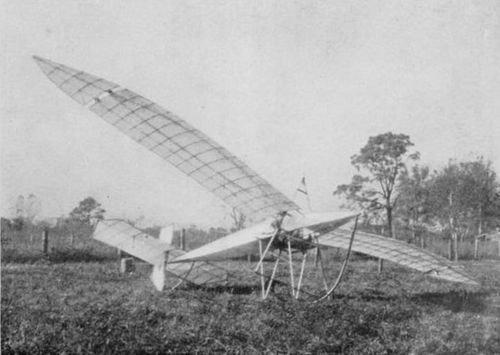
An aerodynamic design built by Daniel D. Wells of Jacksonville, Florida, during 1909/1910. Wells, an early inventor, patented the skid (US Patent 935075) and claimed to have made models with wing-warping already in 1897.
An aerodynamic design, designed and jointly built by a local mechanic, Daniel D. Wells, and a 21 year old machinist of the Seaboard Airline Railroad, Robert Kloeppel, who had just come to Jacksonville from Germany a few years earlier.
Unable to afford an aircraft engine at the time, they installed a Franklin automobile engine.
Kloeppel had received no flying instructions except those he read in a mechanics magazine, yet he shortly prepared the flimsy craft for takeoff. Flexing his piano wire controls he applied power and the plane moved rapidly about 75 feet and rose briefly four or five feet in the air, but when he sought to gain altitude by applying full power, the crankshaft suddenly broke and the plane settled down to earth, a complete wreck. Kloeppel was uninjured but never again built another plane or attempted to fly one.
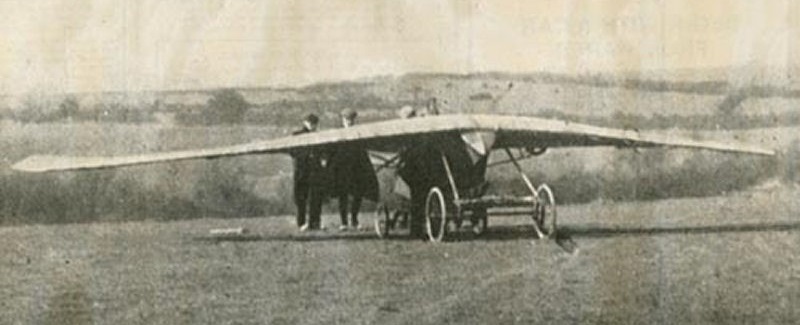
While working for Pemberton Billing, Eric Gordon England met José Weiss, who designed and built tailless gliders, and England became an assistant to Weiss. On 27 June 1909, Gordon England flew a Weiss glider (named Olive after one of Weiss’s five daughters), at Amberley Mount, Sussex, on a height-gaining flight that reached 100 feet. It is the first recorded soaring flight, and is considered to be the birth of the sport of Gliding.
Circa 1908 José Weiss designed and built tailless gliders, and Eric Gordon England became an assistant to Weiss.
On 27 June 1909, Gordon England flew a Weiss glider (named Olive after one of Weiss’s five daughters), at Amberley Mount, Sussex, on a height-gaining flight that reached 100 feet. It is the first recorded soaring flight, and is considered to be the birth of the sport of Gliding.

Built by Preston Watson, it was controlled by tilting the pivoted top wing.
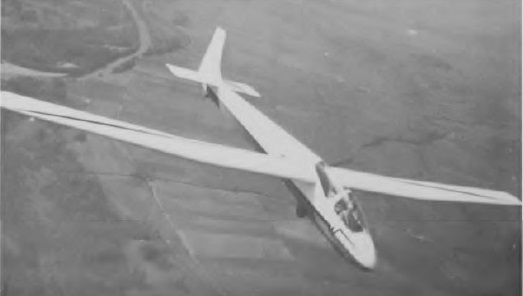
This tandem two-seat advanced training glider was the standard aircraft in this category for the French gliding clubs during the 1960s, and was developed from the WA 21 Javelot. Designed by M Maurice Collard, the first prototype Bijave made its maiden flight on 17 December 1958 and the second prototype, incorporating some improvements, first flew on 18 March 1960.
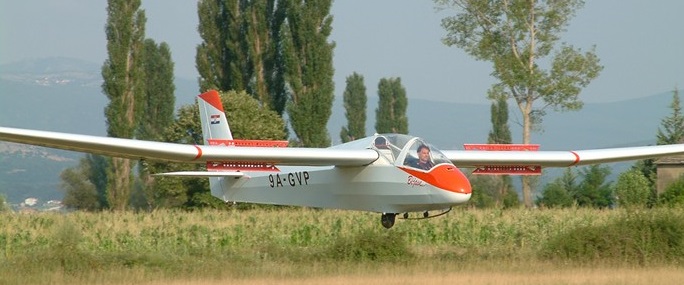
The Bijave is of conventional mixed construction very similar structurally to the Javelot; the cantilever wooden shoulder wings are in three pieces, with 4° 30′ dihedral on the outer wings and none on the centre section. They have single box spars and D type leading edge torsion boxes, with birch plywood covering forward of the spar and fabric covering aft of it; the plain spruce ailerons are also fabric covered. There are no flaps, but perforated Schempp-Hirth wooden air brakes retract into slots above and below each wing; wing tip ‘salmon’ fairings are also fitted. The fuselage is a welded steel tube framework covered with fabric, and with a glassfirbe nose cone. The two pilots sit in tandem under individual blown Plexiglas canopies, the rear seat being raised a bit to give its occupant a good view forward; a full range of instrumentation, a compass, oxygen and radio can be carried. There is a retractable monowheel with rubber ring shock absorption and a SATMO motor-cycle brake mounted aft of a rubber-sprung wooden nose skid, and there is also a steel tailskid. The cantilever wooden tail unit has a fabric-covered rudder, and the all-moving one-piece tailplane has large antibalance tabs.
The type soon went into production and over 300 were eventually built.
WA 30 Bijave
Span: 16.85 m / 55 ft 3.5 in
Length: 9.5 m / 31 ft 2 in
Height: 2.74 m / 9 ft 0 in
Wing area: 19.2 sq.m / 206.7 sq ft
Wing section: NACA 63821763615
Aspect ratio: 15.0
Empty weight: 295 kg / 650 lb
Max weight: 550 kg / 1,213 lb
Water ballast: None
Max wing loading: 28.6 kg/sq.m / 5.85 lb/sq ft
Max speed: 149 mph 130 kt / 240 km/h (in smooth air)
Max aero-tow speed: 93 mph / 81 kt / 150 km/h
Stalling speed: 32.5 kt / 60 km/h
Min sinking speed: 0.75 m/sec / 2.30 ft/sec at 47 mph / 42 kt / 78 km/h
Best glide ratio: 30:1 at 47 mph / 40.5 kt / 75 km/h
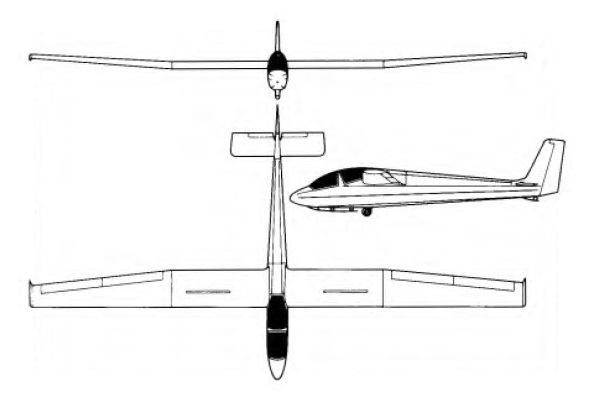
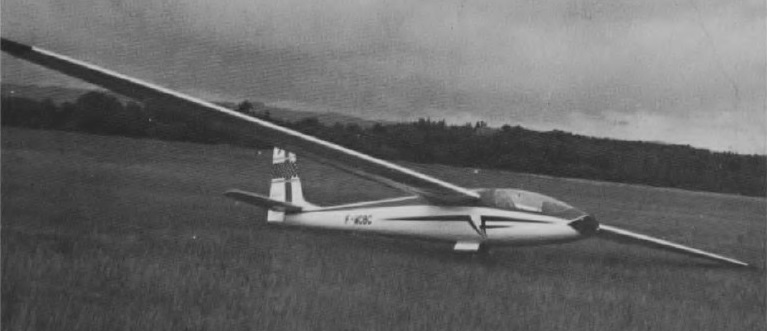
The WA 28 Espadon (or Swordfish) high performance single-seater is the all-glassfibre version of the earlier WA 26 Squale (or Shark), differing from it in having cantilever shoulder wings of the same span, area, aspect ratio and plan form but of glassfibre/plastic foam sandwich construction instead of the WA 26 Squale’s conventional wooden construction with trailing edge air brakes inboard of the ailerons; the Espadon has perforated Schempp-Hirth air brakes above and below the wings.
The WA 26 Squale first flew in prototype form on 21 July 1967; series production started in 1968 and by January 1970 a total of 85 Squales had been ordered. A version without the spring-loaded anti-tab in the allmoving one-piece tailplane was designated WA 26CM.
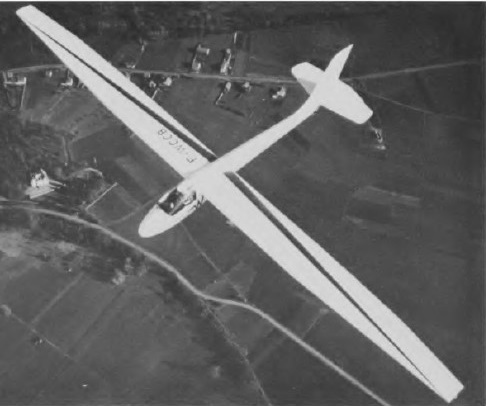
Design work on the Espadon began in 1972 and the prototype WA 28 made its first flight in May 1974, appearing at the Paris Air show in 1975 as F-CCBC, followed by the first production Espadon in November that year; 20 were on order by the spring of 1975. Both types have an oval section fuselage made of reinforced polyester plastics, with the pilot in an adjustable semi-reclining seat, with adjustable headrest and rudder pedals, under a long flush-fitting one-piece Plexiglas cockpit canopy that opens sideways to port. Comprehensive instrumentation is provided. Both types have a retractable monowheel mounted forward of the cg with a hydraulic brake; a fixed tailwheel is optional in place of the bumper fairing. The tail unit is a conventional wooden structure with fabric covering, with an all-moving one-piece tailplane with (on the Espadon) spring-loaded trimming.
WA 28 Espadon (Swordfish)
Span: 15.0 m / 49 ft 2.5 in
Length: 7.65 m / 25 ft 1.25 in
Height: 1.66 m / 5 ft 5.5 in
Wing area: 12.63 sq.m / 135.6 sq.ft
Wing section: Wortmann FX-61-163/60-126
Aspect ratio: 17.82
Empty weight: 245 kg / 540 lb
Max weight: 378 kg / 833 lb
Water ballast: None
Max wing loading: 29.92 kg/sq.m / 6.13 lb/sq ft
Max speed: 151 mph / 131 kt / 242 km/h (in smooth air)
Max rough air speed: 84.5 kt / 157 km/h
Stalling speed: 36.5 kt / 68 km/h
Best glide ratio: 38:1 at 56 mph / 48.5 kt / 90 km/h
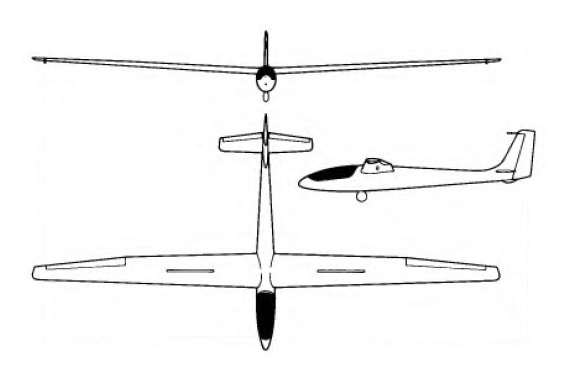
The WA 28 Espadon (or Swordfish) high performance single-seater is the all-glassfibre version of the earlier WA 26 Squale (or Shark), differing from it in having cantilever shoulder wings of the same span, area, aspect ratio and plan form but of glassfibre/plastic foam sandwich construction instead of the WA 26 Squale’s conventional wooden construction with trailing edge air brakes inboard of the ailerons;
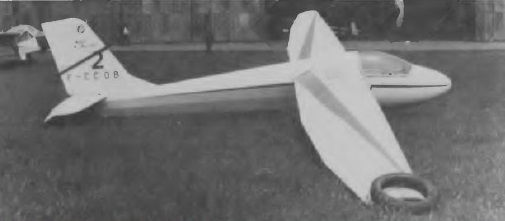
The Super Javelot is a single-seat Standard Class version of the WA 20 Javelot with three-piece instead of two-piece wings of 15m span and 5° 30′ dihedral on the outer panels, there being no dihedral on the centre section; the modified fuselage has the forward portion covered with three resin-bonded glass-cloth panels and the rear part fabric-covered, the nose now being longer and more streamlined and the blown plastic canopy redesigned. In addition, the fin and rudder are now swept back.
The cantilever wooden shoulder wings have single spars and the wooden ailerons are each in two parts operated differentially; there are perforated wooden air brakes above and below each wing, and small end-plate ‘bumper’-type fairings at the wing tips. The welded steel tube fuselage framework is now in two portions, the forward section having four longerons and the rear part only three, both sections being differently covered to those of the Javelot. The cantilever tail unit is of wood, with a trim tab in the one-piece elevator. Landing gear consists of a rubber-sprung nose skid with a non-retractable monowheel mounted aft of it; this has a brake linked to the wing air brake control, and there is also a rubber-sprung tailskid. The pilot sits in a canvas seat and there is provision for radio and oxygen.
The prototype Super Javelot first flew on 26 June 1961 and the type succeeded the WA 21 Javelot in production; in 1964 two Supers a month were being turned out.
A number of refinements were introduced on the 1964 model, which was known as the Super Javelot 64; these included a modified leading edge for improved performance at low speeds, modified wing roots to improve airflow at the wing/fuselage junction, increased dihedral of 5° 30′ on the outer wing panels and the use of birch plywood to cover the entire wings to give better laminar flow.
The Wassmer WA 23, of which the prototype first flew on 6 August 1962, was an experimental ‘one-off’ sailplane used to test a new 18m (59ft 0in) span wing with an aerofoil section developed by M Maurice Collard; this had an aspect ratio of 22 and was married to the fuselage of a WA 22 Super Javelot.
Super Javelot 64
Span: 49 ft 2.5 in
Length: 23 ft 2 in
Height: 6 ft 3 in
Wing area: 155.0 sqft
Aspect ratio: 15.7
Empty weight: 452 lb
Max weight: 750 lb
Max speed: 124 mph
Min sinking speed: 2.29 ft/sec at 50 mph
Best glide ratio: 30:1
WA 22 Super Javelot
Wing span: 15.0 m / 49 ft 2.5 in
Length: 7.06 m / 23 ft 2 in
Height: 1.9m / 6 ft 3 in
Wing area: 14.4 sq.m / 155 sq ft
Wing section: NACA 63821 /63615
Aspect ratio: 15.7
Empty weight: 205 kg / 452 lb
Max weight: 350 kg / 750 lb
Water ballast: None
Max wing loading: 24.3 kg/sq.m / 4.84 lb/sq ft
Max speed: 108 kt / 200 km/h
Stalling speed: 33 kt / 61 km/h
Min sinking speed: 0.7 m/sec / 2.29 ft/sec at 43 kt / 80 km/h
Max rough air speed: 70 kt / 130 km/h
Best glide ratio: 30
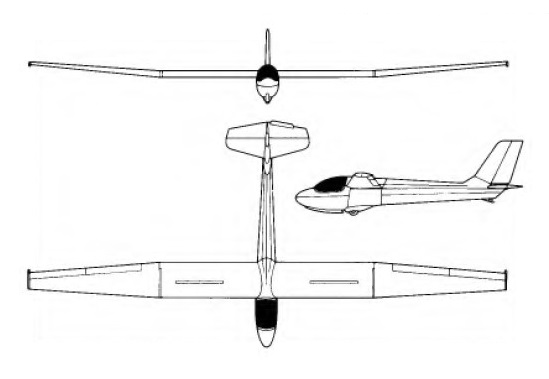
The WA 20 Javelot (or Javelin), designed by Maurice Collard, made its first flight in August 1956, and was intended to meet the growing need of the French gliding clubs for a single-seater of good performance and uncomplicated construction to replace the now obsolescent German designs such as the Weihe and the Nord 2000 (the French-built DFS Meise) and early postwar French types such as the Arsenal Air 100 that were then in service.
The Javelot marked Wassmer’s entry into sailplanes and was of conventional mixed construction, the cantilever shoulder wings being of wood with a single box spar and D-type leading edge torsion boxes; there are air brakes above and below each wing, and small endplate ‘bumper’-type fairings at the wing tips. The wings are in two pieces and joined with two cylindrical pins, being rigged to the fuselage with four securing pins. The fuselage is a steel tube framework covered by fabric and is distinguished by a rather blunt nose and a flush-fitting cockpit canopy that is curved longitudinally but has flat sides and a flat curved top. There is a non-retractable monowheel with a brake aft of the rubber-sprung nose skid, and a tailskid. The tail unit is a cantilever wooden structure with a trim tab in the one-piece elevator.
Span: 52 ft 9 in
Length: 23 ft 2 in
Wing area: 166.9 sqft
Aspect ratio: 16.7
Empty weight: 430 lb
Max weight: 728 lb
Max speed: 124 mph (in smooth air)
Min sinking speed: 2.2 ft/sec at 47 mph
Best glide ratio: 29:1 at 50 mph
 All Aero