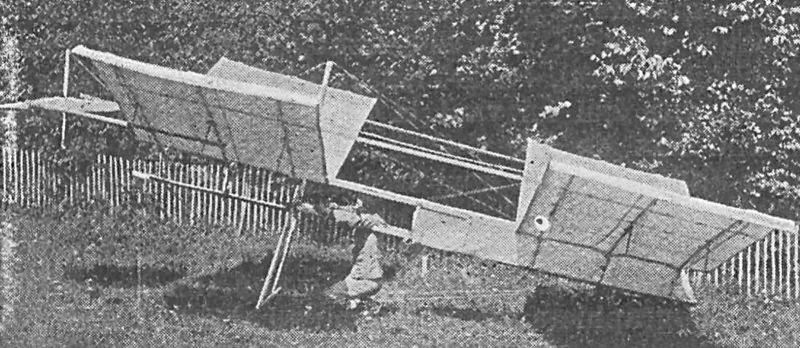
This circa 1905-1908 Langley-type tandem wing glider was one of several built by the famous pilot (and slightly less famous designer) Louis Paulhan and Louis Peyret during the former’s military service as “aérostier” at Chalais-Meudon.
This circa 1905-1908 Langley-type tandem wing glider was one of several built by the famous pilot (and slightly less famous designer) Louis Paulhan and Louis Peyret during the former’s military service as “aérostier” at Chalais-Meudon.
One of the very few water-based gliders, the Sea-Sky was designed and produced in the early 1960s by Partenavia of Naples. The Sea-Sky was a small single-seater with the pilot seated in a single-step speed boat-like wooden semimonocoque hull, with a small water rudder under the step, and the cantilever tail unit, of fabric covered metal construction, carried on a steel tube tail boom. The tailplane is a one-piece all-moving surface, with a tab on the port trailing edge. The braced parasol wing is of constant chord and is carried on an inverted vee steel tube structure at the rear of the hull, with steel tube bracing struts at the sides; the wing is a two-spar wooden structure, fabric-covered, with plain fabric-covered wooden ailerons and small fixed floats at the squared-off wing tips. The pilot sits in an open cockpit and has an overhanging control column and conventional rudder bars; the Sea-Sky is designed to be towed behind a motor boat. It is, however, capable of free flight and the wings and tailplane can be easily removed for transport and storage.
Span: 24ft 7in
Length: 20 ft 0 in
Height: 7 ft 3 in
Wing area: 121.1 sqft
Empty weight: 187 lb
Max weight: 375 lb
Min sinking speed: 4.90 ft/sec at 33.5 mph
Best glide ratio: 9:1
In the postwar period, Luigi “Gino” Pascale and his brother Giovanni “Nino” Pascale of Naples, Italy, having been enthusiastic flying model aircraft makers, decided to work on full-scale aircraft. The first, built while the brothers were college students, was the “P.48 Astore (Goshawk)” — a two-seat aircraft, with the seats in tandem, featuring a high strut-braced wing, fixed taildragger landing gear, and a Continental O-170 / A65 flat-four air-cooled engine with 48 kW (65 HP).
One Astore was built, performing its initial flight in 1952 — by which time Luigi Pascale had become an instructor in mechanical engineering at Naples University, where he would become a full professor and help establish a department of aeronautical engineering. The Astore was followed by other one-off designs:
P.52 Tigrotto (Tiger Cub)
P.53 Aeroscooter
P.55 Tornado
P.57 Fachiro
The Fachiro I was followed by three “Fachiro II” and then 33 “Fachiro III”.
Partenavia Costruzioni Aeronautiche Spa, a Naples company formed in 1949 to build series of light aircraft. First to enter production was the P-57 Fachiro of 1957, a four-seat high-wing monoplane with Lycoming engine. This was followed by various developments including the P.64 Oscar (first flown April 1965), also produced in South Africa under license as the RSA.200 by AFIC (Pty) Ltd, and the P.66 Charlie. Partenavia’s first twin was the P.68 six-seat light transport, first flown in May 1970. It was subsequently placed into production in several forms, including the Observer 2 for observation and patrol. AP.68 TP-600 Viator 11 seat transport followed in March 1985. New projects in the early 1990s included PD.93 Idea four-seat trainer and utility monoplane, but in March 1998 Partenavia ceased work and its P.68 series was bought via auction by VulcanAir SpA.
After financial difficulties the company reappeared, in 1986, as Costruzioni Aeronautiche Tecnam (see Tecnam).
In 2008, Partenavia, an Aeritalia division, announced a decision to transfer manufacturing of single engined aircraft, including the mosquito, to fellow Aeritalia subsidiary Aviolight, which was floated at the end of February 2008.
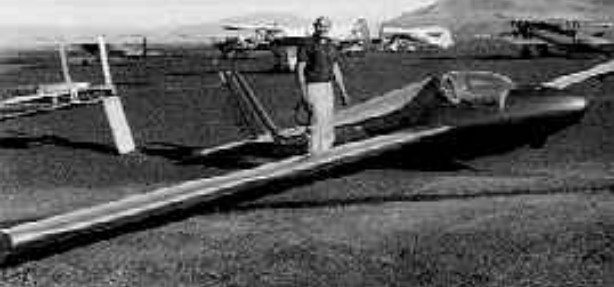
Designed by W.L.Parker, the Ranger originally had a retractable 11 kW/ 15 bhp engine and a 78 cm/ 31 in propeller. The Ranger was unable to take off on its own, so the Righter engine was fitted instead to give self- launch capability. It has a fixed main wheel plus a wheel in the nose, and no glidepath control devices.
Construction is all aluminum, with a laminated aluminum spar.
Engine: 26 kW/ 35 bhp Righter
Wing span: 11.43 m / 37.5 ft
Aspect ratio: 12
Wing area: 11.33 sq.m / 122 sq.ft
Gross Weight: 91 kg / 200 lb
Payload: 263 kg / 580 lb
Empty weight: 354 kg lb / 780 lb
Wing Load: 31.24 kg/sq.m / 6.5 lb/sq.ft
L/DMax: 18
Airfoil: NACA 4418
Seats: 1

The sole wood and fibreglass T-Bird built first flew in 1962 and placed 8th in the Nationals that year flown by its designer/ builder Ray Parker. It was acquired by the Santa Maria (CA) Museum of Flight
Wing span: 15.45 m / 50.7 ft
Wing area: 11.15 sq.m / 120 sq.ft
Gross Weight: 329 kg / 725 lb
Empty Weight: 247 kg / 545 lb
Payload: 82 kg / 180 lb
Wing Load: 29.51 kg/sq.m / 6.04 lb/sq.ft
L/DMax: 34
MinSink: 0.61 m/s / 2.0 fps / 1.18 kt
Airfoil: Wortmann FX 05-191
Seats: 1
Aeronca C-2 G-ABHE c/n A100 was converted to a glider by H.J. Parham in 1937, at Farham, UK, after an inflight engine failure and forced landing.
The nose was faired in after the removal of the engine. It first flew as a glider at Bordon, Hampshire, on 15 May 1937, retaining the original registration of G-ABHE c/n A100.
It went to the Dorset Glider Club but was destroyed at Maiden Newton in the club hanger during a storm in November 1938.
Wingspan: 10.97 m / 36 ft 0 in
Wing area: 13.94 sq.m / 150 sq.ft
Aspect ratio: 8.4
Wing section: Clark Y
Empty weight: 122.47 kg / 270 lb
Seats: 1
The D-8 was designed by Ken Coward as an all-metal glider, easy-to-built home construction project. One belongs to the National Soaring Museum. Three were built.
Pacific D-8
Span: 9.68 m./ 21.75 ft
Area: 9.29 sq. m. / 100 sq.ft.
Aspect ratio: 10
Airfoil: NASA 4418 (mod)
Empty weight: 115 kg. / 253 lb.
Payload: 94 kg / 207 lb.
Gross weight: 209 kg / 460 lb.
Wing loading: 22.40 kg. / sq. m. / 4.6 lb. / sq. ft.
L/D max. 17
Min. sink 1.28 m/s / 4.2 fps / 2.49 kt
Seats: 1

A glider built by Barnard Owen, a chemist of Christchurch, New Zealand, before 1936. A biplane design, featuring a large rudder and an upper wing that appears to pivot.
After completing aviation courses, Bronius Oškinis led the construction of gliders in ATM workshops. Reconstructed the German training glider RRG-23 “Zoegling” and thus in August 1932 developed the Lithuanian T-1 (“Technikas-1”) glider. In Pažaislis.
The Technikas-1 was an improved RRG-23 Zögling (based on German drawings). One was built. The first flight was performed by B. Oškinis himself. This glider was tested by military pilot Gregorius Radvenis. The T-1 was used to test/train Lithuanian military pilots at Kaunas
During 1935-36 four ‘production’ version of the T-1 were built, re-named BrO-1.
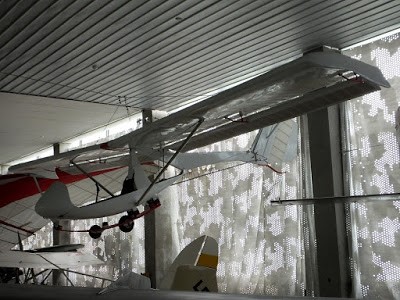
The BRO-23KR was designed by Bronis Oškinis and constructed by Česlovas Kisonas and K. Rinkevičius (the KR of the name) at the Kaunas hang gliding club.
The BRO-23KR is a glassfibre aircraft with a strut and wire-braced high wing and a pod and boom fuselage with an open-sided cockpit and a T-tail. Its wing is rectangular in plan out to blunted and turned-down tips and both its single spar and ribs are formed from woven glassfibre. Three-ply glasscloth skin ahead of the spar forms a torsion resistant D-box. The narrow trailing edge of the wing was cast in epoxy with spanwise glassfibres and glasscloth covered. The whole wing was then covered with glued and thermally bonded, transparent polyethylene terephthalate film. It has narrow, full span, slotted ailerons, operating in co-ordination with rudder deflections and built in the same way as the wings. Single struts on each side brace the spar to the lower fuselage.
The fuselage of the BRO-23KR is formed from two GRP halves and attached to the wing centre-section. It has a long, shallow open cockpit which stretches back under the wing with the pilot in a reclined position. The tail unit, constructed in a similar way to the wing, has a highly swept, near-rectangular fin with a high aspect ratio horizontal tail mounted on its top. Its rather angular rudder, on a backward-leaning hinge, is large.
The BRO-23KR has very adaptable landing gear based on a landing skid sprung on five rubber blocks, which stretches nearly from the nose to just aft of the spar. The skid is wide enough to land on snow but can be fitted with a tyred wheel in summer. More unusual attachments include a set of introductory tricycle wheels and floats for landing on water. There is a long, self-sprung GRP landing skid under the tail.
It first flew in 1981.
Only two BRO-23KRs were constructed, the prototype and one built in 1984 by Panévežio Atsk. One took part in the 2nd World Championship, an Eastern European series gliding contest distinct from the FAI event, where it showed distinct improvements over earlier Soviet primary gliders. Both aircraft remained airworthy in 2015.
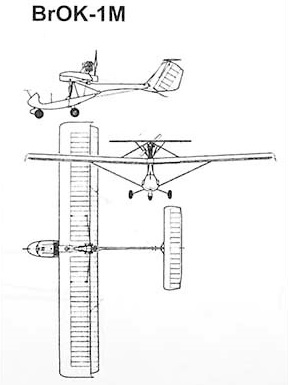
In 1982, Kišonas, Česlovas and Rinkevičius, K. (who had built the BrO-23KR glider) adapted a 25 HP engine on the BrO-23KR which thus became the BrOK-1M. The added K designates KIŠONASr.
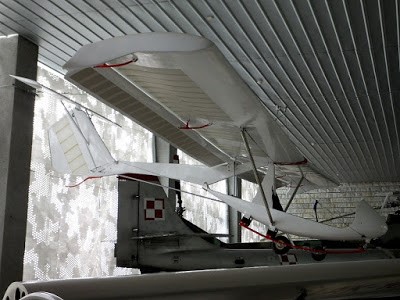
In 1982 the prototype was motorized into the BROK-1M, with a largely uncowled, pusher configuration, 25 hp (19 kW) engine. Its installation, designed by Kišonas, placed it well above the rear part of the wing on forward and aft transverse V-struts from the central wing mountings, laterally braced on each side by a long strut out to the wing. It used the tricycle landing gear.
In 2009 one airframe remained in the Sport Aviation Museum in Kaunas.
Wingspan: 8.20 m (26 ft 11 in)
Wing area: 10.40 sq.m (111.9 sq ft)
Aspect ratio: 6.5
Airfoil: GA(W)-1
Length: 6.40 m (21 ft 0 in)
Height: 2.2 m (7 ft 3 in)
Empty weight: 83.5 kg (184 lb)
Gross weight: 158.5 kg (349 lb)
Maximum speed: 100 km/h (62 mph, 54 kn) smooth air
Stall speed: 42 km/h (26 mph, 23 kn)
Maximum glide ratio: 15
Min sink: 1.1 m / s (200 ft/min)
Seats: 1
 All Aero