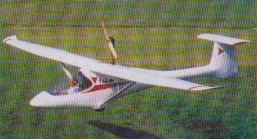
The Tukan features a composite fuselage and fabric covered wood wings. Air brakes are fitted on the upper wing surface. The engine can fold back to inside the fuselage.
Engine: Rotax 447, 40 hp Wing span: 14.7 m Wing area: 14.7 sq.m MAUW: 420 kg Empty weight: 215 kg Fuel capacity: 32 lt Max speed: 125 kph Cruise speed: 85 kph Minimum speed: 60 kph Climb rate: 2 m/s Fuel consumption: 8 lt/hr Seats: 2
A development of the Preiss RHJ-8 (itself a T-tailed, larger span, improved version of the RHJ- 7), the RHJ-9 is similar to its predecessors, but with a larger span wing. The wing has foam ribs bonded to the aluminum spar and skins with PVC ribs. It first flew in 1978.
Wing span: 18.29 m / 60 ft Wing area: 14.38 sq.m / 154.8 sq.ft Empty Weight: 304 kg / 668 lb Payload: 196 kg / 432 lb Gross Weight: 500 kg / 1100 lb Wing Load: 34.77 kg/sq.m / 6.94 lb/sq.ft L/DMax: 38 MinSink: 0.70 m/s / 2.3 fps / 1.36 kt Aspect ratio: 26.6 Airfoil: Wortmann 63-3-318 Seats: 2
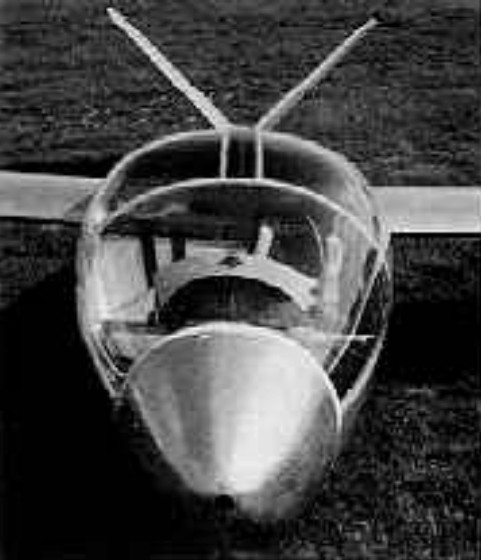
In 1966 Henry Preiss converted an all metal Schreder HP-14 into a 2-place ship with side-by-side seating (two sets of rudder pedals and a center control stick with a bar that swings from one side to the other) and a fixed landing wheel. The design used standard HP-14 wings with a 2-ft center section added in the fuselage.
The Pratt-Read had two distinctions for a World War II training glider; the side-by-side seating and that it was the only training glider designed for the U.S. Navy. After release by the Navy, the LNE-1’s were acquired by the Army Air Corps which used some for a thunderstorm research project. Pratt-Read was a piano manufacturer and the G1 its only glider project. It has Schempp-Hirth type airbrakes. It won the multi-place world record for Absolute Altitude 13,489 m. / 44,255 ft. flown by Larry Edgar and H. Klieforth in 1952. One belongs to the National Soaring Museum.
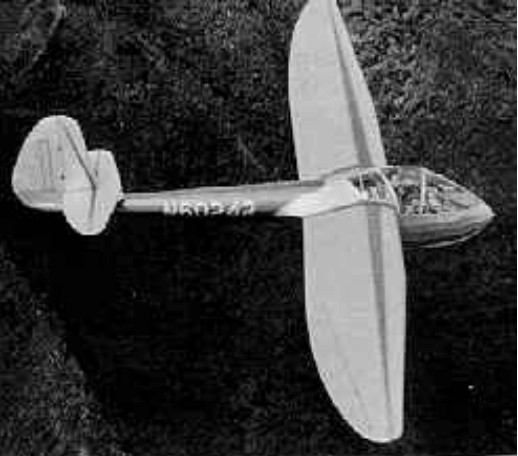
Designed by M. Gluhareff, P. Leonard, J. Buxton, R. Stanley, H. Struck and R.W. Griswold, the PR-G1 has wood/ fabric wings and tail wood aft fuselage, steel-tube/ fabric forward fuselage.
This particualar airplane, N60242, crahsed about 1962 in Waimanalo, Oahu, from a low-altitude spin. Spin came from a low-altitude turn chasing a thermal in the landing approach! The pilot suffered back injuries but the ship was destroyed. Elevator and instrunments were recovered intact but everything is still in the gulch where it crashed. Pilot was a very light person and nose ballast may have been removed during a prior overhaul, as the aircraft was used to set a 71-hr aloft soaring record and all possible weight was removed to allow for supplies to be carried. Ted Ralston
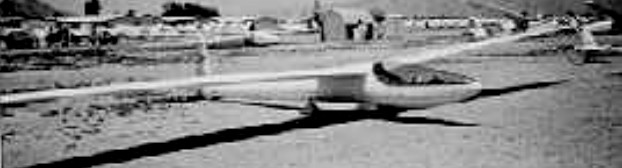
The White Knight was designed in 1963 while Posnansky was a student in Switzerland, but later has been substantially modified. It has a faired fixed landing gear and speed limiting dive brakes on both upper and lower surfaces, a center of gravity tow hook and a side-mounted control stick. The ship’s similarity in looks to the Swiss FFA Diamant is evident: it was designed during the same period when the predecessor to the Diamant was under development in Switzerland, and while that aircraft first flew with Schleicher Ka-6 wings, the White Knight used Schleicher Ka-8 wings.
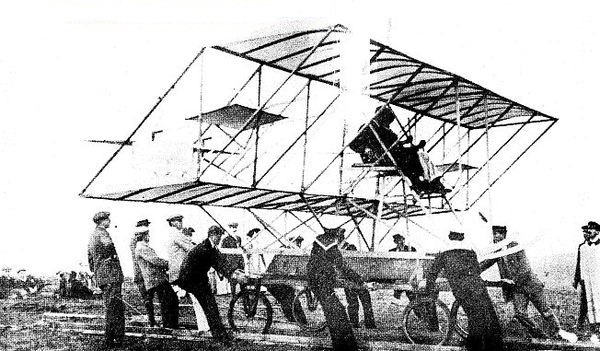
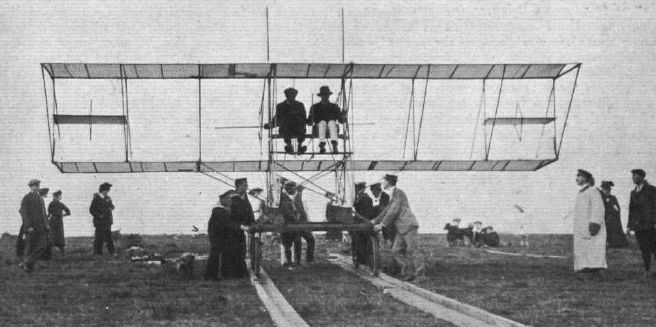
Porte and Pirie were both lieutenants in the Royal Navy when they designed and built this biplane. It was taken to Portsdown Hills, Portsmouth for a trial on 17th September 1909.
To quote “Flight” magazine for 25th September 1909; “With both officers seated in it the machine was mounted on a trolley and run along a temporary track, but it failed to rise, and eventually pitched forward and collapsed, both officers being thrown out, but escaping unhurt.” One of the designers, John Cyril Porte, who went on to have a successful career within aviation, was closely involved with the Curtiss biplane “America” intended to have made a pre-war trans-Atlantic flight.
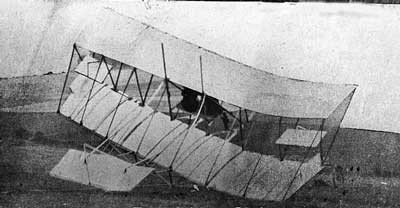
A 1926 glider for basic flight instruction. The Poppenhausen 1926 design was similar to the light gliders of that days, but it was larger and capable of carrying two persons.
Length: 23.524 ft / 7.17 m Height: 5.84 ft / 1.78 m Wingspan: 47.9 ft / 14.6 m Crew: 2
In 1923, in the wake of the Castar, Paul PONCELET designed a second aircraft, this time two-seater, sponsored by Jean-Baptiste Richard, for participation in the Daily Mail competition, which was to take place in Lympne, Kent, England, on October 12 and 13, 1923.
Jean-Baptiste Richard was the representative of the Handley-Page Company in Belgium and also of the ADC Ltd (Aircraft Disposal Company) which liquidated the English planes and engines surplus from the war of 14-18. He was the first assignee of the right to install and operate an aerodrome at Saint-Hubert (Belgium) in May 1925, a right that he will cede in the following months to José ORTA (who was the owner of the aerodrome and constructor – aircraft finance).
Paul Poncelet was the head of the wood construction workshop of SABCA (Société Anonyme Belge de Constructions Aéronautiques) and the machine was built in the workshops of this company which did not hesitate to encourage its executives in technical innovation projects. in the field of aviation.
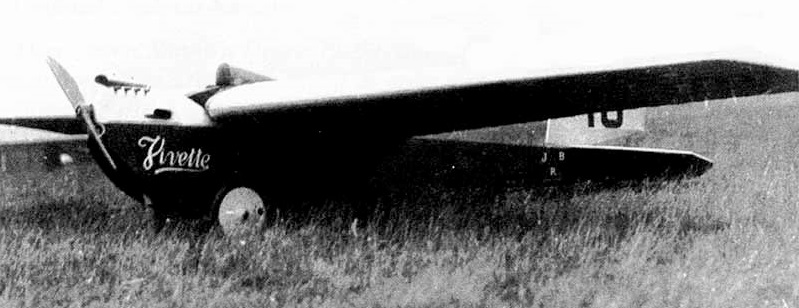
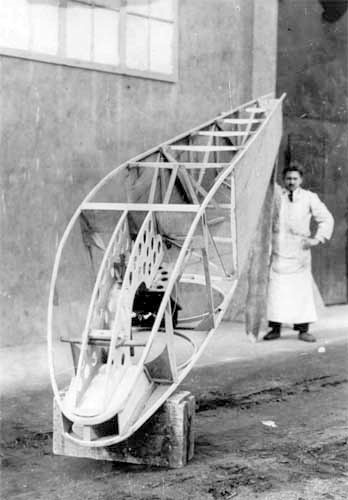
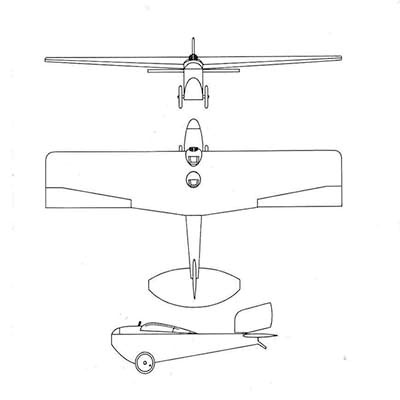
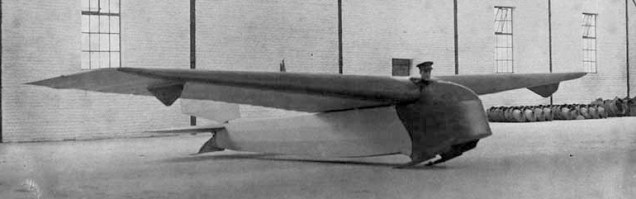
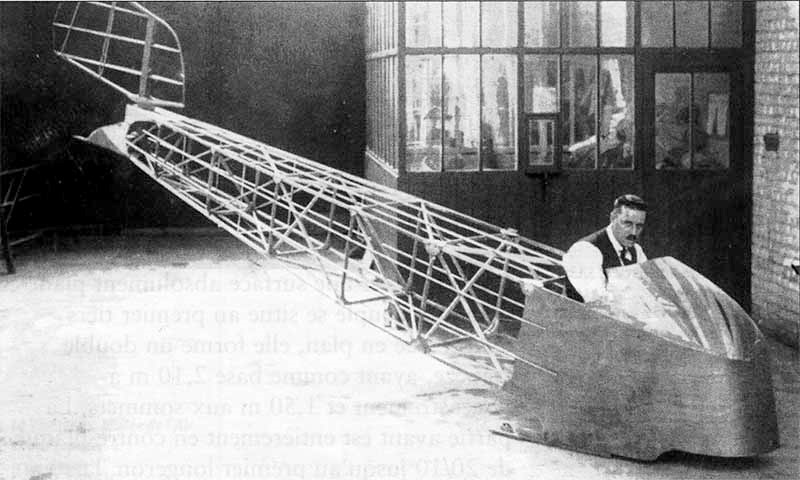
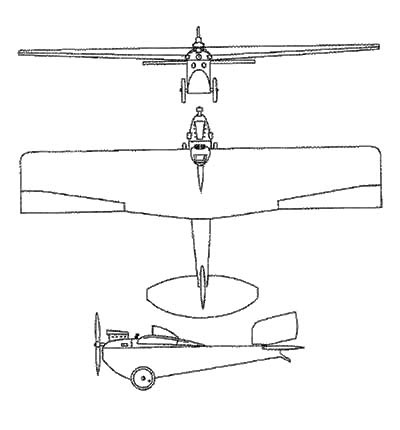
The aircraft was called Vivette, in homage to Jean-Baptiste Richard’s daughter, Geneviève, who was nicknamed Vivette by her family. The Vivette is an airplane derived directly from the Castar, to which Paul Poncelet has made some significant modifications. The fuselage, thinner than that of the Castar, was shortened by about twenty centimeters, and a second station could be installed in tandem by a circular cutout in the thick wing. The fuselage is completely clad in thin plywood.
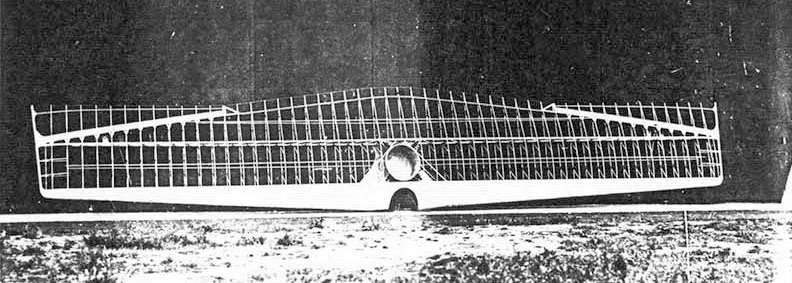
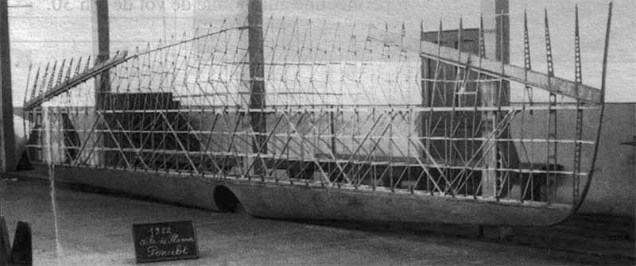
The wingspan of the cantilever wing was 1.80 meters, bringing the wing area to 24 m² so as not to increase the wing loading compared to that of the Castar single-seater. The Poncelet Vivette made its first flights in the hands of Victor Simonet at the end of the summer of 1923. and, although not quite ready, was entered by its owner JB Richard (“That very good friend of England “as said in the magazine” The Airplane “of October 17, 1923) at the Lympne competition (England) at the end of September 1923 with Lieutenant Baron Kervyn de Lettenhove as pilot. The fuselage is thinner than that of the Castar, and the lander
Structure of the Vivette’s wing – Note the hole in the rear seat of the two-seater
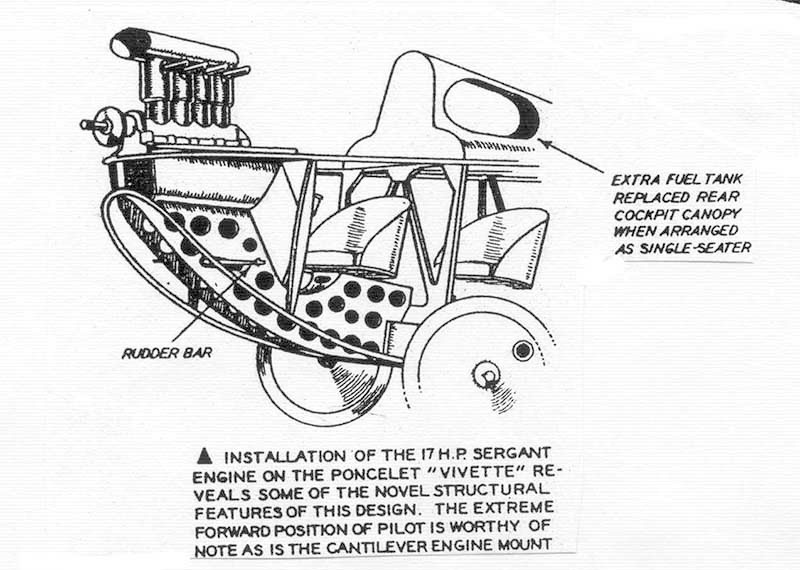
It can be configured as a glider, single-seater or two-seater, by adding a second seat directly behind the pilot’s seat, in place of the fuel tank.
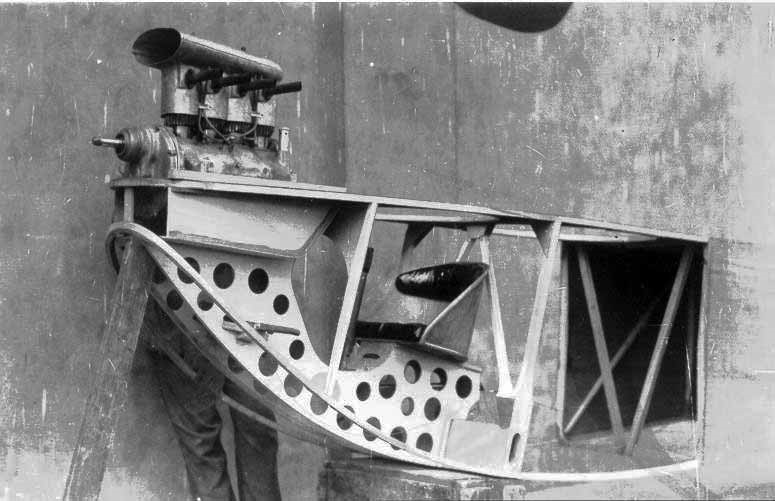
But it was easily converted into a aircraft with the installation of a Sergant engine, 4 cylinders in line, 780 cc, developing a power of 17.5 hp at 3500 revolutions / minute.
In the motor version, the rear seat was removed and a fuel tank could be installed on the wing.
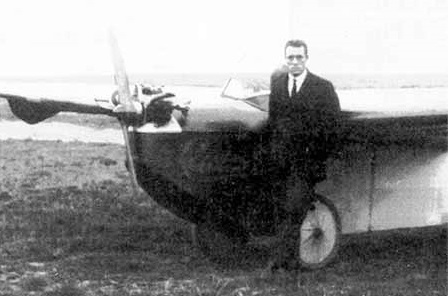
Structure of the front of the fuselage -The Sergant engine is in place
The British Royal Aero-Club organized in October 1923, in Lympne, Kent (England), a richly endowed competition, reserved for moto-aviettes (light planes equipped with low-power engines). Three prizes were contested: a distance competition with given consumption, a speed competition and an altitude competition.
La Vivette made its first flights in the hands of Victor Simonet at the end of the summer of 1923. The aircraft was registered O-BAFH with certificate n ° 88 dated October 1, 1923, very shortly before its departure for Lympne.
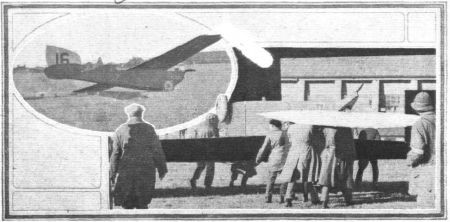
The motorized gliders of Paul Poncelet, Castar and Vivette were registered for the Lympne 1923 meeting by Jean-Baptiste Richard and J.A. de Ro, respectively, but only for the altitude competition. The Vivette went to England on its own, flying over the English Channel piloted by baron Kervyn de Lettenhove, together with the Castar piloted by Victor Simonet. Competition number 16.
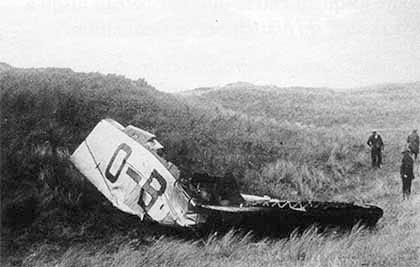
But during the competition, piloted by lieutenant baron Kervyn de Lettenhove, she had no luck: she was damaged during a take-off: When he started to rise, the pilot turned slightly to the left, but at the same moment a gust of wind lifted the right wing. This caused a sudden slip and a violent shock of the left wheel. Another gust lifted the tail of the craft which ended up on its back. Fortunately, the pilot got off without injury. A special feature of these airplanes is the position of the fuel tank, which is located just behind the pilot’s head, serving as protection for the latter in the event of an impact. In fact, during the accident, the tank played its protective role.
The Vivette accident on takeoff: the left wing touched the ground under the effect of a gust of wind, and the aircraft turns over, without damage to the pilot. He is brought back to the hangars still in its back position.
On the return from Lympne, two-seater flights were successfully carried out, with Victor Simonet as pilot, and Mr. Demonty, technical director of SABCA as passenger.
An article in Flight of December 27, 1923, indicates that: “On November 26 (1923) the Belgian light monoplane Poncelet” Vivette “carried out several flights with pilot and passenger, although its engine had a displacement of less than 800 cc” The Vivette began a series of records on November 23, 1923 by making a eleven-minute flight at an altitude of twenty meters with Victor Simonet as pilot and Mr. Demonty (technical director of SABCA) as passenger: The total weight of the machine exceeds 380 kg. With a bearing area of 24 sq,m, the weight per square meter is 15 kg and the weight per HP exceeds 25 kg, which is a world record.
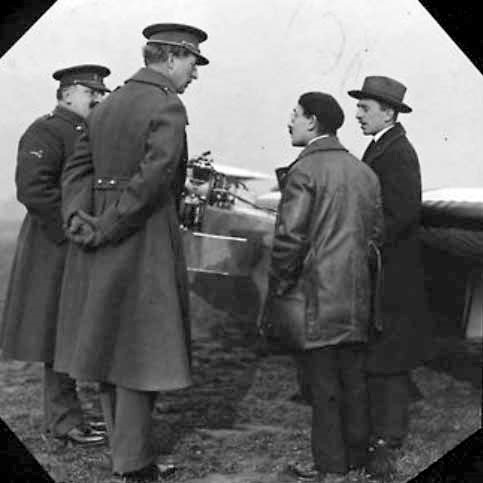
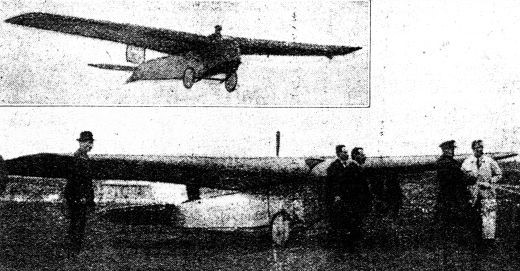
Visit of King Albert I of Belgium – Évère Aerodrome, November 20, 1923 From left to right: Major Smeyers, King Albert Iier, Paul Poncelet, Lieutenant Simonet and Kervyn de Lettenhove. The hood was removed, showing the Sergant engine. A plywood panel seems to have been replaced and “Vivette” has not been repainted yet?
“From a correspondent we have received the accompanying illustrations of Belgian light planes and of a visit paid by King Albert to the aerodrome to inspect these machines. This special royal visit took place on November 20, when the following four Belgian light ‘planes were present : The Poncelet “Castar” type, familiar from Lympne; the Poncelet “Vivette,” equally well known; the EMA biplane, designed and built by the Military Aviation School; and the Jullien SABCA monoplane, built by the Societe Anonyme Belge de Construction Aeronautique . His MAJESTY showed great interest in the construction of the machines explained to him by the various constructors, and was much impressed by the flying qualities of the different types, especially admiring the sharply-banked turns and the good speed range. “
From left to right: Major Sweyers (?), King Albert 1st, van Opstal (pilot) and Mathieu Demonty
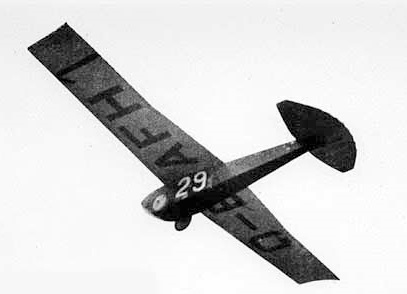
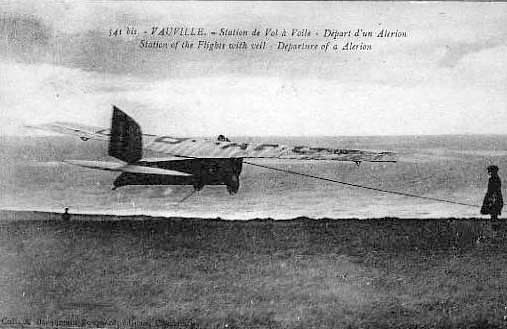
It was in 1925, in Vauville, that the Vivette won its laurels by participating in the Experimental Congress as a glider [competition number 29]. Commander MASSAUX established a world record for the duration of flight without an engine with 10 hours 19 minutes and 43 seconds, and won the “Petit Parisien” cup for a 52-kilometer engineless flight, with 52 turns.
Duration bonus of 800 francs for each flight: July 26, 1925: Poncelet Vivette (Cdt Massaux), 10:19:43 a.m. (world record) July 28, 1925: Poncelet Vivette (Cdt Massaux), 2 h 3 m 15 s August 1, 1925: Poncelet Vivette (Cdt Massaux), 4:29:21 a.m.
The Vivette in flight, glider version – Vauville 1925
The glider was donated by J.-B. Richard to the Air Museum (Brussels) in July 1926. The aircraft was cancelled by the Aeronautical Administration on January 31, 1931.
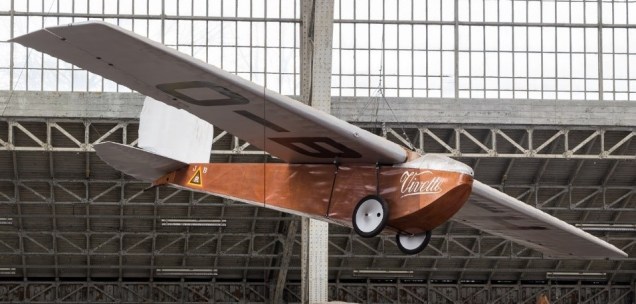
It was restored in 1995, in the workshops of Roger Poncelet (grandson of Paul), under the patronage of SABCA, on the occasion of the company’s 75th anniversary. It has since been exhibited in the aviation hall of the Royal Museum of the Armed Forces and of Military History in Brussels, in glider configuration.
Engine: Sergant Type A, 17.5 hp Wingspan: 13,0 m Wing area: 24 sq.m Length: 6,30 m Height: 1,50 m Empty weight: 140 kg Wing loading: 9-10 kg/sq.m Max speed: 95 km/h
The Castar in its very first glider configuration.
Paul Poncelet, Belgian craftsman expert in woodworking, had already made a first plane, inspired by the Antoinette, in 1908. He was hired at the SABCA (Société Anonyme Belge de Constructions Aéronautiques, which had been created in 1920) as foreman, quickly becoming head of the timber section of the company. Passionate about gliding, which began across the Rhine, it was not long before he designed a glider. It began construction in June 1922, in a cellar on rue Saint-Vincent, in Brussels, with rudimentary means. He devoted all his free time and evenings to it for eight months.
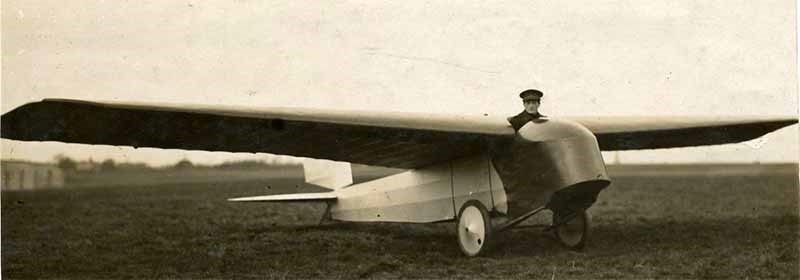
The Castar is made entirely of wood (except wheels, axle and stick). The fuselage of rectangular section, with slightly rounded sides, is profiled at the front with a plywood covering 1.5 mm by 1.5 meters long and canvas on the rear. The canvas is placed on longitudinal rails. The cockpit is embedded in the leading edge of the indented wing which serves as the back of the pilot’s seat.
The aircraft is a monoplane with a 20 sq.m thick cantilever wing. The depth is 380 mm at the root, gradually decreasing towards the tips. The wing seen in plan forms a double trapezoid of 2.10 m chord at the root and 1.50 m at the ends.
The front part is formed in 2 mm plywood up to the first spar, the rest is canvas. The trailing edge is a 2mm string.
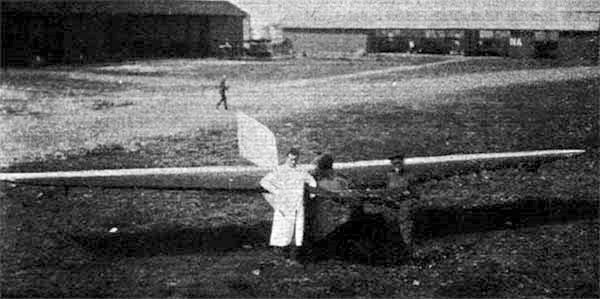
The final assembly of the machine is done in the SABCA workshops in Haren-Evère. On February 10, 1923, on Evère aerodrome, Lieutenant Victor Simonet, pilot at SABCA, made it take off over a distance of 115 meters, launched with the bungee cord, despite the total absence of wind.
Poncelet glider – probably in February 1923, on the Evère aerodrome
“Finally, on February 10, 1923, in front of many enthusiasts and photographers who suspected that we would proceed to tests, that day at 2 pm, everything is ready. We try the controls, the control surfaces work well and the aircraft is driven on the plain of Haren. Mr. Simonet, who must pilot it, designates the place and the direction in which he wishes to carry out the tests. He stops the details of the launch mode, the placement and the tension of the bungee cords, restraint of the device and the various commands it will give. promptly executed, the glider frees itself and performs its first flight, gliding in a straight line, a few meters above the ground, for a few seconds. Despite the falling night and the weak wind, Victor Simonet carried out three new very successful flights, one of which was 115 meters at heights of about 5 meters. “ La Conquète de l’Air, March 1, 1923
Note: Note that this was the first flight of a glider ever designed and built in Belgium.
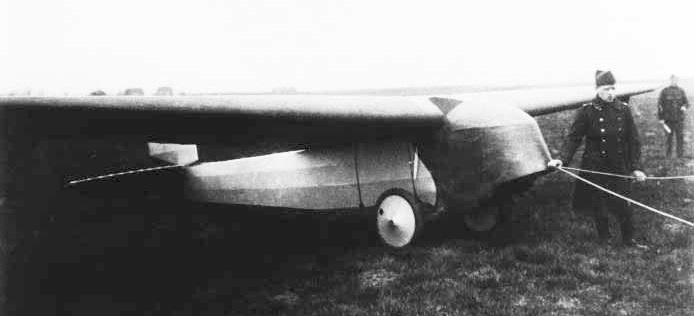
February 10, 1923: preparations for the first launch at the bungee cord – Evère aerodrome
On February 11, 1923, despite a total lack of wind, towed by a car, Simonet made a dozen flights, the most noticeable of which was 225 meters at a height of 20 meters.
In its edition of February 22, 1923, the Flight review reports on the first flights of the Poncelet glider: “FEBRUARY 10 will go down in history as the first occasion on which a motorless flight was made in Belgium. The monoplane glider used in the flight was built by M. Poncelet, who is, we understand, a foreman in the works of the S.A. .Belge de Constructions Aeronautiques. The wind was only very light, and as the flight was made over the Brussels aerodrome, or, in other words, over flat country, no extended flight was expected nor attempted. With the rubbers pulled out to half their length only the machine got off well, and made a hop of about 120 yards, piloted by Lieut. Simonet, who is a test pilot in the Belgian Army Air Service. During the short flight the machine was found to be well balanced, and seemed to answer its controls readily.
ON February 11 there was a flat calm, and it was not though advisable to launch the glider in the ordinary way. Tests were, however, made with towing the glider behind a motor-car, and hops of 300 yards or so were made, the machine reaching a height of 40 to 50 ft. The pilot took the opportunity to test the rudder and ailerons, doing left and right-hand banked turns. We understand that Lieut. Simonet is now going to the Ardennes to look for a suitable place where he can do some real gliding and soaring. “
After these few tests, Poncelet and Simonet are eager to test the glider on longer flights. After prospecting, the glider is tested on a site located near the Remouchamps station, on a drop of 65 meters, where the most promising flight was 3 minutes.
Then transported to Lixhe (near Visé), on the banks of the Meuse, It made four flights of one to two minutes, and altitude gains of around 50 meters.
At the start of the fifth flight, the glider crashes. The fuselage is destroyed, but Simonet comes out unscathed. Not at all discouraged, Poncelet immediately undertook the construction of a new fuselage, this time providing a place for mounting an engine. An Anzani engine, flat twin, developing 7 hp was chosen.
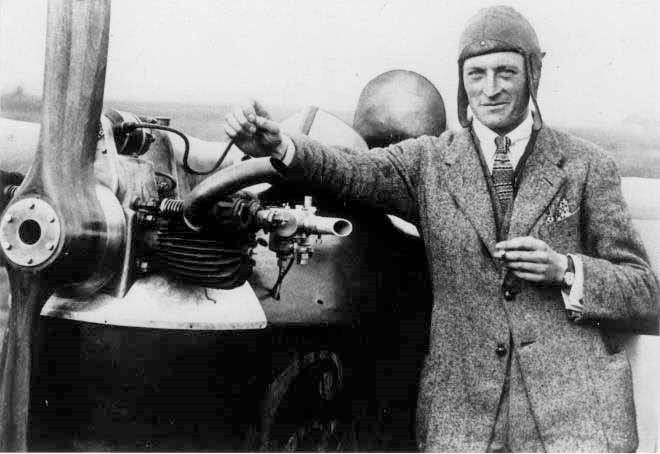
Paul Poncelet with the Castar and Anzani
Simonet flies with the new motorized Castar from Saturday July 7, 1923. The following Tuesday he performs a 45-minute flight, ascending to an altitude of 1100 meters in 20 minutes and flying over Brussels.
On July 12, 1923, the Flight magazine announced: “Some Climb! ACCORDING to reports in the daily Press the ” Motor Glider” looks like putting real aeroplanes completely in the shade. It is stated that Lieut. Simonet ascended from Evere aerodrome on Tuesday and climbed to 2,600 ft. in less than one minute (sic) —in a tiny monoplane fitted with a 7 h.p. engine.”
Simonet corrects the error and gives details: [Flight 2 August 1923] “I have just read in your interesting paper your article ‘Some Climb ‘ regarding my performances on the Belgian glider ‘ Poncelet,’ fitted with a 7-10 h.p. Anzani engine. ” I have not climbed at 2,600 ft. in one minute ! It is, of course, a mistake on the part of the daily press. The truth is this : — ” Saturday, July 7, I tried for the first time the Poncelet light ‘plane (tried before successfully as a glider). I flew 17 minutes at 100 to 200 metres ; next day I flew 15 minutes ; the Monday I flew 28 minutes and reached 800 metres. Tuesday I flew 45 minutes and reached easily (in about 20 minutes) a height of 1,100 metres. The machine is very well balanced, possesses a wide speed range (40 to 85 kms.), lands at 35 kms per hour, and climbs at a rate of 60 to 75 m. per minute. The machine can be readily transformed to a pure glider by only removing engine and gasoline tank, which is placed behind pilot’s head. The balance is exactly the same ; this seems extraordinary as the pilot’s seat is in front of the wing and the engine weighs 32 kgs. I propose, as you know already, to pilot this machine at the French gliding competition at Cherbourg. The ‘ Poncelet ‘ light ‘plane characteristics are as follows : span, 11 m. 20; length, 6 m. 70; weight: with engine, 100 kgs. ; without engine, tank, etc., 155 kgs. ; surface, 20 m2 ; engine, 7-10 h.p. Anzani 1,100 c.c, developing 10 h.p. at max. revs. (1,550) ; petrol tank, 18 litres, oil tank, 3 litres, giving about 3 hours’ flight duration. Wing: Gottingen section—deepest section, 38 mm. “
Paul Poncelet (on the left) and Victor Simonet present the rebuilt and motorized Castar [Flight 2 August 1923]
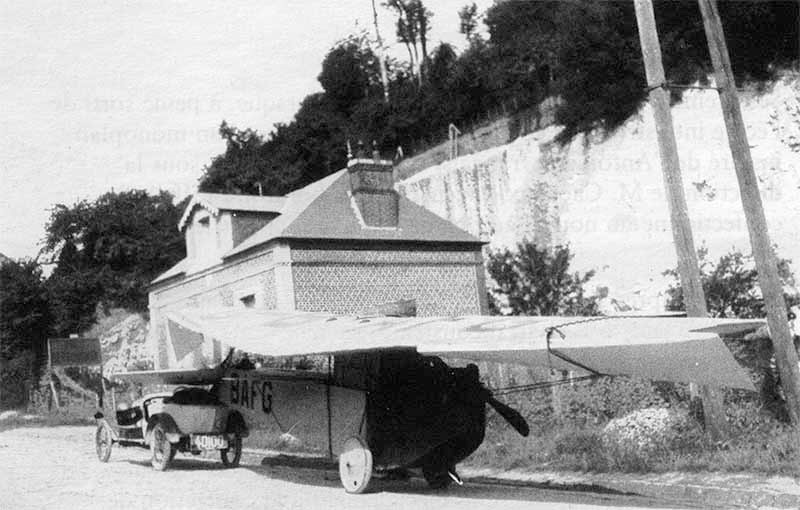
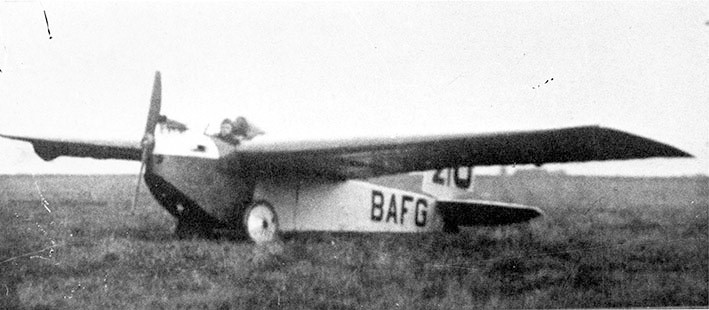
The Castar was registered O-BAFG on July 28, 1923.
The SABCA decided to have Paul Poncelet’s glider participate in the Second Experimental Motorless Flight Congress, which was to take place in Vauville (near Cherbourg-France) from August 5 to 26, 1923, and it was registered with the n° 7. The machine, which took the name of Poncelet-Castar (“castar” being a typical Brussels Belgian euphemism for “beefy” in a somewhat pejorative sense). after its motorization, leaves Brussels by air to go to Vauville. The conveyance, as we will see, will not be easy.
On August 9, 1923 Victor Simonet and the Poncelet plane left Brussels in excellent conditions and landed in Valenciennes where he was prevented from going further, the Belgian pilot not having the necessary papers for customs. It took three days to settle the matter. Simonet set off again, headed for the coast, stopping at Douai, then Calais and Boulogne, and which he followed to Crotoy. Since then, we have been waiting for him every day in Vauville.
Victor Simonet was ill in Montreuil-sur-Mer where he landed with the glider. On August 12 1923 Simonet, recovered, had resumed his flight when he was the victim of an engine accident: the bursting of a cylinder. From Saint-Valéry-en-Caux where the damage we have reported occurred, the glider was transported by road to Le Havre by the care of Mr. Mathieu Demonty, technical director of SABCA.
The Castar whose engine broke down in Saint-Valéry-en-Caux is transported to Le Havre by Mr. and Mrs. Demonty
August 17, 1923, at Vauville, Victor Simonet took his place in the aircraft and at 3.52am took off, in a few meters, almost on the spot. The wind was finally blowing from the west at an average speed of about 10 m / s. The upwelling of the wind was remarkable and in two or three minutes Simonet was over 150 meters high. After staying a while there, he began to sail along the ridge. When he made up his mind to land, Simonet performed one of the most beautiful maneuvers we have seen, tacking, veering above the camp before “taking his ground”. He finally arrived in the line of hangars, crossed the camp at 1 meter above the ground, grazed the ground and, caught up by the updraft, set off again 100 meters high. It really felt like a powered plane with the pilot “pouring the sauce” at the right time. Simonet landed on the beach, in front of the camp, after having glided 47 min 35 sec.
Castar O-BAFG at Vauville
On August 18 the Poncelet glider had been brought up from the beach in the morning; by early afternoon he was ready for another flight. And indeed, Simonet flew away like the day before, with the same ease, in a style of great beauty. He thus flew 1 hour 2 minutes 3 seconds, during which he reached the altitude of 182 meters above his starting point, becoming by this performance holder of the Louis Bréguet Prize.
At 8:30 am on August 19, Simonet takes off for a flight that will last 50 minutes 17 seconds. The good Belgian pilot has advanced too far above Vauville and the sea. He left the favorable zone and after ten minutes of admirable efforts, unable to climb the coast, he decides to land on the beach. Belgium came back to the top of the total with 2 h 48 m 55 s.
At 2:17 p.m., the Poncelet glider having been brought up to the camp, Simonet took off again. His mastery visibly increases with experience. His knowledge of the terrain now allows him to make much more daring evolutions forward as well as behind the ridge.
Simonet who turned towards Vauville, comes back at full speed, initiates a new turn, dives, straightens up, and lands gently on the ground. Simonet flew 2 hours 58 minutes 43 seconds, bringing his total number to 5 hours 47 minutes and 8 seconds.
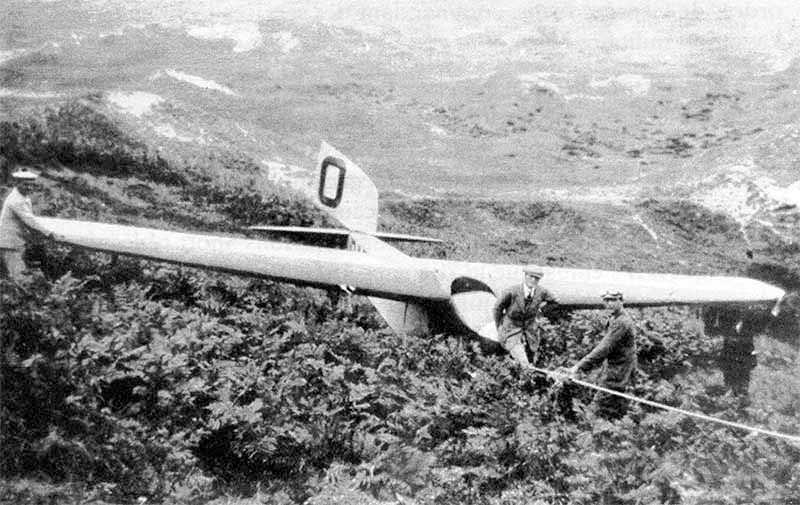
Castar on the dunes of Vauville
On 20 August 1923, Simonet left at 9:11 am. It flew 54 minutes, stopped at the end of this time by the mist and the famous drizzle. Forced to land on the beach, he tried to prolong his flight as much as possible and succeeded quite well since he was going to land at 3 km 200 from its starting point. Simonet therefore took first place in long distance flights. In the afternoon, the weather improved. The Belgian pilot took off again at 3.30 pm but the mist returned with more intensity than ever, interrupting a well-started flight. Simonet was going to be forced to land. He decided to do this by trying to improve the distance performance he had achieved in the morning. Heading towards Siouville, he approached the beach where the high cliff gives way to small dunes 3 to 6 meters high. And above these dunes, Simonet still found a current sufficient to carry it, between 4 and 5 meters of altitude, two kilometers further, where it landed definitively. The experience was remarkable: dunes less than 6 m high, sometimes less than 3 m, allow a glider to sustain itself without the aid of an engine. Simonet, whose flight had lasted 40 minutes, had landed 5 km 10 from his point of departure.
21st of August, a little after 8 p.m., Simonet, chilled and tired, returns to land: he has flown 4 hours 6 minutes 20 seconds. Simonet’s digits are 4 hours 6 minutes 20 seconds and 11 hours 27 minutes 28 seconds. Simonet also reached the height of 221 meters.
August 22, Simonet, for his part, left at 9.26 am and made a flight of 50 m. 50 s. on his Poncelet glider. He thus regained first place in the total with 12 h 27 m 18 s. The barograph indicated a height of 180 meters.
23 August, the wind has turned to the south, now sliding on the cliffs of Vauville instead of attacking them head-on. But the Poncelet glider nevertheless took to the air for a flight that Simonet managed to extend for 1 h 33 m 10 s. With its nice flight of the morning, the glider Poncelet now totals the respectable figure of 17 h 39 m 58 s.
On 24 August Simonet took-off but following a sudden return of the bungee cord, it remained attached to the apparatus and went away with it. Simonet who “felt that something was wrong” did not notice his unexpected overload … He held the air for 10 minutes, but not managing to gain height, he landed in the meadow of … The bungee cord which weighed more than 15 kg and was 40 to 50 meters long offered enormous resistance to the advancement of the machine and it is even remarkable that it was able to fly for so long in such conditions. The Belgian team, who had come with a few sailors, helped Simonet to bring the glider back to the camp, from where it set off again without incident this time, for a fine flight of 1 h 44 m 50 s.
Simonet increased his total by flying 2 h 39 m 20 s on August 25.
Around 1 p.m., on August 26 the weather improved slightly. Simonet took-off on his Poncelet glider. Simonet for his last flight, will hold the air for 2 hours 11 minutes. It will thus have totalled during the last ten days of the Congress, 24 hours 25 minutes 8 seconds. The valiant Belgian driver broke the totalization record set at Biskra by Descamp
Finally the results of Victor Simonet on the Poncelet Castar were as follows: Flight duration: 3rd with 4 h 6 m 20 s (Prize of the City of Cherbourg) Totalization: first with 24 h 25 m 8 s (4000 francs, Prix du Conseil Général de la Manche) Height: 1st with 295 meters (5,000 francs, Louis Bréguet Prize, vermeil plaque from the Aéro-club de France) Distance: 2nd with 5 km 100 (4000 francs, Charles Renard Prize)
In September, the Castar returned from Vauville, but its engine was not repaired even though we were eight days away from the Meeting de moto-aviettes that the Aéro-Club de Bruxelles organized. In an emergency, Poncelet mounted a Coventry Victor engine on the Castar, kindly donated by the Belgian motorcycle manufacturer “Jeecy Vea”. But the aircraft has all the trouble in the world to take off and only manages to complete a runway three meters above the ground.
Victor Simonet, in front of the Castar with Coventry Victor engine, 1923
Characteristics of the Coventry Victor engine: two opposed cylinders, 680 cc developing 16 HP at 3500 rpm and 10 HP at 2000 rpm
“On September 16, in Brussels, the Competition was held between Maneyrol on Peyret, Van Opstal and Van Cottem on SABCA-Jullien, Simonet on Poncelet and Captain Lambert; but in fact Maneyrol alone had fulfilled the conditions: qualified by an ascent to 1600 m and a descent, carried out in 28 ’25 “, he had covered the 5o km of the circuit for the test of consumption by burning 1.212 L of gasoline, in 36′; then in a test of 30 ‘of flight, it had consumed 1.983 L, thus winning the various prizes of the Competition. “[L’Aéronautique n ° 54, November 1923]
Poncelet Castar O-BAFG
The British Royal Aero-Club organized in October 1923, in Lympne, Kent, a richly endowed competition reserved for moto-aviettes (light planes equipped with low-power engines. These were often motorized gliders).
Three prizes were contested: a distance competition with given consumption, a speed competition and an altitude competition.
The motorized gliders of Paul Poncelet, Castar and Vivette were entered in this Lympne meeting by J.B. Richard and J.A. de Ro respectively, but only for the altitude competition.
The performance of the Coventry-Victor engine having been disappointing, the Castar was fitted with a Sergant engine, (4 vertical cylinders, air-cooled, 750 cc is used. A reduction gear is integrated into this engine).
The Castar, went to England on its own, crossing the Channel, in the company of the Vivette (equipped with the same engine).
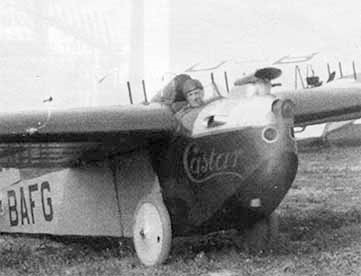
Victor Simonet at the controls of the Castar equipped with the Sergant engine – October 1923 at Evère aerodrome
The Castar, piloted by Victor Simonet, made an excellent start to the competition, but did not break a record in this event. It should be noted, however, that he flew at a speed of 58 mph (over 100 km / h) which would have placed him fifth in the speed contest.
The motorized gliders of Paul Poncelet, Castar and Vivette were registered for the A.F.A. (French Air Association) meeting from July 26 to August 9, 1925, by Jean-Baptiste Richard and J.A. de Ro, respectively, but only for the altitude competition. The Vivette went to England on its own, flying over the English Channel, together with the Castar piloted by Victor Simonet.
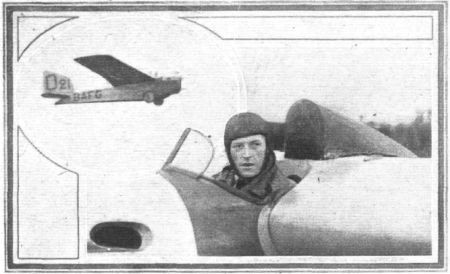
Victor Simonet, in the cockpit of his Castar during the Lympne meeting [Flight].
The Poncelet Castar, piloted by Victor Simonet, made an excellent start to the competition, but did not break a record in this event. However, it should be noted that he flew at a speed of 58 mph (over 100 km / h) which would have placed him fifth in the speed contest.
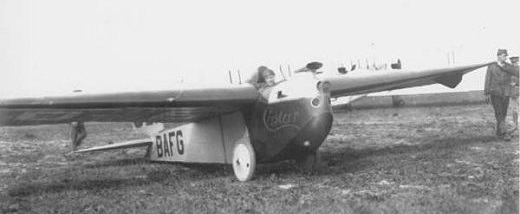
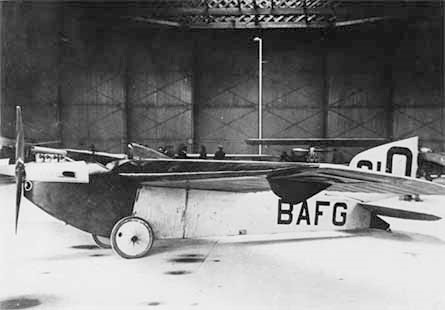
The Castar equipped with the Sergant engine, bearing the n° 21 of the Lympne competition Photos taken in Lympne’s hangar. Note the removable fuel tank serving as the pilot’s headrest.
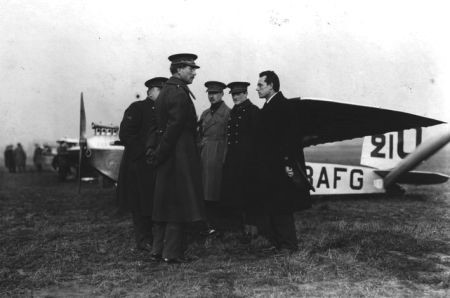
King Albert of Belgium visiting Evère aerodrome, November 10, 1923, in front of the Castar equipped with the Sergant engine. The plate still bears the n° 21 of Lympne’s competition. From left to right: Major Smeyers, Commander of the Belgian Air Force (hidden by the king), King Albert I of Belgium, Lieutenant baron Kervin de Lettenhove, Lieutenant Victot Simonet and Paul Poncelet
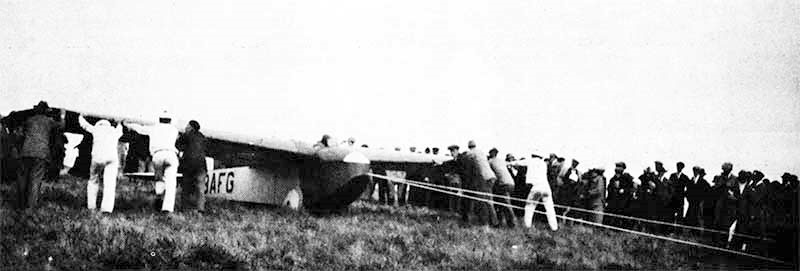
Simonet is about to take off – Vauville 1925 Helpers (many are sailors) hold out the bungee cords
In July 1925 the Castar was in competition between Vauville and Siouville with the Ferber glider, the Poncelet-Vivette glider, the Glymes glider, the Nessler glider, then a little later the Sablier glider.
On Saturday July 25, 1925 Simonet failed to return. Simonet was found killed next to his broken glider. The accident due to a break in the elevator control.



 All Aero