Germany Alfons Pützer KG known primarily as sailplane manufacturer; produced an improved motorized version of the Doppelraab sailplane, known as the Elster in 1957. Small batch produced for German club use. Alfons Pützer and Comte Antoine d’Assche, director of the French company Alpavia SA, formed a new company in 1966, Sportavia-Pützer, to produce the Fournier series of light aircraft.
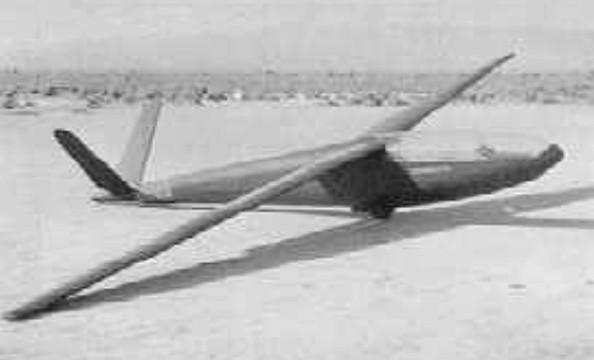
The all metal UHP-1 first flew in 1967 featuring a fixed wheel and skid, spoilers and drag chute and a T- tail with fixed stabilizers and movable rudder and elevator. Fabric covered the wing aft of the spar. A second example was built with an all- metal wing whose specifications and performance are given here(the first ship was more than 100 lbs. Lighter). It is flapped, has retractable gear and gear doors, carries water and has a fully trimmable stabilizer.
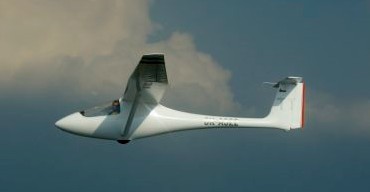
The Super Standard was designed to the early 1960’s Standard Class rules with 15 m wing, fixed gear and no flaps or water ballast, all metal, and with magnesium wing skins.
Amongst other achievements, a Super Standard was flown by sailplane photographer Alex Aldott to win the Hungarian national distance record at 748 km./ 465 miles.
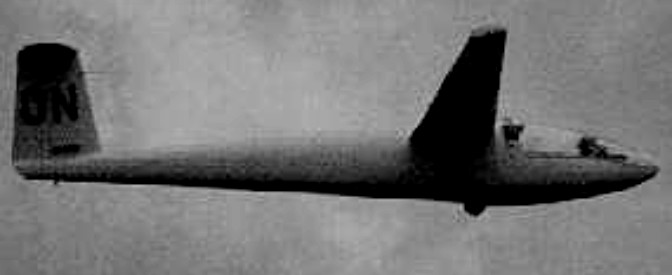
Designed by Irving Prue and first flown in 1949, the all metal 215 was taken by Harold Hutchinson to 2nd place in the 1958 Nationals. The design featured a V-tail and retractable wheel, with flaps for glidepath control. One example belongs to the National Soaring Museum.
Wing span: 12.2 m / 40 ft Wing area: 8.36 sq.m / 90 sq.ft Empty Weight: 154 kg / 340 lb Payload: 91 kg / 200 lb Gross Weight: 245 kg / 540 lb Wing Load: 29.31 kg/sq.m / 6 lb/sq.ft Water Ballast: 0 Aspect ratio: 20 Airfoil: Airfoil NACA 23012,8318 L/DMax: 29 84 kph / 45 kt / 52 mph MinSink: 0.79 m/s / 2.6 fps / 1.54 kt / 64 kph / 35 kt / 40 mph No. of Seats 1 No. Built 3
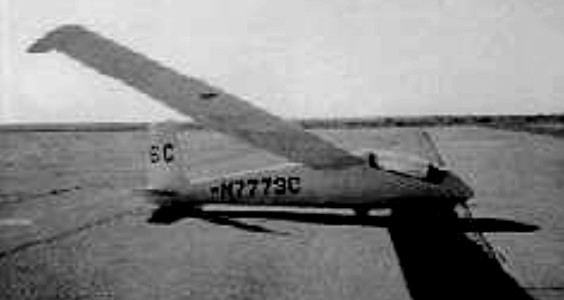
The all metal Prue IIA first flew in 1964, differing from the original Prue II by having a T-tail, fixed gear and a shorter, lighter, 2 piece wing resulting in an empty weight approximately two hundred pounds less. The IIA held the world multi-place out-and-return record (590,5 km./ 366.88 miles) for six months in 1967 and again, of 684.5 km. / 425.3 miles in 1972. The only IIA belongs to the National Soaring Museum.
The Danish Dolphin tandem two-seater motor glider was designed and built by the Projekt 8 I/S company of Roskilde, and 10 construction of the prototype was taking place at three separate sites near Copenhagen, and it was expected that the first flight was to be made late in 1978.
The Dolphin is a cantilever mid-wing monoplane of mixed constrution with a T-tail, powered by a 54hp Volkswagen VW1600 engine driving a two-blade pusher propeller, mounted on a pylon and retracting rearwards behind closed doors into the top of the fuselage aft of the wings. The wings, which have 4° dihedral, have an aluminium centre section and wood and glassfibre outer panels, flaps and ailerons; there are aluminium air brakes in the upper surfaces just ahead of the flaps. The forward fuselage is a welded steel tube framework covered with a light glassfibre shell, and the rear fuselage is a wooden structure reinforced by glassfibre. The tail unit is likewise of wood, with a fixed incidence tailplane, a central trim tab in the elevator and an inset tab at the base of the rudder. There is a semiretractable rubber-sprung mainwheel plus a nosewheel and a steerable tailwheel, as well as retractable wing tip balancer wheels. The one-piece cockpit canopy opens sideways.
Span: 61 ft 5 in Length: 27 ft 10.75 in Height: 4 ft 3.25 in Wing area: 223.9 sq ft Aspect ratio: 16.8 Empty weight: 1,058 lb Max weight: 1,653 lb Max speed: 163 mph Max aero-tow speed: 77.5 mph Min sinking speed: 2.30 ft/sec at 50 mph Best glide ratio: 32:1 at 62 mph
The Projekt 8 I/S company of Roskilde, was formed by Helge Petersen and 10 other glider pilots for construction of the prototype Dolphin, taking place at three separate sites near Copenhagen, Denmark.
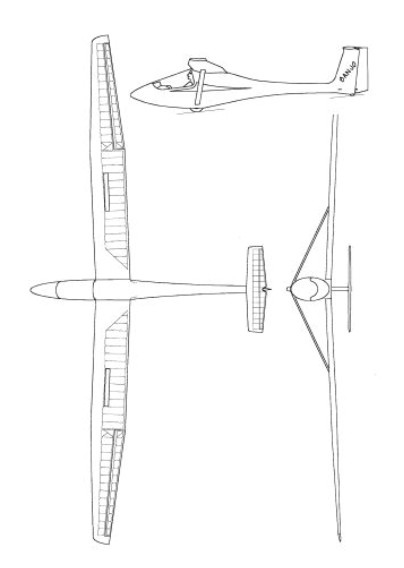
The Banjo sailplane is of mixed construction. Its 13.3 m (43.6 ft) span wing is strut-braced with one lift strut per side and uses a plywood box spar and spruce wing ribs, with the leading edge of the wing covered in plywood and the rear portion covered in aircraft fabric covering. The nose ribs are expanded polystyrene while the ailerons are made of wood and covered in fabric. The wing airfoil is an SM701 at the wing root transitioning to a Wortmann FX-60-126 at the wing tip, while the tailplane uses a Wortmann FX-71-L-150/30 airfoil. The fuselage is of fibreglass monocoque construction, while its one-piece bubble canopy is made from polycarbonate. The aircraft has fixed monowheel landing gear with a wheel brake and upper wing surface air brakes.
Variants:
Banjo Unpowered single-seat sailplane with a 13.3 m (43.6 ft) span wing. Four were reported completed and flying in 1998. In production in 2011.
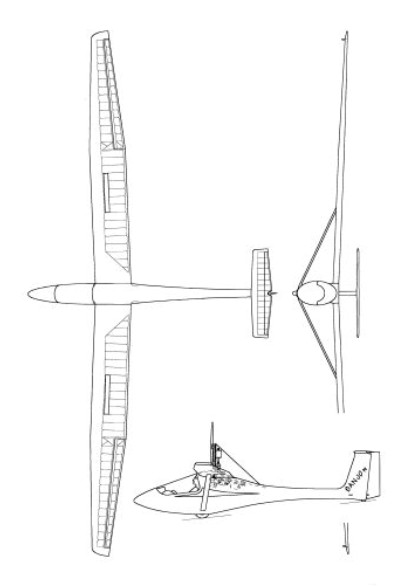
Banjo-MH Powered version of the Banjo, with a retractable tractor configuration Hirth F33 two stroke 21 kW (28 hp) motor powering a two-bladed wooden propeller. Fuel capacity is 14 litres (3.1 imp gal; 3.7 US gal), gross weight is 260 kg (573 lb) and load limits +4 and -2g. The aircraft has a best glide ratio of 28:1. In production in 2011.
DuoBanjo Two seats in tandem version, with two side-by-side main wheels mounted in the fuselage and a retractable tractor configuration Rotax 447 two-stroke 30 kW (40 hp) motor powering a ProFe 1.4 m (4.6 ft) two-bladed wooden propeller. Wing span is 16 m (52.5 ft), fuel capacity is 27 litres (5.9 imp gal; 7.1 US gal), gross weight is 460 kg (1,014 lb) and load limits +4.4 and -2.4g. The aircraft has a best glide ratio of 29:1. In production in 2011.
The Banjo wing is based on the SM701 airfoil, trapezoidal outer part is modified into FX-60-126. Wingtips are equipped with winglets. Basic element of the construction is a plywood, box section beam and ribs made from spruce scantlings. Front part of the ribs is made from expanded polystyrene. Leading edge of the wing is covered by plywood and forms a torsion box. Polyester fabric covers trailing part of the wing. On the upper part of the wing are located hinged aerodynamic brakes. Wooden construction ailerons are also covered by a polyester fabric. They are operated via Dural tube rods. Wings are supported by shaped struts. Wing is fixed to the fuselage by mountings located on the wing beam and on the trailing edge section.
Fuselage, including the tail fin, is formed from a fiberglass monocoque. Monocoque is reinforced by plywood ribs. Ribs are utilized as wings, struts, undercarriage wheel and rescue system mountings.
Cockpit (closed type) is covered by a one-piece canopy made from a splinter-proof polycarbonate (Makrolon). There is a ventilation window on the side of the canopy. Control stick is a classic style type. The cockpit is equipped with aerodynamic brakes lever (left side), rope release control (“T” shaped handle on the instrument panel) and trim handle. The cockpit is ventilated via ventilation outlets, located on the instrument panel. Adjustable pilot’s seat is equipped with 4-point safety belts. The Banj MH Cockpit has engine throttle (left side), power unit position selector, ignition switch, starter, propeller stop control and main power switch (on the right side of the cockpit).
Fixed undercarriage consists of the main unsprung wheel (outer radius 400mm) and uncontrollable tail wheel (outer radius 140mm). The main wheel is fitted with a disk brake. The brake is operated via a cycle brake lever, mounted on the control stick.
Tail surfaces are “T” shaped. Horizontal tail surfaces have similar construction as the wing and use modified Wortmann FX-71-L-150/30 airfoil.
Controls and instrumentation. The instrument panel of the plane is equipped with the following instruments: airspeed indicator, combined electronic altimeter/variometer, compass and bank indicator. The Banjo MH instrument panel also has RPM gauge, fuel gauge, and engine temperature gauge. Power unit management panel is located on the right side of the cockpit. Instrumentation can be customized according to customer’s requirements.
The DuoBanjo is equipped with one instrument panel, containing following instruments: airspeed indicator, altimeter, variometer, RPM gauge, fuel gauge, engine temperature gauge, compass and bank indicator. Power unit management panel is located on the right side of the cockpit.
System of controls. Ailerons and elevator are operated via rods, equipped with swiveling joint ends. Levers are fitted with ball bearings. Rudder is cable controlled. Aerodynamic brakes are also cable controlled, in combination with springs. The DuoBanjo is equipped with dual set of controls, however lifting/retracting of the power unit can be controlled only from the front seat. Control sticks are classic style type. Seats are equipped with 4-point safety belts.
The powered Banjo power unit is based on the engine HIRTH F33 B, equipped with an electric starter, belt reducer and two-blade propeller. Power unit can be lifted or retracted into the enclosed power unit bay during the flight.
Fuel system. Alu fuel tank is located in the fuselage and it can contain 14 liters of the fuel. It is equipped with fuel float system, measuring quantity of the fuel in the tank. Filler neck is located on the left side of the fuselage, below the wing. The DuoBanjo has 27 liters of the fuel.
Electrical system. The main source of the energy is an on-board accumulator 12V-14Ah, which is recharged by the engine. The accu feeds the lifting/retracting system of the power unit together with the electric starter.
Specifications:
Banjo Wing span: 13,3 m Length: 6,3 m Wing area: 10,5 sq.m Main undercarriage wheel diameter: 400 mm Tail wheel diameter: 140 mm MTOW: 220 kg Load factor: +4,4/-2,2 G Max. speed VNE: 140 km/h Max. speed in turbulence VB: 110 km/h Stall speed: 50 km/h Min. sink: 0,68 m/s L/D: 28 Number of seats: 1
Banjo-MH Wing span: 13,3 m Length: 6,3 m Wing area: 10,5 sq.m Main undercarriage wheel diameter: 400 mm Tail wheel diameter: 140 mm MTOW: 260 kg Load factor: +4/ -2 G Max. speed VNE: 135 km/h Max. speed in turbulence VB: 110 km/h Stall speed: 60 km/h Min. sink: 0,86 m/s L/D: 28 Climb performance with MTOW: + 2m/s Fuel tank capacity: 14 liters Number of seats: 1
DuoBanjo Engine: Rotax 447 UL DCDI 1V, 29 kW (6500 rpm) Propeller: ProFe 1400mm Wing span: 16 m Length: 7,35 m Height (propeller in retracted position): 1,57 m Wing area: 13,86 sq.m Aspect ratio: 18,3 Wing load at 460kg: 33 kg/sq.m Number of seats: 2 Empty weight: 250 kg MTOW: 460 kg Max. weight of the crew: 200 kg Min. pilot’s weight: 70 kg Stall speed: 64 km/h Maneuver speed Va: 130 km/h Max. speed in turbulence Vb: 130 km/h Max. speed Vne: 175 km/h Min. sink (at 90 km/h): 0,9 m/s Best L/D (at 100 km/h): 29 Cruise speed (5000 rpm): 110 km/h Max. climb: 3 m/s Load factor: + 4.4 / – 2.4 G Fuel consumption, cruise: 9.5 l/h Fuel tank capacity: 26 liters
Designed and built by Tom Proctor in Australia during 1940-41, The Coogee is essentially a scaled up Hutter 17 hlider.
Registered VH-GFD, Tom Proctor made about 200 short flights in it from 1942 to 1945 and it was then sold to the Victorian Motorless Flight Group. In 1956 ownership changed to the Geelong Gliding Club and subsequently in 1963 it was acquired by E.J. Williams and F.G. Wyer who undertook a thorough overhaul and a complete re fabric of it.
It was then sold to G.C. Curtis, F.O. Connell and R.T. Harris in 1966 who retired it from service 1967 after a total of 3,851 flights and 415 Hours.
The Coogee was donated to a museum by the C. Curtis/G. Downs estate, and restored to display condition.
 All Aero