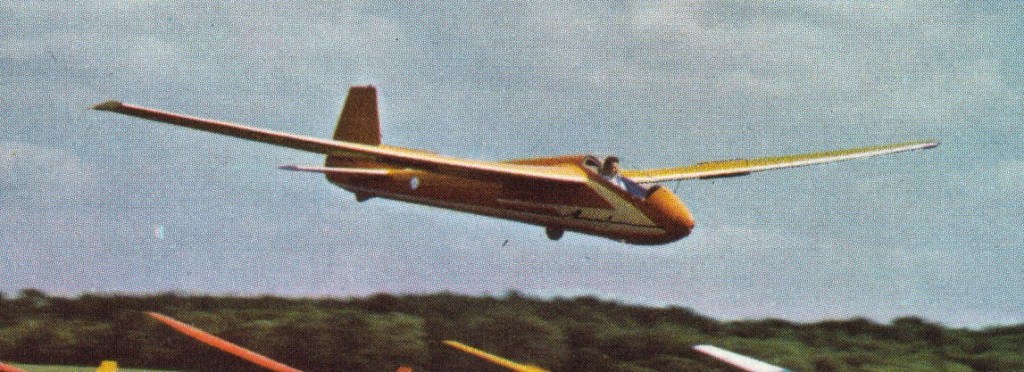
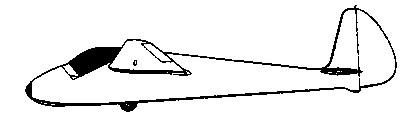
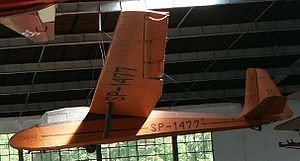
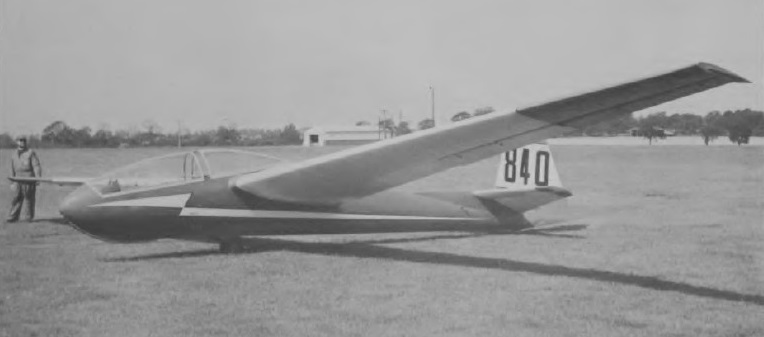
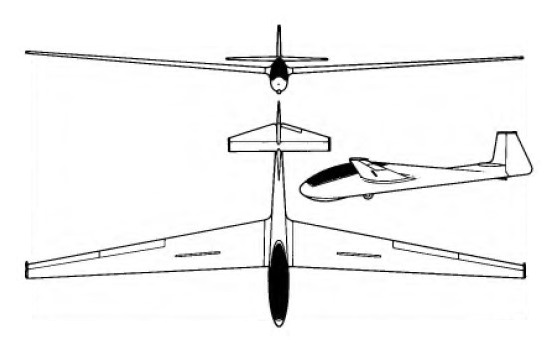
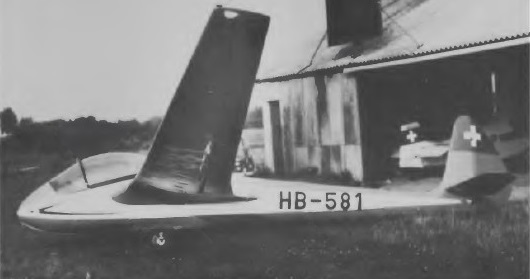
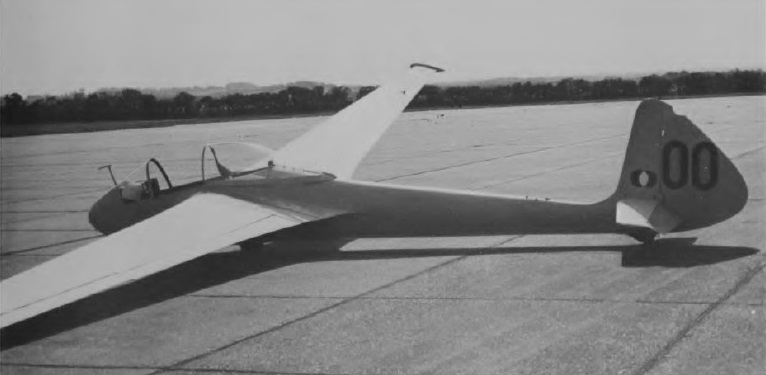
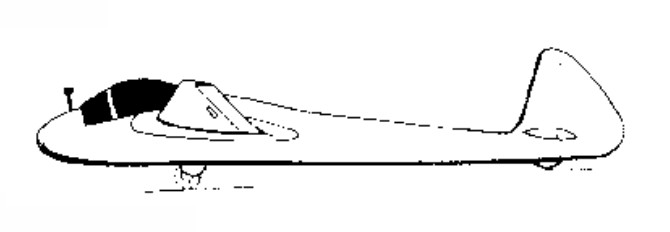
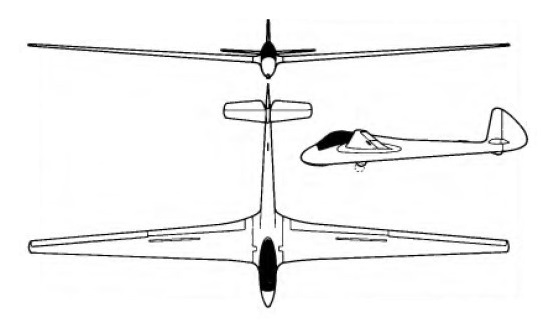
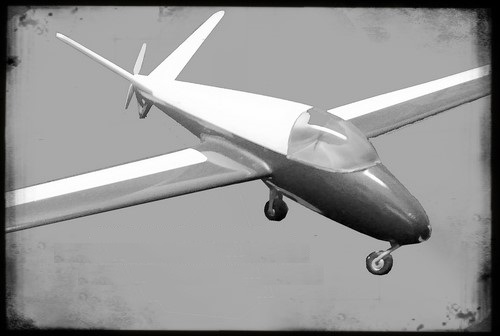
The IS-2 Mucha had a single-spar high wing with an aspect ratio of 15, and was fitted with dive brakes and spoilers; the fuselage was of elliptical cross-section. The Mucha-ter was developed into the SZD-12 Mucha 100 of 1953, this single-seater being used for training. It was of all-wood construction, the cantilever high wings having a single main spar and an oblique auxiliary spar, with a plywood-covered leading edge torsion box; air brakes were fitted and the ailerons were aerodynamically and mass balanced. The oval-section fuselage was plywood-covered and the pilot sat under a one piece Plexiglas canopy. Landing gear consisted of a monowheel and short front and rear skids sprung with rudder pads.
PZL Bielsko / SZD 12 Mucha Sto (100) Length: 22.966 ft / 7.0 m Wingspan: 49.213 ft / 15.0 m Aspect ratio: 15.0 Wing area: 161.46 sq.ft / 15.0 sq.m Max take off weight: 639.5 lb / 290.0 kg Weight empty: 430.0 lb / 195.0 kg Max. weight carried: 209.5 lb / 95.0 kg Max. speed: 119 kts / 220 km/h Landing speed: 30 kts / 55 km/h Cruising speed: 38 kts / 70 km/h Wing loading: 3.90 lb/sq.ft / 19.0 kg/sq.m Glide ratio: 24.0 Crew: 1
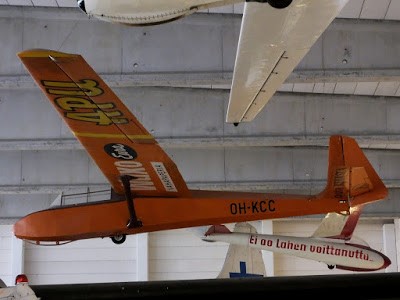
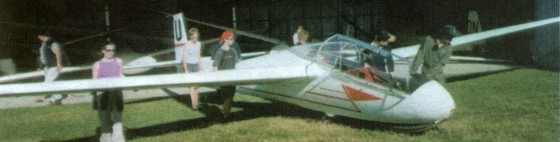
The Czapla (Heron) was a tandem two-seat training glider, with a strut- supported, forward-swept, high-set wing and a welded steel tube fuselage with fabric covering. Design of the Czapla commenced in 1952 to the order of the Soldier’s Friends’ League paramilitary organization, to enable aeroclubs to train glider pilots in a two-seat trainee/instructor system. Main designers were Roman Zatwarnicki, Irena Kaniewska and Marian Gracz. The Czapla was designed to be launched by bungee, winch or aero-tow, and the prototype first flew on 23 November 1953, demonstrating the need for several improvements, which were introduced in the second prototype (flown on 26 March 1954) and the production model SZD-10bis Czapla.
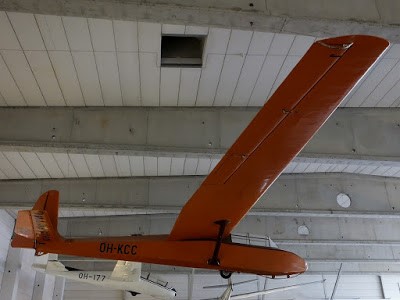
PZL-Bielsko SZD-10bis Czapla OH-204 / OH-KCC
Production was carried out from 1955 at ZSLS (ZSLS – sport aviation equipment workshops) in Krosno, Wrocław, Bielsko and Poznań and the Military Repair workshop at Łódź, with Czapla being used for everyday club flying up to the early 1980s, and exported to Finland and Turkey. A total of 157 were built.
SZD-10bis
Variants:
SZD-10-2 Czapla – two prototypes
SZD-10bis Czapla – 19 production aircraft Wingspan: 16 m (52 ft 6 in) Wing area: 24 m2 (258 ft2) Wing profile: Göttingen 549 Aspect ratio: 10.67 Length: 8.7 m (28 ft 7 in) Height: 1.98 m (6 ft 6 in) Empty weight: 280 kg (617 lb) Gross weight: 435 kg (959 lb) Maximum speed: 160 km/h (99 mph) Stall speed: 48 km/h (30 mph) Maximum glide ratio: 17 @ 64 km/h (40 mph/35 kts) Rate of sink: 0.96 m/s (189 ft/min) Crew: 1 pilot Capacity: 1 passenger
SZD-10bis A Czapla 136 production aircraft, first flew in June 1958
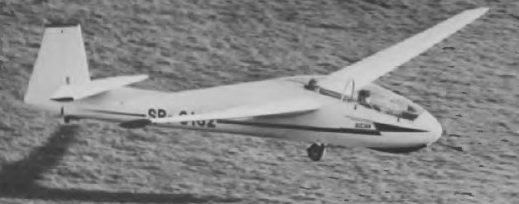
The Bocian (or Stork) tandem two-seater sporting and training sailplane prototype SZD-9 flew for the first time on 11 March 1952.
The Bocian is cleared for cloud flying, spinning and basic aerobatics and was one of the few two-seaters to be stressed for aerobatics, including inverted flight; controls and instrumentation have, from the start, been intended to be suitable for sporting flying as well as training.
Bocian 1D SZD-9bis
Of conventional all-wood construction, the Bocian is distinguished by its mid-set wing swept forward, in the Mk 1E version, by 1°30′ at the quarter-chord line and with 4° dihedral. The first production Bocian flew in March 1953 and the type went through several versions; the Bocian 1C first flew in February 1954, the Mk 1D in 1958 and the final version, the Mk 1E, on 6 December 1966. The early versions featured several differences in the tail, and especially the rudder.
SZD-9bis Bocian 1E
Within a few years of first going into production, the type had set several world speed records over 200 and 300km closed circuits, and in 1962 Franciszek Kepka set a world record for a goal flight distance by flying 401 miles (636.6km) in a Bocian. On 5 November 1966 a Bocian 1D flown by the Polish pilots S. Josefczak and J. Tarczon set an international gain of height record for multi-seaters of 38,320ft, while the corresponding ladies’ record was set in another Bocian on 17 October 1967 by Adela Dankowska and M. Mateliska, who achieved a height gain of 27,657ft.
An experimental verison of the Bocian was being modified during 1964 for flights at up to 15,000m (49,200ft); this was to be flown as a single-seater with the pilot wearing a special WUK type pressure suit with advanced oxygen equipment. Eight 4-litre (0.87 Imp gal) oxygen bottles, sufficient for up to four hours’ flight, were carried in the fuselage, and the cockpit was heat-sealed and provided with R/T radio. At a later stage it was intended to provide heating, double glazing for the canopy and de-frosting of the canopy glass, amongst other improvements, for this special Bocian, and a high altitude pressurized variant with a crew of two was also studied for a time.
The Bocian 1D’s wings are of slightly larger span than the Mk 1 E’s (59ft 5.5in instead of 58ft 4.75in) and have 3° 30′ of forward sweep; the Mk 1D is also 9.75in shorter in overall length than the 1E, and its rudder contours are slightly different to the 1E’s. In both versions the wings are two-spar structures with a plywood D-section leading edge and fabric covering; the slotted ailerons are each in two parts, which are separately controlled. No flaps are fitted but there are SZD air brakes inboard of the ailerons. The oval section fuselage is plywood-covered on both versions and the two tandem seats, under a long two-piece blown Plexiglas canopy, are so positioned that the rear seat is over the cg and there is no need to carry ballast when the aircraft is flown as a single seater. There is a non-retractable monowheel with a brake and a shock absorber fitted, and a short nose skid, plus a tailskid. The cantilever wooden tail unit has a trim tab in the port elevator.
The Bocian was to have one of the longest production runs of any sailplane, a total of 620 having been built when production ended at the end of 1977. The type was exported to 33 countries, including the Chinese People’s Republic, where licence production of Bocians and several other Polish sailplanes commenced at the Glider Manufacturing Centre at Tchan-Tia-Kou during 1955-56.
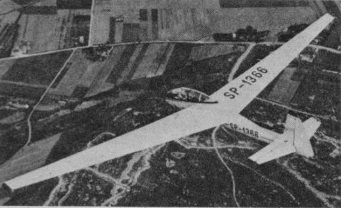
The SZD-8 Jaskolka (or Swallow) high performance single-seater first appeared in 1951, two prototypes being rolled out in September and December that year; in prototype form it had a fuselage length of 22ft 1.5in but in the production version, which started coming off the line in 1954, the length was increased to 24ft 4.25in. The Jaskolka soon began to make its mark in contest flying, and between May 1954 and May 1960 the type held no fewer than 15 world records for speed and distance.
The SZD-8L was a special version for the 1956 World Championships at St Van, France, in which one, flown by Gorzelak, took 3rd place; this version had a wing of laminar flow section, a ‘butterfly’-type V-tail and wing tip end plates which had the effect of increasing the wing span as well as acting as ‘bumpers’. The SZD-8L also carried 100 litres (22 Imp gal) of water ballast to permit maximum performance in varying weather conditions, and was one of the first sailplanes to employ this form of ballast.
Of conventional wooden construction, the Jaskolka has two-piece cantilever mid-set wings with single spars and fabric covering; the Fowler flaps can be lowered to 12° or 25° and air brakes are fitted in the upper surfaces. The wings are quickly detachable and the ailerons are aerodynamically balanced.
The fuselage is plywood-covered and the pilot sits over the wing leading edge, rather than in front of it, thus giving him an excellent view; the cockpit is enclosed by a moulded two-piece Plexiglas canopy the rear section of which slides back for exit and entry. A novel feature of the rear fuselage is a built-in recessed handle each side for ease of handling the Jaskolka on the ground. A semiretractable monowheel with a mechanical brake is fitted, plus a short nose skid and a tail bumper.
Altogether 127 Jaskolkas had been built when production ended in 1961.
PZL Bielsko / SZD 8 bis Jaskolka Length: 24.344 ft / 7.42 m Wingspan: 52.493 ft / 16.0 m Aspect ratio: 18.8 Wing area: 146.39 sq.ft / 13.6 sq.m Max take off weight: 782.8 lb / 355.0 kg Weight empty: 562.3 lb / 255.0 kg Max. weight carried: 220.5 lb / 100.0 kg Max. speed: 108 kts / 200 km/h Landing speed: 32 kts / 60 km/h Cruising speed: 37 kts / 68 km/h Wing loading: 5.33 lb/sq.ft / 26.0 kg/sq.m Glide ratio: 26.0 Crew: 1
Jaskolka-Z Span: 16.0 m / 52 ft 6 in Length: 7.42 m / 22 ft 11 l/2 in Height: 4 ft 7.5 in Wing area: 13.6 sq.m / 146.4 sq ft Aspect ratio: 18.8 Wing section: NACA 230 12A Empty weight: 270 kg / 595 lb Max weight: 370 kg / 816 lb Water ballast: 95 kg / 209 lb Max wing loading: 27.2 kg/sq.m / 5.57 /b/sq ft Max speed: 155 mph / 135 kt / 250 km/h (in smooth air) Max rough air speed: 65 kt / 120 km/h Stalling speed: 27 kt / 50 km/h Min sinking speed: 0.75 m/sec / 2.5 ft/sec at 46 mph / 40 kt / 74 km/h Best glide ratio: 28.5:1 at 51.5 mph / 44.5 kt / 83 km/h
Instytut Szybownictwa (Gliding Institute) Bielsko-Biala Przedsiebiorstwo Doswiadczalno-Produkcyjne Szybownictwa
Between 1947 and 1977 the Polish aircraft industry produced 3,638 gliders of 91 different types, and SZD sailplanes were exported all over the world, setting up many world and national records over the years. The SZD organisation responsible for Polish sailplane design and devleopment was officially formed in April 1946 as the Instytut Szybownictwa (or Gliding Institute) at Bielsko-Biala and was renamed in 1948 the Szybowcowy Zaklad Doswiadczalny – SZD (or Experimental Glider Establishment).
Under political reorganization in 1956, the Polish aircraft industry was revived with production of Soviet aircraft and some indigenous types. In foreign markets most Polish aircraft subsequently appeared under the PZL title, such as the PZL-101 Gawron and PZL-104 Wilga utility aircraft of 1960 and 1962 respectively, the first being a development of the Yak-12. The Gawron was used extensively as an agricultural aircraft, along with the PZL-built An-2 biplane, but later purpose-built dusters and sprayers were built. PZL types are produced under three separate organizations: PZL “Warszawa-Okecie” SA, WSK “PZL-Mielec” SA, and PZL-Swidnik SA.
In July 1969 the name was changed again and since July 1975 the former SZD has been known as Przedsiebiorstwo Doswiadczalno-Produkcyjne Szybownictwa, or Experimental and Production Concern for Gliders, although the well known letters SZD continue to be used for its products. The sale of these to foreign customers, like those of other Polish aircraft, is handled by the PEZETEL trading organsiation.
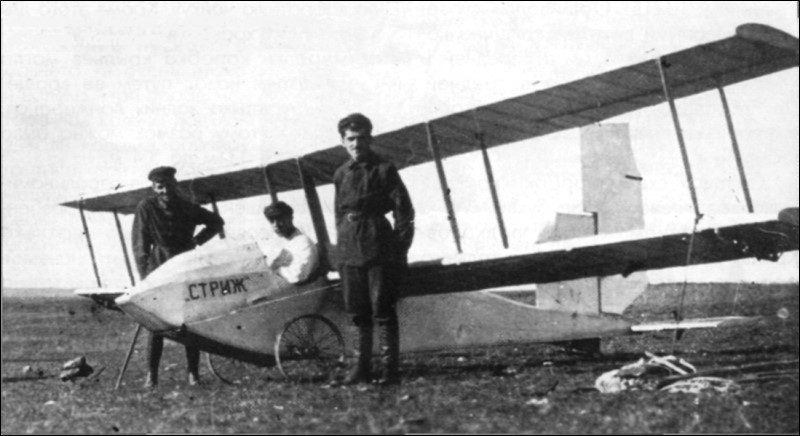
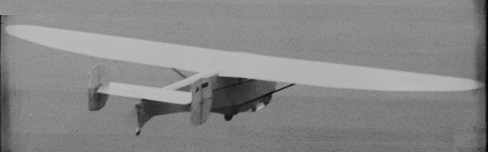
Vladimir Pyshnov at Koktebel during the 1923 competitions alongside the AVF-2 “Strizh” with the modified tail rudder.
In 1923 the Academy of the Air Fleet and the Military Academy of the RKKA leadership allowed students to build gliders and light aircraft using the academy workshops.
Between 1 and 18 of November of 1923 took place in Uzun-Sirt mountains in Crimea First National Competitions Gliding. In these competitions 10 gliders were presented. Among them were three Air Fleet Academy student gliders named AVF-1 Arap , AVF-2 Strizh and AVF-3 Mastyazhart and built by students MK Tijonrarov, VS Pyshnov and SV Ilyushin respectively. The technical commission, chaired by Professor VP Vetchinkin, after reviewing them, allowed the flight of 9 of them.
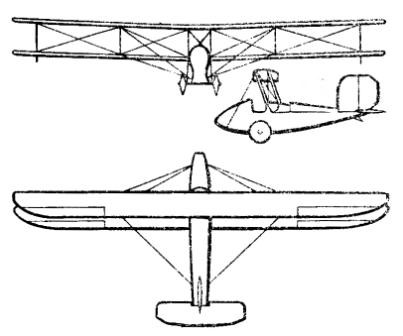
Pyshnovs’ AVF-2 Striz (Russian: Пышнов АВФ-2 «Стриж») glider had a biplane structure with long wings. The fuselage was constructed entirely of wood, with cable ties and featured a rectangular cross-section with a curved top. The fuselage structure ended in a horizontal rib towards the tail. The covering was fabric.
The wing trunk was located above the fuselage. The upper flange had an offset of 0.3 meters and the distance between both planes was 0.9 meters, being joined by means of parallel uprights and braced by cables. The wing construction was also made of wood, with textile covering and corresponded to the Prandtl-387 profile. Roll control was carried out by ailerons located in both planes.
The monoplane tail unit featured a large elevator attached to the rear frame of the fuselage and a large area empennage to which the rudder attached.
The landing gear was of the conventional type with two large spoke bicycle wheels whose axle ran from side to side through the fuselage and was attached to rubber shock absorbers. In the tail it had a fixed skate to the structure.
The pilot was located in a cockpit in front of the wing leading edge.
The Pyshnov glider was the second model designed and produced at the Air Fleet Academy (AVF), for which it received the official designation AVF-2 and the nickname “Strizh.” The Strizh was built in the AVF workshops and assembled at the “Aviarabotnik” factory. Unfortunately by the time the competitions started in November 1923 the AVF-2 had not been finished and was sent to the competitions in that state. All the metallic fixings were already installed in the camp of the participants in the competition.
This situation played a negative role in the fate of the glider. The Strizh was not only incomplete, it had not been tested, so construction defects had not been corrected. During the first tests on November 15 the Strizh on several occasions rotated on its axis before reaching takeoff. To correct this difficulty the builders increased the rudder area considerably but after this the glider refused to rise.
As a consolation, in this competition they also failed to launch their gliders SN Lyushin with their “Maori” and VI Cheranovski with their BICh-1 “Parabola”. Despite the difficulties the 17 of February of 1924, during the conclusions of the first competitions of gliding, the builder VS Pyshnov to the present like other builders, received a special award for its creation.
AVF-2 “Strizh” Wingspan: 10.2 m Wing area: 12.5 m² Length: 4.7 m Height: 1.8 m Elevator area: 1.6 m² Keel rudder area: 0.6 m² Rudder surface area: 0.5 m² Ailerons surface: 2.2 m² Empty weight: 60 kg Wing loading: 10 kg / m²
In 1921, with the help of some fellow students, Vladimir Sergueyevich Pyshnov built his first glider. In November of this year on this glider a group of young students, including Pyshnov himself, BI Cheranovski, VN Belyayev, VV Utkin-Yegorov and others, made more than 20 flights. In the last one carried out, the glider was destroyed and was never restored.
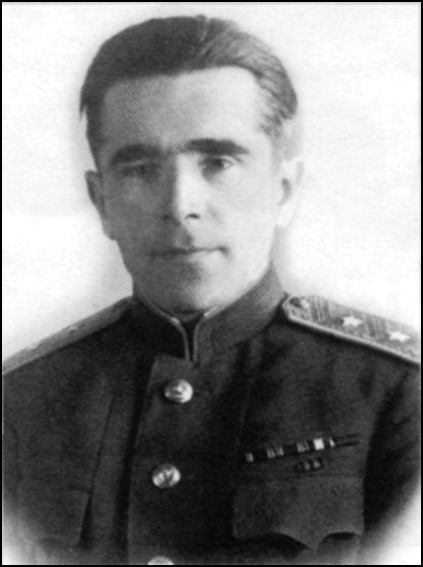
Vladimir Sergueyevich Pyshnov (Russian: Владимир Сергеевич Пышнов) was born on March 6, 1901 in Moscow. In 1918 he finished secondary school at the 3rd Muscovite Gymnasium and in 1919 he entered the Moscow Technical Aviation School, directed by the famous Professor N. Ye. Zhukovski.
In June 1920 VS Pyshnov voluntarily joined the ranks of the Red Army at a call from the school’s leadership and a month later, July 29, 1920 the Revvoyensoviet (Revolutionary Military Soviet) issued an order establishing the transfer of subordination of the school to the Main Directorate of the Red Air Fleet, although methodologically it was still linked to the technical-professional education structure.
Changes continued and the 26 of September of 1920 the Revvoyensoviet N.1946 issued a new order, which established reorganize the School of Aviation Moscow at the Institute of Engineers of Red Zhukovsky Air Fleet (Russian: Институт инженеров Красного Воздушного Флота имени Н. Е. Жуковского) in honor of its creator and on November 23 the state position on the institute was made official.
During the study period, Pyshnov carried out the practices under the guidance of the aeronautical constructor AA Porojovschikov, together with another group of students who worked in his factory as turners, milling cutters and assemblers. On the other hand, from the first year of study Pyshnov decided to try forces in the development of gliders.
In 1921, with the help of some fellow students, he built his first glider. In November of this year on this glider a group of young students, including Pyshnov himself, BI Cheranovski, VN Belyayev, VV Utkin-Yegorov and others, made more than 20 flights. In the last one carried out, the glider was destroyed and was never restored.
These were years of intense development of gliders in the USSR. At the request of the Directorate of the Air Fleet Directorate (Glavvozduxflot), a circle of gliding was created under the auspices of the Air Fleet Scientific Office.
Professor VP Vetchinkin at a meeting on October as November as 1921 asked to name this circle “Paryaschi Poliot” (thermal flying). The first president of the circle was AA Zhavrov, being soon replaced by KK Artseulov. Among the members of this circle, VS Pyshnov was registered.
In May 1923 and from an initiative of the direction of the Academy of the Air Fleet and the Military Academy of the RKKA a military scientific society was organized that greatly promoted the activities of the aviation and planning sections. The AVF leadership allowed students to build gliders and light aircraft using the academy workshops.
By November 1923, the gliding section, with 11 people, participated in the First National Sailing Competitions held in Crimea. Three students from the academy: MK Tijonrarov, VS Pyshnov and SV Ilyushin presented their own gliders named respectively AVF-1 Arap, AVF-2 Strizh and AVF-3 Mastyazhart.
At the Second National Sailing Competitions held in Crimea in September 1924, four-year students Pyhsnov and Tijonrarov were selected for members of the technical committee, led by Professor VP Vetchinkin.
The 2 of April of 1925 there was the first graduation of engineers in the AVF. Among the graduates was Pyshnov, after defending his diploma project under the mentorship of the famous aeronautical builder DP Grigorovch.
After finishing the Pyshnov academy he went on to serve as an engineer in the 8th Squadron of the independent brigade “Krasnaya Moskvá ”. In May 1926, he was placed on the reserve and sent to serve in the industry.
Pyshnov expressed his interest in continuing his studies and in October 1926 he again entered the Military Aeronautical Academy (VVA), where a year later he defended his dissertation, receiving the teaching category. From 1927 he began his work as a teacher at the VVA. As of January 1932, he was appointed head of the chair of Aerodynamics Aeronautics and later, on April 16, 1935, head of the chair of Flight Dynamics.
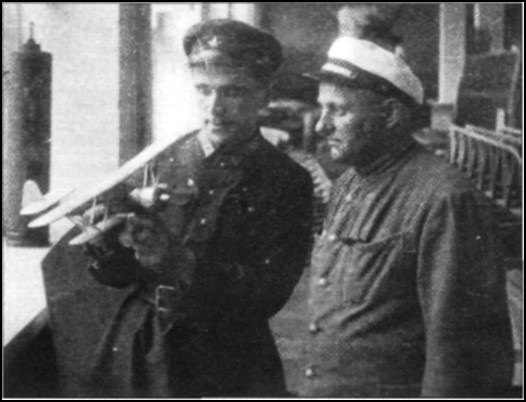
Pyshnov explains the possibilities of his VVA-1 model.
In 1935 Pyshnov developed a light aircraft that received the name VVA-1 of which a copy was built that was flown successfully, although with poor performance.
The 23 of February of 1937 he received the rank of professor and from the 14 of March of 1938, by Resolution No.235 of the SNK, it became part of the Aviation Committee within the Defense Committee of the USSR.
At the beginning of the Great Patriotic War and by order №02201 of the Popular Defense Committee, Pyshnov was appointed consultant to the head of the NII VVS on aviation matters. In this position he stood out for his work to develop a methodology for flight tests and work on the evaluation of military aircraft projects.
In June 1942 he was promoted to Major General of the Aviation Engineering Service and in that same year he received the distinction of Honorary Personality of Science and Technology of the USSR.
In March 1946 he was promoted again to lieutenant general engineer service and order №0763 of the direction of the VVS of the August 12 went on to serve as a consultant scientist and a permanent member of the Technical Committee on Aviation VVS (ATK VVS). Three years later, by ministerial order №01240, he became president of Section 1 (Aeronautics) of the ATK VVS, a position he held until 1958.
In 1958 he received the title of Doctor of Technical Sciences.
In November 1968 Vladimir Pyshnov was graduated, although he remained in teaching until the year of his death, which occurred in 1984, in Moscow.
Titles and distinctions Twice Order of Lenin ; Twice Order of the Red Banner ; Order of the Red Banner of Labor ; Order of the Patriotic War of the 1st level; Medals; Honorary Personality of Science and Technology of the USSR.
Aeronautical construction 1921 glider AVF-2 “Strizh” VVA-1
Works and published works “Aeronautical Auger” (Russian: “Штопор самолета”), 1929; “Aerodynamics of flight” (in Russian: «Аэродинамика самолета»), 1939; “Dynamic Properties of Airplanes” (Russian: “Динамические свойства самолета”), 1951; “Main stages of development of aviation” (in Russian: “Основные этапы развития самолета”), 1984. Pyshnov was also the author of a large number of articles published by popular and specialized magazines, as well as several text brochures used in the subjects taught at the Zhukovski Military Aeronautical Engineering Academy.
Around 1955, Walter Horten was interested in developing a long-distance drive for his flying wing aircraft. He commissioned Prof. Karl Lürenbaum ‘s Institute for Engine Dynamics at RWTH Aachen University to develop a suitable engine. Walter Horten commissioned his childhood friend Alfons Pützer to build a suitable test vehicle for long-distance wave testing. Pützer suggested using a Fritz Raab Doppelraab design, which had already been used in the Pützer Motorraab.
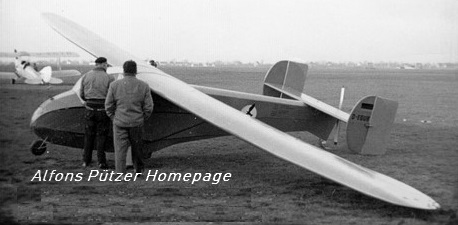
Pützer then commissioned Fritz Raab to modify a Doppelraab 6, in which a small engine was placed in the center of gravity behind the pilot’s seat. The tailplane of the Doppelraab was replaced by an endplate tailplane with two fins, in the middle of which a pusher propeller was placed at the rear of the aircraft. The two-cylinder, two-stroke engine Hansa-Lloyd with 400 cm³ displacement and 12 hp drove the propeller at the rear via the long-distance shaft developed by Karl Lürenbaum. The test vehicle was created by Alfons Pützer KG in Bonn.
In December 1956, the Pützer Dohle took off on its maiden flight in Bonn-Hangelar. The air sports club in Bonn received the jackdaw in early 1957 for its training operations to test in continuous operation. There were several disturbances in the area of the long-distance wave. The propeller, which had little ground clearance at the rear, was also damaged several times.
By arranging the engine in the center of gravity of the aircraft and the pusher propeller at the rear, the fundamentally good gliding characteristics of the Doppelraab were retained with the Dohle. Alfons Pützer then developed the jackdaw as a motor glider. He replaced the weak and too heavy Hansa engine with an Ilo F2x376 with 30 hp, with which the Dohle II should be able to self-launch. The small 14 kg fuel tank was replaced by a 40 kg fuel tank for longer cruising flights. This allowed the Dohle II to remain in the air for up to five hours. To protect the rear propeller from touching the ground, the Dohle II was fitted with a spur wedge at the rear.
The Dohle II was created in 1957 by converting the Dohle I at Alfons Pützer KG. It took off on September 2, 1957 in Bonn-Hangelar with the provisional approval D-EGUB for its first flight under its own power. In 1957, the Dohle II was one of the first usable motor glider constructions in Germany. However, Alfons Pützer had to stop further testing a short time later, since the start of series production of the Pützer Elster in the winter of 1957/58 occupied all capacities at Alfons Pützer KG.
The basic structure of the Dohle II was later the starting point for the development of the Pützer Bussard trainer aircraft , which was also to be equipped with a pusher propeller at the rear in order to achieve jet-like behavior. The first drafts of the buzzard show a completely redesigned fuselage and low-lying wings. As with the Dohle II, however, the terminal plate tail unit with wedge spur was used. This tail was later replaced by a V-tail on the Bussard.
Only after the successful start of Elster production did Alfons Pützer take up the development of a motor glider again at the end of 1958. Drafts from this period show a further developed jackdaw with the V-tail already used in the Bussard and a low-lying wing. From 1959, however, Alfons Pützer gave up further development of the Dohle in favor of the completely new Pützer MS-60 motor glider design. The Dohle II was shut down in 1960.
Jackdaw I Engine: 1 × Hansa-Lloyd, 12 hp Wingspan: 13.20 m Wing area: 18.00 m² Aspect ratio: 9.7 Length: 7.20 m Height: 2.00 m Empty weight: 300kg Maximum take-off weight: 420kg Payload: 120kg Crew: 1
Jackdaw II Engine: 1 × Ilo F2x376, 30 hp Wingspan: 13.20 m Wing area: 18.00 m² Aspect ratio: 9.7 Length: 7.20 m Height: 2.00 m Crew: 1 Empty weight: 325kg Maximum take-off weight: 450kg Payload: 125kg
 All Aero