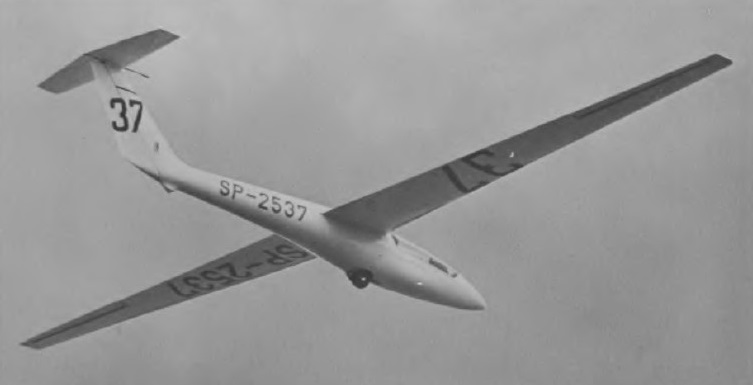
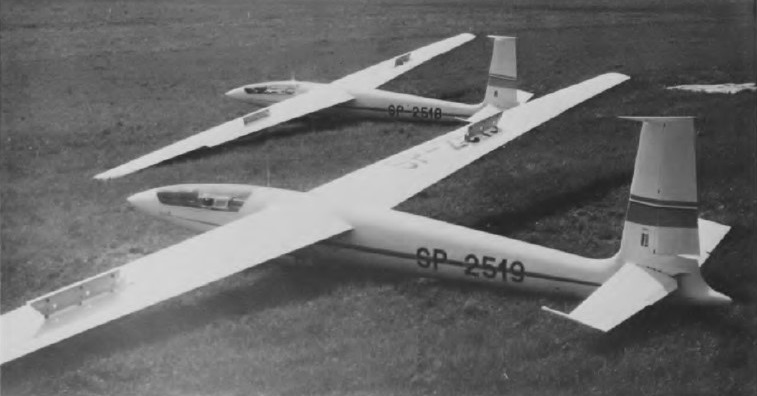
Adam Kurbiel, the 36-year old designer of the Jantar, started in 1969 and it first flew on 14 February 1972. It was the first Polish glassfibre and GRP.
The Jantar headrest, backrest and pedals are all adjustable in the air and all controls are pushrod operated.
The T-tail is fixed and has a spring trim lever on the side of the control column. Flaps and ailerons work in conjunction and water ballast tanks are fitted.
At least two 19m span were built, plus two with a span of 17.5m. Production plans were in the preliminary stages.
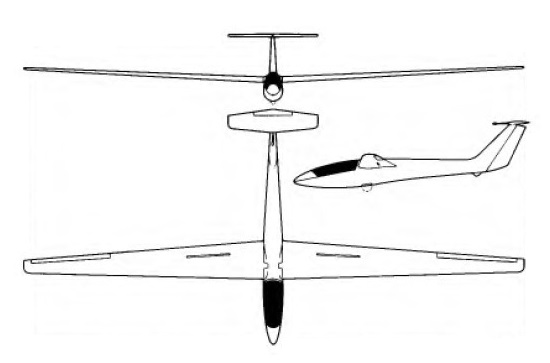
Jantar Wingspan: 19m Wing section: FV K67-170-150 Wing area: 13.38 sq.m Aspect ratio: 27 Empty weight: 275 kg AUW: 490 kg Wing loading: 36 kg/sq.m Min sink: 0,5 m/sec at 75 kph Stall: 65 kph Max speed: 250 kph Glide ratio: 47-1 at 95 kpg
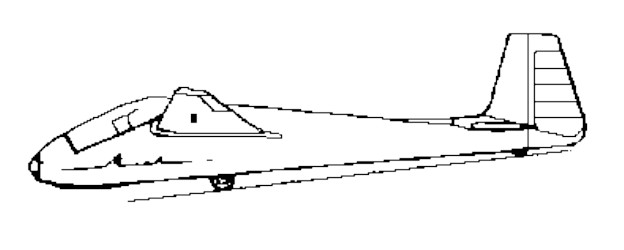
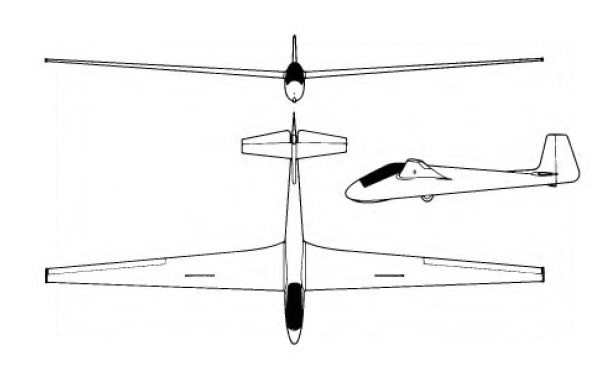
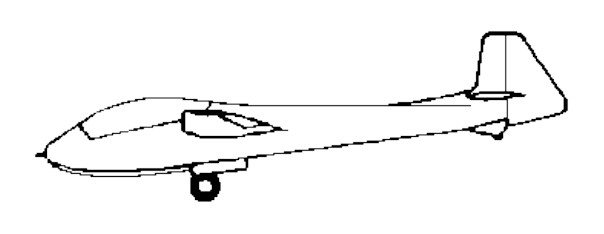
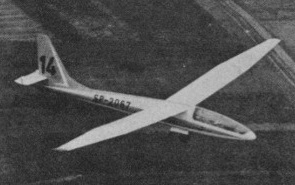
The SZD-36 high performance Standard Class single-seater was designed by Dipl-lng Wladislaw Okarmus for the Polish gliding team at the 1970 World Championships at Marfa, Texas. Design work began in October 1968 and the prototype Cobra 15 made its maiden flight on 30 December 1969. At the 1970 World contest, Jan Wroblewski and Franciszek Kepka of the Polish team flew their early pro¬duction Cobra 15s into 2nd and 3rd places respectively in the Standard Class, and a Cobra 17 – this being the 17m span version – came 5th in the Open Class.
Of all-wood construction with plywood and glassfibre covering, the Cobra 15 has cantilever single-spar shoulder wings with heavy moulded plywood stressed skin covered by glassfibre; the plain ailerons are mass balanced and are of plywood/polystyrene/foam sandwich construction, and there are SZD doubleplate metal glassfibre air brakes in the upper and lower wing surfaces. 45 degree to 45 degree roll rate is less than three seconds. The SZD-39 Cobra 17 is the same as the Cobra 15 except for the increased span (55ft 9.25in) Wortmann profile wing of 23.56 aspect ratio, which has provision for water ballast. The fuselage is an oval section semi-monocoque covered with plywood over the rear part and glassfibre on the forward portion, and there is an aero-tow hook in the lower fuselage forward of the monowheel.
The SZD-36A differs from the SZD-36 in having this hook repositioned about 1 m further forward of the cg with provision for locating it at the cg if required. The monowheel retracts mechanically to lie horizontally in the bottom of the fuselage, and has a brake; there is also a tailskid. The Cobra is distinguished by a sharply swept back fin and rudder with an all-moving mass-balanced tailplane mounted on top of it, with a trim tab on its trailing edge. The pilot sits under a vacuum-formed jettisonable flush-fitting canopy which slides forward to open; there is a small luggage compartment behind the pilot’s seat and also a full range of instrumentation, plus provision for an oxygen system with a 4-litre cylinder in the baggage compartment and a radio.
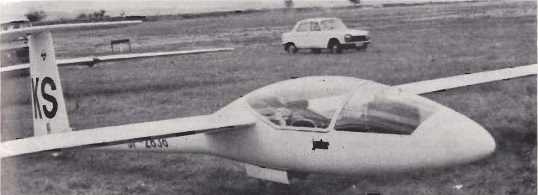
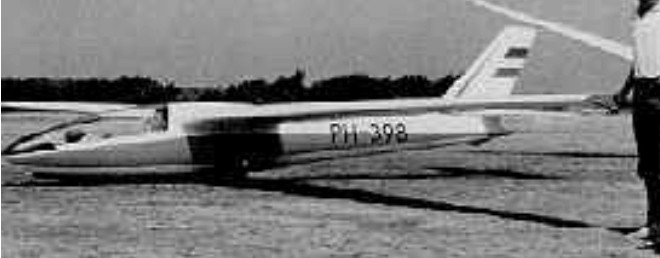
SZD-36A Cobra 15
Altogether 238 Cobras of all versions had been built when production ended in 1977, and the type has been exported to more than 20 countries.
Cobra 15 Wing span: 15 m / 49 ft 2.5 in Wing area: 11.6 sq.m /124.9 sq.ft Aspect ratio: 19.4 Length: 7.05 m / 22 ft 11.25 in Height: 1.59 m / 5 ft 2.25 in Empty Weight: 257 kg / 567 lb Payload: 128 kg / 282 lb Gross Weight: 385 kg / 849 lb Water ballast: None Wing Load: 33.2 kg/sq.m / 6.8 lb/sq.ft Max speed: 155 mph / 135 kt / 250 km/h (in smooth air) Max rough air speed: 91.5 kt / 170 km/h Stalling speed: 36 kt / 67 km/h L/DMax: 38 @ 94 kph / 51 kt / 59 mph MinSink: 0.60 m/s / 1.97 fps / 1.17 kt at 45.5 mph / 39.5 kt / 73 km/h Airfoil: Wortmann FX61-168/60-1261 Seats: 1
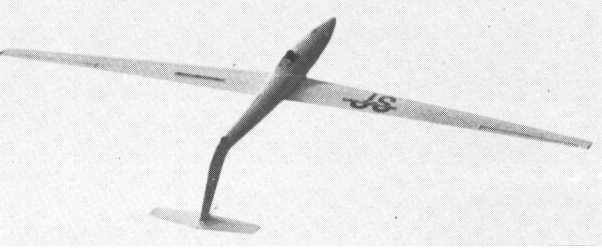
The SZD-29 Zefir 3 was a much improved version of the SZD-19-2 Mk 2 intended for advanced competition flying, with a wing of 19m (62ft 4in) span, full-span Fowler flaps, a longer fuselage and an unswept fin and rudder; the Mk 3 first flew in prototype form in April 1965 and had an improved best glide ratio of about 42:1.
Its production development was the Zefir 4, the first Mk 4 prototype making its maiden flight on 7 December 1967. It was devleoped for the 1968 World Championships, in which one flown by Jan Wroblewski came 14th in the Open Class.
The wing has an NACA 66-series section and no dihedral, unlike the Mk 2’s; it is a multi-longeron sparless stressed skin wooden structure with full-span flaps like the Mk3’s, the outer sections of which are wooden and also act as ailerons while the inboard sections are of plywood/balsa sandwich; unlike the Mk 2, double metal air brakes are featured. The fuselage is an oval section monocoque, the forward part being made of glassfibre laminate and the rear portion of wood. The tailplane is an all-moving mass-balanced surface with trim tab, and the unswept rudder is also mass-balanced. The monowheel is manually retractable with rubber shock absorbers and a hand-operated wheel brake and, like the Mk 2, a tail-braking parachute is fitted; unlike the Mk 2, the cockpit canopy is now sideways hinging.
Zefir 4 Span: 62 ft 4 in Length: 26 ft 3 in Height: 7 ft 0 in Wing area: 169 sqft Aspect ratio: 23.0 Empty weight: 772 lb Max weight: 970 lb Max speed: 149 mph (in smooth air) Max aero-tow speed: 93 mph Min sinking speed: 1.97 ft/sec at 58 mph Best glide ratio: 42:1 at 58.5 mph
The SZD-25 high performance single-seater combines the wings of the SZD-22 Mucha Standard with a metal fuselage developed from that of the SZD-16 Gil prototype. Designed for large scale production, with low manufacturing and maintenance costs, the Lis (or Fox) made its first flight as a prototype on 5 March 1960, and production aircraft began to enter service with the Polish gliding clubs early in 1962; not a great many were built, but several were exported.
Slotted ailerons are fitted, instead of the SZD-22’s Frise-type ones, and these are aerodynamically and mass balanced, and air brakes are also fitted. The all-metal fuselage is built in two portions: the welded steel tube forward part with fabric covering and the tail boom of riveted sheet duralumin, the cantilever all-wood tail unit being fabric-covered. Landing gear consists of a semi-retractable sprung monowheel with brake and a rubber-mounted nose skid. The pilot sits under a sideways-hinging canopy.
Some 30 were built.
PZL Bielsko / SZD 25 A Lis Wingspan: 49 ft 2 in / 15.0 m Wing area: 137.24 sqft Aspect ratio: 17.65 Length: 23 ft 0 in / 7.0 m Height: 5 ft 0 in / 1.5 m Empty weight: 452 lb Max take off weight: 751.9 lb / 341.0 kg Max. speed: 124 kts / 230 km/h / 143 mph (in smooth air) Min sinking speed: 2.5 ft/sec at 43 mph Glide ratio: 27.0 at 47 mph Crew: 1
Appropriately named Foka (or Seal), this high performance Standard Class single-seater was designed by Dipl-lng Wladislaw Okarmus and Mynarski, and first flew in prototype form on 2 May 1960. Flown by Adam Witek, the Foka gained 3rd place in the Standard class in that year’s World Championships at Koln-Butzwerhof, Germany, where the type’s design features aroused interest.
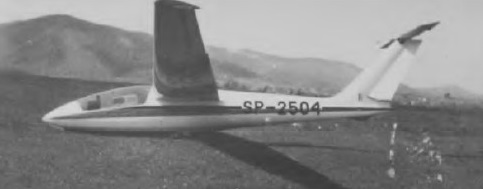
SZD-24 Foka
Three pre-production aircraft designated SZD-24B Foka 2 were completed early in 1961, and the first major production variant was the SZD-24C Foka 4 Standard, which first flew in September 1961; deliveries to the Polish gliding clubs and to export customers began soon after. A Foka 4, flown by Jan Wroblewski, won the Open Class at the 1965 World Championships at South Cerney, England.
This version was succeeded in production by the SZD-24-4A (or SZD-24D) Foka 4, which first flew in prototype form in February 1962 and later took part in the 1963 World Championships in Argentina. The Mk4 had the same fuselage as the Foka-Standard but the wing structure was redesigned to make it much simpler and less costly to produce while retaining the same aerodynamic shape.
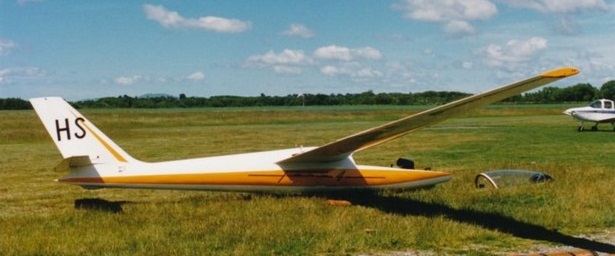
SZD 24-4A Foka ZK-GHS
The first production Foka 4A made its first flight on 7 Feburary 1964 and four Mk4As were flown by the Polish team in the 1965 World Championships at South Cerney, Gloucestershire; in one of these Jan Wroblewski won the Open Class and his team-mate E. Makula came 4th, while the Fokas flown by F. Kepka and J. Popiel took 3rd and 4th places in the Standard Class.
Of all-wood construction, the Foka 4A has two-piece cantilever shoulder wings which are sparless torsion box structures with thick plywood sandwich stressed skin covering which replaces the Foka-Standard’s plywood and foam skinning; the letter’s wing had a central torsion box structure built up of a main spar and two auxiliary spars. There are special SZD plain ailerons of NACA 4415 section. No flaps are fitted but there are SZD metal air brakes at the 60% chord line. The wooden monocoque fuselage is unusual in that the forward part has a modified laminar section, with the maximum depth aft of the pilot’s cockpit at 40% wing root chord; the forward section is covered with a plywood/glassfibre sandwich skin. The pilot sits in a fully-reclining seat under a large flush-fitting canopy which slides forward to open; blind flying instrumentation is standard and there is provision for radio and oxygen. The landing gear consists of a long skid under the nose and a non-retractable monowheel located well aft of the eg, plus a tail bumper. The swept fin is integral with the fuselage and, like the tailplane, is an all-wooden sandwich structure; the laminar flow tailplane and elevator slot into the rear fuselage cone below and behind the rudder in a manner very similar to the Zefir 2. The elevator and rudder are fabric-covered and there is a trim tab in the former.
Final production version was the SZD-32A Foka 5 (formerly SZD-24E), which first flew in prototype form on 28 November 1966 and received its Polish C of A on 7 October 1967; this differed from the Mk 4 chiefly in having a roomier cockpit and the one-piece wooden tailplane and elevator repositioned at the top of the fin. The Foka 5 won first prize at the 1968 OSTIV Congress for the best Standard Class sailplane and a Mk 5 flown by Eward Makula finished 8th in the Standard Class in that year’s World Championships at Leszno, Poland.
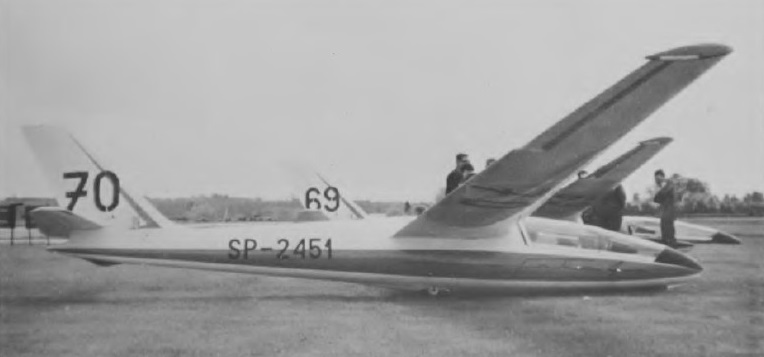
SZD-32A Foka 5
The Foka 5 had several other changes from the Mk 4: the wing section was slightly different and the plywood-covered wing was now a multi-longeron semi-monocoque structure, with spars in the inboard section of each panel only; ailerons and air brakes were the same. The fuselage is now a semi-monocoque of oval section, with the monowheel relocated to be under the eg when the aircraft is empty; its brake is linked with the air brakes and the nose skid is retained. The cockpit canopy is slightly shorter but the pilot has the same blind flying instrumentation and provision for radio and oxygen as on the Mk 4.
Altogether 330 Fokas of all variants had been built when production of the type ended in 1971, and 200 of these were exported to 17 countries.
The SZD-22 Mucha Standard Standard Class single-seater had its origins in the IS-2 Mucha (or Fly) intermediate single-seater of 1948. The first Mucha was designed by Nowakowski, Grywacz and Zatwarnicki in 1948 under the auspices of the Polish Gliding Institute, formed in 1946 at Bielsko-Biala. The Mucha-ter was developed into the SZD-12 Mucha 100 of 1953, this single-seater being used for training. It was of all-wood construction, the cantilever high wings having a single main spar and an oblique auxiliary spar, with a plywood-covered leading edge torsion box; air brakes were fitted and the ailerons were aerodynamically and mass balanced. The oval-section fuselage was plywood-covered and the pilot sat under a one-piece Plexiglas canopy. Landing gear consisted of a monowheel and short front and rear skids sprung with rudder pads.
The SZD-22 Mucha Standard was a further development of the Mucha 100 designed by R.Grzywacz espeically for the 1958 World Championships held at Leszno in Poland and, flown by Adam Witek, came 1 st in the Standard Class section of this event. The next year it entered quantity production as a replacement for the Mucha 100 and the SZD-8 Jaskolka and over 150 were built in several versions.
The SZD-22B had a plywood-covered wing and the SZD-22C, which first flew in 1958, a fabric-covered one, the type having the same all-wood construction with a single main spar and an oblique auxiliary spar as the Mucha 100; air brakes were fitted in the upper and lower surfaces, and the fabric-covered Frise ailerons were aerodynamically and mass balanced. The Mucha Standard was one of the first production sailplanes to have provision for water ballast, which was carried in rubber tanks in the inboard leading edge. The fin and rudder differ from the Mucha 100’s in having a squared-off top and a straight trailing edge. The plywood-covered oval-section fuselage had a very similar landing gear to the Mucha 100’s, with a monowheel and front and rear rubber-sprung skids; the SZD-22D had a modified skid and monowheel and the last variant, the SZD-22E, introduced a new wing. The pilot sits under a streamlined clamshell Plexiglas canopy and is provided with a collapsible chart table as well as the conventional insturments; an oxygen installation can also be fitted.
A special experimental high altitude version of the Mucha Standard was also developed, with the cockpit modified for flights at heights above 39,000ft.
Up to 1962, 286 were built.
Mucha Standard Wing span: 14.98 m / 49 ft 1 in Length: 7.0 m / 22 ft 11.5 in Wing area: 12.75 sq.m / 137.3 sq.ft Wing section: Gottingen 549 Aspect ratio: 17.6 Empty weight: 240 kg / 529 lb Max weight: 350 kg / 772 lb Water ballast: None Max wing loading: 25.6 kg/sq.m / 5.24 lb/sq.ft Max speed: 135 kt / 250 km/h Stalling speed: 32 kt / 59 km/h Min sinking speed: 0.73 m/sec / (2.4 ft/sec at 38.5 kt / 71 km/h Max rough air speed: 108 kt / 200 km/h Best glide ratio: 27.8 at 40.5 kt / 75 km/h
SZD 22C Mucha Standard Wing span: 15m / 49 ft 2 in Wing area: 12.73 sq.m / 138.2 sq.ft Length: 23 ft 0 in / 7.0 m Height: 5 ft 3 in / 1.6 m Aspect ratio: 17.65 Empty Weight: 240 kg / 530 lb Payload: 110 kg / 240 lb Gross Weight: 350 kg / 770 lb Wing Load: 27.49 kg/sq.m / 6.2 lb/sq.ft L/DMax: 28 @ 76 kph / 41 kt / 47 mph MinSink: 0.73 m/s / 2.4 fps / 1.42 kt at 44 mph Max. speed: 135 kts / 250 km/h / 155 mph (in smooth air) Seats: 1 Airfoil: Go 549, M 12 Structure: wood/ fabric wings and tail, wood fuselage
Developed between 1958 and 1964, and one of the very few sailplanes designed especially for aerobatics, this high performance single-seater first flew in prototype form as the SZD-21-2 Kobuz 2 on 3 June 1961, and was designed by Trzeciak. lt was developed into the Kobuz 3, the prototype of which was built at the No 4 ZSLS (Sport Aviation Equipment Plant) at Wroclaw, and flew for the first time on 10 December 1964, piloted by S.Skrzydlewski. An initial production batch of three Kobuz 3s followed in 1965. The Kobuz 3 differed from the Mk 2 in having the cockpit moved forward and the pilot in a semi-reclining instead of a fully reclining seat, a slightly longer and more pointed nose, a wing of 0.5m greater span with plywood stressed-skin covering, and a taller fin and rudder with the low-set tailplane moved back to underneath the rudder. The Kobuz 3 is stressed to airframe limits of + 7G to -5G, and has a cantilever mid-set laminar flow wing built as a sparless torsion box structure with plywood and foam sandwich skinning; the two section ailerons are fabric-covered and flaps as well as air brakes are featured. The monocoque fuselage is built in two portions and is covered with a glassfibre and plywood skin; the cockpit has provision for an oxygen installation and R/T radio. A manually-retractable monowheel is fitted, plus a tail bumper. The cantilever tail unit is structurally similar to the wing, and has a fabric-covered rudder and elevators.
SZD-21-2B Kobuz3 Wingspan: 45 ft 11.5 in / 14.0 m Wing area: 145.3 sqft Aspect ratio: 14.52 Length: 23 ft 7.5 in / 7.3 m Height: 6 ft 3 in / 1.9 m Max take off weight: 884.2 lb / 401.0 kg Max. speed: 108 kts / 200 kph Glide ratio: 30.0 Crew: 1
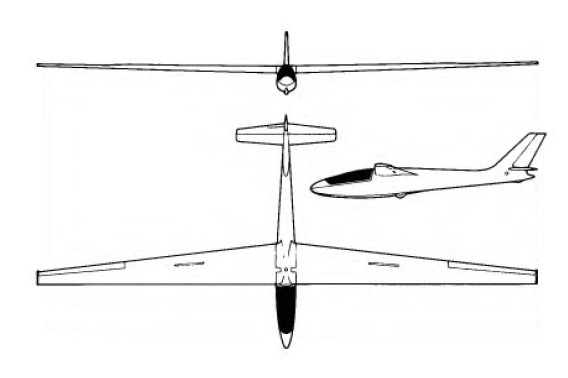
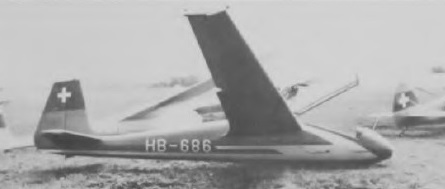
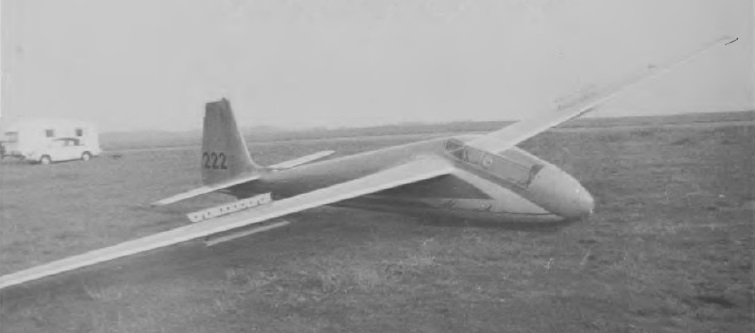
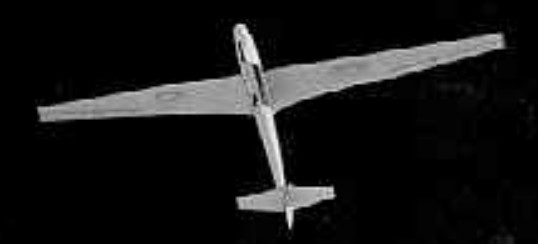
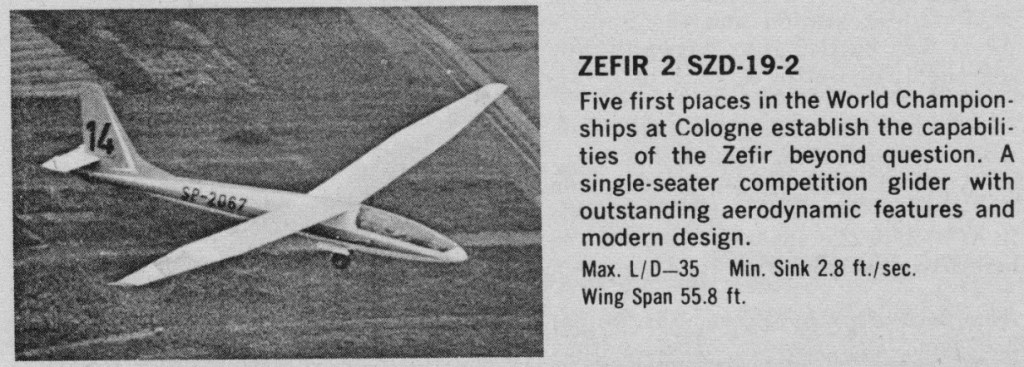
The Zefirs resulted from work done by a team under Dipl-lng B.Szuba and the SZD-19X Zefir 1 prototype, designed by B. Szuba, made its first flight on 4 January 1959 as an Open Class single-seater and this was followed by the SZD-19-2 Zefir 2, which first flew in March 1960. The first two examples of this version, flown by the Polish pilots Makula and Popiel, took 2nd and 3rd places in the Open Class in that year’s World Championships in Germany.
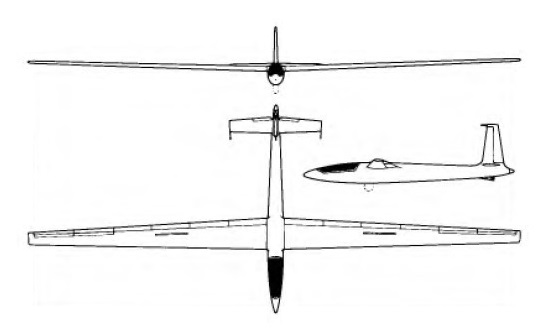
The Zefir aroused great interest here because of its advanced design features, in particular the reclining pilot’s position that made possible such a well streamlined fuselage of low cross sectional area, slotted flaps, the tail braking parachture, the towing hook unit combined in the retractable monowheel, and the swept back fin and rudder with the one-piece tailplane and elevator slotting into the tail cone below the rudder.
The Zefir 2 was rolled out in January 1961 and Polish pilots flying this type were placed first and second in the 1963 World Championships in Argentina. The Zefir 2 went into limited production during 1963-64 and three improved Zefir 2As took part in the 1963 World Championships in Argentina; this time their pilots Makula and Popiel came 1st and 2nd in the Open Class and the Argentine pilot Rudolfo Hossinger, who had won the 1960 World contest in a Skylark 3, was placed 5th in a Zefir 2A. The cantilever shoulder wings were of 17m (55ft 9.5 in) span and 20.7 aspect ratio, with an NACA 65-series laminar flow section; each wing has a central plywood torsion box with a plywood/plastic core sandwich skin, a D-section leading edge and a plywood-covered trailing edge. The wooden ailerons are fabric-covered and the VZLU mechanically-operated slotted flaps are in six sections covering 35% of the chord; there are no dive brakes. The wooden fuselage has the monocoque nose section covered with glassfibre, the centre section and tail cone being ply-covered semi-monocoque structures, the drag parachute being housed in the tail cone. The tail surfaces have laminar flow sections, the fin and tailplane being covered with a sandwich skin and the rudder and elevators fabric covered, with a trim tab in the elevator. The long flush-fitting cockpit canopy slides forwards about 3in and then is opened by hinging upwards from the tip of the nose cone; radio, oxygen and blind flying instruments for the pilot are standard, and a thermal detector can be fitted as an optional ‘extra’.
Jan 1965
The SZD-29 Zefir 3 was a much improved version of the SZD-19-2 Mk 2. Efforts to raise the best glide ratio resulted in the 19 metre Zefir 3 with longer fuselage and full-span flaps.
The Zefir 4 was the last of the wood and fabric built Zefir series. Developed for the 1968 World Championships, the Zefir 4 first flew in December 1967. The tail unit had been entirely redesigned without the sweepback of previous models. The wings feature full-span Fowler flaps, the outer sections of which act as ailerons.
Zefir 2 SZD-19-2 Wingspan: 55.8 ft L/D max: 35 Min sink: 2.8 ft/sec
Zefir 4 Wing span: 19.0 m (62 ft 4 in) Length: 8.0 m (26 ft 3 in) Wing area: 15.7 sq.m (169 sq.ft) Wing section: NACA 66-215-416 Aspect ratio: 23.0 Empty weight: 350 kg (772 lb) Max weight 440 kg (970 lb) Water ballast: None Max wing loading: 28.0 kg/sq.m (5.73 lb/sq.ft) Max speed: 129 kt (240 km/h) Stalling speed: 36 kt (67 km/h) Min sinking speed: 0.6 m/sec (1.97 ft/sec) at 50 kt (92 km/h) Max rough air speed: 108 kt (200 km/h) Best glide ratio: 42 at 51 kt (94 km/h)

 All Aero