Rand Kar Alatus-M

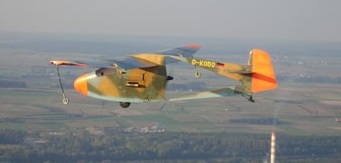
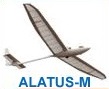
Manufactured by the Aerola company, Alatus-M is a microlight composite motorglider.

Alatus-M has been designed to comply with German standards LTF-UL and DULSV LFG, and with FAR-103 standards.

The engine pylon totally retractile allows very good gliding performances, the cockpit is spacious and vented and gives an excellent visibility.

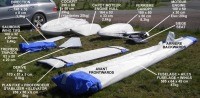
The aircraft can be dismantled by one person in about 40 minutes and carried on an ordinary car
Each plane is delivered with its transport covers.

Packed at delivery: One 303 x 71 x 98 cm wooden box and one 588 x 71 x 53 cm

Engine: Cors-Air 2 stroke, 20 hp electric starter, or Electravia electric 26 hp
Wing span: 13,10 m
Wing surface: 13,6 sq.m
Empty weight equipped: 115 kg
Maximum weight: 235 kg
Pilot size: 60 to 110 kg – 1,60 to 1,95 m
Flight range with engine: 1h 30min
Glide ratio: 27 at 60 km/h
Minimum sink rate: 0,65 m/s
Maximum speed: 110 km/h
Stall speed: 41-45 km/h
Vne 140 km/h

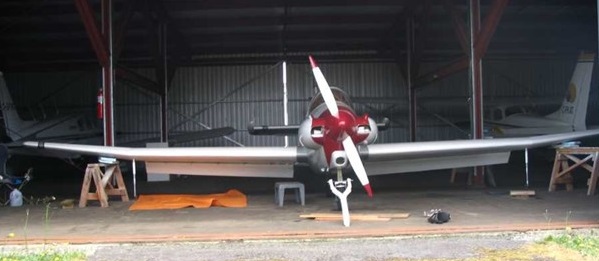
Rand KR-1B

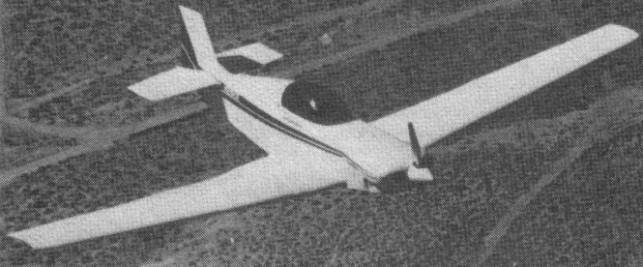
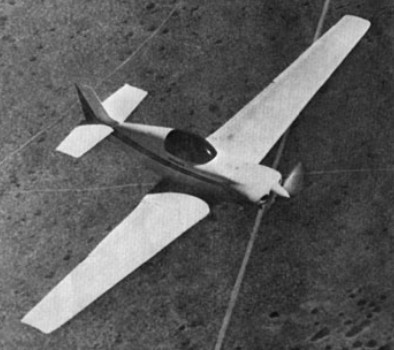
The KR-1B motorglider is essentially a stock KR-1 with longer wings and a bigger tail. For a wing curve, an RAF-48 standard KR-1 airfoil was used for the center section and the GA(W)-2 airfoil for the replacement outer panels. The outer wing section provides a clean and responsive curve for use with a spoiler/flap control, permitting deadstick landings at 70 mph TAS. Where the stock KR-1 wingspan is 172″, the motorglider wingspan measures 27′ from tip to tip, thereby increasing square footage from 64 to 91.

Power is supplied by a 60-hp VW engine. Maximum cruise is 130 mph, and with 33 gallons of fuel, range is 950 miles while getting 29 mpg. At the standard 4-gph burn rate, 33 gallons should deliver 8.25 hours of flying at 120 mph for a range of 1,020 miles.

Engine: 60-hp VW
Wing span: 27 feet
Wing area: 91 sq.ft
Maximum cruise: 130 mph
Fuel capacity: 33 USgallons
Range: 950 miles
At 120 mph Endurance: 8.25 hours
At 120 mph Range: 1020 miles
Airfoil centre: RAF-48
Airfoil outer: GA(W)-2

Rand Robinson

1997-8: 15641 Product Lane, Ste A5 Huntington Beach, CA 92649, USA.
2008-9: 7071 Warner Ave. #F, PMB 724, Huntington Beach, CA 92647, USA.

On September 7th, 2009 Jeanette Rand, President of Rand Robinson Engineering, officially announced that nV Aerospace will be the exclusive Manufacturer and Distributor for the KR line of aircraft and related components.
Rand Robinson retained the rights to the design but all inventory and tooling was acquired by nV|Aero to produce the KR kits. Plans for a fast build fuselage, improved wing and empennage airfoils and several other design improvements are under way.

Ralph Santa Anna 001

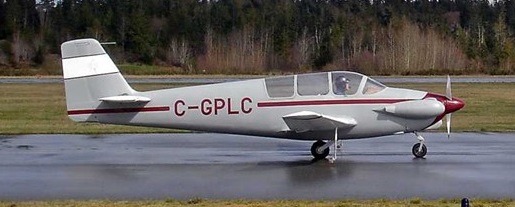
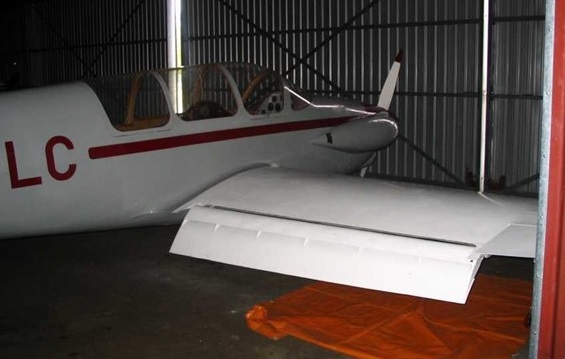
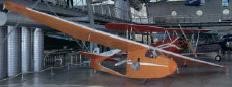
The Santa Anna 001 is a 2 seat tandem touring motor glider with short cruise wings with double slotted flaps and optional long span soaring wings. Retractable tandem nose wheel gear and outriggers. Construction is mixed wood and composite. Yellow cedar structure, glass/kevlar flying surface, Okoume ply fuselage skins.

First flown on 10 April 2008, C-GPLC was owned by Paul Ralph, Victoria BC, Canada.

Engine: Continental A65
Prop: Home made
Cruise: 115 mph
Stall: 45mph

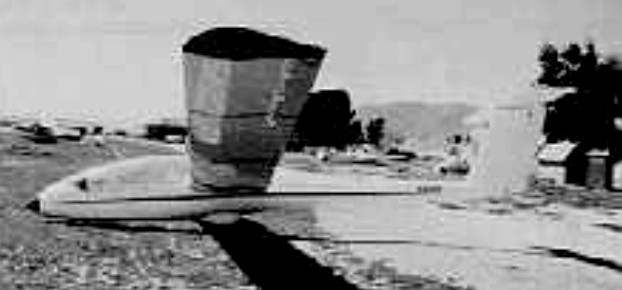
Raab Krähe

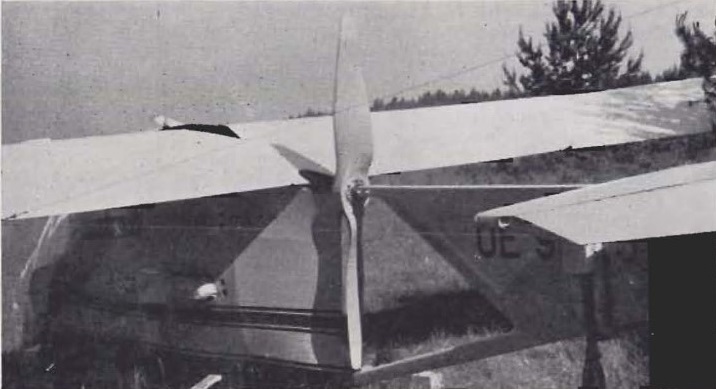
The Raab Krähe (English: crow) is a West German high-wing, single-seat, pusher configuration motor glider that was designed by Fritz Raab for amateur construction. The Krähe first flew in 1957, shortly after powered flight was again permitted in the Federal Republic of Germany. The most widespread problem was that engines proved unreliable when restarted in flight after being switched off for lengthy periods. Inevitably, there was a great deal of trial and error, and the Krähe was fitted with engines from various manufacturers. The aircraft was never commercially manufactured.

The Krähe is constructed from wood, with the fuselage made from a wooden structure covered in doped aircraft fabric. The 12.0 m (39.4 ft) span wings are built with a wooden structure and covered in plywood and fabric. The wings feature spoilers and a custom Raab-designed airfoil. The tailplane is braced with four cables to the wing trailing edge. The landing gear is a fixed monowheel.

The engine is mounted in the rear of the cabin area, with the propeller in between the top and bottom tail boom tubes. Motors used are usually of an output of about 30 hp (22 kW).

Raab designed the Krähe specifically for homebuilders. About 30 examples were reported completed by 1974.

Variants:

Krähe
Initial model with monowheel landing gear and propeller in between top and bottom tail boom tubes.

Austria Krähe
Later model with tricycle landing gear and propeller rotating around the upper tail boom tube.

Krähe
Engine: 1 × Steyr , 20 kW (27 hp)
Propeller: 2-bladed wooden fixed pitch
Wingspan: 12 m (39 ft 4 in)
Wing area: 14.3 m2 (154 sq ft)
Aspect ratio: 10:1
Airfoil: Raab
Empty weight: 238 kg (525 lb)
Gross weight: 333 kg (735 lb)
Fuel capacity: 8 U.S. gallons (30 L; 6.7 imp gal)
Fuel burn: 1.2 U.S. gallons (4.5 L; 1.00 imp gal) per hour
Wing loading: 23.3 kg/m2 (4.77 lb/sq ft)
Cruise speed: 121 km/h (75 mph, 65 kn)
Endurance: 10 hours loiter
Maximum glide ratio: 18-20:1 at 77 km/h (48 mph)
Rate of sink: 1.2 m/s (240 ft/min) at 68 km/h (42 mph)
Crew: one

Krähe IV
Engine: Hirth F 10, 19 kW
Wingspan: 12.0 m
Take-off weight: 340 kg
Best glide ratio: 20 : 1 at 78 km/h
Minimum sink rate: 1 m/s at 65 km/h
Maximum rate of climb: 1.7 m/s
PZL Krosno KR-03A Puchatek

The tandem two place metal framed sailplane was designed by Jerzy Krawczyk and Eugeniusz Pelczar as a basic training glider and first flew in 1985. It has an oleo pneumatic sprung fixed main wheel, a tail wheel and a rubber sprung nose skid. Approach control is by top and bottom surface Schempp-Hirth type airbrakes.

KR-03A Puchatek
Wing span: 16.4 m / 53.8 ft
Wing area: 19.44 sq.m / 209.25 sq.ft
Aspect ratio: 13.9
Airfoil: Wortmann FX-S-01-158
Empty Weight: 350 kg / 771 lb
Payload: 190 kg / 419 lb
Gross Weight: 540 kg / 1190 lb
Wing Load: 27.78 kg/sq.m / 5.69 lb/sq.ft
L/DMax: 27 88 kph / 48 kt / 55 mph
MinSink: 0.78 m/s / 2.38 fps / 1.41 kt
Seats: 2

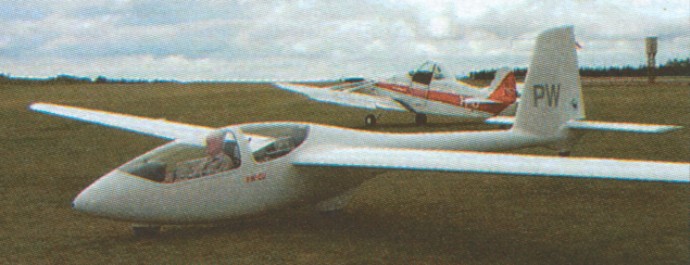
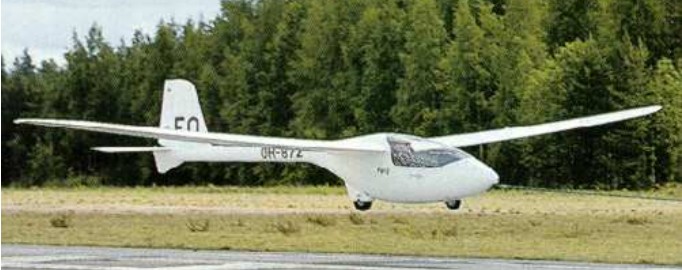
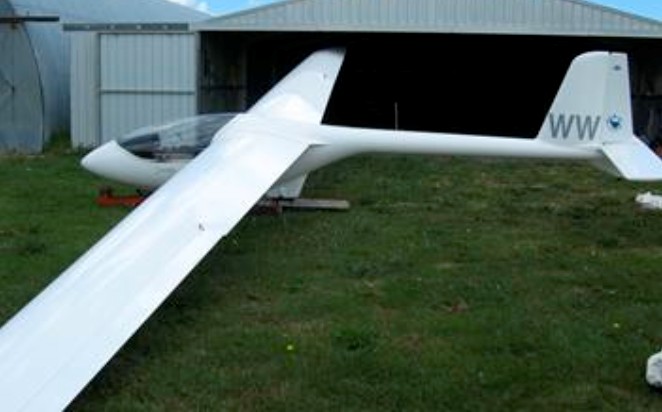
PZL Bielsko PW-5 Smyk

The PW-5 was the winning entry in the IGC/ OSTIV World Class design contest. The Polytechnika Warszawska design was available for license contruction both by manufacturers and homebuilders. PZL Swidnik is the first manufacturing licensee to reach production. It is flapless, has upper surface Schempp-Hirth airbrakes for approach control, and a fixed main wheel. PZL has announced that PW-5 production will be transferred to PZL Bielsko by the end of 1997. The structure is GFRP, with a fabric covered rudder.

Gallery

Wing span: 13.44 m / 44 ft
Wing area: 10.16 sq.m / 109.4 sq.ft
Aspect ratio: 17.8
Airfoil: Polytechnika Warszawska
Empty Weight: 190 kg / 418 lb
Payload: 110 kg / 242 lb
Gross Weight: 300 kg / 660 lb
Wing Load: 29.5 kg/sq.m / 6.03 lb/sq.ft
L/DMax: 32 88 kph / 48 kt / 55 mph
MinSink: 0.67 m/s / 2.2 fps / 1.30 kt
Seats: 1