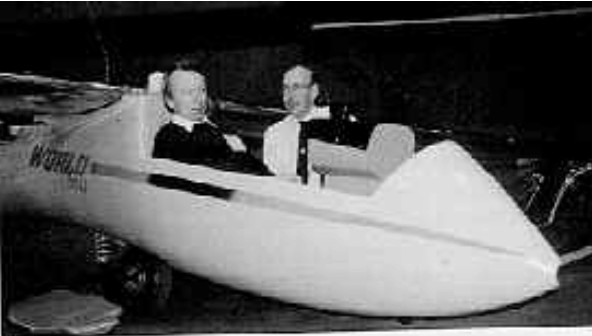
Designed by Donald Roberts, the Cygnet, which first flew in 1992, was the only U.S. entrant in the IGC/ OSTIC World Class sailplane design contest (won by the Polish designed PW-5). It has balanced DFS type airbrakes for approach control, and is fitted with a ballistic parachute emergency recovery system. The structure is steel tube and aluminum with GFRP fairings.
Wing span: 13 m / 42.65 ft Wing area: 9.57 sq.m / 103 sq.ft Aspect ratio: 18 Empty Weight: 165 kg / 364 lb Payload: 110 kg / 242 lb Gross Weight: 275 kg / 606 lb Wing Load: 28.7 kg/sq.m / 5.88 lb/sq.ft Water Ballast: 0 kg Seats: 1 No. Built: 1
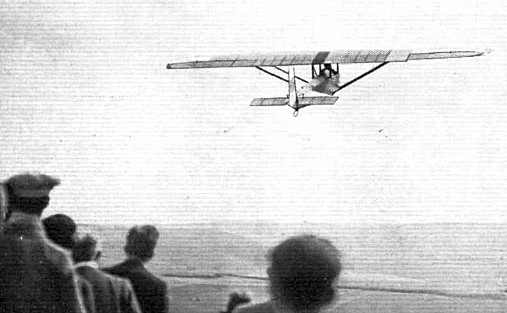
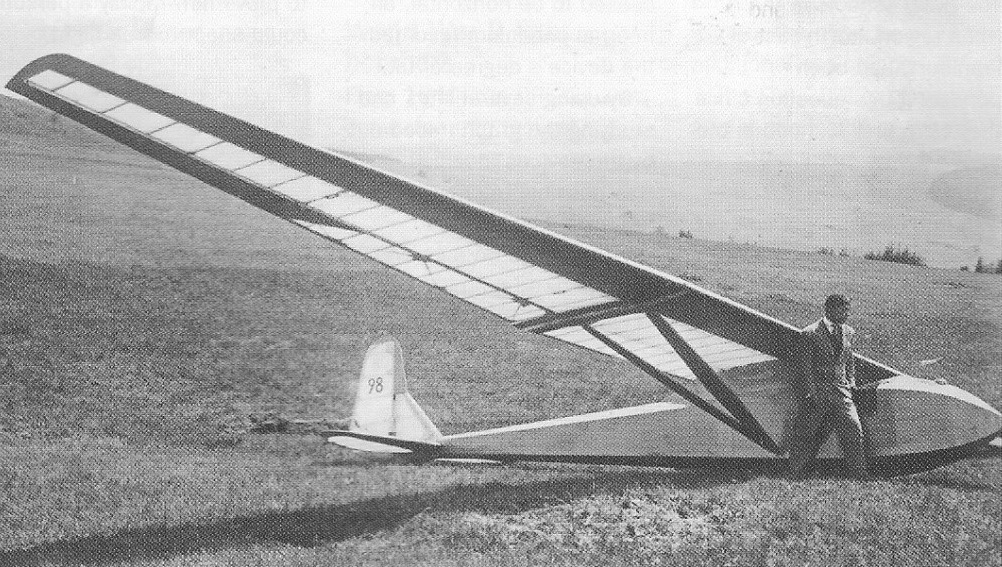
At the end of 1925 at the Martens gliding school on the Wasserkuppe into Rhön-Rossitten Gesellschaft (RRG), Martens chief instructor Fritz Stamer and Alexander Lippisch were brought together to produce two such gliders and within a few days the Zögling (English: Pupil) and the Prufling designs were complete. Some parts, for example the wings and to a lesser extent the horizontal tails, of the two aircraft were similar.
Both had almost rectangular, two-spar, wooden structured, two piece wings with fabric covering everywhere except the leading edges, which were plywood covered. The Prüfling’s wing tips were more rounded and its span 500 mm (19.7 in) greater. They both had simple ailerons reaching to the tips, where they were cropped, though the Prüfling’s were a little longer. Both had triangular tailplanes, carrying elevators that were rectangular apart for a cut-out for rudder movement, though the Prüfling’s tailplane was more strongly swept and was broader in chord.
The major differences between the two were in the fuselages. The Zögling had a very simple open frame girder fuselage, the Prüfling a more conventional hexagonal cross section, wood-framed structure, ply covered forward from under the wing and fabric covered aft. The wing was supported over the fuselage with a pair of parallel lift struts on each side, bracing it at almost mid-span at the spars to the lower fuselage longerons. The open cockpit was below the wing centre section which was supported by two pairs of cabane struts to the upper fuselage longerons. The forward pair, placed just in front of the cockpit were single, upright struts but the rear ones, just behind, were each an inverted V-pair. At the centre there was a noticeable gap between the wings, bridged by a short chord wooden link. The horizontal tail was positioned on the upper longerons. with a triangular fin carrying an upright, straight edged balanced rudder which was slightly angled below the heel and extended down to the keel. The Prüfling landed on a rubber sprung skid below the whole forward, ply skinned fuselage, assisted by a very small tailskid.
It first flew in 1926 and was soon in use with the RRG related Rhön and Rossitten gliding clubs. Plans were sold and many were built inside and outside Germany.[ As examples, one was flying with the Lancashire Aero Club and another with the London Gliding Club in the early 1930s. Despite such success, the Prüfling was something of a disappointment as a secondary training aircraft, for its performance was not much better than typical primaries. Its handling was also not good, with a lack of inherent stability. Lippisch returned to the design of secondary gliders four years later, after exploring tailless types, resulting in the RRG Falke.
A Prüfling was the first glider used by the United States Navy. A single German-made aircraft was purchased from a U.S. civil glider school, assigned serial number A8546, and used for airship launch tests; the first such launch was made from USS Los Angeles (ZR-3) on 31 January 1930. The Prüfling was never assigned a formal U.S. military aircraft designation.
Wingspan: 10.50 m (34 ft 5 in) Wing area: 15.24 sq.m (164.0 sq ft) Length: 5.484 m (18 ft 0 in) Aspect ratio: 7.23 Empty weight: 105 kg (231 lb) Gross weight: 195 kg (430 lb) Wing loading: 12.8 kg/m2 (2.6 lb/sq ft) Capacity: One
Built by RRG following research by Lippisch and Stamer. The fuselage was a polygonal section rather than monocoque, and the central part of the braced wing was completely straight, which was unusual for circa 1922.
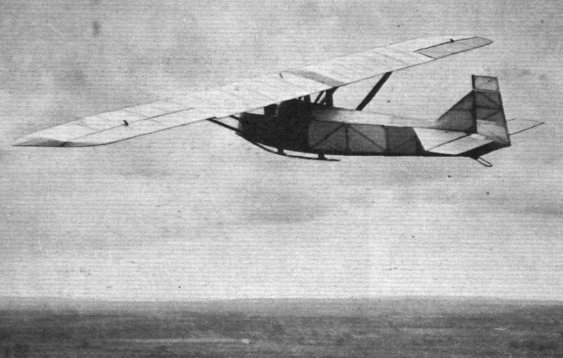
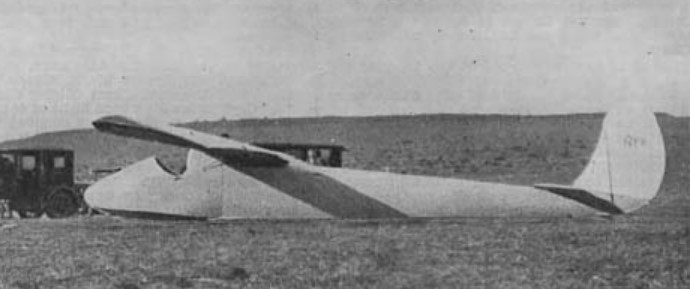
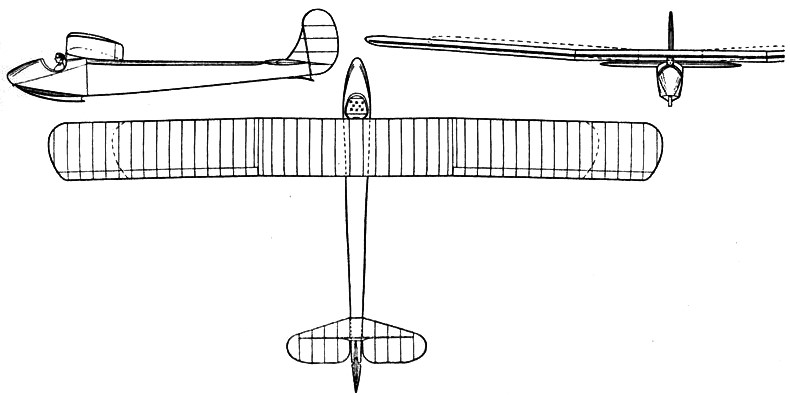
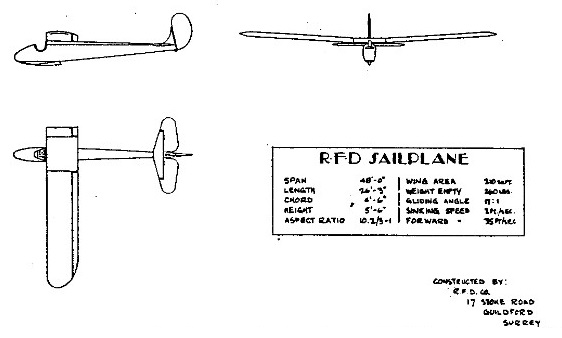
Named for design lead Reginald Foster Dagnall, the all-wood R.F.D. 2’s unusual dual span cantilever wing had outer sections with constant chord, slight sweep, blunt tips and full width ailerons, joined by a choice of two rectangular centre sections. The sailplane centre section was about 15 ft (4.57 m) long, reduced to about 5 ft (1.52 m) for the secondary trainer role. The wing was not fitted with flaps or airbrakes.
The fuselage of the R.F.D. 2 was a flat-sided monocoque with the wing mounted directly on top of it. The single seat open cockpit was immediately ahead of the wing leading edge. The main landing skid ran from the nose to about mid-chord and there was a small tail skid. The triangular tailplane, mounted on top of the fuselage, and curved fin were both small but carried generous, curved edged control surfaces. The rudder extended to the bottom of the fuselage, moving between the elevators.
The R.F.D. 2 first flew in February 1931 but seems not to have received certification or registration. Only one had been built when, in January 1932, the R.F.D. company announced it was selling its glider interests to the British Aircraft Company and would concentrate on its products for the Air Ministry.
Wingspan: 48 ft 0 in (14.63 m) long span; short span 38 ft 0 in (11.58 m) Wing area: 210.0 sq ft (19.51 m2) long span; short span 165 sq ft (15.33 sq m) Aspect ratio: Long span 11.0; short span 8.45 Length: 26 ft 3 in (8.00 m) Empty weight: 250 lb (113 kg) long span; short span 215 lb (97.5 kg) Gross weight: 410 lb (186 kg) long span Rate of sink: 120 ft/min (0.61 m/s) maximum, long span; short span 150 ft/min (0.76 m/s) Lift-to-drag: Minimum, long span 23.4 at 32 mph (51 km/h); short span 20.4 at 34.7 mph (55 km/h) Wing loading: 1.85 lb/sq ft (9.0 kg/m2) long span
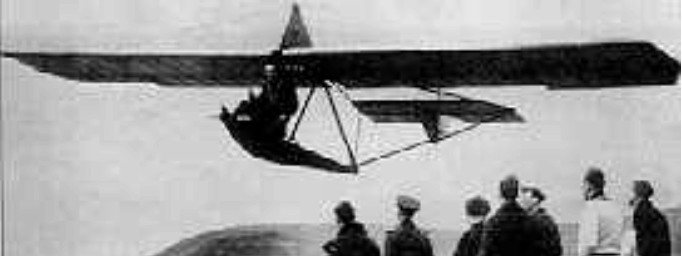
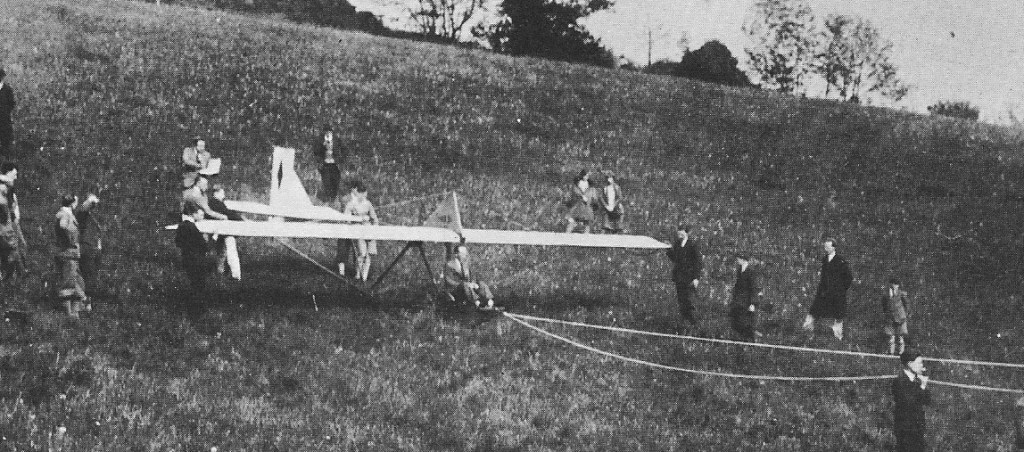
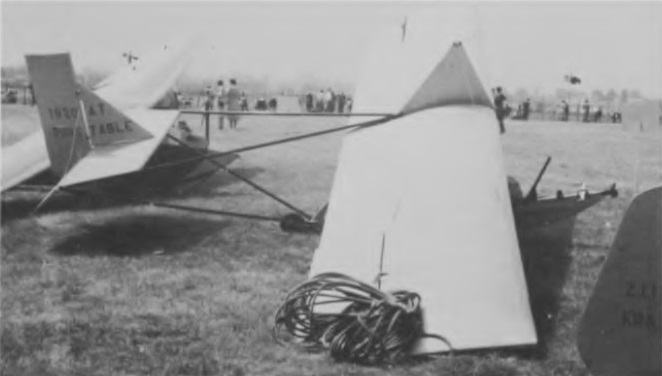
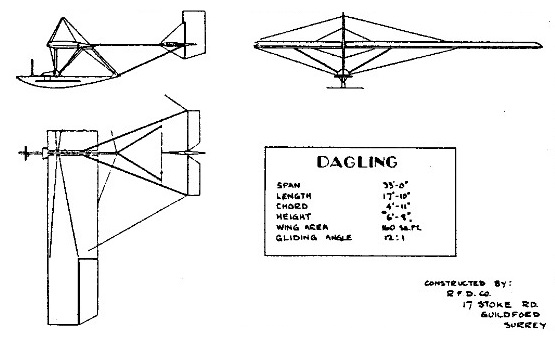
Primary training gliders evolved as very simple, even crude, airframes sufficiently basic and strong to withstand the rough handling of inexperienced beginner pilots while having just enough flying ability (and vices) to give the trainee pilot the feel of the controls and enable him to grasp the basic skill of controlling an aircraft in flight. The best known British prewar example in this category was the Dagling, a primary glider the prototype of which was built in 1930 by R. F. Dagnall, founder of the R.F.D. Co Ltd, for the London Gliding Club using plans acquired through America; this was a version of the German Zogling primary, and the combination of ‘Dagnall’ and ‘Zogling’ resulted in the name Dagling, which was often later applied to all primary gliders regardless of their true identity.
The Dagling had a low aspect ratio constant chord wing from which a rudimentary wooden A-frame fuselage framework was suspended housing the pilot, the tail unit being carried on four steel tubular members – these had been wooden members in the Zogling, but were changed to metal to give a stronger support for the tail. Simple wood and fabric construction was employed, with wire-braced wings and only a main skid on the bottom fuselage member for the landing gear. Some Daglings had a nacelle fitted to give the pilot some protection from the elements, while others had rounded instead of squared-off wing tips, and at least one had a nacelle with two seats in it.
Although pretty basic, the Dagling was successful enough to go into production and the R.F.D. Co built at least 27 but in January 1932 announced the cessation of its glider making activities to concentrate on its Air Ministry contracts.
Dagling production was taken up by several other British firms, the foremost of which was Slingsby, which started building the type at Scarborough in 1933 as the T3 Primary, and eventually built 67; Slingsby’s 1933 price for a complete Dagling was £45, and this had risen to £57 15s (£57.75) by 1939, or £66 with a nacelle. For amateur constructors, the British Gliding Association offered a complete set of Dagling plans in 1933 for only £2. Dagling production was also undertaken by Hawkridge Aircraft Ltd, who built five after the war, by Dart Aircraft Ltd, by the Dunstable Sailplane Co, who built one, and Abbott Baynes Sailplanes Ltd; the type’s simplicity also enabled it to be built by students at technical schools and colleges such as the College of Aeronautical Engineering, who built one at Redhill.
The Dagnell-Brewsher Primary was allocated C. of A. No. BGA 171.
The Dart Zogling was built from the same plans as the RFD Dagling.
Several other nations produced single-seater primary types in the 1930s basically similar in appearance and performance to the Dagling, such as the Italian Allievo Pavullo, also available with or without a nacelle, the US-designed Denver Primary and the German Schulgleiter SG 38 (the 108-14) and the Grunau Ei.
Slingsby T3 Primary Span: 33 ft 0 in Span: 33 ft 11.5 in (with rounded tips) Wing area: 15.06 sq.m / 162 sq.ft Aspect ratio: 7.1 Length: 17 ft 10.5 in Empty Weight: 82 kg / 180 lb Payload: 91 kg / 200 lb Gross Weight: 173 kg / 380 lb Wing Load: 11.5 kg/sq.m / 2.35 lb/sq.ft Stalling speed: 25 mph No. of Seats: 1
Reginald Foster Dagnall was born in Fulham, London on 11 April 1888 the son of Walter and Frances Dagnall, he was educated at Tiffin School, Kingston upon Thames. Dagnall started his career in the drawing office of the Thames Ironworks and Shipbuilding Company. He then joined Ernest Willows in developing Willows airships and during the 1914-18 war he was first works manager and then general manager of Airships Limited., a firm which made kite balloons and blimps.
After World War I Dagnall founded his own company, in a small factory at 17 Stoke Road, Guildford, Surrey Dagnall began the manufacture of equipment and gliders.
The RFD name is now synonymous with “Rapid Flotation Device” and the supply of marine and aviation safety equipment. He had researched flotation gear of various sorts, and in 1918 he built some of the earliest rubber dinghies.
RFD moved to Guildford in 1926 and expanded to Catteshall Lane, Godalming, in 1936 the Godalming factory burnt down and was rebuilt in 1954.
The R.F.D. Co Ltd built the prototype of the Dagling, a primary glider, in 1930 for the London Gliding Club using plans acquired through America. Dagnall was a keen glider pilot and chairman of the Surrey Gliding Club and its later incarnation the Southern Counties Soaring Club.
The non-rigid airship AD1 (registration G-FAAX) was designed by RFD and built by the Airship Development Company at the Stoke Road works in Guildford. It was taken to the old Cramlington Airship Station near Newcastle and erected in the 1918 airship hangar, with its first flight on 18 September 1929. In May 1930 it performed a number of aerial advertising flights with banners laced to the envelope sides. The original ABC Hornet engine was replaced by a 75 hp Rolls-Royce Hawk in July 1930 for work in Belgium. By mid-1931 it was dismantled and parts sold off by auction on 18 June 1931.
The Dagling was successful enough to go into production and the R.F.D. Co built at least 27 but in January 1932 announced the cessation of its glider making activities to concentrate on its Air Ministry contracts, and the name of R.F.D. was henceforth to become far better known for liferafts, dinghies, parachutes, air and sea rescue equipment and related products.
Reginald Foster Dagnall died on 16 November 1942 (aged 54) in Surrey, England, of heart failure.
In 1959 RFD merged with Perseverance Mill. In 1963 it took over Elliot Equipment and acquired GQ Parachute Company Ltd. Dagnall was also a director of G.Q. Parachute Co., Ltd., which leased space in the RFD works in Guildford. It purchased Mills Equipment Company in 1968. In 1970 the three companies merged to form RFD-GQ In 1975 RFD-GQ divided into: – RFD Inflatables Ltd – GQ Parachutes Ltd – RFD Systems Engineering Ltd – RFD Mills Equipment Ltd.
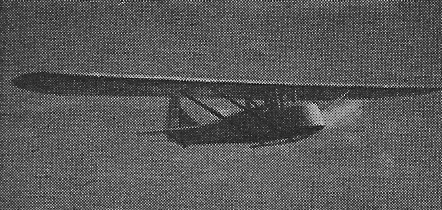
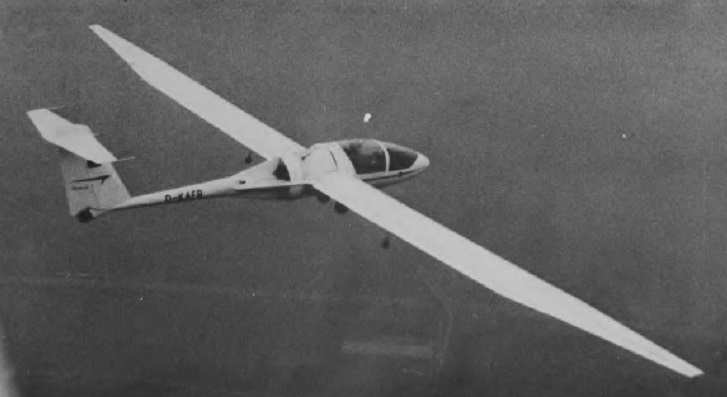
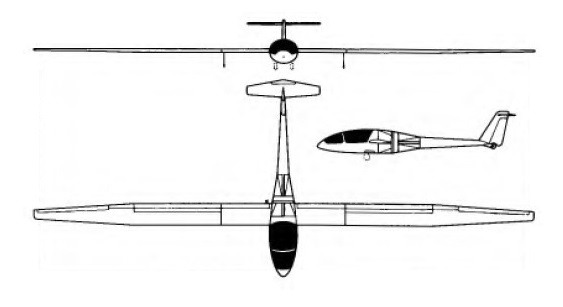
The Sirius 1 was developed to investigate the efficiency of the ducted fan as a means of propulsion for motor gliders. It was developed from the VFW FK-3 all-metal sailplane and was first powered by a Nelson 48 hp two-stroke engine, then by two Yamaha motor cycle engines and finally two 20 hp Fichtel & Sachs Wankel engines were chosen.
First flown in January 1972, the Sirius 2 is the two-seat companion to the Sirius 1, but Rhein-Flugzeugbau, the manufacturers, in this case have arranged with Caproni of Italy to use the wings, tail unit and landing gear of the A-21 Calif. This side-by-side two-seat ducted fan motor glider is powered by two 30 hp Wankel rotary engines which drive a ducted fan embedded in the fuselage just aft of the wing trailing edge. One engine is mounted in front of the fan and the other behind it. The fan shroud utilises an annular slat intake round the wing leading edge to keep the airflow attached to the duct, and suck-in doors fair off this intake when the power plant is not operating to maintain gliding performance.
Sirius 2 Engines: 2 x Wankel driving ducted fan Wing span: 20.38 m / 66 ft 10 in Length: 8.04 m / 26 ft 4.5 in Height: 1.8m / 5ft 11 in Wing area: 16.1 sq.m / 173 sq ft Wing section: Wortmann FX-67-K-170/60-126 Aspect ratio: 25.8 Empty weight: 510 kg / 1,124 lb Max weight: 690 kg / 1,521 lb Water ballast: None Max wing loading: 43.4 kg/sq.m / 8.88 lb/sq ft Max speed (powered): 146 kt / 270 km/h Stalling speed: 39 kt / 72 km/h Min sinking speed: 0.6 m/sec / 2 ft/sec Best glide ratio: 38 T-O run: 200 m / 656 ft Rate of climb: 120 m/min / 394 ft/min Range: 270km / 147nm
Founded in 1957, RFB obtained a license from Rhein-West Flug to build the RW-3 Multoplane in 1957, flying the first production aircraft in 1958 and following with a small batch.
Built and flew the RF1 six-seat STOL transport in 1960; with two Lycoming engines geared to drive single pusher propeller in a wide-chord duct.
In 1968, VFW-Fokker acquired 65% of shares in RFB, and in 1969 RFB acquired a percentage holding in Sportavia company. Company became busy with military contracts for overhaul, and target towing for some years.
Built in collaboration with Grumman-American the Fanliner two-seat light aircraft with Wankel rotary engine, first flown in 1973. It was re-engined in 1976 with a Dowty Rotol ducted propulsor. Based on the Fanliner’s promise, the Federal German Government awarded a contract for two Fantrainer prototypes with ducted fan engines, first flown in 1977 and 1978. In the 1970s German interest in general aviation was maintained by one or two smaller companies, but there has also been quite a large R&D investment by Rhein Flugzeugbau, in ducted fan propulsion for a new generation of lightplanes represent¬ed by its Fanliner.
Production Fantrainer 400s and 600s were ordered only by Thailand, the first (a 600) flying in 1984 and most assembled in Thailand from kits. Projected Fantrainer 800 did not enter production; neither did the proposed Tiro-Trainer with a turbofan engine. Company ceased trading in 1997.
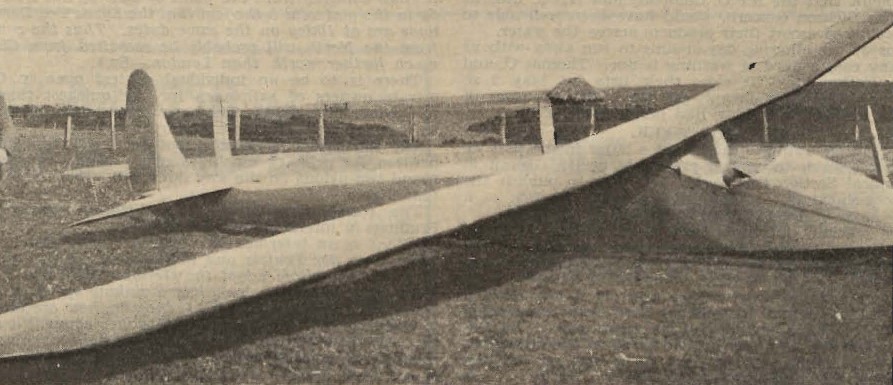
The Reynard R.4 Primary was an open seat primary glider with an open girder fuselage and a high, wire braced wing.
The wing was rectangular in plan, with ailerons at the tips but no flaps or airbrakes. N-form struts from the wing supported a girder about 8.5 ft (2.6 m) long and curved on the underside to form a landing skid. The pilot’s seat and controls were placed, exposed, on its upper surface just ahead of the wing. Lift wires ran from this girder to the underside of the wing beyond mid-span and a pair of landing wires on each side were fixed to the apex of a two strut, triangular central cabane or kingpost above the wing.
Behind the wing trailing edge and the end of the lower girder the rear fuselage was a tapering, vertically orientated, two bay Warren truss, ending at a vertical cross member which supported the rudder. The triangular tailplane and fin were mounted on the horizontal upper fuselage beam and the straight edged rudder extended down through a cut-out between the elevators to the lower beam.
It was designed and at least five built in the UK in 1930 by Reynard Gliders, Leicester. Some Reynards were built with a hinged nacelle to give the pilot better protection from the weather, though still in an open cockpit. To compensate for the extra side area the rear two bays of the fuselage were fabric covered.
It has been suggested that at least two R.4s were built with steel tubed rather than wooden rear fuselages, under the name Reynolds R.4 after the contemporary bicycle tube frame manufacturer.
The Reynard could be bought complete for £45 or built from plans costing 21/- (1 guinea or £1.05) and was regularly advertised in 1930-1. Several were built and active in the early 1930s with UK gliding clubs. One was demonstrated to the Leeds club in October 1930 and they received the first of two the following month. The Bradford, Halifax, Leicester and Ulster Gliding Clubs also had Reynards.
The two Reynards that received BGA certificates of airworthiness, BGA 166 and 167 had serial number R.4/5 and R.4/6 respectively BGA 166 was used by the Leeds and later Bradford Gliding Clubs. BGA 167 was used by the Ulster Gliding Club from 1931, they fitted a nacelle when they rebuilt it aircraft in 1933. This glider went to the Dublin Gliding Club in 1934 and was still active the following year.
Wingspan: 34 ft 2 in (10.41 m) Aspect ratio: 6.6 Length: 18 ft 3 in (5.56 m) Height: 7 ft 2 in (2.18 m) Crew: 1
 All Aero