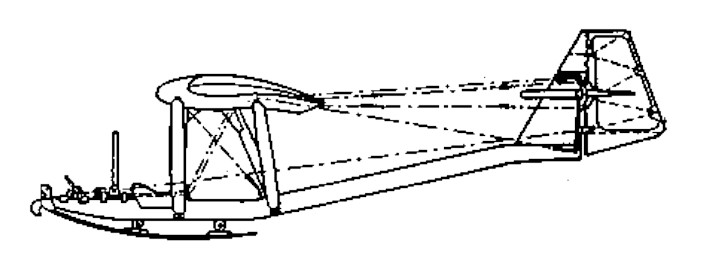
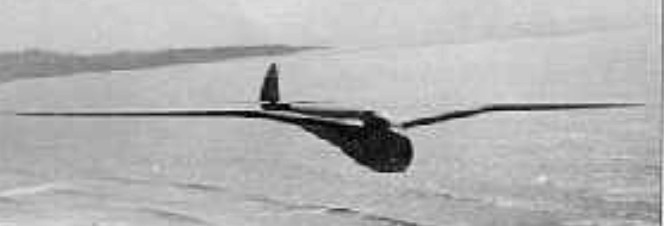
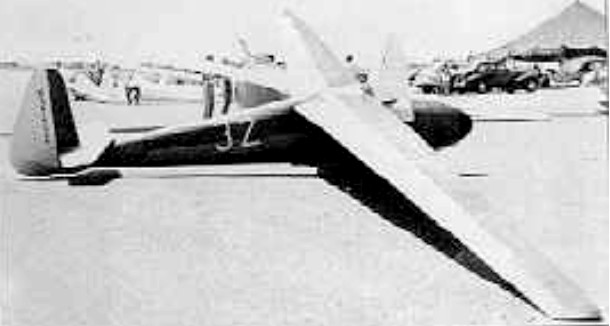
Rubik R-07d / Ever KFT R-07 Tücsöl / Vöcsök

The Ever KFT R-07a Tücsöl (Cricket), open-frame single seat basic instruction glider appeared in 1938.
The R-07a Tücsök was a reduced-scale Vöcsök to replace the Zögling.

The Ever KFT R-07b Vöcsök (Grebe) appeared in 1940, a productionized version of the R-05/R-06 Vöcsök.

The Rubik R-07d was a postwar Vöcsök with modified ailerons, 30 built 1955/56.

As a production series of the R-06, 361 were built.

Rubik Aero Ever KFT R-07b Vöcsök
Length : 20.669 ft / 6.3 m
Wingspan : 38.058 ft / 11.6 m
Wing area : 161.46 sq.ft / 15.0 sq.m
Max take off weight : 430.0 lb / 195.0 kg
Weight empty : 242.6 lb / 110.0 kg
Max. weight carried : 187.4 lb / 85.0 kg
Glide ratio : 15.0
Minimum sink rate : 177.17 ft/min / 0.9 m/s

Rossitten-As Training Glider

The Rossitten-As of 1931was a simple glider for basic flight instruction, which could be launched by rubber ropes. It is a typical design of a glider of the years between the wars. The gliders were too small to carry two, so the student had to fly solo.

Length : 20.308 ft / 6.19 m
Height : 7.054 ft / 2.15 m
Wingspan : 35.761 ft / 10.00 m
Crew : 1

Ross RS-1 Zanonia

Harland Ross built the all wood RS-1 in 1937 for Harvey Stephens, hence the designation. It was one of the first small-span high-performance sailplanes. The lines of the ship were inspired by the Lippisch Fafnir II and the name comes from an Australian seed with good gliding characteristics.

Ross flew the RS-1 in the 1937 U.S. Nationals and placed 3rd behind Peter Riedel and Richard du Pont. The ship placed 2nd in the Easton design competition.

Later, owned and piloted by John Robinson, it made American Soaring history by winning the 1940, 1941 and 1946 Nationals, placing third in 1947 and second in 1948, and setting National distance record of 466 km. /290 miles in 1940 and 523 km. /325 miles in 1947 and the world altitude record of 10,211 m. / 33,500 ft. in 1949. Robinson also completed the Worlds’s first Diamond badge using the RS-1

Wing span: 14.02 m / 46 ft
Wing area: 11.61 sq.m / 125 sq.ft
Empty Weight: 150 kg / 330 lb
Aspect ratio: 17
Airfoil: NACA 2418,2412
Payload: 122 kg / 270 lb
Gross Weight: 272 kg / 600 lb
Wing Loading: 23.43 kg/sq.m / 4.8 lb/sq.ft
Water Ballast: 0
L/DMax: 30 77 kph / 42 kt / 48 mph
MinSink: 0.70 m/s / 2.3 fps / 1.36 kt
Seats: 1
No. Built: 1

Ross RJ-5 / RHJ-5

The original design was almost entirely that of Harland Ross, whom Dick Johnson commissioned to build it in 1948. Johnson took delivery of the semi-complete ship in 1950 and finished it at Mississippi State University, incorporated some changes of his own.

The RJ-5 became one of the world’s most famous sailplane when Dick Johnson flew it 861 km/ 535 miles in 1951 for a world sitance record that stood for 13 years. It was one of the first sailplanes to utilize a laminar airfoil and to archieve a glide ratio of 40 to 1. With it Dick Johnson won the 1950, 1951, 1952 and 1954 Nationals and set a 510/ 317 miles National goal record, a 584 km/ 363 miles National distance record, a 85.0 kph/ 45.9 kt/ 52.8 mph 100 km. Triangular speed course record as well as the world distance record.

The wood fuselage and tail were badly damaged later in an accident so the then owner had an-all metal fuselage and tail built, designed by Adnan Kisovec (thus the K in the later designation). The ship originally used a takeoff dolly, but the fuselage was later modified to incorporate a Schweizer 1-34 retractable landing gear and airbrakes.

It now belongs to the National Soaring Museum, which has a project under way to build a replacemant original fuselage and tail.

RHJ-5
Wing span: 16.76 m / 55 ft
Wing area: 11.61 sq.m / 125 sq.ft
Aspect ratio: 24.2
Airfoil: NACA 63 (2)-615
Empty Weight: 295 kg / 650 lb
Payload: 91 kg / 200 lb
Gross Weight: 386 kg / 850 lb
Wing Loading: 33.25 kg/sq.m / 6.8 lb/sq.ft
Water Ballast: 0
L/DMax: 37 85 kph / 37 kt / 53 mph
MinSink: 0.61 m/s / 2.0 fps / 1.18 kt
Seats: 1
No. Built: 1