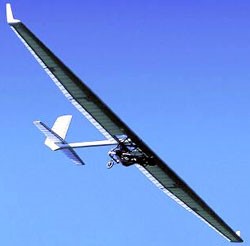
Ruppert Composite Archaeopteryx

Designed by Roger Ruppert, the 1998 Archaeopteryx was conceived as a conventional glider configuration for foot launch. Primary targets were set to minimize the mass, allowing slowest possible flight speeds and providing good manoeuvrability based on a friendly stall behaviour as well as outstanding high-speed flight performances with full fairing on the cockpit. The concept permits a safe foot launch also in nil wind conditions. Excellent climb rates and an efficient riding out of extremely weak and slim thermals (microlift) are possible.
No. Built: 1

Wing span: 13.6 m / 44.6 ft
Wing area: 12.8 sq.m / 138 sq.ft
Gross Weight: 160 kg / 353 lb
Aspect ratio: 12.07
L/D Max: 24
MinSink: 0.44 m/s | 87 fpm
Hang glider weight: 40 kg
Minimum pilot weight: 70 kg
Maximum pilot weight: 110 kg
Minimum speed: 29 km/h
Maximum speed: 140 km/h
Packed length: 6 m
Seats: 1

Rubik R-27 Kópé (Scamp) / MME / Miizseripari MCivek Esztergom R-27 Kópé

This single-seater training sailplane first flew in prototype form on 7 October 1961 and is closely related to the R-26 Gobe, having basically the same fuselage, and 80% of the components of the two types are interchangeable. The wings are the same as the R-26’s but of reduced area and lower aspect ratio (9.35), and the fuselage is very much the same metal monocoque structure, partly fabric-covered. The tail unit reverts to the cantilever ‘butterfly’-type of the R-25 Standard, again of fabric-covered metal construction with a trim tab in each elevator. Landing gear consists of a non-retractable monowheel with torsion rubber spring and a brake, and the pilot is seated under a removable blown plastic canopy.

Span: 39 ft 4.5 in
Length: 23 ft 0 in
Wing area: 165.8 sqft
Aspect ratio: 9.35
Empty weight: 344 lb
Max weight: 595 lb
Max speed: 124 mph (in smooth air)
Max aero-tow speed: 62 mph
Min sinking speed: 3.28 ft/sec at 43.5 mph
Best glide ratio: 20:1 at 46.5 mph

Rubik R-26 Góbé / MME / Miizseripari MCivek Esztergom R-26 Góbé

The R-26 Gobe metal and fabric two-seater sailplane was developed from the R-23 Gebics and R-24 Bibic and has a conventional fabric-covered cantilever metal tail unit with the tailplane mounted part of the way up the fin, and lower aspect ratio (10.88) constant chord wings.

The first of two R-26 Gobe prototypes made its maiden flight on 6 May 1961 and an initial production batch of 50 was put in hand. The cantilever high wings are single-spar all-metal structures with a leading edge torsion box and fabric-covered from the 35% chord line aft; the slotted metal ailerons are also fabric-covered and DPS air brakes are fitted. The metal monocoque fuselage is partly fabric-covered and the landing gear consists of a non-retractable monowheel with a torsion rubber spring and a brake. The two pilots are seated in tandem under a sideways-opening blown plastic canopy.

  • R-26P1 – 1st prototype, v-tail
  • R-26P2 – 2nd prototype, conventional tail
  • R-26SU – Góbé 82, renewed production version, 78 built 1982/’82 at Szombathely
  • R-26M Motor Góbé – motorized Góbé (pusher engine above wing)
  • R-26S – serial production version, 115 built 1963/’65 at Esztergom

Wing span: 14 m / 45 ft 11 in
Wing area: 18 sq.m / 193.75 sq.ft
Length: 29 ft 5 in
Empty Weight: 240kg / 529lb
Payload: 200kg / 441lb
Gross Weight: 440kg / 970lb
Wing Load: 24.4kg/sq.m / 5lb/sq.ft
Aspect ratio: 10.88
L/DMax: 23.7 @ 81 kmh / 44 kt / 50 mph
Airfoil: Go 549 modified
Max speed: 106 mph (in smooth air)
Max aero-tow speed: 68.5 mph
MinSink:0.97 m/s / 3.18 fps @44kts/81kmh/50mph
No. of Seats: 2
Structure: aluminum, fabric cover on wings.

Rubik R-25 Mokány (Little Devil) / MME / Miizseripari MCivek Esztergom R-25 Mokány

Hungary’s leading postwar sailplane designer is Erno Rubik, a number of whose designs in the R series went into production at Esztergom during the 1940s and 1950s. The metal and fabric R-25 Standard had its origins in the all-metal single-seater R-23 Gebics experimental sailplane which first flew in 1957 and was designed at the Alagi Kozponti Kiserleti Uzem Dunakeszi, where Erno Rubik was head of the design office. This organisation’s development of the Gebics and the services of Rubik as chief designer were taken over that year by MME / Miizseripari MCivek Esztergom, and a Standard Class derivative of the Gebics with a laminar flow wing, the R-24 Bibic, was completed in 1958. This was further developed by Rubik into the R-25 Standard single-seater, the prototype of which first flew on 29 September 1960; as its name implies, this is a Standard Class sailplane and is fully aerobatic, as well as being suitable for cloud flying. This design has a pod-and-boom all-metal monocoque fuselage and a ‘butterfly’-type V-tail, with an included angle of 90° between the tail surfaces. The cantilever high wings are all-metal single-spar structures with a leading edge torsion box and fabric covering aft of the spars. Slotted Frise ailerons are fitted and an unusual feature is the use of fan-type air brakes on each side of the fuselage instead of the more usual wing type. The all-moving tail surfaces are of fabric covered metal construction, with a geared tab in each trailing edge. Landing gear consists of a non-retractable monowheel with torsion rubber spring and a brake, and the pilot sits under a removable one-piece blown plastic canopy.

R-25-4 (E-31) Esztergom

Span: 49 ft 2.5 in
Length: 23 ft 11.5 in
Wing area: 120.6 sqft
Aspect ratio: 20.09
Empty weight: 408 lb
Max weight: 683 lb
Max speed: 137 mph (in smooth air)
Max aero-tow speed: 84 mph
Min sinking speed: 2.23 ft/sec at 47 mph
Best glide ratio: 31.2:1 at 51 mph

Rubik R-22 Futár (Courier) / Június

A 15m span single-seat wooden sailplane, 1943, 11 built

  • R-22S (-2) Június 18, 15m span sailplane, wooden construction, flown 1950, 70 built
  • R-22-3 Super Futár, 15.7m span sailplane, Futár/Június 18 successor, 12 built 1957
  • powered versions: R-22S (R-22-2) Június 18, R-22-3 Super Futár, R-22-4 Standard Futár
  • NB: Super Futárs are also listed as R B-22 or R-22B and R C-22 or R-22C