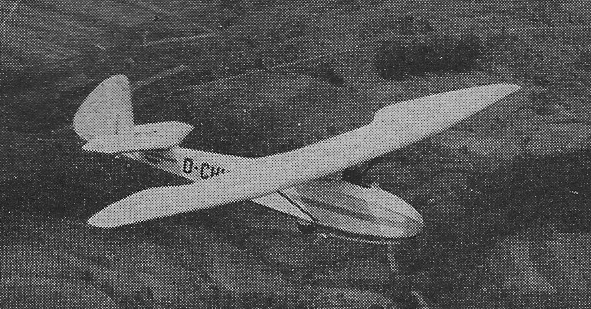
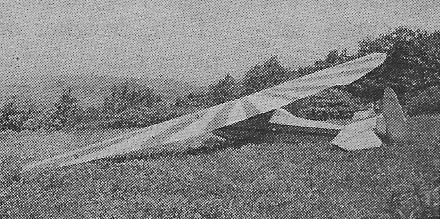
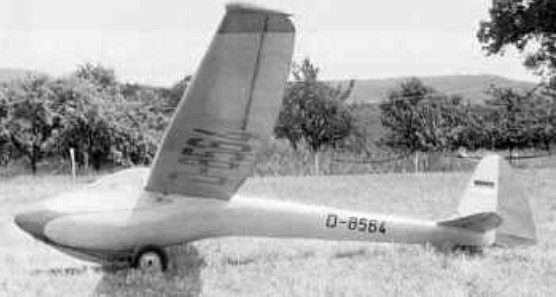
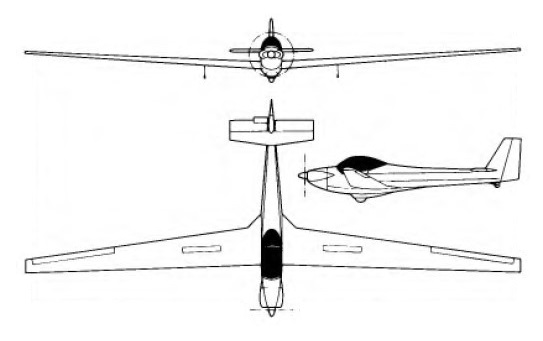
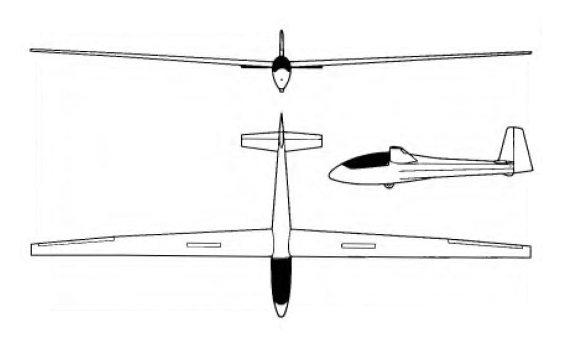
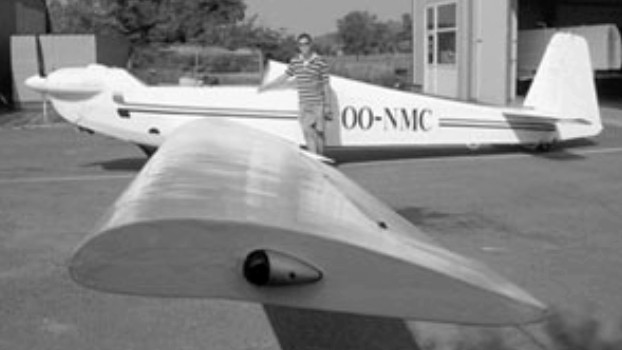
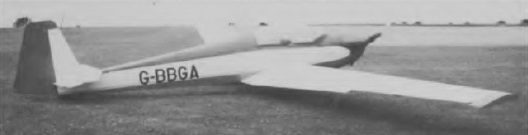
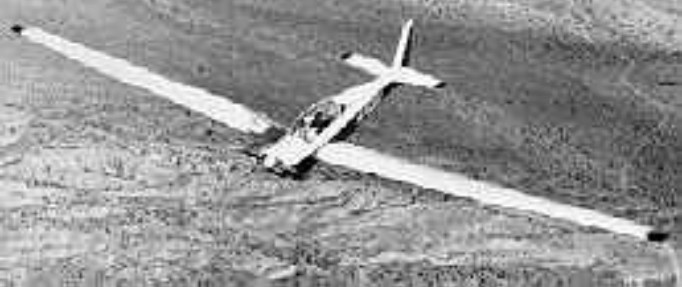
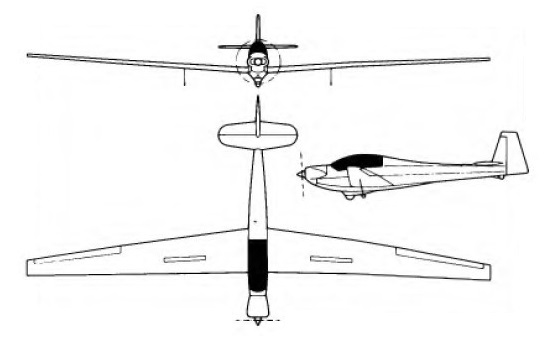
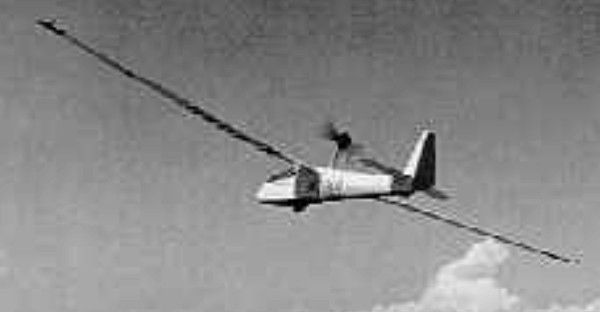
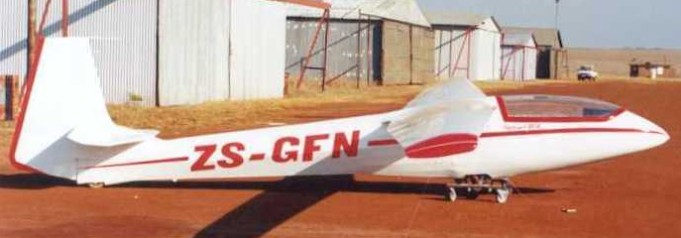
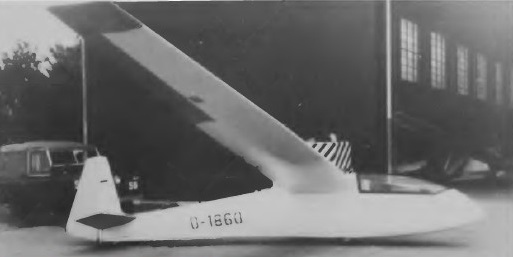
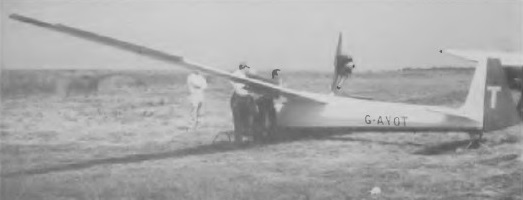
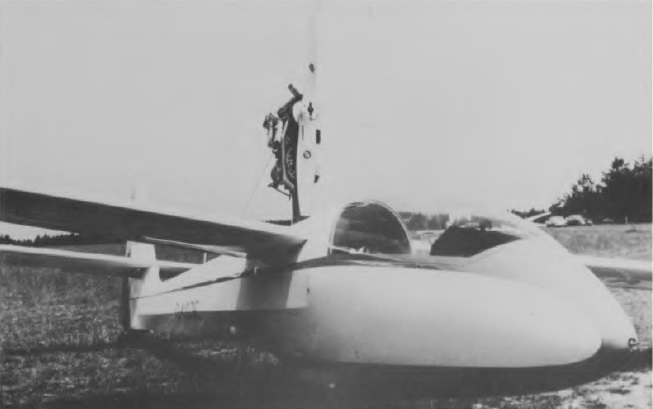
Goppingen GÖ-1 Wolf 1

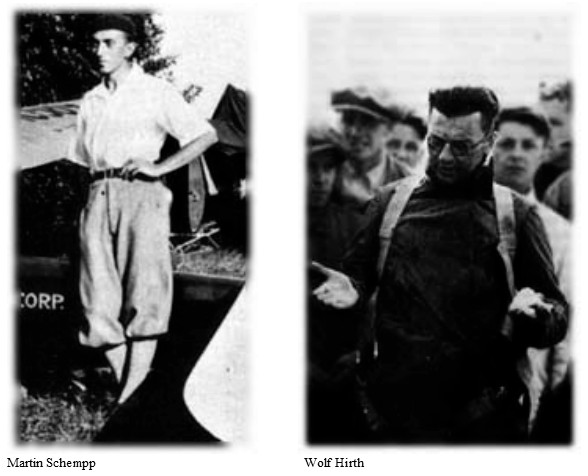
The Wolf was named after Wolf Hirth, partner with Martin Schempp in the then new firm of Sportflugzeugbau Goppingen (now Schempp-Hirth). It was produced in 1935 as a rival to the Schneider Grunau Baby as a utility (rather than a high performance) sailplane. It lacks any approach control devices but has a built-in wheel, an unusual feature for the time. It was used widely for aerobatic displays, for which it could be fitted with an extra strut (making a V- strut) to permit inverted maneuvers.

It had poor spinning characteristics, and in 1938 all those flying in Germany were grounded until modifications were incorporated in the wingtip and ailerons.

Structure: I-strut-braced wood/ fabric wings and tail, wood fuselage.

Göppingen Gö 1 Wolf
Wing span: 14m / 45ft
Wing area: 14.5sq.m
Length: 20.669 ft / 6.3 m
Empty Weight: 145kg / 330lb
Max Payload:100kg
Gross Weight: 220kg
Wing Load: 14.6kg/sq.m
Aspect ratio:13.1
Airfoil: Gottingen 535
Seats: 1
L/DMax: 17 @72 kph / 39 kt / 45 mph
MinSink: 0.91 m/s /3.0 fps / 1.78 kt
Crew: 1

Schempp-Hirth / Göppingen

Sportflugzeugbau Göppingen (Sport Aircraft Göppingen)
Sportflugzeugbau Schempp-Hirth
Schempp-Hirth Flugzeugbau Gmbh

Martin Schempp and Wolf Hirth first met in 1928 and beginning in 1935, the team developed the Minimoa, the first high performance glider to sell more than 100 models. The production of Schempp-Hirth gliders began in the municipal building yard in Göppingen, near Stuttgart, where Martin Schempp founded the Sportflugzeugbau Göppingen (Sport Aircraft Göppingen) company in 1935.

In 1938 the company moved to Kirchheim/Teck and employed more than 300 people during the war time.

The first serial gliders were the aerobatic single seat trainer GÖ-1 ‘Wolf’ from Wolf Hirth and the renown GÖ-3 ‘Minimoa’ as well as the two seat GÖ-4 from Wolfgang Hütter. Occasionally there are single examples which are preserved and maintained as oldtimers which can still be found at airshows.

During the war, the production was forcefully expanded to build parts for, amongst other things, the ME-109, the “Giant” and for the Bachem “Natter”. Alongside the GÖ-4 there were also complete aircraft which were built, like the GÖ-8 and the 13,6m-“Habicht”.

The period after the war till 1955 was bridged with the production of plywood suitcases, leg prosthesis, furniture, weaving looms etc, yet also with fighter jet dummies (F-86) and sound studios for television stations.

The connection to the aviation industry was implemented early on with the production of the Matteson M-1 glider, the production of the powered aircraft GS-6a “Milan” and with works on engine pod and tail section of the “Trumpf” airship D-LEDA.

Licenced production such as “Emeraude” and “Smaragd”, subcontracting for “Kl-107” “, “Do-27”, “Do-28” and subsequently the production of the Standard Austria glider in several versions, ensured the employment of the about 50 employees till 1965.

In 1960s company renamed and built the Milan 656 light tourer, also French Piel Emeraude under licence. During early 1960s production of powered aircraft ceased, licence rights for Emeraude being transferred to Binder Aviatik KG.

Regaining a foothold in the world market was achieved with an own design, the SHK, by Rolf Kunz which was flown into third place in its first attempt at the 1965 World Championships in South Cerny/England.

After that the technology revolution from wood to fiberglass was completed in quick steps – at Schempp-Hirth under the directorship of Klaus Holighaus, who, with the maiden flight of his Cirrus in January 1967, was able to celebrate a successful debut.

Two years later, again in January, he already flew his first “Super Orchid”, the Nimbus-1. With this glider George Moffat won the 1970 World Championships in Marfa/Texas, USA.

With more than 700 produced examples, (of which 200 were produced by Grob), the Standard Cirrus was Schempp-Hirth’s second most successful aircraft in produced units. Further successes followed in 1972 and 1974 when Göran Ax in Yugoslavia and George Moffat in Australia became World Champions in the Open Class flying the Nimbus-2 (the production version of the Nimbus-1).

1974 also marked the maiden flight of the Janus, being the worlds first two seat glider in fiberglass construction. Constantly refined (e.g. 20 m CFK wings) it was only retired from production in 1996 after over 20 years. The last variants were the janus-Ce and janus-CT.

Also in 1974, there was the maiden flight of the single seat motorglider Nimbus-2M. Not only were the first experiences with retractable engines achieved, but also numerous world records were set, from the limited series production.

For the FAI introduced “15 m Racing Class”, Schempp-Hirth delivered the Mini-Nimbus, which came on to the market in many versions and was superseded in 1980 by the Ventus.

A new material had found its way, however, into the Kirchheimer production halls: the carbon fiber. What was included into the Nimbus-2C in a rather inconspicuous manner, proved itself to be the start of, at that time not appreciative of how large, an effective future in the production of high performance gliders. The thin wing profiles of the succeeding developments would not have been possible without the higher strength and stiffness of the carbon fiber.

The lengthening of the lifespan for fiberglass constructed gliders from 3000 to 6000 hours was for example, proven with a Nimbus-2 inner wing.

Serial introduction of carbon fiber was first included on the Nimbus-2C, Mini-Nimbus-C, Janus-C and Janus-CM. the optimal qualities of this new material were only utilized fully later on in the Ventus and Nimbus-3, in the production of the long and thin wings of these models.

Just a few months after its maiden flight, the Nimbus-3 won the 1981 World Championships in Paderborn.

Then the Ventus and Nimbus-3 won the 1983 World Championships in Hobbs/USA and subsequently the Nimbus-3 was also at the front in Rieti in 1985. Together with this, a string of national championships titles for both models and a number of world records for the Nimbus-3 were achieved.

Whilst the production of the single seat Nimbus-3 had to be discontinued after a fire in one of the production halls, this enabled the production of the Racing Class glider Ventus to be increased, allowing the increase in demand for its motorized variant Ventus-bT to be satisfied.

Constant refinement was also the key for the success of the Racing Class glider Ventus which debuted in spring 1986 as the model Ventus-c (on request with wing tip extensions for 17,6 m wingspan). Production of this model was ceased in 1994 after over 600 examples were produced (including self launchers and turbos).

January 1998 saw the delivery of the 4000th built Schempp-Hirth aircraft since the start of the company (including aircraft built under licence).

Today thousands of their gliders are flying around the world. Schempp-Hirth sailplanes include the Ventus A, an advanced 15-meter-class plane with carbon-fiber technology, thin wings, and a low-profile fuselage. The Ventus B is a 15-meter-class craft with a larger cockpit for tall pilots. The Nimbus 2C (open class) has a 20.3- meter wingspan with either carbon or carbon/fiberglass construction. The Janus B has an 18.2-meter wingspan for high-performance tandem two-place flying. The Janus C has a 20-meter span with carbon wings, seating for two, and competition-type performance. The Janus CM, with a 20-meter span, is a two-place motorglider with carbon wings and fully retractable engine. Schempp-Hirth’s newest sailplanes include the Discus, Duo Discus, Ventus and Nimbus, available in a variety of variations, including pure gliders and powered sailplanes.

January 1998 saw the delivery of the 4000th built Schempp-Hirth aircraft since the start of the company (including aircraft built under licence).

2014: Schempp-Hirth Flugzeugbau GmbH
Type Certificate: EASA.A.532
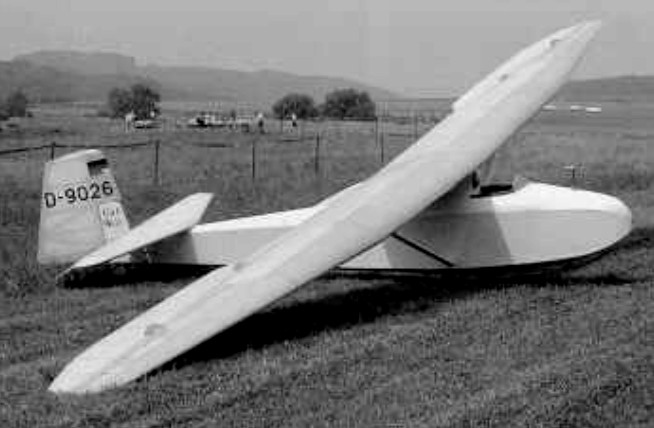
Scheibe Sperber

The third postwar design of Scheibe-Flugzeugbau GmbH, following the Mu-13E Bergfalke and the Spatz, was the Specht (or Woodpecker) tandem two-seater training glider, which was completed in prototype form in March 1953.
This featured the usual Scheibe construction of fabric-covered steel tube fuselage and two-spar braced wooden wings, which had a span of 44 ft 3.5 in and an aspect ratio of 11.

The Specht was developed into the Sperber (or Sparrowhawk), also a two-seat trainer but with enclosed side-by-side instead of tandem seating, and this first flew on 7 March 1956, later going into small-scale production. It also had a fabric-covered steel tube fuselage and braced fabric-covered wooden wings of 14% Mȕ section. The landing gear consists of a fixed monowheel and a spring steel tailskid.

Span: 46 ft 7 in
Length: 24 ft 3 in
Height: 4 ft 7 in
Wing area: 187.3 sq ft
Aspect ratio: 11.6
Empty weight: 485 lb
Max weight: 882 lb
Max speed: 106 mph
Min sinking speed: 3.05 ft/sec
Best glide ratio: 19:1

Scheibe SF-36

The SF-36 two-seater motor glider was developed from the SF-H34 and uses the letter’s wings and tail unit married to a new fuselage, seating two side by side instead of the SF-H34’s tandem seating. The wings are low-mounted with Schempp-Hirth air brakes, and are detachable for hangarage; folding wings were planned for the SF-36.

Engine is an 80hp Limbach SL2000 driving a fixed-pitch or a three-position variable-pitch airscrew. Construction is of glassfibre-reinforced plastic, and a two mainwheel undercarriage similar to that of the C-Falke ’80 is featured, although a single monowheel with small outrigger wheels under the wings was also offered to customers. The latter was featured on the prototype, which first flew in the summer of 1980, and a retractable single-wheel undercarriage was planned for a later version; in all cases the tailwheel is steerable. The forward-sliding canopy allows entry to be made over the wings.

First SF-36 deliveries were due to start in the spring of 1981. The SF-36 R two-seat motorglider was expected to go into production in France.

Span: 53 ft 6 in
Length: 23 ft 10 in
Wing area: 166 sqft
Aspect ratio: 17.2
Empty weight: 950 lb
Max gross weight: 1,390 lb
Min sinking speed: 3.0 ft/sec at 50 mph

Scheibe SF-H34 Delphin / S.N. Centrair Alliance 34

Intended to succeed the Bergfalke, the SFH34 tandem two-seater training and sporting sailplane can be used for ab initio and advanced training and cross-country flying, and is Scheibe’s first unpowered design of all-glassfibre construction.

Design work, headed by Dipl-lng Hoffman, began in 1978 and the SF-H34 prototype first flew on 28 October 1978; production began early in 1979. The cantilever two-piece mid-set wing has a glassfibre roving main spar and is of glassfibre honeycomb sandwich construction, as is the tail unit with its low-set tailplane; there are Schempp-Hirth air brakes in the wing upper surfaces, and production aircraft have no leading edge sweepback. The fuselage is a glassfibre honeycomb sandwich shell, and there are towing hooks fitted under the nose and at the centre of gravity. Landing gear consists of a fixed semi-exposed monowheel directly below the cg and a nosewheel, plus a tailskid. The pilots sit in semi-reclining seats with dual controls under a large one-piece frameless flush canopy that opens sideways; the seat backrests and rudder pedals are adjustable in flight.

The SF-34B Delphin was produced in France as the S.N. Centrair Alliance 34 two-seat glider.

Wing span: 15.8m / 51.9ft
Wing area: 14.8sq.m / 159.3sq.ft
Empty Weight: 330kg /727lb
Payload: 210kg / 463lb
Gross Weight: 540kg / 1190lb
Wing Load: 36.49kg/sq.m / 7.47lb/sq.ft
Aspect ratio: 17
Airfoil: Wortmann FX-61-184
MinSink: 0.70 m/s / 2.3 fps / 1.36 kt
Seats: 2
L/Dmax: 35 @ 95 kph / 51 kt / 59 mph
No. Built: 40

Scheibe SF-H34
Span: 15.8 m / 51 ft 10 in
Length: 7.5 m / 24 ft 7.25 in
Height: 1.45m / 4 ft 9 in
Wing area: 14.8 sq.m / 159.3 sq.ft
Wing section: Wortmann FX-61-184/FX-60-126
Aspect ratio: 16.9
Empty weight: 290 kg / 675 lb
Max weight: 490 kg / 1,102 lb
Water ballast: None
Max wing loading: 33.2 kg/sq.m / 6.8 lb/sq.ft
Max rough air speed: 86 kt / 160 km/h
Max speed: 155 mph / 135 kt / 250 km/h (in smooth air)
Stalling speed: 35 kt / 65 km/h
Min sinking speed: 2.30 ft/sec / 0.70 m/sec at 47 mph / 40 kt / 75 km/h
Best glide ratio: 35:1 at 59 mph / 52 kt / 95 km/h

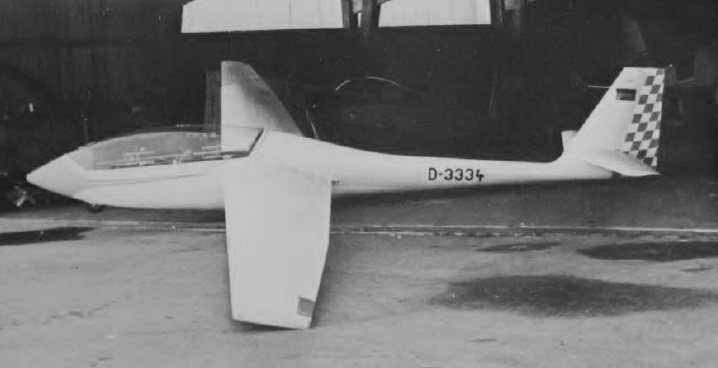
Scheibe SF-33

This single-seater motor glider was developed from the earlier SF-29 and is intended especially for training and powered cross-country flying, and for use by clubs as well as private owners.

It made its first flight in 1977, and although it did not go into production it was aimed at filling the gap between the two-seater SF-25 Falke variants and the higher performance single-seat powered gliders such as the PIK-20E and Nimbus 2M; it was also designed for ease of handling by the less experienced pilot. Like the earlier SF-25 Falke variants which it resembles, the SF-33 is a cantilever low-wing monoplane of basically wooden construction; the fuselage is a steel tube framework covered with plywood and fabric, and the engine cowling panels are of glassfibre reinforced plastic. The two-piece wings have plywood leading edges and wooden ailerons, and there are spoilers in the wing upper surfaces. The wooden tail unit has a trim tab in the starboard elevator. The landing gear consists of a fixed monowheel, a steerable tailwheel linked to the rudder for taxying, and two detachable outrigger wheels under the wings. The pilot sits under a large blown canopy that opens sideways to starboard and gives excellent all-round visibility. Powerplant is a 900cc BMW two-cylinder motorcycle engine derated to 35hp and driving a Hoffman two-blade variable pitch propeller; total fuel capacity is 4.8 Imp gallons.

The SF-33 is self-launching, and its gliding performance is claimed to be comparable to that of the Schleicher Ka 8.

Engine: BMW 900 cc, 26 kW (35 hp)
Span: 15.0 m / 49 ft 2.5 in
Length: 6.75 m / 22 ft 1.75 in
Height: 4 ft 9 in
Wing area: 12.5 sq.m / 134.5 sq.ft
Aspect ratio: 18.0
Wing section: Scheibe
Empty weight: 300 kg / 661 lb
Max weight: 410 kg / 904 lb
Water ballast: None
Max wing loading: 32 kg/sq.m / 6.55 lb/sq.ft
Max speed: 106 mph / 92 kt / 170 km/h (in smooth air, power off)
Max cruising speed: 93 mph (power on)
Stall speed: 36 kt / 67 km/h
Min sinking speed: 0.85 m/sec / 2.79 ft/sec at 50 mph / 43 kt / 80 km/h
Best glide ratio: 29:1 at 47 mph
Take-off run: 150-200 m / 490-655 ft
Rate of climb: 150 m/min / 492 ft/min
Range with max fuel: 186 miles / 300 km / 162 nm

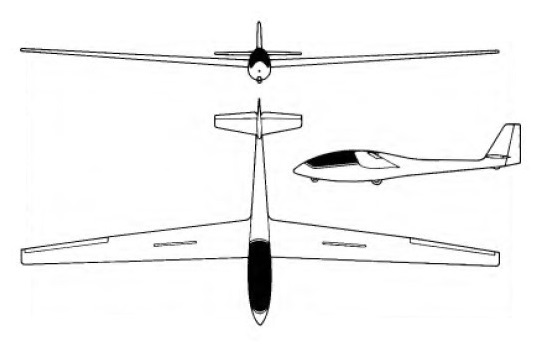
Scheibe SF-30 Club-Spatz

Although bearing the same name as the earlier LSpatz-III, the SF-30 Club-Spatz single-seater Club Class sailplane was developed from the SF-27A Zugvogel, which it resembles, and was designed to the German Club Class requirements intended to meet the need for simple and easy to fly gliders for inexperienced pilots, which would also be strong and easy to rig.

Design work started in 1973 and the prototype Club-Spatz first flew on 20 May 1974; eight had been built by the spring of 1977 but production has now ended.

The fuselage is of traditional Scheibe welded steel tube construction with fabric covering, except that the forward fuselage is glassfibre-covered. The pilot sits under a one-piece sideways-hinging flush-fitting blown Plexiglas canopy, and his seat and rudder pedals are adjustable. Landing gear consists of a fixed unsprung monowheel with brake, and a sprung tail skid. Wings and tail surfaces are of composite glassfibre construction, with the outer surfaces made wholly of glassfibre supported by plastic foam; there are spoilers in the wing upper surfaces. Instead of the SF-27 Zugvogel’s all-flying tailplane, the Club-Spatz has a conventional tailplane and damped elevators, the latter having an adjustable spring for trimming.

Span: 15.0 m / 49 ft 2.5 in
Length: 6.1 m / 20 ft 0 in
Wing area: 9.3 sq.m / 100.1 sq.ft
Aspect ratio: 24.0
Wing section: Wortmann
Empty weight: 185 kg / 408 lb
Max weight: 295 kg / 650 lb
Water ballast: None
Max wing loading: 31.7 kg/sq.m / 6.49 lb/sq ft
Max speed: 131 mph / 114 kt / 211 km/h
Stalling speed: 35 kt / 65 km/h
Min sinking speed: 0.59 m/sec / 1.9 ft/sec at 47 mph / 40.5 kt / 75 km/h
Best glide ratio: 37:1 at 57 mph / 49 kt / 91 km/h

Scheibe SF-28 Tandem Falke

SF-28A

The Tandem-Falke is a development of the SF-25C Falke wth the two seats in tandem positioned over the wings under a lengthened one-piece perspex canopy, instead of the side-by-side layout of the earlier Falke series. The Tandem-Falke can be flown solo from the front seat, with space for up to 198lb of baggage on the rear seat.

Design work on the SF-28 began in 1970 and the prototype, registered D-KAFJ, made its first flight in May 1971, powered by a 45hp Stamo MS 1500 modified Volkeswagen engine. The production SF-28A has a 65hp Limbach SI 1900EA1 engine, the same as fitted to the SF-25C Falke but fitted to drive a Hoffman two-blade variable-pitch feathering propeller; a fixed-pitch prop was available as an option and the fuel capacity totals 8.8 Imp gallons. Full electric system and starter were standard equipment.

Scheibe SF-28A Tandem-Falke

The type has the same basic wooden construction with fabric covered welded steel tube fuselage as the SF-25 Falke series; both wing span and length are slightly greater than the SF-25C’s, the fin and rudder are now unswept. The single-spar wooden wings have spoilers in the upper surfaces and no flaps; there is an outrigger stabilising wheel on a nylon leg under each wing, as well as a faired non-retractable monowheel with internal brake and a steerable tailwheel. There is a trim tab in the elevator.

Altogether 112 Tandem-Falkes had been built by January 1980 and the Tandem-Falke has competed in the German Motor Glider Competition. In 1973, SF-28A’s took the first four places in the two-place class of the international motorglider contest at Burg Feuerstein in Germany. One flown by Peter Ross set up two United Kingdom records for motor gliders in 1976.

SF-28A Tandem Falke

Gallery

Tandem Falke SF-28A
Engine: Limbach SL 1700 EA1, 48 kW/ 65 bhp
Wing span: 16.28m / 53.4ft
Wing area: 18.49 sq.m / 199 sq.ft
Wing section: Gottingen 533
Length: 8.1 m / 27 ft 3 in
Height: 1.55 m / 5 ft 1 in
Empty Weight: 410kg / 903lb
Payload: 200kg / 441lb
Gross Weight: 610kg / 1344lb
Water ballast: None
Wing Load: 32.99 kg/sq.m / 6.75 lb/sq.ft
Aspect ratio: 14.5
Max speed: 118 mph / 102.5 kt / 190 km/h (in smooth air, power off)
Max cruising speed: 87 mph
Stall speed: 33.5 kt / 62 km/h
MinSink: 0.90 m/s / 2.95 fps / 1.75 kt at 43.5 mph / 37.5 kt / 70 km/h
L/DMax: 26 @ 85 kph / 46 kt / 53 mph
Best glide ratio: 27 at 51 kt / 95 km/h
Take-off run: 180 m / 591 ft
Max rate of climb S/L: 126 m/min / 413 ft/min
Range: 500 km / 270 nm
Range with max fuel: 261 miles
Seats: 2
Structure: steel-tube/ fabric fuselage, wood/ fabric wings and tail.

SF-28A

Scheibe SF-27 Zugvogel / SF-32 / Lorraine Aviation Loravia LA-11 Topaze / SLCA SLCA-10 / LA-10

Scheibe’s first postwar essay into the high performance field was the Zugvogel (or Migratory Bird) single-seat sailplane which had laminar flow wings of NACA 63-series section and with a forward sweep of 2.5°. This made its competition debut when it was flown by veteran test pilot Hanna Reitsch into the winning place in the 1955 German National gliding championships. It had the traditional Scheibe fabric-covered steel tube fuselage (with a fiberglass nose section) and wooden single-spar wing and tail surfaces, all-flying tail, the wing span being 16m (52 ft 6 in) with an aspect ratio of 18.3 and area of 150.16 sq ft. The Sf-27A has Schempp-Hirth type dive brakes and semi-reclining seating. The wing ribs are spaced only 4 inches apart and heavy plywood skins cover 85 % of the surface in order to help maintain the laminar profile.

Next version as the Zugvogel-II, which had an unswept wing of simpler construction, a simplified control system and various other changes over the initial version. This was developed into the Zugvogel-III, which first flew in prototype form in April 1957 and which differed from the Mk II only in having the wing span increased to 17m (55ft 9in) and a larger fin and rudder, the aspect ratio now being 20.0 and wing area 155.9sq ft. Further versions were the Zugvogel-IIIA and IIIB, the latter version, the prototype of which was completed in June 1962, having a redesigned nose and cockpit canopy, the stepped canopy of earlier versions being replaced by a longer flush fitting one-piece plastic canopy blending into a shorter, more pointed nose. The high cantilever wings have Schempp-Hirth aluminium air brakes, and depending on the degree of surface polishing the best glide ratio can be improved from 36:1 at 62 mph to 39:1.

Helen Dick flew a -3B to set the following U.S. national feminine single-place records: Distance (492.2 km./ 305.84 miles), goal (364.6 km/ 226.57 miles) and Out & Return (400.00 km./ 248.82 miles) between 1964 and 1967.

Zugvogel-III

The SF-27 Zugvogel V, the prototype of which first flew on 12 May 1964, is a single-seat Standard class development of the Mk IIIB with cantilever shoulder instead of high wings of 15m (49 ft 2.5 in) span and Wortmann aerofoil sections; the tailplane is now an all-moving surface and more glassfibre is used in the fuselage structure. The wings have a single laminated beechwood box spar and plywood ribs, with a leading edge torsion box; the outer halves of the wings are plywood-covered, and the inboard halves are ply-covered to just behind the spar, the rest of the wings being part plywood- and part fabric covered. The wooden ailerons are ply-covered and the Schempp-Hirth air brakes are of glassfibre and metal. The welded steel tube fuselage has the nose section back to the wing trailing edge covered with moulded glassfibre shell, and the rear section fabric covered over wooden stringers. There is a moulded glassfibre fairing over the wing/fuselage junction. The cantilever tail unit is of wood, with a ply- and fabric-covered tailplane, the fin is plywood-covered and the rudder fabric-covered; there is an antibalance tab in the tailplane. Landing gear consists of a non-retractable and unsprung monowheel ahead of the eg, with a brake, and a tailwheel. The pilot sits in an inclined seat under the moulded Plexiglas canopy, and there is a baggage compartment behind the seat.

Scheibe SF-27 Zugvogel V

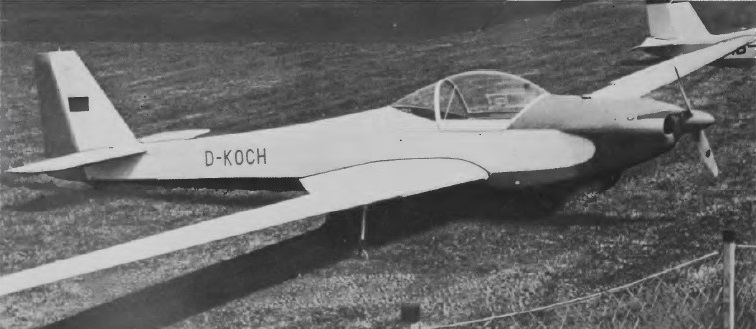
The SF-27M, designed in 1967, is a single-seater powered version of the SF-27 Zugvogel V, and was an early example of the completely retractable powerplant installation, the 26hp Hirth Solo vertically-opposed four-cylinder engine being mounted just aft of the wings and retracting backwards into the centre fuselage behind closed doors. This retractability gives the SF-27M about the same soaring performance as the Zugvogel V, and makes it capable of self-powered take-off as well as normal launching by winch or aero-tow; the engine installation weighs only about 88lb, so its effect on soaring performance is minimised.

Scheibe SF-27M

The SF-27M is structurally similar to the Zugvogel V except that the fuselage centre section has been modified to take the engine, increasing the overall length, and the wings and control surfaces have been strengthened internally; the main wheel tyre size has also been increased. The engine is raised into position and retracted manually by a crank-driven draw chain pushrod system, swinging up into its operating position; raising and lowering it is very simple, requiring only 3.5 turns on the crank and being completed in five seconds. The doors over the engine and propeller bay open and close automatically while this is being done, the two-blade propeller of about 4ft 5in diameter being stopped in the vertical position for retraction. Engine starting is by a hand-operated cable, and a specially-designed ignition system facilitates easy starting. A fuel tank of 4.4 Imp gallons capacity is mounted in the fuselage behind the pilot.

The first Distance Diamond award for a powered sailplane flight was granted by the German Aero Club to Willibald Colle, who flew his SF-27M a distance of 334 miles from Elz to Le Rabot airfield, France, on 28 July 1968. Colle took off under his own power just before 11am, climbed to about 3,000ft and switched off and retracted the engine; he covered the distance to Le Rabot in about eight hours at between about 2,500 and 6,000ft, and the special barograph installed confirmed that the flight had been made without assistance from the engine. The SF-27M also won the single-seater class at the German Motor Glider competitions held in 1970 and 1971.

About 30 SF-27Ms were built. It was succeeded by the SF-32, also a single seater, which first flew in prototype form in May 1976 and is basically very similar, being powered by a 40hp Rotax 642 ‘flat twin’ two-stroke driving a fixed-pitch two-blade wooden propeller, and mounted on a pylon and retracted into the fuselage in the same way as the SF-27M’s but electrically instead of manually. The cantilever shoulder wings, which are built in two parts, are of 17m (55ft 9.25in) span instead of the SF-27M’s 15m span, and are basically the same as the Swiss Neukom Elfe 17’s, with an aluminium alloy main spar and a glassfibre and plywood/foam sandwich skin. There are Schempp-Hirth air brakes in the upper surfaces but unlike the Elfe 17 – no provision for water ballast. The fuselage is very similar to the SF-27M’s and Zugvogel V’s, being a welded steel tube structure with the nose section covered with a moulded glassfibre shell back to the wing trailing edge, the rear section being fabric-covered. The tail unit is very similar to the SF-27M’s, with a geared anti-balance tab in the all-moving tailplane. Only the prototype SF-32 was built.

Scheibe SF-32

The Zugvogel V is built under licence in France by Lorraine Aviation as the Loravia LA-11 Topaze, this company having taken over production of the type from SLCA, which had built nine SF-27s under the designation SLCA-10 (now LA-10). The LA-11 has the monowheel lowered by 80mm and first flew on 15 October 1973; 18 LA-11s were built by SLCA and Loravia had built 30 by early 1976.

SF-27
Wing span: 15m / 49.2ft
Wing area: 12sq.m / 129.2sq.ft
Empty Weight: 205kg / 452lb
Payload: 115kg /254lb
Gross Weight: 320 kg / 706lb
Wing Load: 26.67kg/sq.m / 5.42lb/sq.ft
MinSink: 0.65 m/s / 2.14 fps / 1.27 kt
Aspect ratio: 18.7
Seats: 1
L/DMax: 34 @ 80 kph / 43 kt / 50 mph
Airfoil: FX 61-184 root, FX 60-126 tip
Structure: steel-tube/ fabric fuselage, wood/ fabric wings and tail.

Zugvogel 3
Wing span: 17m / 55.8ft
Wing area: 14.49sq.m / 156sq.ft
Empty Weight: 250kg / 551lb
Payload: 115kg / 254lb
Gross Weight: 365kg / 805lb
Wing Load: 25.19kg/sq.m / 5.2lb/sq.ft
Aspect ratio: 20
Airfoil: NACA 63(2)-616/614
Seats: 1
L/DMax: 37 @93 kph / 50 kt / 58 mph
MinSink: 0.61 m/s / 2.0 fps / 1.18 kt

Zugvogel V
Span: 49 ft 2.5 in
Length: 23 ft 3.5 in
Wing area: 129.9 sqft
Aspect ratio: 18.6
Empty weight: 474 lb
Max weight: 728 lb
Min sinking speed: 2.10 ft/sec at 46 mph
Best glide ratio: 34:1 at 55 mph

SF-27M
Engine: 19 kW/ 26 bhp Hirth
Wing span: 15m / 42.9ft
Wing area: 12sq.m / 129.2sq.ft
Empty Weight: 205kg / 452lb
Payload: 115kg / 254lb
Gross Weight: 320kg / 706lb
Wing Load: 26.67kg/sq.m / 5.42 lb/sq.ft
Aspect ratio: 18.7
Airfoil: FX 61-184 root, FX 60-126 tip
Seats: 1
L/DMax: 34@ 80 kph / 43 kt / 50 mph
MinSink: 0.65 m/s / 2.14 fps / 1.27 kt
Structure: steel-tube/ fabric fuselage, wood/ fabric wings and tail.

SF27 M-A

Scheibe SF-32
Engine: Rotax 642, 30 kW (40 hp)
Span: 17.0 m / 55 ft 9.25 in
Length: 7.0 m / 22 ft 11.5 in
Height: 1.25m / 4 ft 1.25 in
Wing area: 13.3 sq.m / 143.2 sq.ft
Wing section: Wortmann FX-61 -163/60-126
Aspect ratio: 21.73
Empty weight: 340 kg / 750 lb
Max weight: 450 kg / 992 lb
Water ballast: None
Max wing loading: 33.8 kg/sq/m / 6.92 lb/sq ft
Max speed: 136 mph / 119 kt / 220 km/h
Stall speed: 36.5 kt / 68 km/h
Min sinking speed: 0.65 m/sec / 2.1 ft/sec at 50 mph / 43.5 kt / 80 km/h
Best glide ratio: 37:1 at 56 mph / 48.5 kt / 90 km/h
Max rate of climb at S/L: 120m/min / 394 ft/min
Take-off run: 200 m / 656 ft
Range: 186 miles / 300km / 162nm

Scheibe SF-32