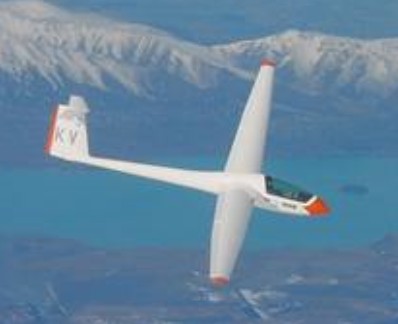
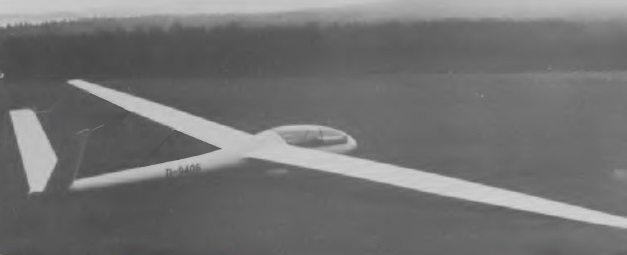
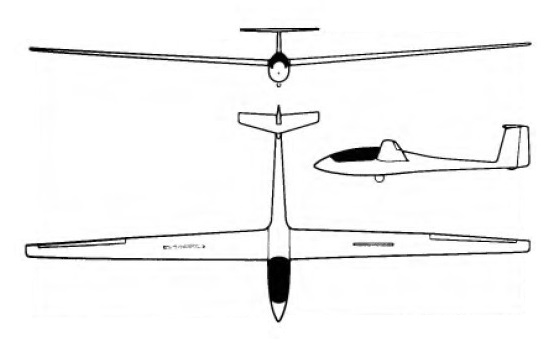
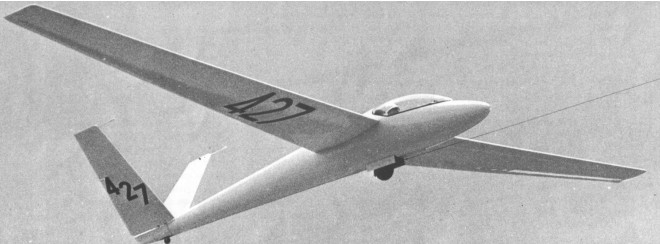
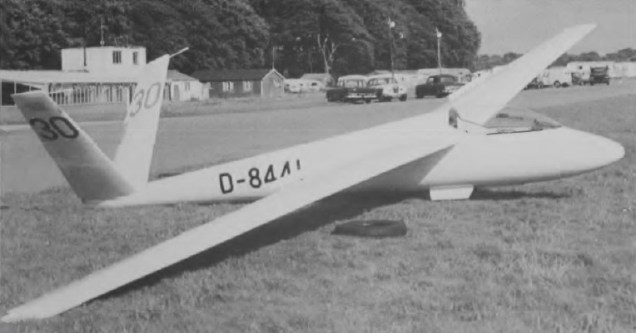
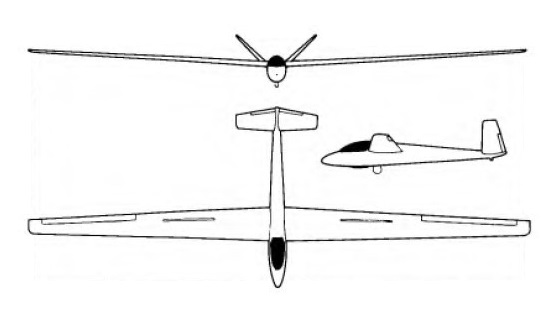
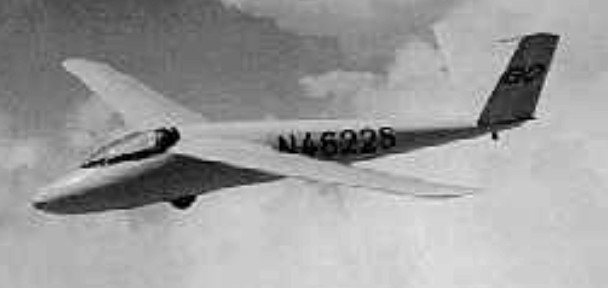
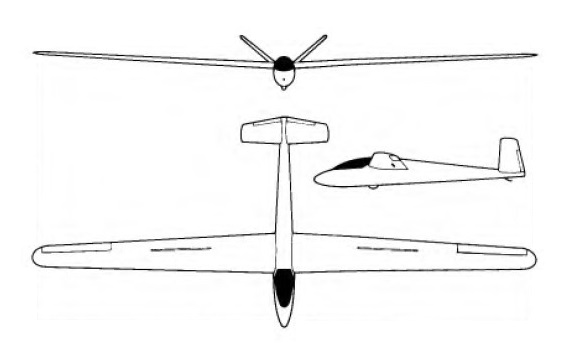
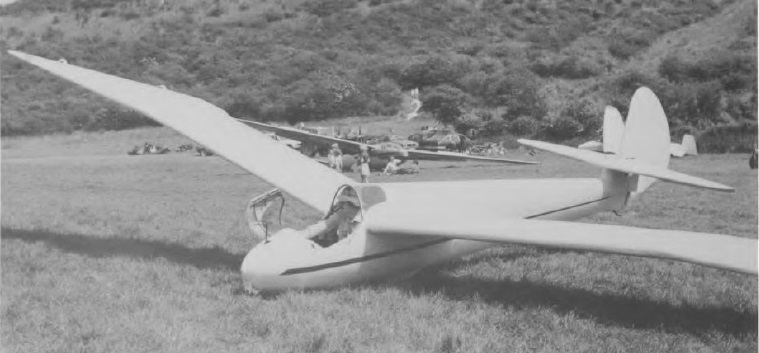
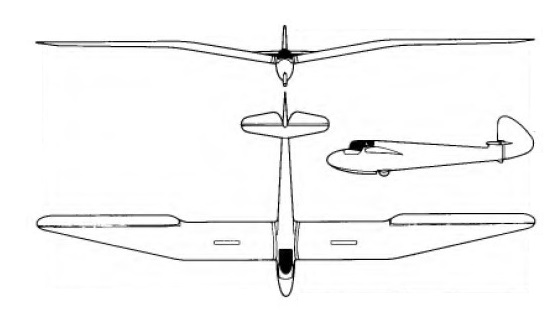
The HS-3 Nimbus high performance single-seater was designed and built in his spare time by Dipl-lng Klaus Holighaus, with the aid of Schempp-Hirth. It had the same fuselage as the Open Class Cirrus married to a new high-set three-piece wing of 22m (72ft 2.5in) span and the high aspect ratio of 30.6; the tail unit was similar to that of the Cirrus.
The HS-3 Nimbus was of glassfibre/foam sandwich construction, the fuselage having a steel tube frame for the attachment of wings and landing gear, and the manually-retracted monowheel had a drum brake. No air brakes were fitted, and the pilot sat under a long two-piece canopy. The Nimbus had an exceptionally high performance, with a best glide ratio of 51:1 at 56 mph and a minimum sinking speed of only 1.44ft/sec, and this performance would ensure its sales prospects.
In January 1969 Klaus Holighaus flew his first “Super Orchid”, the Nimbus-1. With this glider George Moffat won the 1970 World Championships in Marfa/Texas, USA.
Design work on the Nimbus 2 began in January 1970 and the prototype, construction of which began in April that year. The Nimbus 2 was developed from the 1969 22 m Nimbus which George Moffat won the Open Class World Championships at Marfa, Texas in 1970, and first flew in 1971. The four piece wing has flaps interconnected with the ailerons with settings which range from +6 to -8 degrees, with 20 degrees for landing. Later -2B and -2C developments carry more ballast with higher gross weight. The 2C replaced the all moving tailplane with a conventional fixed horizontal and moving.
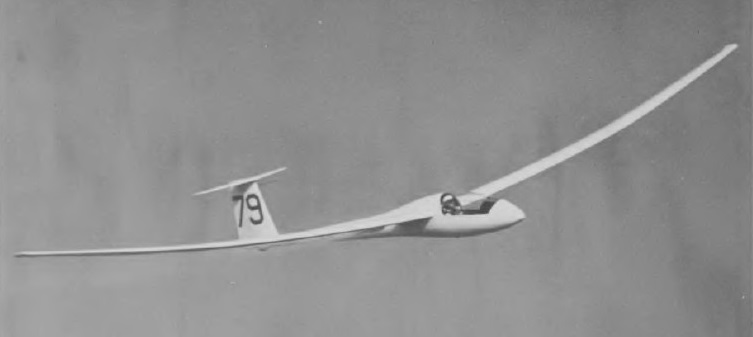
With the Nimbus-2C the inner wings were GRP and the combined curve/air brake system of the Mini Nimbus was provided. The first flight of this variant took place in October 1978, the type certification in February 1979.
The HS 3 Nimbus is a high performance Open Class sailplane, and was designed by Dipl Ing Klaus Holighaus and first flew in January 1969. Construction is almost entirely of glass fibre, with a foam sandwich structure for the wings and tail unit. A single-seat midwing monoplane in carbon fibre, the four or six-part wing, has flaps, and air brake. Separate water tanks are in the outer and inner wing panels.
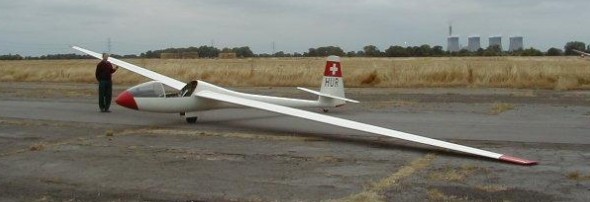
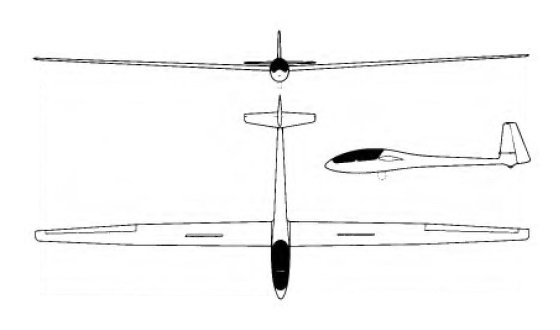
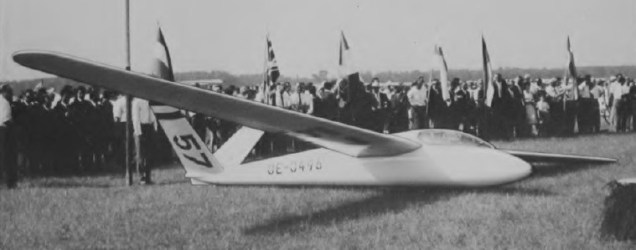
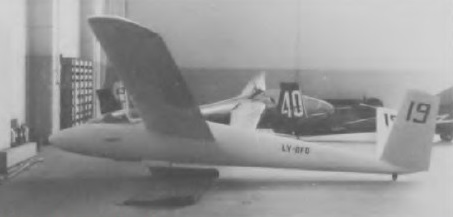
The Nimbus 2 is the production version, differing from the HS-3 in having the same fuselage as the Standard Cirrus married to a wing of shorter span (20.3m) and built in four sections to limit weight and dimensions for ease of rigging, storage and trailer transport. The glassfibre/foam sandwich wing structure was stiffened to eliminate the bending experienced with the earlier Nimbus wing, and glassfibre Schempp-Hirth air brakes are fitted in the upper surfaces; there is also a tail braking parachute. The ailerons and interconnected flaps are glassfibre shells, the flap settings ranging from -8° for high speed flight to +6° for soaring in thermals and 20° for landing; the flaps of the earlier Nimbus drooped to 90° for landing. Up to 353lb of water ballast can be carried.
The glassfibre fuselage shell is stiffened with bonded-in foam bulkheads and there is a central tubular steel framework for attaching the wings and landing gear. The Nimbus 2 also differs from the earlier version in having a glassfibre/foam sandwich T-tail very similar to that of the Standard Cirrus; the first 132 Nimbus 2s havean all-moving tailplane, but 133rd and later aircraft known as the Nimbus 2B have a fixed incidence T-tailplane and elevator. The retractable rubber-sprung monowheel has a drum brake. The pilot sits in a semi-reclining seat under a long flush-fitting hinged canopy.
Successes followed in 1972 and 1974 when Göran Ax in Yugoslavia and George Moffat in Australia became World Champions in the Open Class flying the Nimbus-2 (the production version of the Nimbus-1).
Three New Zealand pilots, B.L. Drake, Don Speight and S.H. Georgeson, jointly won the World goal/ distance record of 1,254 km./ 779 miles in 1978 flying Nimbus 2’s. Women pilots have also gained the following records flying Nimbus 2’s: Doris Grove of the U.S., goal/ return distance of 1,127 km /700.2 miles in 1981, Y. Loader of New Zealand, height gain of 10,212 m /33.504 ft in 1988, and Joan Shaw of the U.S., goal/ distance of 951.43 km / 591.2 miles in 1990.
In 1974, there was the maiden flight of the single seat motorglider Nimbus-2M. Not only were the first experiences with retractable engines achieved, but also numerous world records were set, from the limited series production.
The Nimbus 2C has a higher gross weight, is fitted with new brake type flaps instead of upper surface air brakes, and is available to customers with wings and tailplane built of carbon-fibre as an alternative to glassfibre construction; with the former up to 550 lb of water ballast can be carried.
A new material had found its way, however, into the Kirchheimer production halls: the carbon fiber. What was included into the Nimbus-2C in a rather inconspicuous manner, proved itself to be the start of, at that time not appreciative of how large, an effective future in the production of high performance gliders. The thin wing profiles of the succeeding developments would not have been possible without the higher strength and stiffness of the carbon fiber.
The lengthening of the lifespan for fiberglass constructed gliders from 3000 to 6000 hours was for example, proven with a Nimbus-2 inner wing.
Serial introduction of carbon fiber was first included on the Nimbus-2C, Mini-Nimbus-C, Janus-C and Janus-CM. the optimal qualities of this new material were only utilized fully later on in the Ventus and Nimbus-3, in the production of the long and thin wings of these models.
By 1 January 1979 a total of 185 Nimbus 2s, 2Bs and 2Cs had been delivered, and the type has an outstanding competition record. It has twice won the Open Class in World Championships, in 1972 at Vrsac, Yugoslavia, flown by Goran Ax of Sweden and in 1974 at Waikerie, Australia, flown by George Moffat of the USA; in the 1976 World Championships in Finland, Nimbus 2s took no less than 14 of the first 25 places.
On 15 February 1977 a Nimbus 2 flown by R.J. Rowe of Australia set a speed record of 83.264mph over a 750km course, and a similar record over 500km was set up by Edward Pearson of Rhodesia in another Nimbus 2 on 27 November 1976. The world distance record to a goal, for single-seaters, was set up by a group of three Nimbus 2s which covered 779.36 miles in New Zealand on 14 January 1978. The Nimbus 2CS that won the 1980 German National championships was modified to have extra wing panels to increase the span to 23.5m (77ft 0in). This preceded the Nimbus 3 which has a four-piece carbon-fibre wing of 22.9m span, and which was first flown in prototype form on 21 February 1981 by its designer Klaus Holighaus.
The Nimbus 2M, or Motor Nimbus, was developed under the direction of Dipl-lng Klaus Holighaus and is fitted with a 50hp Hirth two cylinder two-stroke engine. This drives a two-bladed fixed-pitch wooden propeller and is completely retractable, being lowered when stopped behind closed doors in the centre fuselage, the propeller being stopped so as to lie on the fuselage centreline. The powerplant is raised and lowered electrically, using the motor and rack-and-pinion gearing from a Bosch car sun roof installation, and since the engine weight is less than that of the water ballast carried by the unpowered Nimbus 2, its effect on performance when retracted is very slight. Up to 88lb of fuel can be carried in wing tanks and the take-off run with engine on is 1,310ft; rate of climb is 395ft/min and the range is 310 miles. The prototype Nimbus 2M first flew in June 1974, and made its debut at the First International Motor Glider Competition at Burg Feuerstein, West Germany, that same month. Apart from the engine installation, the Nimbus2M is the same as the unpowered Nimbus2.
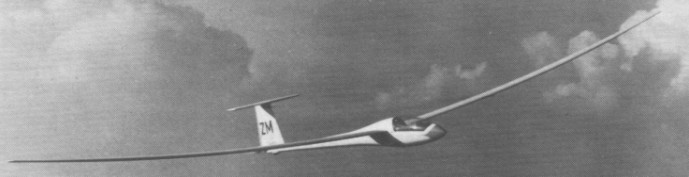
Schempp-Hirth’s replacement for the Nimbus 2 was the Nimbus 3. The original version, which first flew in 1981, has a 22.9 m wing, which may be increased to 24.5 m. with tip extensions. The wing is in four pieces plus the tip extensions, and is equipped with flaps interconnected with upper surface trailing edge airbrakes. The wing division is moved opposite the Nimbus-2, further inward, so that the heaviest end of each wing for assembly is under 40 kg. The assembly takes place via a tongue fork connection with one main pin each in the trunk and at the interfaces, as with the Nimbus-2. Approach control is assisted by top surface double segment airbrakes. The 24.5 m tips have spoiler flaps incorporated at the trailing edge. When rolling at large aileron deflection, the spoiler flap deploys to compensate for lack of rudder to permit coordinated flight. The curving flap operation is coupled with the trim. The absorbed horizontal tail unit has a span of 2,5 m and an area of 1,25 sq.m.
The GRP /Dural air brakes with springy cover plates are in the inner wing, so that separate attaching is not necessary when the assembling of the outerwing. The wings consist of a KFK box spar in the interior and a KFK double T cross-beam in the outerwing. The curving flaps and ailerons are manufactured in KFK /Kevlar building method. The spar boom is about 42% depth of profile directly under the reinforced outer skin of the wing, in order to obtain the highest possible flexural rigidity for a slim, thin and long wing.
The Nimbus 3 makes extensive use of carbon-fibre in its structure, only the forward fuselage being of glassfibre. The three part ailerons droop in conjunction with the flaps, and over 80 gallons of water ballast can be carried. The Nimbus 3 is probably the first sailplane to achieve a glide angle of better than 1 in 50, a figure of 55:1 being claimed, and Mk 3s took the first three Open Class places in the 1981 World Gliding Championships.
The Nimbus-3 did not become only world champion in 1981 at Paderborn, West Germany, at the first attempt, but also won the first 6 places in the Open Class at the 1983 World Soaring Championships at Hobbs, NM, as well as taking 9 of the next 12 places. It also won the first 8 places in the Open Class at the 1985 Worlds at Rieti, Italy. Flight testing by Dick Johnson measured the L/D max of the 22.9 version (which has an increased gross weight 750 kg /1,654 lb) to be substantially less at about 50 : 1. Tom Knauff of the U.S. won the world goal/ out and return distance record of 1,647 km / 1,023.4 miles in a Nimbus 3 in 1983. He also won, jointly, the world triangle record at 1,363 km. / 846.9 miles in a Nimbus 3 in 1986. A world record for 100 km and 300 km speed triangles were also made by pilots flying Nimbus 3’s.
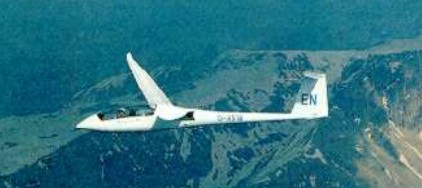
The vertical stabilizer gained increased area after the testing of the pre-production aircrafts and with an optional water ballast tank.
On both seats take additional load, to between 100 and 110 kg. Backrest and rudder control pedals are the front and back are flight adjustable.
Whilst the production of the single seat Nimbus-3 had to be discontinued after a fire in one of the production halls, this enabled the production of the Racing Class glider Ventus to be increased.
Development of the Nimbus-3D was in response to the appearance of a new (third) generation of high speed single-seaters of the open class with a far higher performance level.
Investigations resulted in the a plan to revise the trunk of the Janus and to combine the 24.5 m and/or 25.5 m carbon fiber wings of the Nimbus-3. New wing attachments for the slim wing geometry, and reinforcement of the basic wing structure around to 60% due to the substantially higher additional load than with the single-seater.
The Nimbus 3D, which first flew in 1986, combined a modified Janus C fuselage with 24.5 Nimbus 3 wings. In addition to the unpowered sailplane, it was produced with as a sustainer (3DT) with a 19 kW/ 26 bhp Oehler Solo 2350 engine and a self-launcher (3DM) with a retractable mast mounted Rotax Rotax 535 C engine of 44 KW (60 HP) at 7200 rpm.
ICAO Type Certificate
Manufacturer: Schempp-Hirth Flugzeugbau GmbH
Type Certificate: Musterzulassungsschein Nr. 04-373
Issued by: Luftfahrt-Bundesamt, Bundesrepublik Deutschland
Date of Issue 20 January 1989
LBA Type Certificate Data Sheet No.373 – Nimbus-3D – Issue 3, dated 03.12.1992
Model(s): Nimbus-3D
MCTOW 750 kg [1653 lb.]
Max. No. of Seats: 2
Including the use of flexible tanks in the inner wings the maximum fuel capacity is 50 litres and is enough for nearly two hours flying time during climb.
A Nimbus 3D took third place in the Open Class of the 1989 World Championships at Wiener Neustadt, Austria. A Nimbus 3DM flown by Theo Newfield and Michael Oakley of New Zealand won the world two seat motorglider out and return record of 841.17 km./ 522.7 miles in 1995.
The sustainer version (Nimbus 3t) has a 15 kW/ 21 bhp Oehler Solo 2350 turbo engine.
Altogether nearly one hundred copies were manufactured, of it are approximately a third with the ‘ Turbo’. The ‘Way home’ assistance equipped (Nimbus-3T) and one was developed further in a private initiative as a self-starter (Nimbus-3MR).
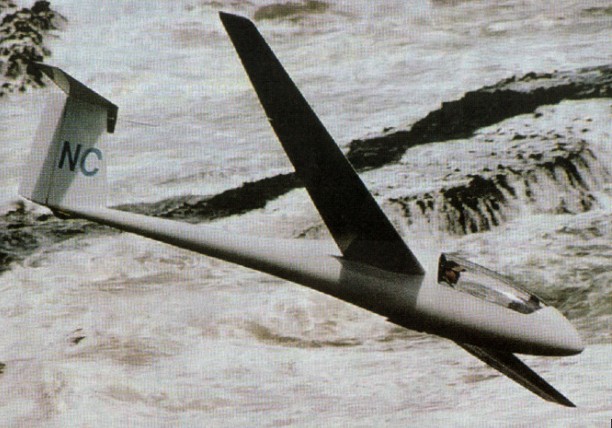
The Nimbus 4, increased span replacement of the single place Open Class Nimbus 3 first flew in May 1990. The six piece wing has a multi-stage Discus style leading edge sweepback. When the double panel top surface airbrakes are opened, the flaps lower automatically to the landing position (approximately 40 degrees). There is a fin mounted trim ballast tank. It comes ununpowered and sustainer versions, the latter powered 19 kW/ 26 bhp Oehler Solo 2350 turbo engine and with a max gross of 750 kg / 1,764 lb. Nimbus 4’s took 3rd, 4th and 5th places in the Open Class in the 1991 World Championships at Uvalde, TX
As already successfully proven with the two seat Nimbus 3D, the Nimbus 4D is also based on a single seat version, the Nimbus 4. The Nimbus 4D is the successor to the earlier 24.6 m Nimbus 3D. The six piece Discus planform wing has full span camber changing flaperons. Approach control is by double segment top surface Schempp-Hirth airbrakes which are interconnected with the inboard sections of the flaps. There is an optional fin ballast tank for trimming purposes. The sustainer model (4DT) has a 20 kW/ 26 bhp Oehler Solo 2350 Turbo engine which is started by windmilling the propeller. The blades fold up automatically when the engine stops.
With the title of European Champion in all three classes, in 2000 two new motor gliders were announced. The Discus-2T, and the Nimbus-4M with an internal lying Solo 2625-02 engine as copied from the Nimbus-4DM. The self-launching Nimbus 4DM has the engine buried in the fuselage with only the radiator, propeller and its drive system on the electrically actuated retractable mast which is raised into the airflow.
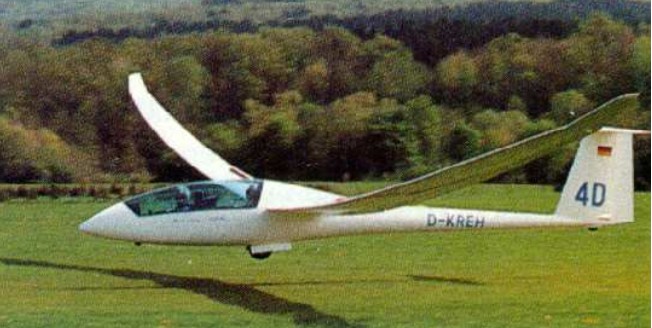
Nimbus 2
Span: 20.30 m
Length: 7.33 m
Wing area: 14.4 sq.m
Empty weight equipped: 315 kg
Flying weight: 650 kg
Wingloading: 27-45 kg/sq.m
Least sink: 0.49 at 75 km/h
Best lift/drag ratio: 47,5 at 95 km/h
Nimbus II
Wing span: 66.6 ft
Wing area: 155 sq.ft
Wing aspect ratio: 28.6
Length: 23.9 ft
Height: 5 ft
Wing loading 7.54 lbs/sq ft
Gross 1,168 lb
Empty 749 lb
Useful 419 lb
Water ballast: 333 lb
Minimum sink: 94 fpm at 41 kt
Max speed: 146 kt
Rough air speed 135 kt
Stalling speed: 35 kt
Max wt: 1,278 lb
Glide ratio (L/D): 49:1 at 48 kt
Standard empty wt: 770 lb
Rough-air airspeed: 146 kt
Seats: 1
Nimbus 2C
Wing span: 20.3m / 66.6ft
Wing area: 14.39sq.m / 154.9sq.ft
Aspect ratio: 28.6
Airfoil: Wortmann FX-67-K-1 70
Empty Weight: 355kg / 782lb
Payload: 295kg / 651lb
Gross Weight: 650kg / 1433lb
L/DMax: 49 90 kph / 49 kt / 56 mph
MinSink: 0.49 m/s / 1.6 fps / 0.95 kt
Wing Load: 45.17kg/sq.m / 8.25lb/sq.ft
Seats: 1
Nimbus 2C (carbon-fibre wings)
Span: 20.3 m / 66 ft 7.25 in
Length: 7.33 m / 24 ft 0.5 in
Height: 1.45 m / 4 ft 9 in
Wing area: 14.4 sq.m / 155.0 sq ft
Wing section: Wortmann FX-67-K-170
Aspect ratio: 28.62
Empty weight: 315 kg / 694 lb
Max weight: 650 kg / 1,433 lb
Water ballast: 250 kg / 551 lb
Max wing loading: 45.0 kg/sq.m / 9.2 lb/sq ft
Max speed: 168 mph / 146 kt / 270 km/h (in smooth air)
Stalling speed: 32 kt / 60 km/h
Max aero-tow speed / rough air speed: 99 mph / 146 kt / 270 km/h
Min sinking speed: 0.47 m/sec / 1.5 ft/sec at 50 mph / 43 kt / 80 km/h
Best glide ratio: 49:1 at 65 mph / 56.5 kt / 105 km/h
Schempp-Hirth Nimbus 2M
Engine: Hirth 0.28, 37.3 kW / 50 hp
Span: 66 ft 7.25 in / 20.3 m
Length: 24 ft 0.5 in / 7.33 m
Height: 4 ft 9 in / 1.45 m
Wing area: 155.0 sq.ft / 14.4 sq.m
Aspect ratio: 28.62
Wing section: Wortmann FX-67-K-170
Empty weight: 970 lb / 440 kg
Max weight: 1,279 lb / 580 kg
Water ballast: None
Fuel capacity: 40 kg / 88 lb wing tanks
Max wing loading: 40.28 kg/sq.m / 8.25 lb/sq.ft
Max speed: 155 mph / 135 kt / 250 km/h
Stalling speed: 37.5 kt / 70 km/h
Min sinking speed: 1.8 ft/sec / 0.54 m/sec at 53 mph / 46 kt / 85 km/h
Best glide ratio: 47:1 at 62 mph / 54 kt / 100 km/h
Take-off run: 350 m / 1,148 ft
Rate of climb: 120 m/min / 395 ft/min
Range: 500 km / 269 nm
Nimbus-3
Wing span: 72 ft 2 in (22.00m)
Wing aspect ratio: 30.6
Length: 23 ft 11.5in (7.30 m)
Gross weight: 1102 lb (500 kg)
Max speed: 137 mph (220 km/h) in rough or smooth air
Best glide ratio: 51/1 at 56 mph (90 km/h)
Accommodation: 1
Nimbus 3
Wing span: 24.5m / 80.36ft
Wing area: 16.7sq.m / 179.76sq.ft
Aspect ratio: 35.9
Empty Weight: 396kg / 873lb
Payload: 304kg / 673lb
Gross Weight: 700kg / 1546lb
Wing Load: 41.92kg/sq.m / 9.2lb/sq.ft
L/DMax: 60 80 kph / 43 kt / 50 mph
MinSink: 0.41 m/s / 1.35 fps / 0.80 kt
Water Ballast: 260kg / 574lb
Airfoil: Wortmann/Holighaus
Seats: 1
Nimbus-3
Span: 25,5 m
Wing area: 16,9 sq.m
Aspect ratio: 38,4
Length: 7,63 m
Empty weight: 408 kg
Max weight: 750 kg
Wing loading: 28-44 kg/sq.m
Water ballast: 338 lt
Maximum speed: 270 km/h
Maneuver speed: 190 km/h
Least sinking: 0.40 m/s
Best lift/drag ratio: 58,5
Nimbus 3D / Nimbus 3/24.5
Wing span: 24.6m / 80.7ft
Wing area: 16.85sq.m / 181.4sq.ft
Aspect ratio: 36
Airfoil: Wortmann FX-79-K-143/17
Empty Weight: 485kg / 1069lb
Payload: 265kg / 584lb
Gross Weight: 750kg / 1653lb
L/DMax: 57 105 kph / 57 kt / 65 mph
MinSink: 0.48 m/s / 1.57 fps / 0.93 kt
Wing Load: 44.51kg/sq.m / 9.11lb/sq.ft
Water Ballast: 168kg / 370lb
Seats: 2
Nimbus 3DM
Engine: Rotax 535 C engine of 44 KW (60 HP) at 7200 rpm
Span: 24.6 m / 80.7 ft
Wingarea: 16.85 sq.m / 181.4 sq.ft
Wing aspect ratio: 36
Empty weight: 610 kg
Gross weight: 820 kg
Wing loading: 41-48.7 kg/sq.m
Water Ballast: 168 kg / 370 lb
Best lift/drag ratio: 57 at 105 kph / 57 kt / 65 mph
MinSink: 0.48 m/s / 1.57 fps / 0.93 kt
Fuel capacity: 50 lt
Fuel consumption (cruise): 21 l/h
Max. range (in cruising): 320 km
Cruising speed: 150 km/h
Max. engine running time climbing: 100 min
Max. speed engine extended: 180 km/h
Max. speed engine in: 275 km/h
Seats: 2
Airfoil: Wortmann FX-79-K-143/17
Nimbus 4
Wing span: 26.4m / 86.6ft
Wing area: 17.86sq.m / 192.2sq.ft
Aspect ratio: 38.8
Empty Weight: 470kg / 1036lb
Payload: 280kg / 617lb
Gross Weight: 750kg / 1653lb
Wing Load: 41.99kg/sq.m / 8.6lb/sq.ft
Water Ballast: 300kg / 662lb
L/DMax: 60 110 kph / 59 kt / 68 mph
MinSink: 0.38 m/s / 1.25 fps / 0.74 kt
Seats: 1
Nimbus 4D
Wing span: 26.5m / 86.94ft
Wing area: 17.96sq.m / 193.32sq.ft
Aspect ratio: 39.1
Empty Weight: 525kg / 1157lb
Payload: 225kg / 469lb
Gross Weight: 750kg / 1653lb
Wing Load: 41.76kg/sq.m / 8.55lb/sq.ft
Water Ballast: 163kg / 360lb
L/DMax: 60
MinSink: 0.50 m/s /1.63 fps / 0.97 kt
Seats: 2
Nimbus 4DM
Wing span: 26.5 m / 86.94 ft
Wing area: 17.96 sq.m / 193.32 sq.ft
Empty Weight: 595 kg / 1312 lb
Payload: 225 kg / 496 lb
Gross Weight: 820 kg / 1808 lb
Water Ballast: 163 kg / 360 lb
L/DMax: 60
Wing Load: 45.66 kg/sq.m / 9.35 lb/sq.ft
MinSink: 0.50m/s / 1.63 fps / 0.97 kt
Aspect ratio: 39.1
Seats: 2
 All Aero