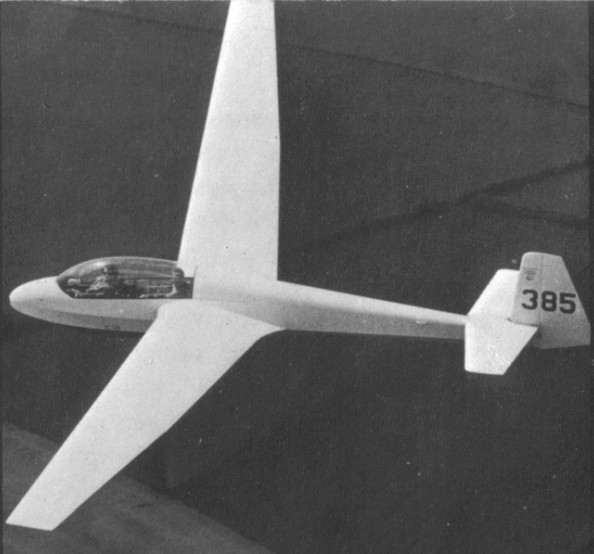
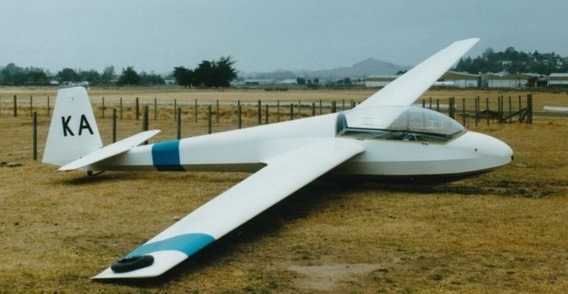
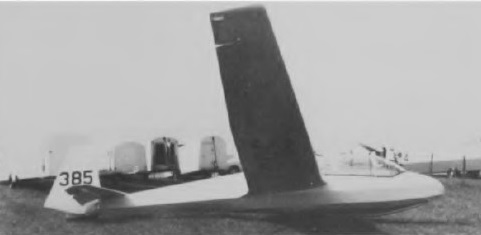
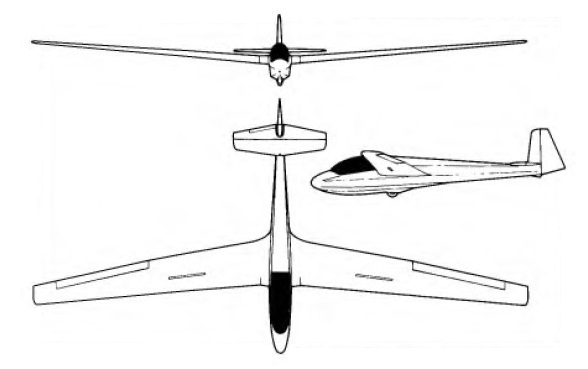
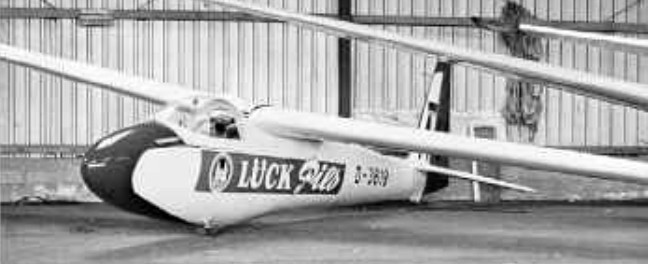
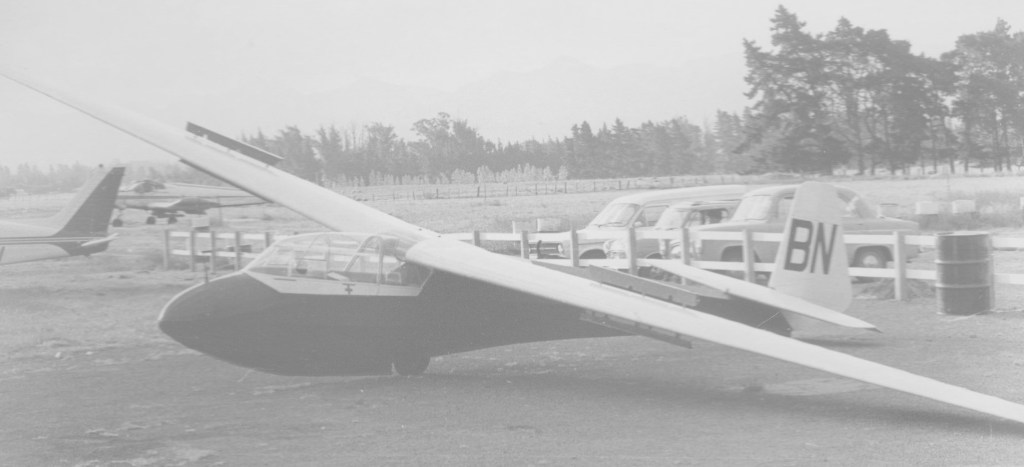
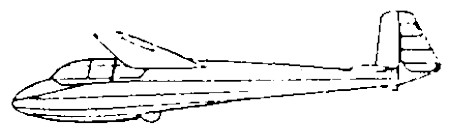
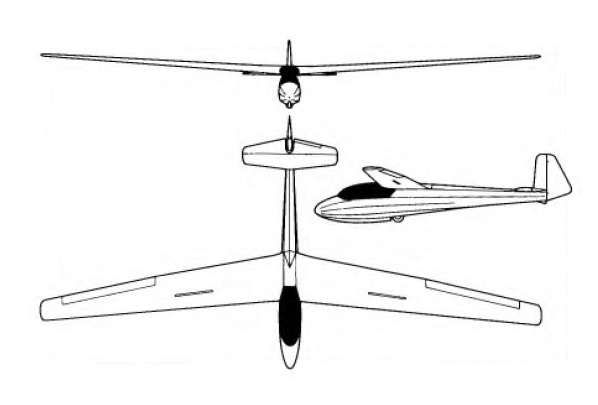
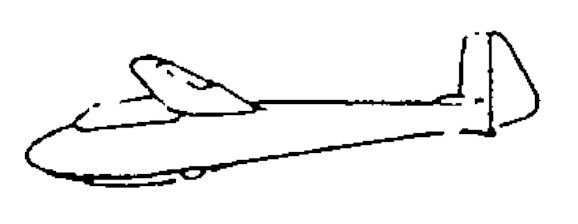
This tandem two-seater training and high performance glider was developed from the earlier Ka 7, likewise designed by Rudolf Kaiser, and has similar swept forward single-spar wooden wings in the mid-set instead of high position, this lowering of the wings allowing a larger one-piece blown Mecaplex canopy, hinged to starboard, to be fitted giving better all-round visibility; other improvements over the Ka 7 include more comfortable seating, while the AS-K 13 has a better performance than the Ka 7.
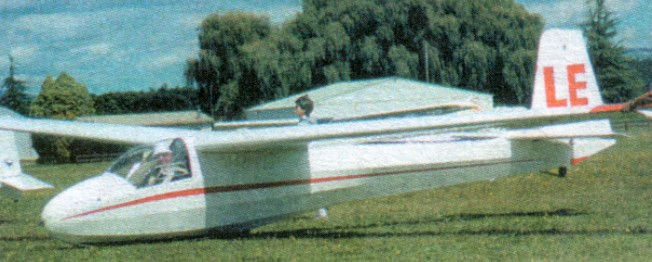
AS-K 13 ZK-GKA
There are metal Schempp-Hirth air brakes above and below the wing, and the wooden ailerons are fabric-covered. The wings have a forward sweep of 6° at the quarter-chord line and 5° of dihedral; the D-type leading edge torsion box is of plywood and the whole wing is fabric-covered. The fuselage is a welded steel tube structure with spruce stringers and fabric-covered overall, except for the nose, which is of glassfibre; the turtle decking aft of the cockpit canopy is a plywood shell. The cantilever wooden tail unit is plywood-covered, except for the rear part of the rudder and elevators, which are fabric-covered, and there is a Flettner trim tab in the starboard elevator. In later models, a nosewheel was substituted for the skid. Landing gear consists of a non-retractable sprung monowheel with a drum brake, mounted aft of the cg, with a skid under the forward fuselage and a steel tailskid. The pilots have glassfibre seat panels for greater comfort, and adjustable rudder pedals; there is provision for radio and oxygen, and an aero-tow release is fitted in the nose.
It first flew in prototype form in July 1966 and by January 1978 a total of approximately 700 AS-K 13s had been built, with production continuing. The type is also sold in kit form for amateur constructors.
After Schleicher ceased production, the sailplane has been license-built by Jubi GmbH of Oerlinghausen, Germany.
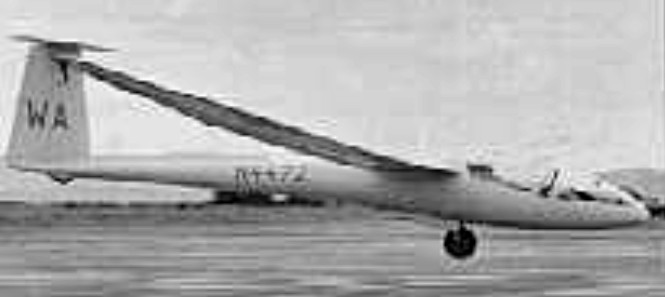
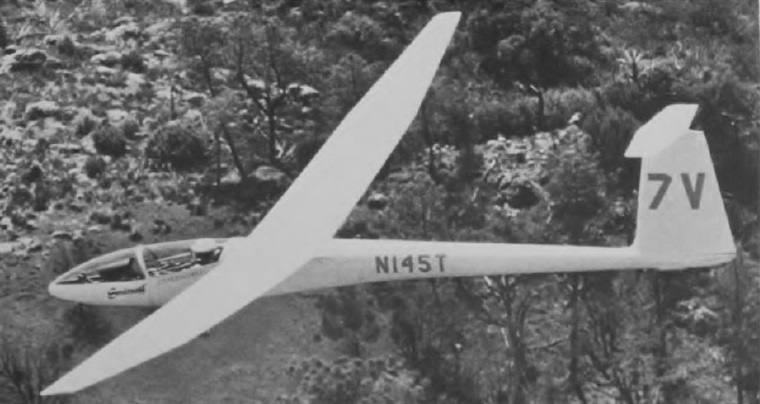
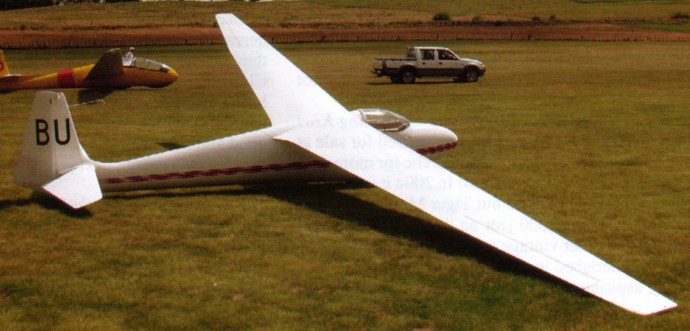
This Open Class single-seater was designed by Gerhard Waibel – hence the ‘W in its designation -as a production development of the Akaflieg Darmstadt D-36 Circe, in the design of which Waibel had also participated, and which had won the 1964 German National championships.
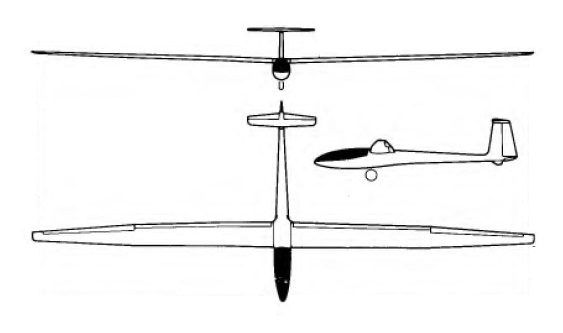
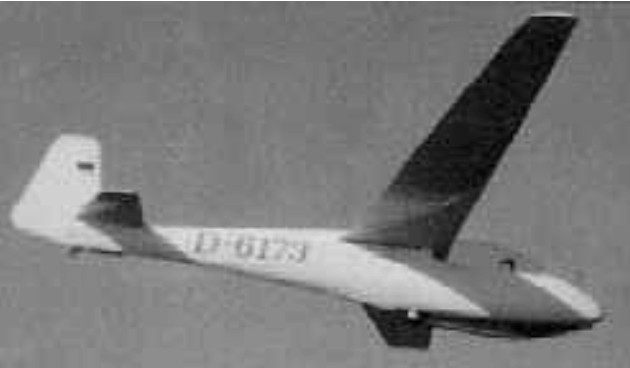
Of glassfibre reinforced plastic/balsa sandwich construction, the AS-W 12 has cantilever shoulder wings of high aspect ratio (25.8) and with full-span camber-changing flaps interconnected with the ailerons. There are no air brakes, and early examples lacked the later added (and at first non- jettisonable) tail chute. The monocoque fuselage is similar in outline to that of the D-36 Circe, and the pilot sits in a semi-reclining position under a long flush-fitting two-piece cockpit canopy. Landing gear consists of a large retractable unsprung monowheel with brake, plus a tailskid, and a small fixed-incidence tailplane and elevators are mounted on top of the fin.
The prototype AS-W 12 was built by Edgar Krȁmer, who made the first flight in it on 31 December 1965, and the type has since achieved a number of important competition victories and record-breaking flights. In 1969 W. Scott of the USA set a new world goal flight record of 600 miles in an AS-W 12, and in 1970 Hans-Werner Grosse of West Germany became one of the few pilots to make a flight of 1,000km (621 miles), also in an AS-W 12; on 25 April 1972 he set a world record for distance in a straight line by flying 907.7 miles. Grosse was also runner up in the Open Class of the 1970 World Championships at Marfa, Texas, in which five of the first nine places in this class were taken by AS-W 12s.
One example belongs to the National Soaring Museum. No. Built: 15
Wing span: 18.3 m / 60 ft 0.5 in Length: 7.35 m / 24 ft 1.5 in Height: 5 ft 3.75 in Wing area: 13.0 sq.m / 140 sq.ft Aspect ratio: 25.8 Airfoil: Wortmann FX 62-131K mod. Empty Weight: 290 kg / 640 lb Payload: 140 kg / 308 lb Gross Weight: 430 kg / 948 lb Water ballast: None Max speed: 124 mph / 108 kt / 200 km/h Max rough air speed: 54 kt / 100 km/h Stalling speed: 35 kt / 65 km/h L/DMax: 47 at 105 kph / 56 kt / 65 mph MinSink: 0.49 m/s / 1.6 fps / 0.95 kt at 45 mph / 39 kt / 72 km/h Wing Load: 33.06 kg/sq.m / 6.07 lb/sq.ft Seats: 1
The Ka 6E had a low-set all-moving tailplane the same (except for the lack of trim tabs) as on the Ka 10, which did not go into production and was a modified Ka 6CR with the tailplane moved to about one-third of the way up the fin. In the spring of 1965, the Ka 10 took part in the World Championships at South Cerney.
Designed by Rudolf Kaiser, the Ka-8 was derived from the Ka-6 series as a simple single-place sailplane with dive brakes using construction techniques similar to the Ka-7, and is basically a single-seater version of the two-seater Ka 7, simplified for amateur construction from kits. The structure is wood/ fabric wings and tail, steel-tube/ fabric fuselage. Emphasis was on rugged construction, good climbing ability in thermals and good handling characteristics.
The prototype Ka 8 made its first flight in November 1957 and in its original form the Ka 8 had a very small cockpit canopy, the second version had windows in the sides of the cockpit for improved visibility, and the third version, the Ka 8B, has a larger one-piece blown Plexiglas canopy under which the pilot sits.
The cantilever high wings are single-spar structures of pine and plywood, with a plywood leading edge torsion box and fabric covering aft of the spar; their forward sweep is 1°18′ and dihedral is 3°. There are Schempp-Hirth air brakes in the upper and lower surfaces and the wooden ailerons are plywood covered. The cantilever tail unit is of similar construction to the wings, with ply-covered fixed surfaces and fabric-covered rudder and elevators, and a trim tab in the elevator is an optional fitting.
The fuselage is a welded steel tube structure, with fabric overing over spruce longerons and a glassfibre nose cone. There is a non-retractable and unsprung monowheel, with no brake, and a nose skid mounted on rubber blocks in front of it, plus a steel spur at the tail.
The Ka-8B, by far the most numerous variant, has a substantially larger canopy while the Ka-8C features a longer nose, larger main wheel located ahead to the center of gravity and deletion of the larger wooden nose skid resulting in a roomier cockpit.
Karl Striedeck of the U.S. made a 767.0 km / 476.6 miles ridge flight in a Ka-8B to win the world out and return in 1968.
A motor glider conversion of the Ka 8B was offered by LVD (the Flying Training School of the Detmold Aero Club) similar to their conversion of a Scheibe Bergfalke IV known as the BF IV-BIMO, in which a Lloyd LS-400 piston engine mounted in the fuselage drives a pair of small two blade pusher propellers rotating within cutouts in each wing near the trailing edge.
Schleicher Ka 8B Span: 15.0 m / 49 ft 2.5 in Length: 7.0 m / 23 ft 0 in Height: 1.57 m / 5 ft 1.75 in Wing area: 14.15 sq.m / 152.3 sq.ft Wing section: Gottingen 533/532 Aspect ratio: 15.9 Empty weight: 190 kg / 419 lb Max weight: 310 kg / 683 lb Water ballast: None Max wing loading: 21.9 kg/sq.m / 4.48 lb/sq ft Max speed: 124 mph / 108 kt / 200 km/h (in smooth air) Max aero-tow speed: 81 mph / 70 kt / 130 km/h Stalling speed: 29 kt / 54 km/h Min sinking speed: 2.1 ft/sec / 0.65 m/sec at 37.5 mph / 32.5 kt / 60 km/h Best glide ratio: 27:1 at 45.5 mph / 39.5 kt
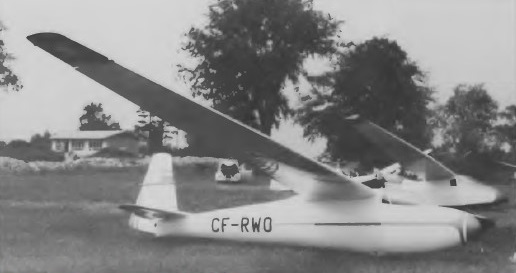
This tandem two-seater training and club sailplane was designed by Rudolf Kaiser to succeed the wooden two-seater Ka 2 and Ka 2B which had proved to be popular trainers in Germany and had been Kaiser’s first design for the Alexander Schleicher firm which he had joined in 1952.
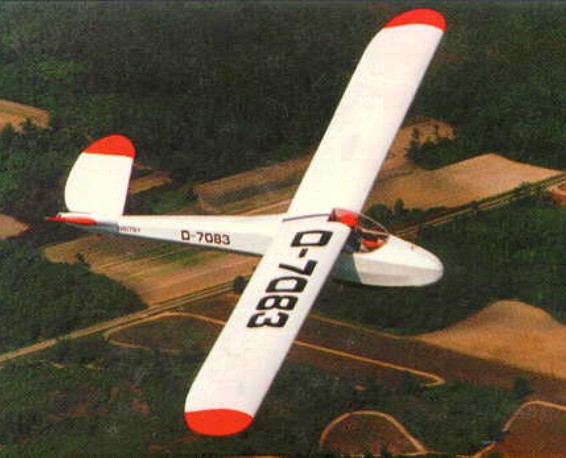
Of conventional wood and fabric construction, with a steel tube fuselage which had fabric covering over wooden formers, the Ka 7 is characterised by high cantilever wings with a forward sweep of 6° 36′ at the quarterchord line and 4° dihedral. The single-spar wings are of pine and plywood with fabric covering and a plywood-covered leading edge torsion box; there are Schempp-Hirth air brakes above and below the wings and the wooden ailerons are fabric-covered. The cantilever tail unit is of similar construction to the wings, and there is a trim tab in the starboard elevator. Landing gear consists of a non-retractable and unsprung Dunlop monowheel and a nose skid forward of it carried on rubber blocks for shock absorbtion; there is also a tailskid. The two pilots sit under a Plexiglas canopy the front portion of which hinges to starboard and the rear portion hinges rearwards.
The Ka 7 first flew in prototype form in 1959 and was intended to provide not only basic training but continuation training without a break for pilots graduating to the more advanced high performance sailplanes. In this it was successful and a total of 370 had been built by the spring of 1964.
Ka 7s twice set new German distance records and the type also set a new German goal flight record for two-seaters over a decade after it first appeared. It once held the multi-place world record for speed around a 500 km Triangle at 84 kph/ 45 kt/ 52 mph, set in South Africa in 1964.
A modified plan exists to lower the wings to the mid position and fit a one piece canopy, which makes the modified glider (Ka-7/ 13) look very similar to its successor, the Schleicher Ka-13. The lowering of the wings greatly improves the visibility from the rear seat.
Schneider also built a few Ka 7 two-seaters under licence.
Kaiser K 7 Rhonadler Length: 23.622 ft / 7.2 m Wingspan: 57.087 ft / 17.4 m Max take off weight: 1058.4 lb / 480.0 kg Max. speed: 92 kt / 170 km/h Crew: 2
Schleicher K7 Rhonadler Wing span: 16 m / 52.5 ft Wing area: 17.56 sq.m / 188.4 sqft Length: 8.1 m / 26 ft 7 in Empty weight: 280 kg / 617 lb Max weight: 480 kg 1,058 lb Water ballast: None Max wing loading: 27.43 kg/sq.m / 5.62 lb/sq ft Max speed: 124 mph / 108 kt / 200 km/h (in smooth air) Max aero-tow speed: 81 mph / 70 kt / 130 km/h Stalling speed: 32 kt / 60 km/h L/DMax: 26 at 80 kph / 43 kt / 50 mph MinSink: 0.70 m/s / 2.3 fps / 1.36 kt at 43.5mph Water Ballast: 27.34kg/sq.m / 5.6lb/sq.ft Aspect ratio: 14.6 Airfoil: Gottingen Go 533, 16/14% Seats: 2
Designed by Rudolf Kaiser and developed by Rudolf Hesse, the Ka 6 series of single-seat Standard Class sailplanes first flew in prototype form in November 1955, with a wing span of 14m (45ft 11 in), and the type’s high performance and attractive price led to steady sales and widespread use in contest flying; more than 1,400 Ka 6s had been built when production ceased in 1968, and the type has been widely exported.
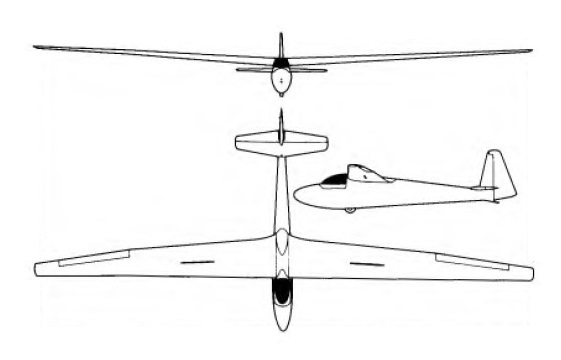
Of conventional wooden construction with ply and fabric covering, the Ka 6 has cantilever high-set single-spar wings of pine and plywood, covered with fabric; they have a forward sweep of 1° 12′ and 3° of dihedral. Schempp-Hirth air brakes are fitted and the wooden ailerons are plywood-covered. The wooden semi-monocoque fuselage is also ply-covered, and the cantilever tail unit is of similar construction to the wings, and a trim tab in the elevator is an optional fitting.
In 1956, when the Standard Class regulations were revised, the wing span was increased to 15m (49ft 2.5 in), this version being the Ka 6B with a landing skid under the fuselage, and the Ka 6BR with a non-retractable monowheel in place of the skid. The Ka-6B won the OSTIV prize for the best Standard Class design at the 1958 World Championships at Leszno, Poland.
The -6C version was a -6B with modified wing root. It has more of the wing covered with plywood and incorporates other minor improvements, and also comes in skid and wheeled (-6CR) models. The Ka 6CR has a non-retractable unsprung monowheel with a band-brake, and both the Ka 6C and CR have a tailskid. The pilot sits under a one piece blown Plexiglas canopy just ahead of the wing leading edge. All models have airbrakes for approach control. Some later -6CR models are designated as Ka-6CRPE’s, the PE standing for pendulum elevators (the all-moving tail used on the Ka-6E).
Ka 6CR
An Australian-built version of the Ka 6CR was produced by Edmund Schneider Pty Ltd, the makers of the prewar Grunau Baby, who had transferred their operations to Australia after the war. Known as the ES Ka 6, this licence-built Australian version first flew in December 1961, and had many changes to suit Australian conditions. The keefer main spar was retained, but the rest of the structure was changed to spruce. The monowheel was enlarged to allow interchangeability with that of the ES 52 Kookaburra, and a new sideways-hinging metal-framed Perspex canopy was introduced. Lifting handles were also provided at the nose and tail. Schneider built seven ES Ka 6s, and was planning to start a further batch of four late in 1964, but production was ended apparently before the latter were built.
At the 1958 World Championships at Leszno in Poland, a Ka 6 flown by Heinz Huth of Germany came 3rd in the Standard Class, and Rudolf Kaiser was awarded the prize for the best sailplane design in this class for the Ka6. Heinz Huth of Germany won in the Standard Class at the 1960 Koln-Butzwelerhof, Germany and 1963 Junin, Argentina World Championships in Ka-6’s; 16 of the 35 Standard Class entries in 1960 were Ka 6s, which took 2nd, 4th, 5th and 6th places, and in 1963 22 out of 38 Standard Class entries were also Ka 6s, the best position gained by a Ka 6CR was 6th place, taken by W. Scott of the USA. In 1963 two Ka-6’s were flown 876.0 km / 544.3 miles by Karl Betzler and Otto Schauble from Germany to France, setting a world distance record, and in 1964, Wally Scott of the U.S. flew his Ka-6CR to a world goal of 837.7 km / 520.55 miles.
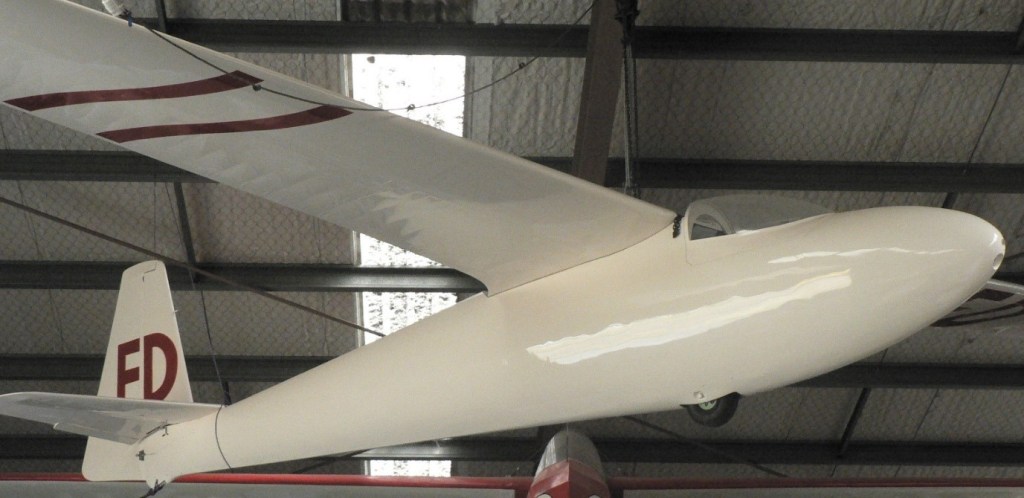
Ka-6CR ZK-GFD
ZK-GFD piloted by Ann Johnson achieved a number of New Zealand local and national women’s records including a maximum height of 28,000 ft.
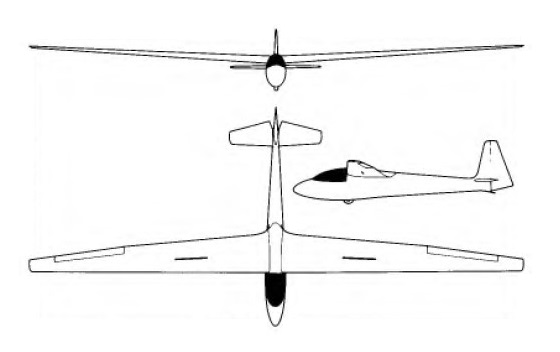
The Ka-6E was produced concurrently with the Ka-6CR for three years. The Ka 6E Standard Class single-seater differs from the Ka 6CR in having a revised wing with modified leading edge profile and mounted just a little bit lower on the fuselage, a slightly different fuselage profile of 10% less cross-sectional area, a slightly longer cockpit canopy lowered by three inches and a redesigned tail unit, with a taller fin and rudder and a low-set all-moving tailplane; the latter is the same (except for the lack of trim tabs) as on the Ka 10, which did not go into production and was a modified Ka 6CR with the tailplane moved to about one-third of the way up the fin. Like the CR, the Ka 6E has Schempp-Hirth air brakes, and tailpiane stability and trimming are controlled by a single lever which adjusts the spring tension on the control column; glassfibre wing tips are featured. The Ka 6E first flew in the spring of 1965, and the E version took part in many national championships and other contests. It is of the same wooden construction with ply and fabric covering as the Ka 6CR, and the landing gear is the same except that the monowheel is now retractable.
Ka-6E
Hans Werner Grosse of Germany, flying a Ka-6E as a guest, was the highest scoring pilot at the 1965 U.S. Nationals. Wally Scott won the 1967 Barringer Trophy by flying 888 km / 552 miles in a Ka-6E. One belongs to the National Soaring Museum.
Schleicher Ka 6 Rhönsegler Length: 21.982 ft / 6.7 m Wingspan: 49.213 ft / 15.0 m Max take off weight: 661.5 lb / 300.0 kg Max. speed: 108 kt / 200 km/h Crew: 1
Schleicher Ka 6b Rhönsegler Length: 21.916 ft / 6.68 m Wingspan: 49.213 ft / 15.0 m Max take off weight: 661.5 lb / 300.0 kg Max speed: 108 kt / 200 km/h Crew: 1
Ka-6CR Wing span: 15m / 49.2ft Wing area: 12.45sq.m / 134sq.ft Length: 6.66 m / 21 ft 10 in Height: 5 ft 1.5 in Empty Weight: 190kg / 420lb Payload: 114kg / 250lb Gross Weight: 304kg / 670lb Water ballast: None Max wing loading: 24.2 kg/sq.m / 4.95 lb/sq ft Max speed: 124 mph / 108 kt / 200 km/h Max aero-tow speed: 87 mph / 76 kt / 140 km/h Stalling speed: 33.5 kt / 62 km/h L/DMax: 31 80 kph / 43 kt / 50 mph MinSink: 0.61 m/s / 2.0 fps / 1.18 kt at 42 mph / 36.5 kt / 68 km/h Wing Load: 24.41kg/sq.m / 5lb/sq.ft Aspect ratio: 18.1 Airfoil: NACA 63-618/63-615 Seats: 1
Ka-6E Wing span: 15 m / 49.2 ft Wing area: 12.41 sq.m / 133.6sq.ft Aspect ratio: 18.1 Airfoil: NACA 63-618/63615/Joukowsky 12% Length: 6.66 m / 21 ft 10 in Height: 1.6 m / 5 ft 3 in Empty Weight: 190 kg / 420 lb Payload: 110 kg / 243 lb Gross Weight: 300 kg / 663 lb Water ballast: None Max speed: 124 mph / 108 kt / 200 km/h (in smooth air) Max aero-tow speed: 87 mph Stalling speed: 32 kt / 59 km/h L/DMax: 33 80 kph / 43 kt / 50 mph MinSink: 0.62 m/s / 2.03 fps / 1.20 kt at 38 kt / 70 km/h Wing Load: 24.17 kg/sq.m / 4.97 lb/sq.ft Seats: 1
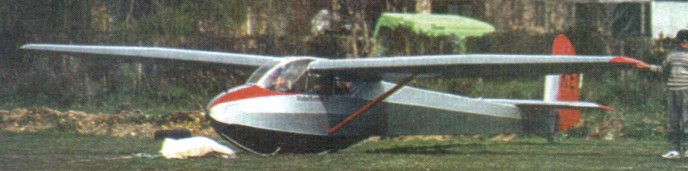
Designed by Rudolf Kaiser, the Rhonlerche is a small, strut-braced, 2-seat trainer which first flew in 1955. It features a steel-tube, fabric-covered fuselage, a wooden fabric-covered wing with top-surface spoilers, a fixed wheel and nose skid, and tandem seating.
The type’s comparatively steep glide slope of 19:1 combined with relatively ineffective airbrakes and very restricted visibility from the back seat seem mediocre compared to modern sailplanes.
The Rudolf Kaiser designed Ka-3, which first flew in 1956, was a development of the earlier Ka-1 with a steel fuselage instead of wood. The wood and fabric wing, steel tube and fabric fuselage Ka-3 has top surface spoilers for approach control and main skid, but no wheel.
Schleicher also offered the Ka-3 in kit form.
Wing span: 10 m / 32.8 ft Wing area: 9.9 sq.m / 106.6 sq.ft Empty Weight: 95 kg / 210 lb Payload: 100 kg / 220 lb Gross Weight: 195 kg / 430 lb Wing Load: 19.7 kg/sq.m / 4.03 lb/sq.ft L/DMax: 18 75 kph / 40 kt / 47 mph MinSink: 0.95 m/s / 3.12 fps / 1.85 kt No. of Seats: 1 Aspect ratio: 10.1 Airfoil: Go 549
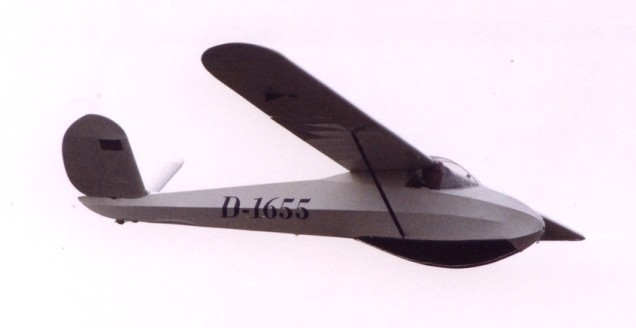
The 1955 Ka-2 was designed as a two-place advanced trainer. The later Ka-2B had the wingspan inceased to 16 m. Approach control is effected by top and bottom surface Schempp-Hirth type airbrake.
Ka-2 Wing span: 15 m / 49.2 ft Wing area: 16.8 sq.m / 180.8 sq.ft Aspect ratio: 13.4 Airfoil: Go 533 Empty Weight: 254 kg / 560 lb Payload: 208 kg / 454 lb Gross Weight: 460 kg / 1014 lb Wing Load: 27.38 kg/sq.m / 5.61 lb/sq.ft L/DMax: 24 87 kph / 47 kt / 54 mph MinSink: 0.96 m/s / 3.15 fps / 1.87 kt Seats: 2
KA2b Rhonschwalbe Wingspan: 52.493 ft / 16.0 m Wing area: 17.5 sq.m / 188.4 sq.ft Aspect ratio: 14.63 Airfoil: Go 533 Length: 26.739 ft / 8.15 m Empty Weight: 278 kg / 613 lb Gross Weight: 480 kg / 1058 lb Payload: 202 kg / 445 lb Wing Load: 27.43 kg/sq.m / 5.62 lb/sq.ft Max. speed: 92 kt / 170 km/h Crew: 2







 All Aero