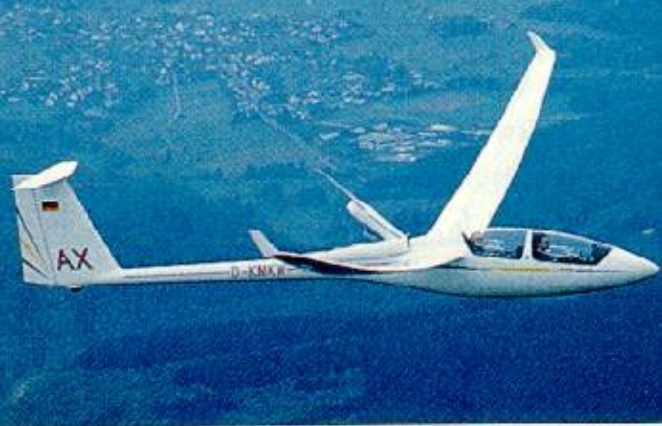
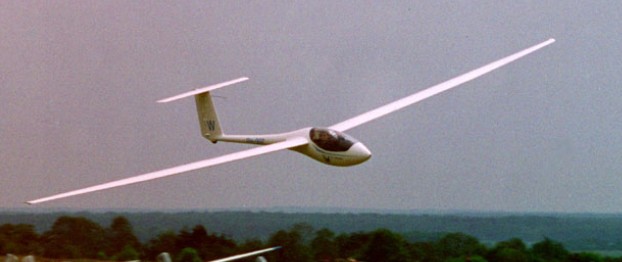
Schneider Arrow ES-59

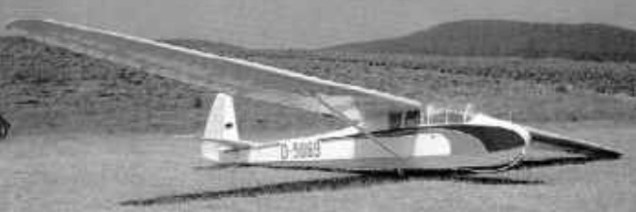
Edmund Schneider, who manufactured at Grunau in Silesia, Germany before World War II, moved to Australia after the war with his two sons and this single-seat general purpose club sailplane was commissioned by the Gliding Federation of Australia.

The prototype Arrow flew for the first time on 14 April 1962, and completed its airworthiness trials on 7 May that year.

The cantilever high-set plywood-covered wooden wing has ‘bumpers’ at the tips and a forward sweep of 3° at the spar; there are wooden scissor-type air brakes at the 45% chord line and flaps are not fitted, the wooden ailerons being ply-covered. A one piece wing designed by Edmund’s son Harry. The fuselage is plywood-covered semimonocoque and the tail unit a ply-covered cantilever wooden structure. There is a non-retractable monowheel with a band brake, and a foam rubber-sprung nose skid forward of it which has a steel shoe; there is also a spring steel tailskid. The pilot sits under a sideways-opening Perspex canopy, and is provided with cushions and a sunshade; extra instrumentation can be installed if required.

Small-scale production was put in hand, and 10 Arrows had been built by 1966, the latest production version being the ES 59 Series 2, which had a shorter swept fin and rudder than the initial production aircraft.

A two-piece 15 m wing version was contructed for the 1965 World Championships.

No. Built: 10

Wing span: 13.23m / 43.4ft
Wing area: 11sq.m / 118.3sq.ft
Aspect ratio: 16
Airfoil: NACA 63-618 mod.
Empty Weight: 174kg / 383lb
Payload: 106kg / 233lb
Gross Weight: 280kg / 616lb
L/DMax: 30 89 kph / 48 kt / 55 mph
MinSink: 0.82 m/s / 2.7 fps / 1.60 kt
Wing Load: 25.45kg/sq.m / 5.2lb/sq.ft
Seats: 1

ES 59 Series 2
Span: 43 ft 5 in
Length: 22 ft 2.5 in
Height: 4 ft 7 in
Wing area: 118.3 sqft
Aspect ratio: 16.0
Empty weight: 375 lb
Max weight: 616 lb
Max speed: 148 mph
Max aero-tow speed: 80 mph
Min sinking speed: 2.7 ft/sec at 46 mph
Best glide ratio: 28:1 at 51 mph
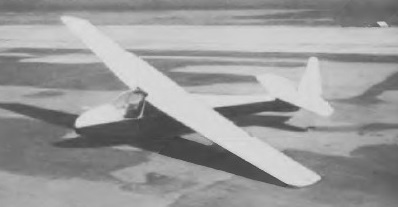
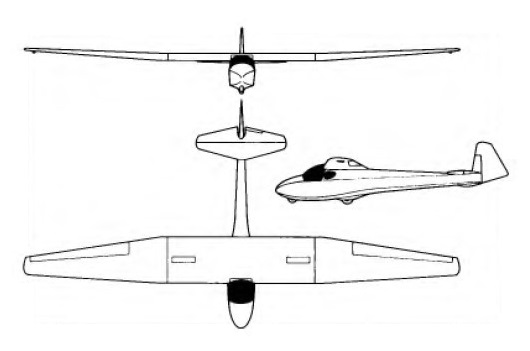
Schneider ES.52/II Kookaburra

After the war Edmund Schneider, one of the pioneer prewar German sailplane designers and co-creator and manufacturer of the Grunau Baby trainer, was invited by the Gliding Federation of Australia to set up a sailplane factory in that country, and so he transferred his operations there, Edmund Schneider Pty Ltd being duly formed as a private venture at Parafield airport near Adelaide, South Australia. Its first design here was the Kangaroo two-seater, which first flew in 1953, and this was followed by an improved version of the Baby, the Grunau Baby 4, the Nymph and Kingfisher, and the ES 52 Kookaburra two-seater side-by-side trainer, which was used by most of the Australian gliding clubs and is semi-aerobatic. Of conventional wooden construction, the ES 52 Kookaburra first flew in prototype form on 20 June 1954, and four Mk Is, eleven Mk IIs and eight Mk IIIs were built. The ES 52B Kookabura IV, which first flew in 1959, featured an increased wing span of 48ft 9in, a nose wheel in place of the rubber-sprung wooden nose skid ahead of the monowheel, a brake for the monowheel and an enlarged cockpit.

By early 1966 a total of 23 Mk IVs had been built, and production ceased when Schneider decided to build the Schleicher Ka 7 two seater under licence. The Mk III’s cantilever high-set one-piece wing is a single-spar wooden structure with a D-section plywood leading edge and fabric covering; there are wooden scissor-type air brakes above and below each wing, and the sealed-gap ailerons are fabric-covered. The fuselage is a plywood-covered semi-monocoque made up of wooden frames and stringers, and there is a non-retractable unsprung monowheel, without a brake on the Mks I-III, these versions having the nose skid and the Mk IV a nose wheel; all Marks have a tailskid. The tail unit is a fabric-covered wooden structure, with a trim tab in the port elevator. The one-piece Perspex canopy hinges rearwards to open, and the two pilots sit in slightly staggered side-by-side seats; there is also a window on each side under the leading edge wing root to improve visibility. Extra instrumentation can be fitted if the customer so desires.

ES 52 Kookaburra
Wing span: 11.7 m / 38 ft 4.5 in
Length: 7.9 m / 25 ft 11 in
Height: 1.38m / 4ft 6.5 in
Wing area: 15.0 sq.m / 161.5 sq ft
Wing section: Gottingen 549/M-12
Aspect ratio: 9.13
Empty weight: 220 kg / 485 lb
Max weight: 393 kg / 866 lb
Water ballast: None
Max wing loading: 26.2 kg/sq.m / 5.36 lb/sq ft
Max speed: 119 kt / 220 km/h
Stalling speed: 36 kt / 67 km/h
Min sinking speed: 1.05 m/sec / 3.4 ft/sec at 39 kt / 72 km/h
Max rough air speed: 81.5 kt / 151 km/h
Best glide ratio: 20 at 44 kt / 81 km/h

ES52 Mk.III
Span: 38ft 5in
Length: 25ft 11 in
Height: 4ft 6.5 in
Wing area: 161.5sqft
Aspect ratio: 9.13
Empty weight: 484lb
Max weight: 865lb
Max speed: 136mph (in smooth air)
Max aero-tow speed: 70mph
Min sinking speed: 3.36ft/sec at 45mph
Best glide ratio: 20:1 at 50 mph

Schneider, Edmund

Edmund Schneider, who designed the Grunau Baby and manufactured at Grunau in Silesia, Germany before World War II, moved to Australia after the war with his two sons. With support from the Gliding Federtion of Australia, Schneider established the sailplane business there and produced several new sailplane designs.

Schmutzhart SCH-1

Berthold Schmutzhart’s SCH-1 homebuilt was designed to be small enough to be built in his Washingtion D.C. townhouse. The fuselage was made by bending the outside skin into a wooden jig and riveting the bulkheads and stringers to it from the inside, working through the open top which was then covered. The main wing spar center section was milled from a solid I-beam of 6061 T6 aluminum. The outer spars are of bent flat stock and angled extrusions. Ribs ahead of the spar were bandsawed from dense Styrofoam : aft of the spar they are of sheet aluminum hammered over formblocks. The T-tail was originally all moving, but later modified to have a conventional stabilizer. Approach control is by means of flaps, the setting of which are 0, +4, +45 and +70 degrees.

Wing span: 13.41 m / 44 ft
Wing area: 9.29 sq.m / 100 sq.ft
Aspect ratio: 18
Airfoil: Nickel 17%
Empty Weight: 180 kg / 398 lb
Payload: 80 kg / 175 lb
Gross Weight: 160 kg / 573 lb
Wing Load: 27.98 kg/sq.m / 5.73 lb/sq.ft
L/DMax: 30 80 kph / 43 kt / 50 m
MinSink: 0.56 m/s / 1.85 fps / 1.10 kt
Seats: 1
No. Built: 1

Schleicher ASW-28

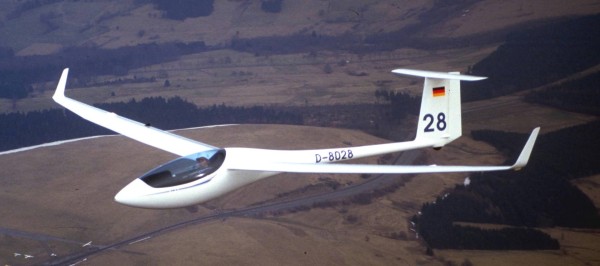
Designed by Gerhard Waibel and built in Poppenhausen, Germany, the Schleicher ASW 28 is a Standard Class glider with a laminar wing profile for “turbulent” conditions. By using carbonfibre and Aramid along with a new Polyethylene fibre, joining a high strength with low weight, Schleicher tries to achieve an empty weight of only 325 kg, and a wing loading of only 30 kg/sq.m. Four integrated tanks for a maximum water ballast of 180 liters keep the spectrum at a 50 kg/sq.m wing loading open.

The ASW 24 derived fuselage is designed to be fitted with a rescue system. The ASW 28 features a new profile from Professor Loek Boermans, which is supposed to give the new glider a top performance and excellent handling characteristics in turbulent air.

L/DMax: 45
MinSink: 0.55 m/s / 1.86 fps / 1.00 kt
Seats: 1
Wing span: 15 m / 49.2 ft
Wing area: 10.5 sq.m / 113 sq.ft
Empty Weight: 235 kg / 510 lb
Gross Weight: 525 kg / 1202 lb
Wing Load: 50 kg/sq.m / 10.24 lb/sq.ft
Aspect ratio: 21.43
Airfoil: Boermans DU 99-146MOD

Schleicher ASW 27

Designed by Gerhard Waibel, the 15 m racing class successor to the ASW-20 has been designed to maximize performance without regard to possible span extension or addition of an engine. Airbrakes are top surface triple element Schempp-Hirth type to compensate for the very thin wing section.

ASW-27
Wing span: 15m / 49.2ft
Wing area: 9sq.m / 96.88sq.ft
Empty Weight: 225kg / 496lb
Payload: 275kg / 606lb
Gross Weight: 500kg / 1102lb
L/DMax: 48 100 kph / 54 kt / 63 mph
MinSink: 0.52 m/s / 1.70 fps / 1.01 kt
Wing Load: 55.55kg/sq.m / 11.37lb/sq.ft
Water Ballast: 180kg / 396lb
Aspect ratio: 25
Airfoil: Boermans DU 89-134/14
Seats: 1

Schleicher ASH-26

Designed by Martin Heide as a dedicated 18 m sailplane rather than an extended-tip 15 m model, flapped self-launching ASH-26E claims better performance from being optimized for this span. The Midwest engine installation is distinctive from most previous mast mounted retractable engines in that the engine remains in the fuselage when the propeller is raised, permitting reduction of the sailplane’s noise footprint.

Engine: 38 kW/ 51 bhp Midwest AE50 AP
Wing span: 18 m / 59 ft
Wing area: 11.7 sq.m / 125.94 sq.ft
Aspect ratio: 27.69
Airfoil: Boermans DU 89-134/14
Empty Weight: 424 kg / 935 lb
Payload: 161 kg / 354 lb
Gross Weight: 585 kg / 1289 lb
Wing Load: 50 kg/sq.m / 10.24 lb/sq.ft
MinSink: 0.52 m/s / 1.70 fps / 1.01 kt
L/DMax: 50 96 kph / 52 kt / 60 mph
Seats: 1

Schleicher ASW-22-2 / ASH 25

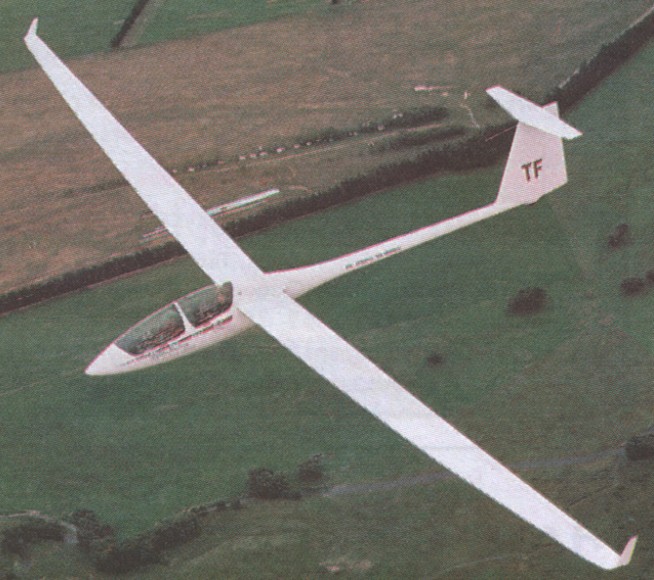
Designed by Martin Heide, the tandem two seat Schleicher ASH25 featured the longest wingspan of any production glider (25 metres). First flown in 1986, the ASH25 first went into production in that year. Construction is all carbon fibre and the sailplane can sustain a glide angle of 1:58. The design was specifically aimed at producing a two seat glider with single seat perform¬ance and utilises the wing of the ASW22B married to a new fuselage of carbon/ aramid fiber reinforced plastic.

Within a couple of years the ASH25 had set five world speed records for triangular courses varying from 330 km / 205.1 miles to 1,380 km / 857.0 miles. Hans Werner Grosse of Germany has set 12 world records in all flying an ASH-25.

The ASH-25 is the production version of the one-off two-place ASW-22-2 using a fuselage adapted from the Akaflieg Stuttgart FS-31.

The ASH-25E is powered by a retractable 19 kW/ 25 bhp Rotax 275 sustainer engine.

ASH-25E

A flight test evaluation by Dick Johnson measured a best L/D of 54.3 : 1 without turbulator tape or special sealing. An ASH-25 flown by G. Herbaud and J-N. Herbaud of France both won the world multiplace straight distance and goal distance records of 1,383 km./ 859.3 miles in the same flight in 1992.

ASH-25E
Engine: 19 kW (25 bhp) Rotax 275
Wing span: 25m / 82ft
Wing area: 16.31sq.m / 175.6sq.ft
Empty Weight: 480kg / 1058lb
Payload: 270kg / 595lb
Gross Weight: 750kg / 1653lb
Wing Load: 45.98kg/sq.m / 9.41lb/sq.ft
L/DMax: 57 108 kph / 58 kt / 67 mph
MinSink: 0.45 m/s / 1.48 fps / 0.88 kt
Water Ballast: 225kg / 496lb
Aspect ratio: 38.3
Airfoil: HQ 17
Seats: 2

Schleicher ASW 24

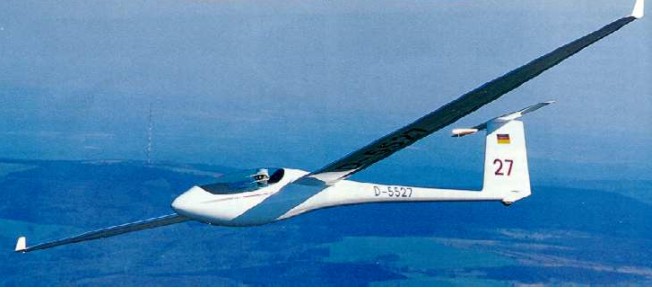
The ASW-24, which first flew in 1987, is the Standard Class successor to the Schleicher ASW-19. Approach control is effected by top surface Schempp-Hirth type airbrakes.

Designer Waibel won the 1992 OSTIV Award for significant contributions to safety for the ASW-24 design.

The ASW-24E is the self-launching version.

ASW-24
Wing span: 15m / 49.2ft
Wing area: 10sq.m / 107.6sq.ft
Empty Weight: 230kg / 507lb
Payload: 270kg / 595lb
Gross Weight: 500kg / 1102lb
L/DMax: 44 105 kph / 57 kt / 65 mph
MinSink: 0.58 m/s / 1.90 fps / 1.13 kt
Wing Load: 50kg/sq.m / 10.24lb/sq.ft
Water Ballast: 170kg / 375lb
Aspect ratio: 22.5
Airfoil: Boermans DU 84-158
Seats: 1

ASW-24E
Engine: 19kW/ 25bhp Rotax 275
Wing span: 15m / 49.2ft
Wing area: 10sq.m / 107.6sq.ft
Empty Weight: 230kg / 507lb
Payload: 270kg / 595lb
Gross Weight: 500kg / 1102lb
L/DMax: 44 105 kph / 57 kt / 65mph
MinSink: 0.58 m/s / 1.90 fps / 1.13kt
Wing Load: 50kg/sq.m / 10.24lb/sq.ft
Water Ballast: 170kg / 375lb
Aspect ratio: 22.5
Airfoil: Boermans DU 84-158
Seats: 1